Creature
Synth
Synth (short for synthetic humanoids, also called androids or artificial…
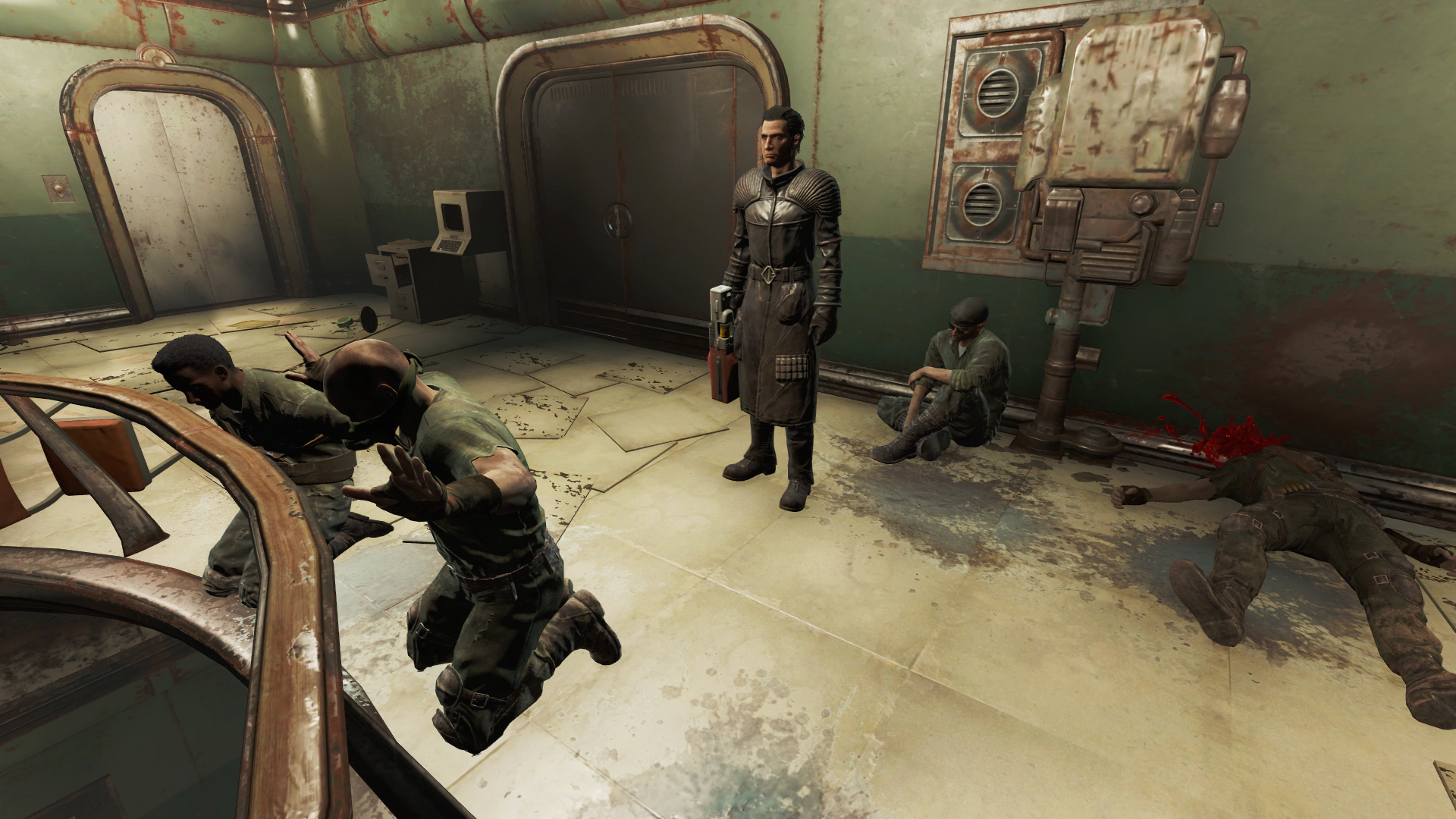
Synth (short for synthetic humanoids, also called androids or artificial humans) is a common term used to refer to the robotic and biomechanical beings manufactured within the Institute's laboratories. While Generation 1 and 2 synths are entirely mechanical designs utilizing simplistic AIs, Generation 3 synths produced from the late 2220s onward are biological constructs near-indistinguishable from humans, and are frequently sent to abduct and replace residents of the Commonwealth for espionage purposes.
Generation 3 synths seem to display a level of consciousness resembling sentience, evidenced by their attempts to escape the Institute, with the Synth Retention Bureau hunting down any that succeed. Desdemona claims synths can think and feel. However, Shaun, the leader of the Institute, claims they are not truly sentient, making the truth unclear. Alan Binet believes synths could be sentient similar to humans, mentioning he has evidence they dream, and he posits they may have souls.
While viewed with suspicion and paranoia by most wastelanders (particularly the Brotherhood of Steel, who consider them an existential threat to humanity), some view them with sympathy, such as the Railroad, who compare their treatment at the hands of the Institute to slavery. Many synths are unaware that they are synths, having pre-programmed selected memories.
Nomenclature
Both android and synth are terms which were formerly used interchangeably by the Institute to refer to its creations. The former term has been deprecated at the insistence of the Institute's most recent director Shaun, following the introduction of the third generation models. In his rationale, "android" is no longer a technically correct term because the third generation synths are fully synthetic beings.
Synths are all issued a four character identification number when processed and assigned duties. It always begins with a letter, followed by a number, dash and two more numbers. The "M" prefix is seen in use with M7-62 (Mayor McDonough) and M7-97 (Paladin Danse).
Background
Synths have been manufactured by the Institute for decades, with no precise date as to when first generation synths were fielded to the Commonwealth; however, it was at a time when the Institute had not yet become the major bogeyman of the region and were able to continue their work in relative peace. Further attempts to work peacefully with the native inhabitants of the Commonwealth eventually culminated in mutual mistrust that ended any possible relationships between the two rather quickly.

By the 2170s, the first generation synths were no longer enough for the Institute's needs, and in order to overcome the limitations of limited and nonrenewable materials, the Institute endeavored to create synthetic flesh, so that their creations could more safely traverse the above world. Research into this officially began in 2178 under the auspices of Doctor Frederick, on F.E.V. samples, despite the objections of some senior members of the BioScience division. Both women and men were abducted from the Commonwealth and submerged in the Institute's modified FEV, their mutations carefully tracked and extensively investigated. Successful mutations were monitored to ensure survivability, then tagged and discarded. The research was intended to produce effective synthetic organics, but it ground to a halt in March 2224, as the research team concluded that the organic synth project could not proceed despite perfecting two FEV strains for the project. Radiation-induced hereditary damage proved too much of an obstacle.

Just three years later, in 2227, the organic synth project was spun off from the FEV research initiative due to the acquisition of Shaun and his undamaged pre-War genetic code. He was recovered by Conrad Kellogg, and his DNA became the basis of the third generation of synths in a project led by Dr. Walter. The infant Shaun became "Father" to a whole family of engineered synthetic beings.
Tests were not without setbacks; in May 2229, a defective 3rd generation infiltrator caused the Broken Mask incident in Diamond City, vilifying the Institute in the eyes of the Commonwealth. The synth, which called itself Mr. Carter, was a prototype that was field tested without the Institute director's approval. After an apparent malfunction, Carter went on a shooting spree, murdering at least four people before being brought down by Diamond City Security and revealed to be a synth. Though the Institute did not actually intend to massacre the people of Diamond City, the people of Diamond City have feared and resented the Institute ever since.

Nick Valentine and DiMA are unique synths, both being prototype synths intended to bridge the gap between the Gen 2 synths and the truly sapient Gen 3 synths. While DiMA was made to freely develop a personality from experience, Nick's personality was built upon the mind of a pre-War detective who had his mind encoded from a pre-War brain scan, giving him all of the memories and experiences of his namesake. The two of them escaped the Institute together, but due to the limited memory space of their prototype brains, Nick's memory of the escape was deleted. This led him to believe that he was thrown out by the Institute. DiMA later traveled to the Island and founded the synth refuge of Acadia with Faraday. As DiMA reached the limit of remaining space in his prototype brain, he began to artificially increase his memory capacity by storing his memories in connected computers.
Synth Retention Bureau
The Synth Retention Bureau is a branch of the Institute tasked with tracking and capturing escaped synths. Coursers are elite gen-3 synth hunters and operatives trained to carry out specific surface missions for the Institute, recruited by the SRB from synths observed to be exceptionally tenacious and independent.
First generation
The first models created by the Institute are skeletal creatures with an unmistakable provenance. Patterned after the human silhouette, their basic chassis consists of a human-like skeleton constructed from alloys, with the power cell and additional mechanisms stored where the chest cavity would be, while visual receptors and the primary processing unit are contained within the artificial skull. Limbs are minimalist, articulated by a network of tensile fibers, simulating muscle action, like in early human prostheses.
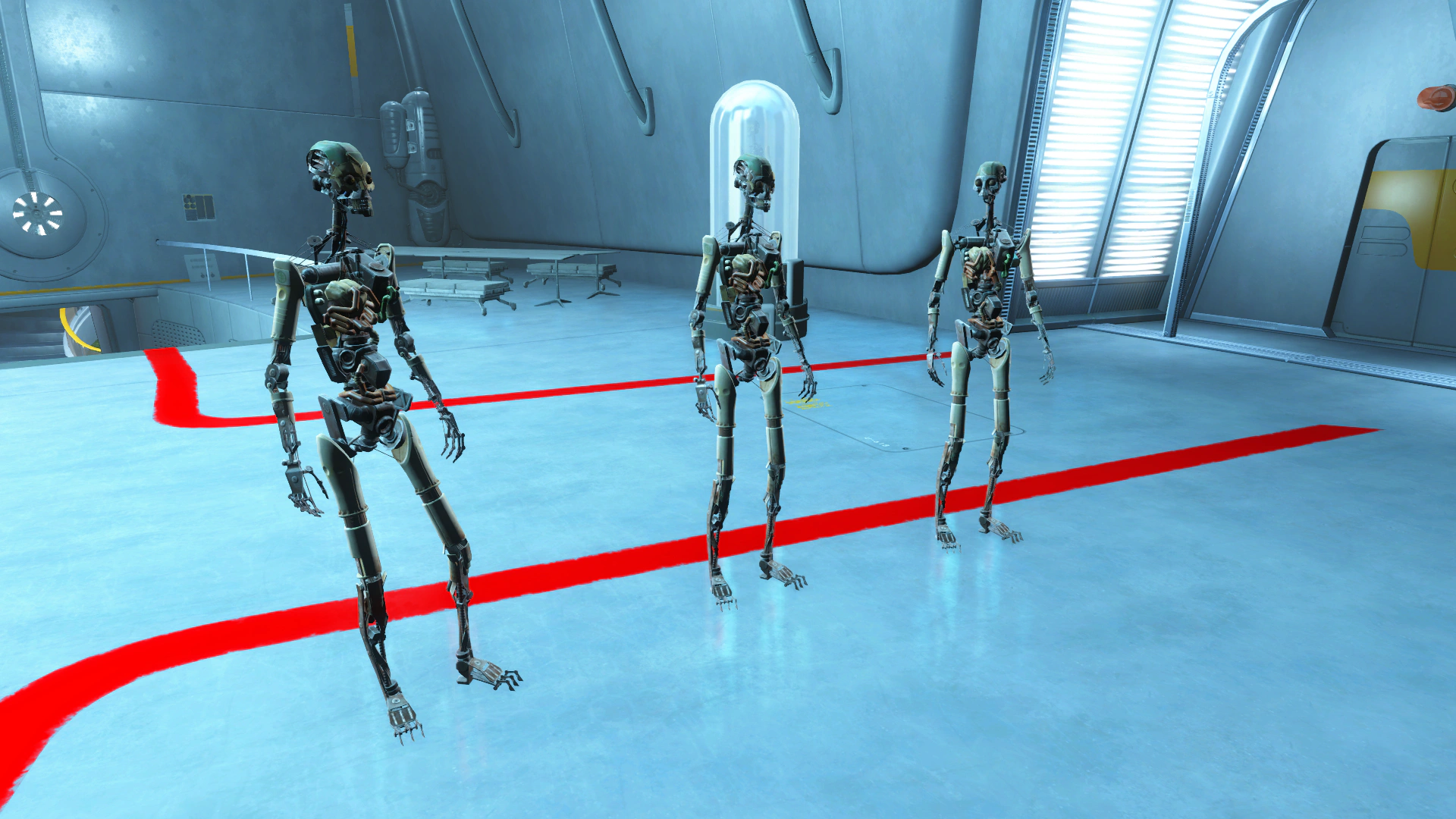
In practice, first generation synths are simple, yet effective machines. They are employed by The Institute for menial labor within the Institute, maintaining the hundreds of systems keeping the underground habitat in operation, and performing tasks that can be easily automated. Like all robots, they can take large amounts of damage, almost never backing down from a fight even with their limbs blown off. What the Gen 1 synths lacked in ability or strength compared to later models, they made up for in expendability and numbers, always capable of being replaced by the Institute.
While capable of recognizing human speech and interpreting commands given to them, they require careful programming and instructing, as well as patches to keep them in operation. The most notorious functionality of first generation synths is navigational software, which requires frequent patching and fixing. Pathfinding software frequently causes first generation synths to try to walk through walls.
Second generation
The most common variant of mechanical synth in the Commonwealth, second generation synthetics are essentially Gen 1 synths provided with a suite of upgrades to their mechanisms and programming. The most noticeable difference is the inclusion of an internal mesh that shields the mechanisms of the synth from damage and provides support for the artificial skin layer that makes the Gen 2 similar to a human. Though more humanoid in appearance, Gen-2s still possess limited A.I. and superficially resemble a mannequin more than a human. These synths are often found dressed in synth armor when on the surface, or else in Institute jumpers when working down in the Institute. They also speak in a robotic voice, but at a much lower pitch than Gen 1 synths.
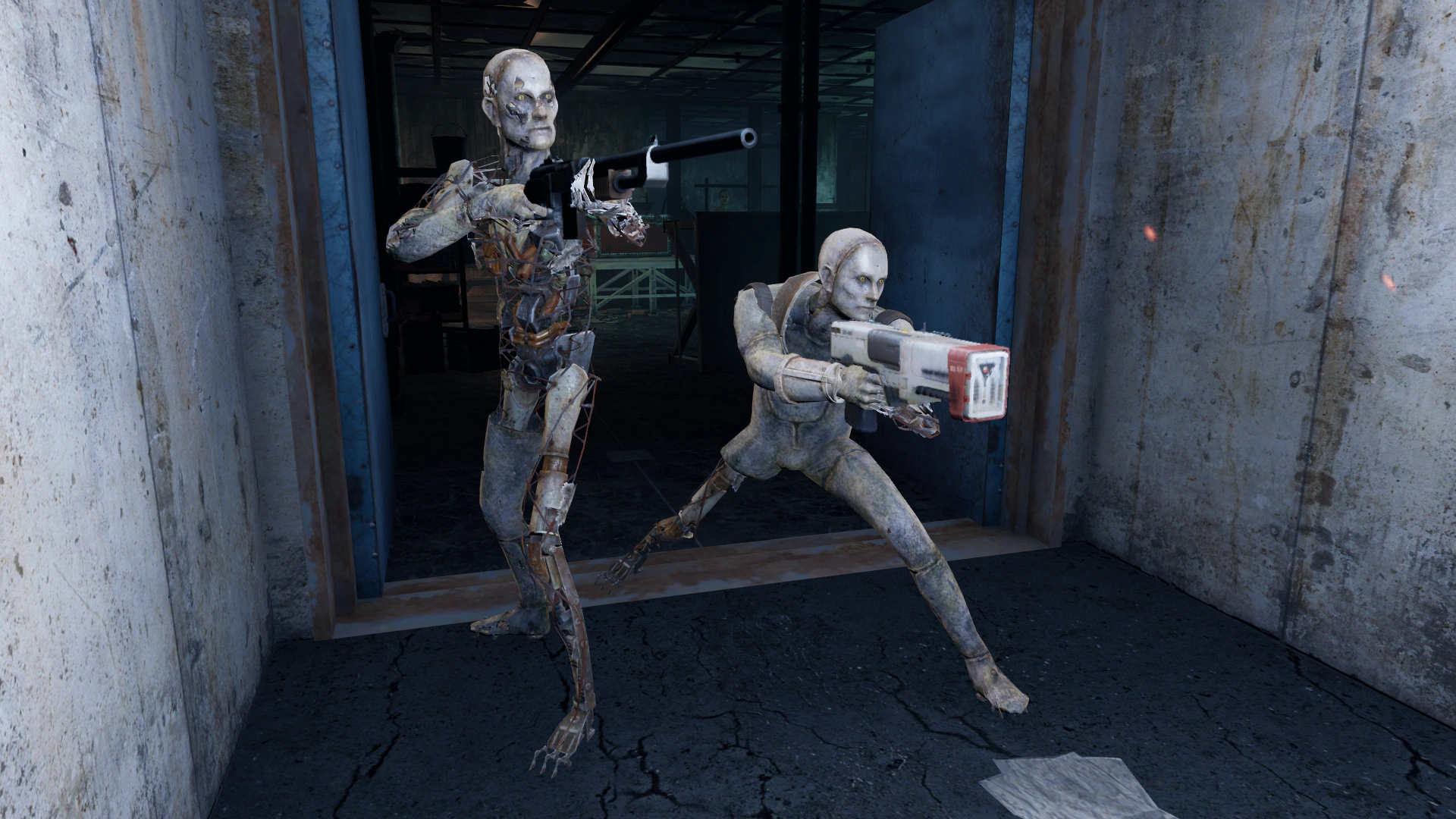
The Gen 2 synths work in maintenance roles within the Institute but are also used on the surface, where their artificial skin layer and improved mechanics improve their performance well above that of Gen 1s. On the surface, Gen 2 synths are the primary workhorses of scouting operations and scavenging missions. They are feared, as they are usually witnessed stripping entire settlements down for parts and killing everything that gets in their way. One of the latest targets of a Gen 2 stripping unit was University Point, which saw its population exterminated for resources after failing to hand over a girl the Institute mistakenly believed was in possession of pre-War energy research.
Of course, due to their mechanical nature, mechanical synthetics can suffer from major software bugs, such as remaining in a single room executing its duties in a loop due to faulty navigation software. Other failures are typically mechanical in nature, with their servo motors and drives breaking down due to age. In fact, most second generation synths have lasted long past their projected lifespans, with all the bugs that crop up due to overuse.
Third generation
The most advanced synthetics created by the Institute are fundamentally different from their predecessors. Despite the sequential numbering, they are unrelated to their mechanical counterparts. They are derived from Shaun's pre-War DNA extensively modified using the Institute's own research into the Forced Evolutionary Virus, combining the advantageous adaptations encoded into FEV with the versatility of the human body shape. This allowed the Institute to create varieties of synths of different races and appearances despite the base DNA coming from only one source. They are the result of nearly five decades of research, from 2178 to 2227.

Third generation synthetics represent the pinnacle of synth technology, being virtually indistinguishable from natural-born humans right down to the cellular level. Each Gen 3 synth is built from lab-grown bones, muscles, and other tissues that are assembled and brought to life at the Institute's Robotics lab, and are "born" with the bodies and mental faculties of full-grown adult humans. Though entirely biological, each Gen 3 synth contains a neurological implant inside their brain allowing them to be "programmed" and manipulated via voice commands. This implant cannot be detected or removed without killing the synth. Synths can also have additional components installed, such as neuro-servos and other implants.
Third generation synthetics are unlike humans in some respects, and some liberated synths do not consider themselves human at all. The reasons for this are multiple; chief among them is the assembly process. Max Loken suggests that synths do not require sleep at all to function properly (although Gen 3 synth companions are shown to sometimes sleep) and need not "fear" hunger or disease (though he does not mention thirst or breathing). This is in conflict with Curie, who mentions needing to sleep and eat when in her synth body; to some degree, it appear that synths can still maintain these functions even if not required. They may even specifically want to eat, such as the case of third generation synths' shared affinity for Fancy Lads Snack Cakes.
Generation 3 synths are physically and mentally indistinguishable from ordinary humans, having lab-grown bodies of real human flesh, bones, and organs instead of plastic and metal. As Dr. Roslyn Chambers found, no medical tests or procedures can identify someone as a synth without killing them (synths that infiltrate settlements, for example, only drop synth components when killed). Psychological tests, such as Covenant's SAFE test, are dubious at best. However, they are not perfect duplicates and have a few key differences from humans that are not immediately obvious: synths do not age, may or may not require sleep, and will not normally gain or lose weight (Mayor McDonough was specifically designed to be obese to match the human he replaced).
Views on synths
Many denizens of the Commonwealth have become paranoid and prejudiced against synths, fearing they might be abducted by the Institute and replaced with identical copies of themselves. Their paranoia is justified, as some of the most sophisticated synths encountered act as spies and could fool the unaware. There are some examples of Commonwealth citizens that were murdered and replaced with synth duplicates who the Sole Survivor interacts with on missions if they choose to join the Institute.
The synths' Institute creators view them as nothing more than machines and treat them as slaves. The Railroad has committed itself to freeing Generation 3 synths from their masters and smuggling them out of the Commonwealth to somewhere the Institute cannot reach them. In contrast, the Brotherhood of Steel has sworn to eliminate all synths, for to them, a machine capable of thinking like a man is an abomination of technology and cannot be allowed to exist, likening the lack of ethics used to create them to that of decadent pre-War corporations.
Gen 1 and 2 synths are less intelligent than Gen 3 synths, but display a certain level of sapience, as exemplified in their dialogue. They call out to their target "whoever you are, I know you're there" and will comment that their systems may be in need of recalibration if they lose track of a target. During the Tradecraft quest, Deacon comments that Gen 1 and 2 synths are on a similar mental level to protectrons and other pre-War robots, causing some debate among members of the Railroad as to if Gen 1 and 2 synths are worth trying to rescue.
Characteristics
While most synths are Gen 1 or Gen 2 and are thus allied to the Institute, they can also be encountered in other places.
If the player character has built a radio beacon, incoming settlers have the potential to be Gen 3 synths (non-infiltration). If these settlers are put on a supply line and happen to pass any major Brotherhood of Steel encampment (Cambridge, etc.) they will be fired upon by the entire station, stalling any building the player can do.
Synths can also be a part of a Minutemen patrol if the Sole Survivor has retaken the Castle and has an ample amount of well-off settlements. If a Minutemen patrol that possesses these synths passes a Brotherhood encampment, they will not be fired upon. Sometimes their patrol routes take them straight through the Boston Airport, into the courtyard of Fort Strong, and back through again. They will not fire upon each other and will sometimes pleasantly engage in dialogue with each other.
If the player character has established a bad reputation with the Institute (in other words, completed the quest Banished from the Institute), the Sole Survivor's settlements will often be infiltrated by synths who will eventually open fire on the player character's other settlers.
This will be a rare occurrence after the Institute is destroyed.
According to Dr. Zimmer, synths can think and feel like humans, and can even eat and digest food realistically.
Gameplay attributes
A synth's limbs will be destroyed when crippled, which will affect a synth in different ways based on its armament. Should a synth's legs be destroyed, it will sit in place and fire upon the player character. A synth armed with a pistol can continue to fire while down after having its left arm destroyed, a synth armed with a rifle must have both arms intact in order to attack. Should a synth's arms be destroyed, they will continue to attack by striking the player character with their electrified stumps. A synth that has its weapon arm and a leg destroyed will be effectively removed from combat, and will not even attempt a melee strike if the player character wanders close.
Synth
Synths often come in groups of four or so, armed with Institute weapons.
Synth strider
Stronger than an ordinary synth, these striders, while fairly weak, are still a significant step up. They, like their counterparts, almost exclusively use Institute weapons and in some instances, shock batons.
Synth leader
Unlike most synths, leaders are armored and possess heavily modified Institute weapons. They almost exclusively travel with other synths and often act as the final opponent in synth occupied areas.
Synth patroller
A step up from the synth strider and leader variants, the patroller is stronger and has better aim. They are usually seen in groups with other synths, such as synth striders or leaders, and are usually seen with Institute pistols or rifles.
Synth seeker
A variant even stronger than the synth patroller. As with other synths, they can be found traveling in groups. Usually seen with the same weapons as the synth patroller.

Synth trooper
Synth troopers are the standard Institute soldier and more aggressive than most of their counterparts. They usually spawn in weaker packs of synth striders or occasionally patrollers.

Synth assaulter
The synth assaulter is a mid-to-high level synth, that is the first variant to be equipped with synth heavy armor.
Synth stormer
The synth stormer is a high-level synth, often seen with other high-level variants of synths equipped with sturdy or heavy synth armor.

Synth eradicator
The synth eradicator is the second strongest variant of synth. Boasting strong weapons and armor, they are on par with Brotherhood knights.

Institute courser
The courser is the strongest variant of synth, on par with the Brotherhood star-paladins, and possess a stealth boy along with strong weapons and high endurance. It can summon various synths through the teleporter grenades.

Bases
ArcJet Systems (during Call to Arms)
Fort Hagen (during Reunions)
Mass Fusion building (after Mass Fusion)
The Switchboard (during Tradecraft)
Ticonderoga (during Operation Ticonderoga)
Fallout 4
Barbara
Brooks (L7-92)
Burner (R3-11)
Captain Carol Janssen (PR-15)
Mr. Carter
Curie (after Emergent Behavior; originally G5-19)
Paladin Danse (M7-97)
Derrick
Gabriel (B5-92)
Glory (G7-81)
K1-98 (Jenny)
K8
K8-23
Mayor McDonough (M7-62)
Naveen
NM-96
R5
Shaun (S9-23)
Yuki (S.N.O.W.; optional)
Sturges - based on game files, no in-game dialogue indicators
Synth cafeteria worker
Synth refugee
Synth virus
High Confessor Tektus (after Reformation)
Unnamed synth in Ticonderoga
Sources
Adapted from the original article, under CC BY-SA 3.0.