Group
Atomic Mining Services
Pre-War mining company that mainly operated in the Appalachia region.
Atomic Mining Services (AMS), sometimes erroneously referred to as Automated Mining Services, was a pre-War mining company that mainly operated in the Appalachia region. and would later partner with both Hornwright Industrial and Garrahan Mining Company. AMS would also develop the Auto-Miners and participate in the construction of Watoga with RobCo Industries.
Background
One of the younger companies operating in Appalachia, especially compared to Hornwright Industrial and Garrahan Mining, AMS was welcomed with open arms when it promised to restart shuttered mines through the use of new mining techniques: Detonating nuclear charges to blast their way through to coal veins and other precious deposits. Used to such hazards, the mining communities embraced the company with open arms.
One offshoot of this technology was the creation of ultracite, which immediately captured the attention of AMS research and development. Initial enthusiastic reports stated that, "energy production from Ultracite continue[d] to exceed expectations," while noting that the exact process of ultracite's emergence was poorly understood. Research continued in hopes of taking their production of such "to the national level."
While further attempting to perfect its ultra-deep mining methods, the company experienced numerous failures with the underground detonations in Welch - and severe environmental damage around Mount Blair. As a result, AMS pulled out of the western part of Appalachia citing "technical failures," throwing the coal towns into economic free fall again. Some sites were sold off earlier to Raven Financial Holdings, and the pull-out continued a demoralizing trend among the miners.
AMS refocused on the Greater Cranberry Bog area and its partnership with RobCo, erecting Watoga, an automated city for the rich elite, surrounded by collapsing or collapsed towns squeezed by the economic crisis. AMS bought up the rights to land surrounding the city and continued experiments with ultracite, with a network of drop sites in the wilderness around Watoga. The detonations resulted in marked subsidence and ecological devastation. Jobless miners were contracted as haulers to transport ultracite by hand up from the excavation sites, while being paid a paltry sum - especially in comparison to the technicians maintaining the Auto-Miners. The situation eventually led to widespread protests east of the Appalachians.
However, the worst was yet to come: The company's interest in Welch was reignited when veins of raw ultracite were discovered there after the fact, many simply bursting through the floors and walls of homes in Welch. The company quickly descended upon the town, attempted to evict townspeople from their homes in order to extract the valuable ore, claiming that "they had resource rights to the land." Welch residents formed a militia in response and when the first forcible eviction was about to happen, opened fire on corporate security. AMS actions precipitated the automation riots, which resulted in the National Guard being summoned by the governor to pacify the region.
Corporate affairs
AMS was a particularly ruthless corporation, especially towards workers: While they routinely handled radioactive materials, all the company did was provide protective gear and a mandate to wear it around the clock. RadAway was not commonly available to increase profit margins and developing cancer due to exposure was grounds for immediate termination. AMS became infamous for automation, cutting workers and replacing them with Hornwright Auto-Miners as fast as possible. Cuts could happen at many time, for any reason, with many miners becoming demoralized and expecting the company to let them go at any moment.
While automation resulted in marked savings, the company still had no way to haul ultracite up from the mine shafts without breaking it. The answer was to hire some of the miners replaced by bots, except cutting their pay (as they were no longer mining technicians, just menial laborers). The result was a disparity in pay between them and the robot techs, who earned ten times as much, leading to inevitable tension. This eventually led to protests, which the company ignored, pushing for more termination and automation.
Partnerships
AMS cooperated closely with both RobCo Industries and Hornwright Industrial. The partnership with RobCo was invaluable when dealing with politicians and helped them deflect attention away from other operations. Watoga was the flagship project of the collaboration, with AMS footing the majority of the cost due to these political benefits.
The partnership with Hornwright, spearheaded by Penelope Hornwright, COO, daughter of CEO Daniel Hornwright, and one-time AMS intern, resulted in AMS licensing Auto-Miners and becoming a key client, purchasing them as fast as Hornwright could produce them. Hornwright's expertise with drilling and mining expedited mining tremendously.
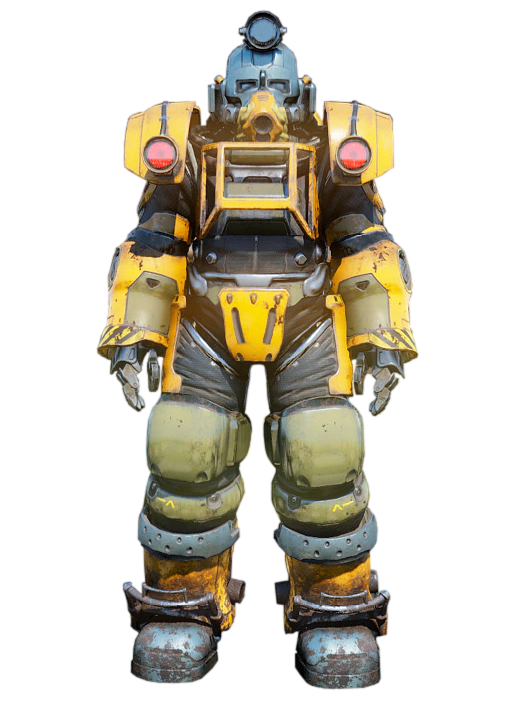
Other partnerships include Hornwrights' competition, Garrahan Mining Company, which contracted the ultracite reactors to install them in the Excavator power armor in exchange for a ten year commitment to AMS tech. Poseidon Energy also licensed ultracite for their own use, retrofitting Poseidon Energy Plant WV-06 to use it exclusively as a power source.
Projects
Ultracite: A mysterious, radioactive glass-like ore that had the potential to become a significant fuel source in the United States.
Excavator power armor: AMS sold ultracite reactors to Garrahan Mining Company.
Poseidon Energy Plant WV-06: Ultracite was licensed for use as fuel.
Watoga: A fully-automated city of the future, developed thanks to a lucrative partnership with RobCo.
Retroencabulator system - An obscure, technically proficient project using generators. Would have been involved in the cut event Technobabble Trouble.
Locations
Gleaming Depths (formerly)
Mine Shaft No. 9
Drop Site D4
Mine shaft D
Employees
Corporate
Kilson - CEO
Dalton Yaborough - Corporate agent
E. Uttley - Headquarters supervisor
K. Nakamura - Headquarters employee
Michael - Headquarters financier
Harvey Brock - R&D fellow
N. Loper - Headquarters scientist
Riley Mustafa - Headquarters employee
Gleaming Depths crew
Marcus Hodgins - Foreman
Ashley Gibbins - Robotics technician
Hanley Gonzalez - Robotics technician
Angel Victorino - Heavy equipment operator
Jasmine Knox - Heavy equipment operator
Tony Halpert - Heavy equipment operator
Roy Kang - Miner
Jo McKinney - Miner
Jacob Astor - Miner
Kell Blanc - Miner
Other
Billy Braxton - Glassed cavern miner
Grayson - Glassed cavern supervisor
Judy - AMS testing site employee
Roy Kerwood - Kerwood Mine fire boss
Sally - Glassed cavern scientist
Sam Bailey - Kerwood Mine foreman
Sources
Adapted from the original article, under CC BY-SA 3.0.