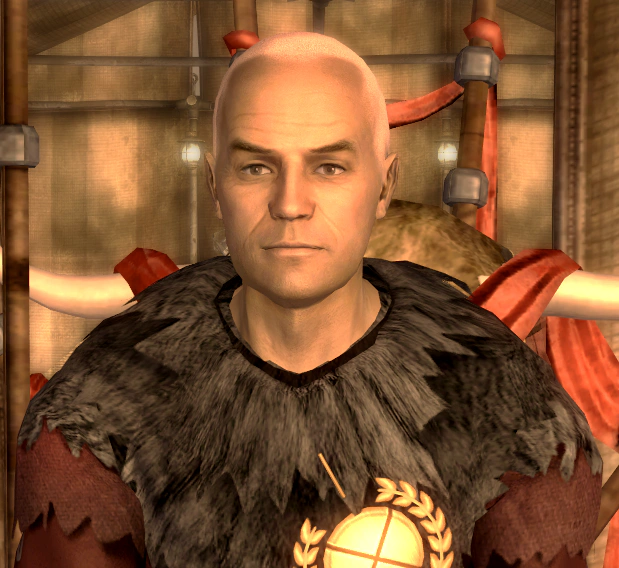
Person
Julius Caesar
Dictator of the Roman Republic
Gaius Julius Caesar (13 July 100 BC – 15 March 44 BC), also known as Julius Caesar, was a Roman politician, military general, and historian who played a critical role in the events that led to the demise of the Roman Republic and the rise of the Roman Empire.
In the Fallout series, the historical Caesar's rise to power served as the inspiration for Edward Sallow to rename himself Caesar and form Caesar's Legion, conquering the tribes of Arizona and aiming to conquer the greater wasteland itself. Sallow utilized the knowledge of his namesake's own literary work Commentarii de Bello Gallico as well as Edward Gibbon's The History of the Decline and Fall of the Roman Empire.Fallout: New Vegas Official Game Guide Collector's Edition p. 459: "Rebirth of the Son of Mars The adolescence and young adulthood of the man who calls himself Caesar were spent as a scribe of the Followers of the Apocalypse. While this boy had a quick mind, he made for a scribe of uneven ability, for his success in academics was equal to his interest in the subject assigned. Nor was he a favorite among his fellows. Though athletic, handsome, and petulance held him back. He never felt that he belonged among the Followers, and blamed them for it. their rigorous devotion to scholarship was stifling, their mission to ensure that humanity would never repeat the mistakes of the Great War was ridiculously naive. The boy longed for something more. When the time came for the boy to leave the Boneyard and trek the wastes as part of a nine-person expedition, wanderlust soon curdled into disappointment. The primitive conditions of the tribes the expedition encountered disgusted him. Inferior people all, wretched in their squalor. Still, he seemed to discern, amid the chaos of their petty struggles and everyday atrocities, the true order of the wastes-and it was one of anonymous, amoral liberty. The wastes called to the boy as a blank slate upon which a man of will could write his own destiny. During the same period of the time that the boy was coming to these insights, the expedition uncovered a cache of well-preserved historical texts. Among with adventure fiction and comic books, history had always been his favorite subject, and so the task of cataloguing and studying the texts fell to him. Though the boy had long been aware of basic facts concerning many ancient empires, these new texts filled in many previously obscure details. Reading The History of the Decline and Fall of the Roman Empire rendered him a veritable hermit for two weeks. But even that could not have prepared him for the Commentarii, the account of the military campaigns of Gaius Julius Caesar, written by the man himself. Reading Commentarii changed the boy's life. Unfortunately, it was destined to change the lives of thousands more, and for the worse. In Gaius Julius Caesar the boy found a man who seamed to have fulfilled the full measure of potential greatness allotted to him by fate, a man whose career spanned political accomplishment and military achievement in equal measure. Such adventure! And intrigue! And cool uniforms! The boy's frustrations with his lot in life gained sharp focus. In reading about Caesar, he was like an ant scurrying about the feet of a regal statue. He resolved that he would go to any lengths necessary to change the course of his life. The Commentarii would be his blueprint. In an illiterate, benighted world, who would ever know that Caesar was not his original creation? That night, Caesar offered a different sort of assistance to a tribe his expedition had contacted recently: weapons, medical supplies, and tactical expertise. He led several tribal accomplices back to the expedition's camp and through its defenses, and there oversaw the murder of his eight fellows. Within a week he was leading the tribe on ever more ambitious raids against neighboring bands of raiders and tribals." (Behind the Bright Lights & Big City)
Background
Julius Caesar rose to become one of the most powerful politicians in the Roman Republic through his accomplishments, such as his military victories in the Gallic Wars. Caesar's wars extended Rome's territory to Britain and past Gaul, with his forces including Legio X. These achievements granted him unmatched military power but also caused him to be seen as a threat by elites within the Roman Senate, who ordered for Caesar to give up his command and return to Rome. Refusing to do so, Caesar instead opted to take his army across the Rubicon to challenge the dominant Republican faction. This began Caesar's civil war, and his subsequent victory put him in an unrivaled position of power and influence.
After assuming control of the government, Caesar began numerous social and governmental reform programs. He also centralized the bureaucracy of the Republic and was eventually proclaimed "dictator for life" (Latin: "dictator perpetuo"), giving him additional authority. His populist and authoritarian reforms angered Roman elites, who began to conspire against him. On the Ides of March (15 March), 44 BC, Caesar was assassinated by a group of rebellious senators led by Gaius Cassius Longinus, Marcus Junius Brutus, and Decimus Junius Brutus, who stabbed him to death. These events directly led into the fall of the Roman Republic and its transition into an empire.
Sources
Adapted from the original article, under CC BY-SA 3.0.