Group
Caesar's Legion
Totalitarian dictatorship
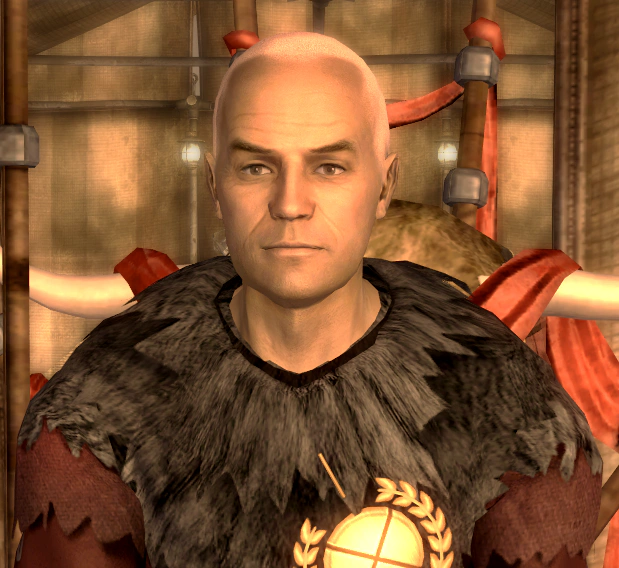
Caesar's Legion (Latin: Legio Caesaris), also referred to simply as the Legion, is an imperialistic slaver society and totalitarian dictatorship founded in 2247 by Edward Sallow (Caesar) and Joshua Graham, built on the conquest and enslavement of tribal societies and ruling over subjects of civilized settlements in the American southwest. To enforce unity, the Legion loosely models itself after the military of the Roman Empire, repurposing its language and aesthetics for the post-apocalypse.
As of 2281, the Legion controls large amounts of territory east of the Colorado River, primarily in the former states of Arizona and New Mexico, with footholds in Utah and Colorado. Worshipped as the "son of Mars" by his followers, Caesar's ultimate goal is to conquer the New California Republic and merge its civil institutions and infrastructure with the military strength of the Legion, creating a new totalitarian empire.
Caesar's Legion appears as a faction in Fallout: New Vegas, in which it can facilitate one of the game's major endings, as well as season 2 of the Fallout TV series.
Formation and early conquests
In the year 2246, the Followers of the Apocalypse sent a group to the Grand Canyon to study the region's tribal languages. The group included the Follower Edward Sallow, the Follower physician Bill Calhoun, and the Mormon missionary Joshua Graham, the latter a specialist in tribal dialects. Not long into their travels, the group was captured by the Blackfoot tribe and held for ransom.
At the time, the tribe warred against seven other tribes and suffered from a lack of skill in warfare. Sallow noticed the Blackfoots' martial ineptitude and feared that their more numerous enemies would soon overwhelm them. Unwilling to leave his and his comrades' fate up to chance, and against their wishes, Sallow instructed his captors in the arts of war, granting them knowledge in gun maintenance, small unit tactics, explosives, and military strategy. He drew largely on what he had read about the military tactics of ancient Roman legions.
Under his guidance, the Blackfoots not only defeated but subjugated the neighboring tribes and came to respect Sallow, following him as their leader. Sallow granted himself the name Caesar and began reorganizing the tribals he commanded into the Legion. Through his leadership, he implemented warfare policies in the Legion based on the Roman concepts of "divide and conquer" and "total war." He saw the tribes as having been "playing at war," the tribals accustomed only to minor skirmishes and raids that never escalated into major conflicts.
The Legion defeated the region's seven tribes from weakest to strongest and completely dominated each tribes' land and people, subsuming them into a growing army. Those who surrendered were conscripted, with the remainder either enslaved or killed. Through this process, Caesar elevated his Legion into a fanatically loyal army of assimilated warriors. A prime example of this subjugation was the tribe once known as the Twisted Hairs, whose members served as scouts during incursions into the former American Southwest. Despite their dedication to the Legion's continued conquests, Caesar never saw them as anything but a conquest in and of itself. After proving their value to the Legion's progress, Caesar and his frumentarius, Vulpes Inculta met the tribe at Dry Wells, where they were betrayed and conquered to be assimilated into the Legion like the rest; those who resisted were crucified along the old roads of Interstate 40 as an example and a warning to enemies of the Legion.
In the course of these conquests, Caesar appointed Graham, who had shed some of his earlier reluctance, as the "Malpais Legate." He was considered one of the Legion's greatest champions and an emissary of its destructive will.
In 2271, the growing threat of the Legion served as a catalyst for the Ranger Unification Treaty. President Kimball recounts during that year, the Desert Rangers of Nevada joined the New California Republic's forces to protect the region against "the tyranny of [Caesar's] regime."
War for the Mojave
After many years gathering strength, Caesar was brought a piece of information that changed the course of his budding empire. One of his frumentarii returned west from the Mojave Wasteland and told him about Hoover Dam, a pre-War hydroelectric dam spanning the Colorado River, and the flag of the New California Republic that flew over it. From this, Caesar determined that the republic would be a worthy enemy to test the Legion's strength and commanded his army to expand westward into the Mojave, establishing a base of operations on Fortification Hill overlooking Lake Mead and the Colorado River in 2277. The advancing Legion eventually made contact with the NCR near New Vegas and began a campaign to take the region, with their forces consisting of 65 conquered tribes.
Under the command of the Malpais Legate, Legion forces marched against the New California Republic garrison at Hoover Dam, in an attempt to take the strategic asset and river crossing. In what became known throughout the region as the First Battle of Hoover Dam, The Malpais Legate led a massive assault against the entrenched NCR defenders, seeing some limited early success in routing the NCR from the dam. However, the NCR First Recon and NCR Rangers, under the command of Chief Hanlon, executed a tactical retreat west into Boulder City after using their prowess in marksmanship to pick off the Legion's centurions and decani from afar, creating chaos and confusion among the lower ranks. The Malpais Legate ordered the Legion's elite forces to push forward in pursuit of the enemy sharpshooters instead of consolidating their gains, realising too late that the Rangers and First Recon had booby-trapped Boulder City, laying explosives all along their route of retreat and throughout the city itself.

When the Legion's elite forces entered the city, the Rangers and First Recon detonated the explosives and inflicted severe casualties on the enemy, crippling their offensive. Shortly after, the remaining Legion pursuers at Boulder City were finished off, and NCR Troopers under the command of General Lee Oliver then counter-attacked, pushing back and eventually routing the Legion's main force after having successfully held the dam. Caesar, angered at the failure of his Legate, made an example of him. The Praetorian Guard covered the Legate in pitch, set him on fire, and cast him into the depths of the Grand Canyon. Caesar forbade mention of his name and now he is spoken of only in hushed whispers by the lowest legionaries and slaves, who call him the Burned Man.
Though bruised by their defeat at the dam, the Legion did not retreat. By 2281, Caesar's Legion has reestablished its power in the west, rebuilt its army, and has slowly encroached on the city of New Vegas, now with 87 tribes brought to heel (or put to the sword). They continue to contest NCR in the Mojave region, destroying several NCR bases such as Ranger Station Charlie and Camp Searchlight, overrunning the NCR town of Nelson, decimating the town of Nipton and sowing discord and terror across the region.
Civil war
Though the outcome of the Second Battle of Hoover Dam for the Legion is unclear, it is shown that the original Caesar, Edward Sallow, has died by 2296. By the time of his death, Sallow had written down his final plans for the Legion: that it would be dissolved upon his death. This note was on Sallow's body when he died. However, this information was never revealed to the rest of the Legion, who mistakenly believed that Sallow's note instead left the name of the person whom he declared as his successor.
Before this information could be revealed, rivalries within the Legion boiled to the surface and caused the unified army to fragment, with at least two different men declaring themselves the new Caesar and plunging the Legion into civil war, just within a single central camp somewhere in the Mojave Wasteland. By that year, the Legion as a whole remains an enemy to the remnants of the NCR still in the region, as well as other forces such as the Great Khans and the Brotherhood of Steel. It seems that the Legion also still holds much territory to the south and east of the Mojave Wasteland, with another Legion force moving into the Mojave from the northwest, based on a map used by the Knights of San Fernando at Area 51. However, it remains unclear whether the brewing civil war seen within the Legion's Mojave camp, where the two sides squabble over Edward Sallow's skeleton for the paper they believe to name his true successor, has had an effect elsewhere in Legion territory.

In that year, Lucy MacLean was brought into the camp after encountering and rescuing a wounded Legion slave from Affordable Al's Discount Hospital. She was introduced to one of the Caesars and his second-in-command, the Lacerta Legate, who showed her the internal conflict in their camp before having her crucified and left to die. Later, after seemingly making a deal to trade Lucy's freedom for the location of NCR holdouts, the Ghoul secretly used his old lighter to ignite a stash of dynamite near the center of the camp; the explosion ignited open conflict as both Legion factions blamed the other and started an attack.
A new Caesar, a new war
The civil war took its toll on the Legion, with both of the self-proclaimed successor Caesars dead. The Lacerta Legate took this opportunity to retrieve Sallow's skeleton and read his note, discovering its true contents: "I am Caesar. I am the Legion. It ends with me." Refusing to accept this, the Lacerta Legate murdered the one legionary who witnessed this event, ate the note to hide the evidence, and then took Sallow's crown for his own, proclaiming himself Caesar.
The new Caesar's ascension was accepted by the surviving Legion forces. The new Caesar promptly ordered a renewed march on New Vegas in order to finally claim their "holy land," where they would establish a palace worthy of the Legion: "Caesar's Palace." The new Caesar and his forces arrived to the outskirts of New Vegas not long after a remnant battalion of the New California Republic Army had returned and established control over Freeside; onlookers such as Lucy MacLean believe that this will likely lead to a new war between these groups, though any such conflicts are yet to be seen.
Society
In and of itself, the Legion proper is purely a military force: a slave army, the sole owner of which is Caesar. As Caesar conquers the peoples of the wasteland, he strips them of their tribal identities and merges them into his forces. There is no other tribe than the Legion itself. Any non-enslaved, non-tribal people who live in Legion-controlled territory are not considered part of the Legion. They are non-citizen subjects of the Legion, living in the cities and towns under its control, and are generally left free to live their own lives, as long as they satisfy all requests or demands made of them and do not interfere with Legion operations.Question: "Even in ancient Rome's slave-based economy the majority of people weren't slaves. Is that the case with the Legion and is that what you wanted to show with additional Legion locations? Joshua Sawyer: "The additional Legion locations would have had more traveling non-Legion residents of Legion territories. The Fort and Cottonwood Cove made sense as heavy military outposts where the vast majority of the population consisted of soldiers and slaves. The other locations would have had more 'civilians'. It's not accurate to think of them as citizens of the Legion (the Legion is purely military), but as non-tribal people who live in areas under Legion control. While Caesar intentionally enslaves NCR and Mojave residents in the war zone, most of the enslavement that happens in the east happens to tribals. As Raul indicates, there are non-tribal communities that came under Legion control a long time ago. The additional locations would have shown what life is like for those people. The general tone would have been what you would expect from life under a stable military dictatorship facing no internal resistance: the majority of people enjoy safe and productive lives (more than they had prior to the Legion's arrival) but have no freedoms, rights, or say in what happens in their communities. Water and power flow consistently, food is adequate, travel is safe, and occasionally someone steps afoul of a legionary and gets his or her head cut off. If the Legion tells someone to do something, they only ask once -- even if that means an entire community has to pick up and move fifty miles away. Corruption within the Legion is rare and Caesar deals with it harshly (even by Legion standards). In short, residents of Legion territories aren't really citizens and they aren't slaves, but they're also not free. People who keep their mouths shut, go about their business, and nod at the rare requests the Legion makes of them -- they can live very well. Many of them don't care at all that they don't have a say in what happens around them (mostly because they felt they never had a say in it before the Legion came, anyway)." (Joshua Sawyer on Formspring, May 12, 2012)

The brutality of the Legion is a major problem for many, but it also brings benefits. Arizona was once a lawless wasteland, thick with raiders and other threats to the point where crossing two miles without a clash with raiders was considered rare. The Legion brought peace and stability to the entire state by exterminating and enslaving the raider tribes. However, despite this brutal subjugation and the relative peace it brought, the Legion does little to actually govern its territory in the traditional sense, possessing almost no civil institutions or permanent infrastructure, instead relying on tribute extracted from those living in their territory to continue expanding.J.E. Sawyer (source): "Edward Sallow created Caesar's Legion as an imitation of the Roman Legion, but without any of the Roman society that supported the Roman Legion. I've written this before, but there are no optimates, no populares, no plebes, no equestrians, no patricians, no senate, no Rome. There's no right to private property (within the Legion itself). There's no civil law. There aren't even the ceremonial trappings of Roman society. Legates don't receive triumphs following a victory. No one in the Legion retires to a villa in Sedona. It's essentially a Roman legion with only the very top commander having any connection to the "source" culture, the rest being indoctrinated conscripts from cultures that were honestly less well-developed than anything in Gaul. Gauls are pretty sophisticated compared to the 80+ tribes. Gauls could read the Latin or Greek alphabets (Gallic language, obviously), had extensive permanent settlements, roads, calendars, mines, and a whole load of poo poo that groups like the Blackfoots never had. What Caesar gave to those tribes was order, discipline, an end to internecine tribal violence (eventually), common language, and a common culture that was not rooted in any of their parent cultures. The price was extreme brutality, an enormous loss of life and individual culture, the complete dissolution of anything resembling a traditional family, and the indoctrination of fascist values. Caesar's Legion isn't the Roman Empire or the Roman Republic. It isn't even the Roman Legion. It's a slave army with trappings of foreign-conscripted Roman legionaries during the late empire. All military, no civilian, and with none of the supporting civilian culture." These are part of the reasons why civilian subjects in Legion-controlled lands are not citizens, not even on a de facto basis.
Iconography
The Legion is styled by Caesar, selectively, on the military of the Roman Empire. The Legion flag is that of a golden bull on a red background, and hangs down rather than to the side like most other faction flags; the bull is used to symbolize the strength and fortitude of the Legion. According to Joshua Sawyer, the design of this flag is based on the standard of Legio X Equestris, Julius Caesar's favored legion. The bull also appears on Legion currency, and is associated with the faction to the extent that some use the word "bull" interchangeably to refer to them.
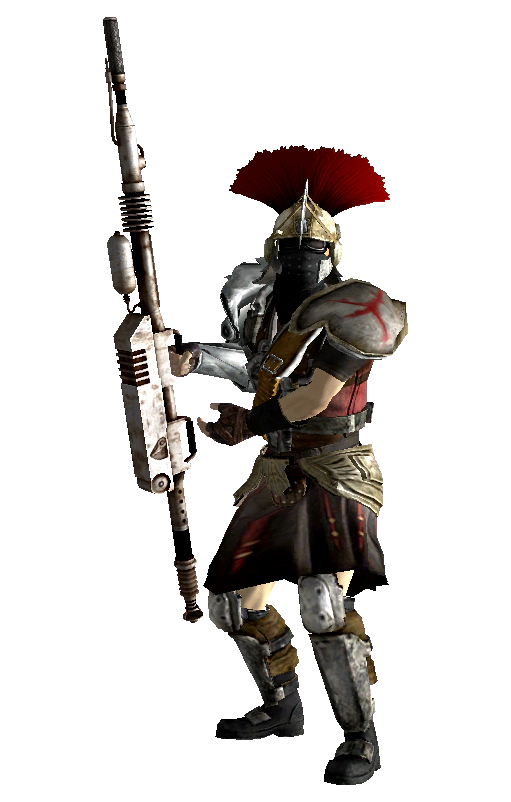
Legion soldiers dress in red tunics with scrapped together armor often from pre-War sports equipment. Higher-ranking legionaries incorporate a T-45d pauldron, supposedly taken from the Brotherhood. Their helmets completely obscure the face using goggles and face-mask.
Caesar uses his likeness on Legion coinage and is often seen as the pre-eminent symbol of the Legion itself, both within and without. One coin shows him as a young man, and another in his older age. One of the coins shows Caesar, Bill Calhoun and Joshua Graham on their journey to the southwestern tribes from which the Legion would arise. This remains the only instance left of Joshua Graham to be acknowledged in the Legion after Caesar forbade anyone to speak his name. This would give rise to a new myth in the Legion of the "Burned Man." A coin also refers to the Grand Canyon in Latin.
Another symbol often associated with the Legion is crucifixion, a common punishment meted out by Caesar to any of his enemies that resist. Those crucified are purposefully left by roads so that passersby see them and associate them with the Legion.
Ideology
The focus of the Legion's ideology is survival and long-term stability at all costs. Caesar disregards democracies as ineffective, fostering corruption, and disintegration. In Caesar's view, Ancient Rome was a militarized autocracy that effectively assimilated the cultures it conquered, which he saw as the perfect template for a society that would survive and thrive in the face of the challenges of the post-nuclear world. By dedicating its members to a higher ideal, he seeks to prevent humanity from fracturing and destroying itself again. He believes that the only way to achieve this is through enforcing a nationalist, imperialist, totalitarian, homogeneous culture that obliterates the identity of every group it conquers. The individual has no value beyond his utility to the state, whether as an instrument of war or production.

A natural consequence of this is the emphasis placed on personal sacrifice. Victory cannot be achieved without sacrificing blood and life. To this end, the Legion shuns robots, as they firmly believe that mankind requires warriors and their sacrifice, rather than gadgets that allow for bloodless victories. The Legion also forbids painkillers and other chems (including medically beneficial chems like stimpaks) as detrimental to the human condition and Caesar's long-term plans to reshape humanity. Ignorance of medical science among the legionaries also ensures that only the hardiest will survive and go on to become deadly veterans.
Politically, this philosophy is expressed in a general disdain for democracy as a weak and ineffective system that fosters disunity, greed, and self-interest at the expense of the collective and the greater good. Caesar cites the NCR as an example, focusing on government corruption by wealthy brahmin barons and landowners, greed permeating every level of society, all leading to the abandonment of the collective and the greater good. The Legion is intended to be the Republic's antithesis, shunning democracy in favor of a strong, centralized rule that would prevent fragmentation and internal weakness. The conquest of NCR will establish a new order, akin to the Roman Empire, complete with the transformation of the Legion, in Caesar's words, "from a basically nomadic army to a standing military force that protects its citizens, and the power of its dictator." This is what Caesar considers the synthesis.
This opposition is based on a loose interpretation of Hegelian dialectics, where the thesis (NCR) and the antithesis (Caesar's Legion) will inevitably form a synthesis at the resolution of the conflict, eliminating flaws and leaving a new quality, with common elements and ideas. He likens the situation between the NCR and the Legion to the transformation of the ancient Roman Republic into the Roman Empire.
Social structure
The Legion employs a very strict hierarchy and clear division of roles between the sexes. Legionaries are the main fighting force of the Legion, composed of able-bodied men enslaved by the Legion or born into it. They have only one purpose: to fight for Caesar until they fall in battle. This principle is imprinted into each legionary during his reconditioning or upbringing (for those born into slavery), creating fanatically loyal soldiers. Unlike the Roman Empire, experience and veteran status have no bearing on a legionary's position. While they receive better equipment as they advance, this is solely for the purpose of accomplishing more dangerous and complex tasks, with much smaller tolerance for failure. They have no personal freedoms or rights. Their only real choice is where and when they die for Caesar, to whom they are disposable tools, discarded the moment they stop fulfilling their purpose. October 28, 2011: "One token Nazi medal for pure aryan mothers hardly balances the the vast, VAST majority of male-dominated civilizations throughout history that have treated women as sub-human or property. Men in the Legion have power, women don't have any. Why are people so obsessed with the "balance" between the different gendered roles under the Legion? I've never said it's balanced. But there is very clearly a trend among people questioning the Legion to project the concept of military service as a noble endeavor (for which one is rewarded, no less) onto legionnaires when it's never presented in that way. They are slave soldiers. Service is not voluntary, they can't retire, there are no parades and pats on the back for them. They aren't Roman patrician officers who are going to retire to a Tuscan estate when they turn 50. The only power that male legionaries have is to serve Caesar well enough to be promoted to a position of more responsibility. Nothing really comes with that additional responsibility other than increased scrutiny and better equipment (to match the increased danger). Most of my commentary on this topic has been to highlight the following: If you want to weigh the individual horror of rape and forced child-bearing against forced military service for life, knock yourself out. It's two terrible ways to go through life."
Women are expressly forbidden from fighting, being considered breeding stock as well as being treated as personal goods or rewards among Legionaries. They are caretakers, healers, midwives, and breeders, fulfilling roles essential to maintaining the Legion's continuous campaign of expansion. Of particular note are the priestesses, who raise children taken from their parents and raise them in keeping with Caesar's doctrine.
Many members of the Legion express condescending or misogynistic opinions of women and their non-combat roles. The Legion justifies the sexist segregation of genders in their society with the principle of minimax, Caesar strictly divides the duties between the sexes in order to fully utilize their potential and optimize the Legion's might. By forbidding women from engaging in combat, he increases the likelihood of their bearing of children, especially necessary due to the high infant mortality resulting from the low level of medical care. Population growth is required for expansion, providing a greater number of warriors to use in military campaigns. Caesar himself is not particularly prejudiced against any sex, or rather, treats them both instrumentally, like pawns on a chessboard.
In order to maximize breeding and eliminate factors that might lower it, Caesar has decreed homosexuality a capital offense and mandated child quotas from all legionaries.
Despite this, it is believed that by many in the NCR and even in the Brotherhood of Steel that - similarly to the actual Roman empire - homosexuality is present within the military but is either on a "don't ask, don't tell" basis to openly gay relationships. Veronica, when asked about the Legion, states that they "Mount their soldiers as much as they mount their women." Cass also states to a male Courier with the Confirmed Bachelor perk when asked about caravan life that she "doesn't like soft living or soft men" to which the Courier may reveal his lack of sexual or romantic interest in women leading Cass to state that he has a "Legion outlook on things". Major Knight also confides to a male homosexual Courier that the Legion is "a little more forgiving about... friendships."
It is unclear how the Legion views cannibalism, but it does not dissuade Caesar from working with members of the White Glove Society to further his goals. It is also believed by some NCR citizens that those in the Legion practice cannibalism. And according to Hank MacLean, the former slave Rita used to "cook people" for the Legion while enslaved by them.
The Legion evidently tolerates submissive mutants, or at least ghouls. Due to their limited numbers, Caesar does not consider super mutants and ghouls as a relevant issue.
Caesar's Legion is subdivided (by Caesar) based on gendered/sexed roles. These subdivisions are sexist (inherently), but they are neither misogynistic nor misandric.
Legionaries under Caesar are not like Roman patrician officers. They are not part of a larger society that celebrates and rewards military service with things like conference of honorific titles, triumphs, etc. All legionaries are slave soldiers, period.
The opinions of individual legionaries are not the opinions of Caesar. These individuals may make misogynistic comments, but those comments did not originate with Caesar, nor is there any reason to believe that he shares them, given his willingness to employ a female courier.
Subjects

Non-enslaved people living under the Legion are primarily inhabitants of non-tribal communities that existed before the rise of the Legion and have been left free, as non-citizen subjects. Instead of enslaving skilled people and cutting into their power base, the Legion opts to enslave tribes (in areas they dominate, such as Arizona and New Mexico). In certain cases, within active war zones like the Mojave or NCR-controlled territories, the Legion will make an exception and enslave non-tribal persons.
Those who are spared this fate and become subjects enjoy relative stability and security from the Legion's governance. Inhabitants of towns in Legion-controlled territory enjoy a stable flow of power and water, an adequate food supply, and low crime and corruption levels. They enjoy safe and productive lives with one caveat: never disobey or disturb the Legion. Caesar's men only ask once and the order has to be carried out without question, even if it means resettling in a distant location at a moment's notice. This generally means that Legion subjects have little, if any, political freedom, rights, or say in what happens to their communities.
However, if one keeps quiet, goes about their business and fulfills the rare request the Legion has, then Caesar is a harsh but fair and peaceful lord. As such, people under the Legion's rule may not consider this to be a problem if they perceived themselves as having had little say in the wasteland either way.
Legion territories are also profitable for traders. Traders can travel on their own without guards most of the time in Legion lands, as all bandits were either ruthlessly exterminated or chased off. Any incursions into Legion lands or against its people are invariably and mercilessly punished; even the savage Fiends think twice before troubling Legion caravans. Coupled with the absence of heavy NCR taxation out in the frontier, many traders stick to Legion lands for regular trading, though some cross the river to trade with the NCR from time to time, and the Legion apparently does not try preventing them from doing so. The Legion holds firm to their ideology against drugs and alcohol, punishing those they capture with the illicit substances severely.
As a form of entertainment, the Legion operates arenas where slaves and prisoners are forced to fight. Young legionaries are also allowed to fight, which is one way for them to make a name for themselves. Outsiders can also fight, but not women; the only known exception is Stella, a female NCR Ranger who was taken prisoner.
Slaves and outsiders
Anyone outside the Legion ranks or under their rule is considered to be "dissolute" or are called "profligates," referring to those lacking morals. Freshly caught humans are called "captures" and are considered the lowest of the low. Their only right is to be tested as a slave. Male captures too old to be trained as legionaries are typically killed.
Slaves are one step above captures and consist of captured humans unfit for combat duty as a legionary. They are expected to adhere to the virtues of a slave (honestas, industria, prudentia - honesty, industry, and prudence) and follow their master's orders without question. They are given a new name and wear rags with a bright red X painted over the chest. Some captures and slaves are forced to wear slave collars to ensure their docility.
Slavery is managed by the Consul Officiorum ab Famulatus. Consul Officiorum typically acts through his representatives or administrators, who handle sales, bargainining, and issuing legal documents, such as bills of sale. The Legion treats documentation with exceptional care, especially when pregnant women are concerned: Slavers may receive subsequent payments if the child is born.
Language
The vocabulary of Legion members is a mixture of Latin and English. There was no soft ⟨c⟩ in classical Latin, where it was always pronounced as /k/, such as in their pronunciation of Caesar's name as /ˈkaisar/. Individuals outside of the Legion generally use the Modern English pronunciation of /ˈsiːzər/. Legion members are fastidious about classical Latin pronunciations, including the /v/ to (w) phonology, heard in the greeting "ave" (hail) as "ah-wey" or in how Vulpes Inculta introduces himself, pronouncing his first name as "wool-pes." Those outside of the Legion that have come in contact with them may use the pronunciations interchangeably. Legion members are called "legionaries" (as opposed to "legionnaires," which is a modern phrase used by the French Foreign Legion. Those who are liked by the Legion are called "amicus," Latin for comrade/friend.
Religion
The Legion enforces the Cult of Mars, a pseudo-Roman neopagan-based cult of personality focused on worshiping Caesar as the Son of Mars, as the state religion. It began in 2250 when Caesar declared himself the Son of Mars, ordered by Mars to conquer all of Earth. To facilitate this conquest, Mars cleansed the Earth with fire, bringing humans to their lowest ebb. Caesar's divine duty is to deliver the wasteland from chaos and barbarism. Caesar's divine status allows him, in the minds of the Legion, to demand servitude from everyone. The general rule is that obeying and following him is to follow the will of Mars. By extension, disobedience is synonymous with condemning oneself to death.
The religion is strictly enforced. To prevent dissent, children of slaves are removed from their families and indoctrinated by priestesses of Mars. The appearance of divinity is maintained through enforced ignorance. Legionaries are taught to believe (or made to) that all of the customs enforced by Caesar were dictated to him by Mars himself.
While to most this comes with no problems, the education of the average wastelander being what it is, Caesar truly fears the educated men, most importantly the Followers of the Apocalypse. To prevent his grand plagiarism from being discovered, the standing order is to kill Followers on sight or deliver them (and any other learned captures) to Legion interrogators. Those that make the mistake of speaking out about this end up executed and their severed heads on spikes.Fallout: New Vegas Official Game Guide Collector's Edition pp. 460-461: "True to Caesar" "Many years have passed, and by post-apocalyptic standards, Caesar's accomplishments have been prodigious. But the man's hunger for greatness has never been sated. Having assembled a loose nation of slavers and slaves, having won countless "wars" against inferior peoples, secretly he still feels like an upstart, an amateur-a barbaric King of the Gauls, instead of a lofty emperor of Rome. To advance, he needs two things: a Carthage and a Rome. In the NCR he has at last found a great adversary, against which he can wage a military campaign worthy of history books. (Indeed, worth teaching his subordinates how to read and write, so that future generations can read his own Commentarii.) And in Vegas, powered and watered by its great dam, he has found a capital worthy of, well, a Caesar. Contrary to the old saw, Rome will be built in a day. With that out of the way, the next step will be to proclaim his apotheosis. All good Roman emperors became gods, although that was usually done posthumously... Besides a (highly unlikely) military defeat, Caesar fears one thing only: exposure. The denizens of the wastes are too ignorant to realize that his entire empire is a grand act of plagiarism, but the Followers of the Apocalypse know exactly who he is and what he has done. Should his tribe discover that he cribbed the entire culture from books about ancient Rome, rather than having its customs dictates dictated to him by Mars...well, it's very unlikely that could happen. And he won't let it happen. That is why his forces have a standing order to kill all Followers of the Apocalypse on sight, and to brutalize all 'civilized' or learned captives and haul them before Caesar's interrogators. Those who make the mistake of saying, 'Hey, you guys, it's like you're emulating the ancient Roman empire,' end up as severed heads on poles." (Fallout: New Vegas Official Game Guide; Behind the Bright Lights & Big City) In addition to Caesar, Mars also appears to be worshiped by legionaries, although there is no mention of the other Roman gods.
Military
Caesar has patterned his slave army after the post-Marian reform Roman Imperial Legions. What follows is a breakdown of the organization of the Legion.Fallout: New Vegas Official Game Guide Collector's Edition p. 41: "Caesar's Legion This horde of cruel, yet highly disciplined slavers has spread across the southwest like an all-consuming flame. Founded by a fallen member of the Followers of the Apocalypse, Caesar's Legion is effectively an enormous, conscripted slave army. As Caesar conquers the peoples of the wasteland, he strips them of their tribal identities and turns their young men into ruthless legionaries and women into breeding stock. Unlike the rag-tag Raiders back east, Caesar's "Legionaries" neither look nor act like haphazard, irregular troops. They are well organized, moving and attacking in large packs, and deliberately commit atrocities to terrorize those who might dare oppose them. True, Caesar is the perfect man. But he is not just a man: he is the Son of Mars, ordained by the god of war to conquer all Earth. To prepare the way, Mars razed the Earth, cleansed it with fire, and brought the weak and the wicked low; and now his son has come to deliver the wasteland from chaos and barbarism. To follow Caesar is to obey the will of Mars; to disobey is to condemn oneself to death. As the Son of Mars, Caesar has the divine right to demand servitude from all he encounters. Not everyone believes that Caesar is the product of a god's loins, of course. The most recently captured slaves tend to be pretty skeptical. But they aren't very vocal in their criticisms, and their children are raised not by skeptical parents but by priestesses appointed to that task by virtue of their knowledge of an adherence to the state religion. Nearly all physically capable, compliant males are compelled to serve in its armed forces. The primary value of pre-menopausal females is to serve as breeding stock (with Caesar or a legate governing how they are assigned to males), though they, like older females and less physically-capable men, are also used to perform a variety of other tasks. The largest unit of organization in Caesar's Legion is the Cohort, numbering about 480 infantrymen. Cohorts are further divided into Centuriae, which contrary to their name numbers about 80 men, and each Centuriae is divided into ten "tent groups" (Contubernia), making this the squad level of organization. Raiding parties are of this size (about eight men) and will be led by a decanus (a squad leader, basically). Caesar desires two things: a Carthage, and a Rome. In the NCR he has at last found a grand adversary, against which he can wage a military campaign worthy of history books. And in Vegas, powered and watered by its great dam, he has found a capital worthy of, well, a Caesar. Contrary to the old saw, Rome will be built in a day. All it takes is plentiful slave labor, and Caesar has that in spades." (Fallout: New Vegas Official Game Guide faction profiles)

One feature of the Legion is that the rank is determined by experience and merit in combat. The least seasoned legionaries (equivalent to pre-Marian hastati or post-Marian auxiliary skirmishers) are typically fielded first during a battle, allowing them to prove their mettle in combat. Those who survive and prove themselves on the battlefield become prime legionaries (equivalent to the pre-Marian principes), eligible for command as a decanus and deployment as second-wave attacks.
The top ranks of the legions are occupied by veterans (equivalent to pre-Marian triarii), who form the third wave and rear guard. These elite troops are deployed once the first two waves fail to achieve their objectives, allowing the Legion to field its most powerful, fresh troops against a weakened, tired enemy.
Veterans who prove themselves as leaders may be eligible for centurion status, becoming the deadliest members of the legion and its most skilled commanders. Each has reached their rank through their battlefield accomplishments and their armor reflects that fact - it is made up of trophies taken from defeated enemies. However, they rarely enter the battlefield, as they are few in number and possess valuable leadership skills, essential to maintaining unit cohesion.
The Legion has special postings and branches in addition to regular military ranks. The vexillarius (standard-bearer) carries the Legion's vexillium (banner or flag) into battle and serves as a rallying point for other legionaries. The frumentarii are the Legion's intelligence service, tasked with infiltration, subterfuge, reconnaissance, occasional diplomacy and other covert tasks in hostile territory, with legionaries requiring specialized training in order to achieve such ranks and serve as Caesar's eyes and ears throughout the wasteland. The Praetorians are an elite unit of bodyguard hand-picked by Caesar to protect him and the legates.
Caesar's Legion: The entire slave army, led by Caesar (political leader) and a favored legate (military commander).
The Legion is divided into cohorts of 480 men, which are divided into:
Six centuriae of 80 men, each led by a centurion, which divide into:
Ten contubernia of 8 men, each led by a decanus. The contubernium is the squad-level unit of organization and the usual size of a task force tasked with skirmishes or harassing larger groups of opponents.
Legionaries
The Legion invests much of its time and effort into hardening its slave warriors into some of the most capable combatants the wasteland has ever seen. The Legion draws its manpower from the dozens of assimilated tribes that it has conquered over the years and any male children born within the Legion. The physical conditioning regimen is brutal and extremely demanding, on par with the NCR Rangers. Legionaries are uniformly fast, strong, and extremely dangerous. They can run half again as fast as the best of NCR troops and are capable of closing distances with frightening speed. Developing resistance to pain is also an integral part of the training, usually carried out via brutal hand-to-hand combat and melee weapons exercises.

Even more impressive than their physical traits is their discipline. Rank and file legionaries are trained to not have to think for themselves, to have conflict removed from their minds. The resulting discipline in the field is beyond the ken of their closest competitor, the NCR, as the legionaries will perform any order given by their superiors and will not back down until they are dead or recalled by their commanders. If training fails, fear will motivate legionaries to succeed. Legionaries who fail or disobey orders end up crucified or torn apart in front of Caesar. In extreme cases, the Legate may order decimation, where a tenth of the unit's troops are beaten to death by the other nine-tenths, as an extreme disciplinary action.
These traits make them ferocious close-quarters combatants, where they have few equals. NCR soldiers are generally advised to take down legionaries at long range before they can engage them in close combat. Of course, while the standard kit is light armor and a melee weapon, the Legion is a pragmatic fighting force. Legionaries also receive training in ranged combat and firearms are not uncommon, though most are in poor condition. Legionaries are authorized to and will scavenge better weapons from fallen enemies and use them in combat. As such, the NCR orders troops to destroy their weapons (e.g. by throwing them over the edge of Hoover Dam) if fatally wounded, to avoid bolstering the firepower of the legionaries. Higher ranking legionaries, like veterans and centurions, are commonly provided with high quality, well maintained firearms, like the anti-materiel rifle or 12.7mm submachine gun, which they can use with frightening efficiency.
The result is a well rounded military force that is capable of fighting on all distances, using all types of weapons, and particularly adept at taking enemy fortifications and bases. Of course, the Legion has weak sides. The extreme discipline and obedience of the lower ranks require a strong chain of command to exist, to guide the soldiers on the field of battle. Without decani and centurions, the legionaries will become a disorganized mass, easy to rout and destroy. This reliance on veterans has been exploited to great effect by Chief Hanlon during the First Battle of Hoover Dam. By eliminating officers, the Legion's forces were easily drawn into a trap at Boulder City and destroyed.
Military doctrine
The Legion employs an organized method of warfare. Despite the organizational structure of the Legion resembling the post-Marian Roman Legions, the deployment for battle order more closely echoes the early-republic maniple system. In larger battles, legionaries are deployed in waves, with recruits upfront, prime soldiers behind them, and veterans, the old guard, bringing up the rear. The enemy wears himself out dealing with the first two waves, with the veterans mopping up any remaining resistance when their turn comes. This is not an omnipresent, cardinal rule, however: Caesar can adapt and run any mix of legionaries as skirmishes, while retaining order in the ranks.
Smaller Legion raids involve both quick attacks and methodical slaughter and crucifixion, such as in Nipton. Legate Lanius states their forces are much better suited at taking positions than holding them due to their up-close style of fighting. Furthermore, legionaries will deliberately commit atrocities to terrorize their enemies and break their morale. On occasion, they are known to use children as traps and soldiers, and rape to terrorize civilian populations. The Legion also seeks to demoralize opposing armies before the battle even begins by torturing prisoners in sight of the army's position.
Relations with the outside
The Legion's aim is to dominate the known world and unite it under its banner. In 2281, it is locked in conflict with the New California Republic at the Colorado River. Tribes that weren't pressed into it are also openly hostile to the Legion, fearing that they too will become victims of its campaign of conquest, as even with guarantees of safety and independence, Caesar has gone against his word and assimilated tribes he previously promised he'd leave alone. This causes even ruthless organizations like the Van Graffs to oppose the Legion in addition to organizations like the Desert Rangers. However, while many civilized groups dislike the Legion's ways, they have great success in assimilating tribal groups. Tribals, with their general respect for power over anything else, typically side with the Legion over the NCR. The White Legs are firm allies of the Legion and are used as proxies for the Legion in the war for Zion. In 2281, after suffering an incredibly devastating defeat at Hoover Dam, the Legion has resorted to finding ways to gain the allegiance of local factions so that they can sow the seeds of their enemy's demise closer to home. They have allied with the Great Khans and Omertas and plan to use them to aid their plans in the Mojave before assimilating or exterminating them. This alliance had evidently splintered by 2296, with the Legion considering the Khans to be enemies with whom they were at war.
Dale Barton often prefers to trade in Legion territories, saying that he finds it cheaper as he doesn't have to hire protection on most occasions, nor does he have to pay extortionate taxes, due to the effectiveness of Legion suppression of raiders and wasteland creatures. Rose of Sharon Cassidy admits that caravan life would be much easier if the Legion controlled the roadways instead of the NCR, as the Legion does not require the same exorbitant tolls and simultaneously provides consistent and effective protection of routes in their territory. She states that for the same reasons caravans side with the Legion, if towns could be provided the same level of security, they would likewise be tempted to capitulate.
According to Ulysses, Caesar has commanded Legion couriers not to kill another courier (even if they appear to not be Legion), as many couriers are disguised frumentarii.
The Legion follows a strict policy of frontier justice, wiping out all savage, chem-dependent raider gangs and tribes they deem unfit for absorption into their ranks.
Technology
With some exceptions, most legionaries lack technological expertise, though they make up for it in resourcefulness. Combat gear is built with a focus on reliability and ease of manufacture, standardized across the Legion. Furthermore, the Legion is easily capable of erecting large fortifications from scrap (e.g. the Fortification Hill encampment), establishing supply chains for its massive army, and, as mentioned above, mass-producing standardized weapons and armor for its legionaries. Caesar firmly believes that reliance on technology weakens humans and was partially responsible for the Great War. The Legion espouses martial prowess and individual fitness to reduce the need for technologically advanced weapons. The technological refinement of an individual legionary's gear is directly tied to his status. Lower ranks typically use either simple firearms (typically revolvers or lever-action rifles), power fists, or melee weapons in the form of machetes and throwing spears, crafted from scavenged materials that mimic the ancient Roman short sword (gladius) and javelin (pilum). Higher ranks, such as prime legionaries, decani, and centurions have access to superior weapons, such as anti-materiel rifles, marksman carbines, and super sledges. The personal guards of Caesar themselves are equipped with high tech ballistic fists to complement their martial prowess. The Legion's general lack of technical expertise means that many legionaries are untrained in the use of certain weapons, with some being unable to disarm landmines.
While no Legion member wields energy weapons, they show interest in purchasing them from the Van Graffs. The Legion is also never shown using power armor, though pieces of what appears to be T-45 power armor are used in centurion armor. The Legion has a large number of Stealth Boys. These Stealth Boys are never seen used by Legion soldiers in the Mojave but are used by the Legion at Dry Wells and the Legion marked men in the Divide. A high reputation with the Legion will lead to a steady cache of Stealth Boys for the Courier.
All troops wear standardized Legion armor, mimicking the Roman lorica hamata or lorica segmentata, created from pre-War sports gear (mostly if not exclusively American football gear, salvaged from the University of Arizona) and armored with metal plates, including the helmet. The gear is worn over a tunic. Centurions make their own armor, crafted from elements of body armor scavenged from felled foes. Also, certain high-ranking members, such as Gaius Magnus and Legate Lanius, have bespoke metal armor, indicating at least some original craftsmanship by Legionary blacksmiths.
Due to a ban on modern medicine, alcohol, and synthetic chems, the Legion creates and uses traditional medicines derived from the local flora and fauna. Healing powder and bitter drinks are the most common remedies used to heal wounds. In order to restore crippled limbs, the Legion creates and uses a chem called hydra, a potent brew derived from the Mojave Wasteland's wildlife and cave fungus. The Legion also produces antivenom for its members as a precaution against wounds suffered from encounters with the venomous creatures of the wasteland.
The only absolutely prohibited technology, aside from addictive and unreproducible pharmacy and medicine, is robotics. Caesar dislikes the thought of having robots win a war fought by men, as it defeats the need for a sacrifice for the greater good. Beyond that, the Legion is opportunistic and will use any kind of technology to further its goals, whether it be using a howitzer to suppress NCR snipers, or occupying HELIOS One if the Courier wipes out its NCR garrison with ARCHIMEDES. Radios are frequently used for communication, and legionaries can be seen using some other electricity-powered devices such as electric lamps and grindwheels, but overall, the Legion tends to use devices that do not require power for reliability. The Legion does not need or truly desire power sources like the NCR, but at no point opposes their usage as it does with chems, alcohol, and combat robots.
Interactions with the player character
Siding with the Legion can make keeping companions very difficult while following the main questline, and most human companions will likely abandon the player character over time. Veronica Santangelo will likely leave when the Brotherhood bunker is destroyed, Craig Boone will leave when one kills several NCR soldiers, and Arcade Gannon will leave when the Courier's reputation with the Legion rises too high. Rose of Sharon Cassidy allows the player character to work with the Legion despite her dislike for them, and Raul Tejada is somewhat supportive due to their ability to provide security. It is possible to maintain all companions through a mix of not speaking to Gannon, not traveling with Boone while killing NCR soldiers, and for Veronica, destroying the bunker when she is not present. Lily, Rex, and ED-E are neutral to this and will still follow the Courier regardless of their alignment.
Although initially neutral towards the player character, Legion patrols in the Mojave Wasteland are openly hostile towards most travelers, including prospectors and traveling merchants, and will attack them on sight.
A female Courier will not be allowed to fight in the arena, regardless of reputation or progress in the game. An exception is made, should the female Courier choose to fight Benny to the death during Render Unto Caesar, as well as with Lupa during the quest Nothin' But a Hound Dog.
Many non-Legion characters comment about the Legion's future leadership, in that without Caesar, the Legion will fall to in-fighting, including Mr. House, Marcus, and Joshua Graham.
Notable members (by rank)
Caesar
Edward Sallow (deceased)
Legate
Joshua Graham (formerly)
Praetorian Guard
Weather station guard
Frumentarii
Ronald Curtis (code name "Picus")
Strange man
Disguised frumentarius
Ulysses (formerly)
Centurions
Decani
Other
Legionary blacksmith
Legionary instructor
Legionary main gate guard
Salt-Upon-Wounds (White Legs) (ally)
Sources
Adapted from the original article, under CC BY-SA 3.0.