Group
Metro
Pre-War public transit system of Washington, D.C.
The Metro Mass Transit System, commonly referred to as the Metro, is a pre-War public transit system of Washington, D.C., administrated by the District of Columbia Transit Authority.
Background
An extensive transit network, providing service to Washington, D.C., and surrounding areas. Complemented by an above-ground network of City Liner buses, the network of stations and rail lines were advertised as a faster, more convenient, cleaner commuter option.
With portions of the system semi-automated, Protectrons were utilized for security, sales, and ticket collectors. Wartime regulations also led to a heightened level of security among DCTA personnel, whose security teams were provided with laser pistols as standard sidearms as outlined in the DCTA Employee Handbook. The authority signed contracts with local businesses to facilitate their operations, such as Darren's Discounts, an electronics wholesaler. In some areas, unauthorized use of DCTA material was considered a violation of the New Amended Espionage Act and could be punishable by fines or imprisonment.
By 2277, DCTA metro stations are closed off with chain link fences and warnings to keep out. Metro tickets can be found and will be recognized as valid by functioning Protectrons, while downloadable DCTA Metro maps provide overviews of the metro network, some of which still have power.
Layout
The metro system is comprised of rail stations, connected by three metro lines - Red Line, Blue Line, and White Line. The system is located underneath the streets of Washington, D.C., extending outwards to both the north and south. The metro network tunnels provide shelter to raiders and wastelanders alike, alongside dangers such as super mutants and feral ghouls.
Stations
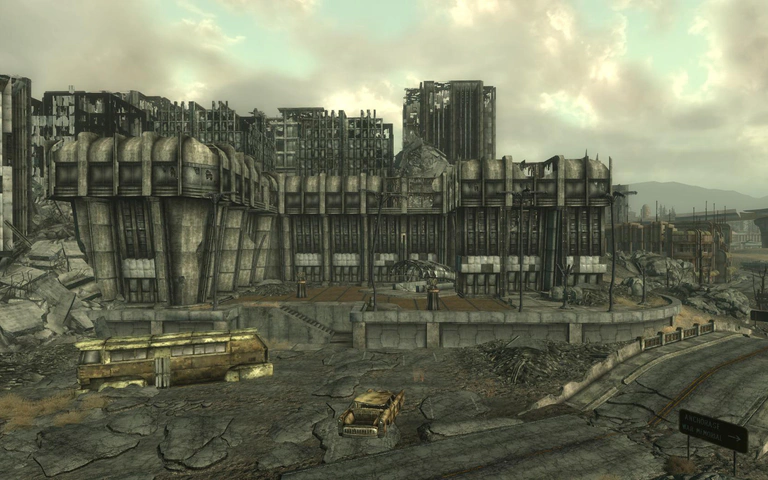
Stations are identified on the surface level by directional signs and obelisks with the metro symbol. The main stations have a grander entrance, with four escalators leading down to the station entrance. Smaller stations have single concrete staircases that lead down to the entrance underneath a curved roof of glass panels, now broken. Double chain-link gates open to connect the entrance to the station's lobby.

Generally, the stations share a similar configuration. They have a lobby where the customers once bought tickets from a metro employee ("agent") in a ticket booth. Restrooms and offices are located off the lobbies. Some lobbies have vending machines. In a few lobbies, there are status displays that show the power status of stations on the three primary lines in Washington, D.C. There is no display for the surrounding communities.
Customers would walk down a sloping hallway into the mezzanine. In the mezzanine, customers would present their tickets to turnstiles or to the Protectrons that patrolled the lobby. On the mezzanines, and lower down on the platforms, the customers could rest on benches.
On the platforms, accessible by escalators, customers waited for their trains. Station identifying signs are posted on either side of the platforms. Some stations are known by more than one name. For example, one station is known both as Anacostia Crossing station and Eastern Market. Further down, in the subway tunnels, signs identified the line.
Metro lines
By 2077, the Red Line, Blue Line, and White Line were the primary lines for the metro.
Anacostia Crossing
The Red Line consists of six known stations. It was the first line completed in the system. This line serves the central DC area and connects it with the northern and southern suburbs through its north-south orientation. The line serves from Friendship in the north to Anacostia Crossing in the south, and interchanges with the White Line at Metro Central. The line is shown on maps to extend further to the north and south.
Trains on this line are serviced from Meresti trainyard in the north. Like most of the network, the Red Line is not in a serviceable condition due to damage to stations, tunnels, tracks, and rolling stock. However, all stations appear to be receiving electricity according to control monitors.
Jury Street
The Blue Line consists of nine known stations. It was the second line completed in the system.
The Blue Line serves the west of the greater DC area. The line is known to extend from Marigold in the southwest, to as far east as L'Enfant, and then northwest to North Potomac. The line is shown to extend beyond these points on DCTA maps, but it is not known if these were in passenger service, links to service depots, or were used for long-distance services.
The Blue Line does not share any stations with either of the other metro lines; although the line appears to cross the White line near Arlington Wasteland (on the blue line) and Foggy Bottom station (on the white line) on the system map, the lines are grade-separated, meaning a service linking the lines would not be possible without further construction.
Trains on the Blue Line were serviced from the Warrington trainyard, which also acted as the line's terminus in Virginia.
Like most DC metro lines, the Blue Line is currently not in a serviceable condition due to damage to stations, tunnels, tracks, and rolling stock. However, large parts of the line can be traversed on foot, with the exception of irradiated parts of the line, such as near L'Enfant and Warrington trainyard, and certain waterlogged sections.
Most stations still have access to electricity according to control monitors; additionally, some stations retain their Protectron security guards; however, some stations have become home to groups of feral ghouls.
Takoma
The White Line consists of eight known stations and was the last line completed in the system.
This line extends from Takoma in the northeast through the center of the city (meeting the Red Line at Metro Central) through to Platz in the west. Although the White and Blue Lines cross, this crossing is on different grades preventing any interchange of services or stations. Like the other lines, the route map appears to extend into Maryland and Virginia.
Like most of the network, the White Line is not in a serviceable condition due to damage to stations, tunnels, tracks, and rolling stock. However, all stations appear to be receiving electricity according to control monitors.
There are many stations in the Capital Wasteland whose connection to these three lines is not fully understood. This is due to the extensive damage that is visited upon these stations. These stations include the Fairfax Metro station and Bethesda underworks. Other stations had their entrances so completely destroyed that any attempt at locating them is impossible.
Red Line
Stations
Tenleytown/Friendship Heights
Metro Central (meets White line)
Blue Line
Stations
North Potomac
White Line
Stations
Takoma
Abernathy
Becton
Metro Central (meets Red line)
Platz
Other stations
Metro cars
These cars were introduced with the modernization of the metro. Each car is an independent unit with a passenger compartment that can be connected to another car by a coupling. A specially built car, the engine car, had an engineer's compartment placed ahead and above the passenger compartment. At a minimum, the engine car could tow four cars.

Most of the cars, save for the engine cars, survived the War. The engine cars were either destroyed completely or salvaged by later visitors to the metro. It's possible that the engine cars were buried in the tunnel collapses. The appearance of engine cars is preserved in advertisements created for the metro.
Sources
Adapted from the original article, under CC BY-SA 3.0.