Place
Washington, D.C.
Former capital city and federal district of the United States of America
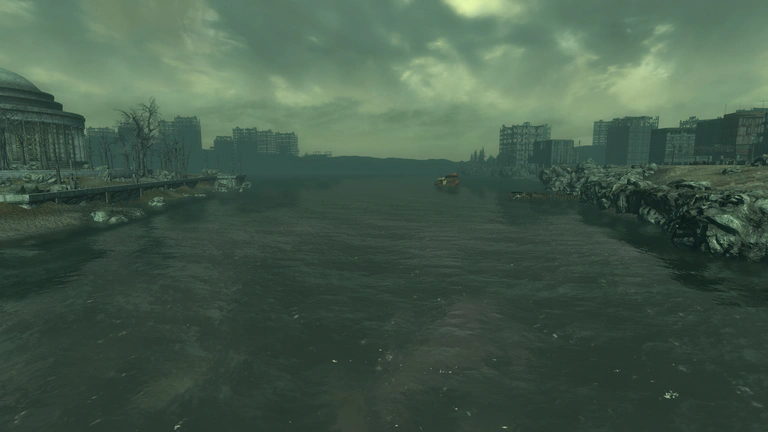
Washington, D.C., formally the District of Columbia, also known as just D.C. or Washington, was the former capital city and federal district of the United States of America. In the aftermath of the Great War, the radioactive ruins of D.C. and its surrounding metropolitan area came to be known as the Capital Wasteland.
Background
Located on the eastern shore of the Potomac River, bordering the states of Virginia and Maryland, Washington, D.C. was the capital city of the United States and the seat of the United States government. Founded after the American Revolutionary War, the city was named after George Washington, a Founding Father and the first president of the United States.
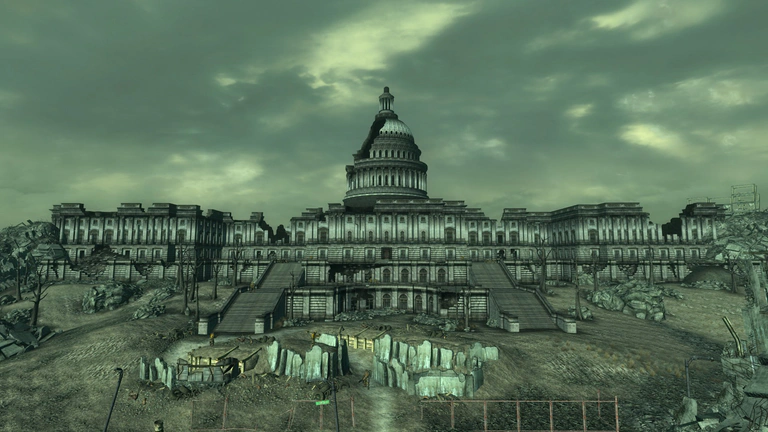
As the seat of the federal government, D.C. housed the Capitol Building, where the U.S. Congress assembled to conduct legislative activity; as well as the White House, the official residence of the U.S. President. Many government departments and agencies were also headquartered in D.C. proper, such as the Department of Energy, the United States Geological Survey, and the United States Space Administration.
Being the capital of the United States, Washington, D.C. and its surroundings were a major target in the Sino-American War. Despite this, no Vault-Tec Vaults are known to have been built within the city itself, although several were built in the surrounding region. However, Pulowski Preservation Services' personal shelters were common throughout the city, while other larger shelters also existed in the city.
The forewarning afforded to D.C. by the first bombs striking the West Coast did not protect the city from the Great War. D.C. was heavily targeted by thermonuclear warheads and suffered multiple impacts. Within the city, the White House received a direct hit and was reduced to a crater. Vernon Square was the site of another impact, seemingly caused by a crashed American Delta IX rocket. Another impact occurred at an industrial site in Takoma Park, remaining as a heavily irradiated crater even two centuries later.
Early post-War
Though civilians in D.C. received some warning about the bombs, this did not prevent the total collapse of order in the city. According to Carol, a ghoulified survivor who hid underground in the Museum of History during the War, D.C. burned for weeks if not months after the bombs struck, while many above ground turned to looting and killing for survival. Although the chaos above ground eventually died down, what remained were large numbers of refugees who sought shelter in places such as the Museum of History. However, high levels of radiation persisted after the bombs, leading to consequences such as the ghoulification of the entire refugee population of the Museum of History. Over time, the refugees' home in the museum became the settlement of Underworld, as more and more ghouls heard about a haven for their kind and came to join them.
Outside Underworld, the situation in the D.C. ruins remained chaotic even after the initial looting died down. Radiation was a threat for those above ground, to such a degree that the air in the capital was visibly toxic green before 2103 (and it remains that way in 2277), with no surviving nature in sight. Many survivors saw the ruined city as hell on Earth and sought to find a better chance at survival in other regions such as Appalachia, even if it cost them everything they had. Some remaining soldiers in a unit led by Colonel Ellen Santiago tried to restore a chain of command, but could not find any sign of the government surviving in D.C., and by 2081 they had left for Appalachia to chase rumors of government remnants in the region.
D.C.'s Union Station was still preserved to some degree prior to 2103, and the last train in the station was used by Paige, the former head of a D.C. Construction Workers Union, and a group of settlers following him, to leave the capital. On the other hand, the D.C. ruins also attracted some refugees from elsewhere, namely ghouls from neighboring regions who heard about a growing ghoul community in the city ruins around twenty years after the War and wanted to try joining them.
Later post-War (23rd century on)
In 2255, the Brotherhood of Steel arrived at the ruins of D.C., settling in the abandoned building of the Pentagon.
The Mall
The Mall is the location between the Museum of Technology, Museum of History, Washington Monument, Lincoln Memorial and Capitol Building. The Capitol Building and Lincoln Memorial are on the far ends, the Washington Monument near the center, and the museums are on the sides. When going straight down the middle of the Mall, expect to be attacked by dozens of super mutants, and by the Capitol Building expect more super mutants, Talon Company mercs and an Enclave camp if one is far enough into the game.
Washington Monument
The obelisk that is the Washington Monument now has a wall made of concrete surrounding it and is occupied by the Brotherhood of Steel. The monument's sandstone and marble have fallen off in many places and reveal its internal metal structure. The bronze statue of George Washington has disappeared from the lobby, nowhere to be found. It also houses the Galaxy News Radio dish at the building's top.
The Capitol Building
Before the Great War, the United States Capitol Building housed the legislative branch of the government of the United States. It is located in Washington, D.C., on top of Capitol Hill at the east end of the Mall. The other side of the Capitol opens onto Seward Square. When discovered by the Lone Wanderer, it is a battle site between super mutants, Talon Company and later, the Enclave.
Lincoln Memorial
The Lincoln Memorial stands in ruins at the heart of D.C.; the seated statue of Lincoln is missing its head (it is located in the Temple of the Union). Sandbags are scattered around the memorial, which is used as cover by slavers and possibly runaway slaves if a quest is completed. The head may be restored after completing a quest given by Hannibal Hamlin who leads a small unit of escaped slaves that are trying to create a haven for other runaway slaves.
National Archives
The National Archives is a pre-War building that housed an agency that was charged with preserving and documenting government and historical records. The building is relatively undamaged, but the documents and records have mostly been destroyed or ruined. It has also become home to super mutants, centaurs and robots; one of which has a personality. The super mutants have placed many traps around to keep out unwanted visitors.
Museum of History
The Museum of History seems to have largely escaped most pillaging other than the structural damage of general decay and trash can fires. Old posters for the space exhibit at the Museum of Technology still hang. A woolly mammoth statue sits in the center untouched by time or the Great War. Due to the decaying ruins, three of the four exhibits entryways are blocked, including WWII, the Anchorage Reclamation and the Resource Wars, only leaving the Abraham Lincoln exhibit mostly intact. Further, inside the museum, the player character can find the Underworld museum exhibit, which has been converted into a city of non-feral ghouls. However, if the player explores any other parts of the museum, they will find Lincoln's artifacts, such as the Lincoln Memorial poster, Lincoln's repeater and dozens of feral ghouls.
Museum of Technology
A monument to man's pride and achievement, the Museum of Technology is a dilapidated shell of its former glory and currently occupied by super mutants. The Wright brothers' Flyer has fallen, its wings are broken, and a faded old Vault-Tec banner hangs nearby. The Virgo II lander remains, containing the needed communications relay dish, several Stealth Boys and plaques about several artifacts. There is also an exhibit featuring a Vault-Tec Vault, labeled Vault 106.
Citadel
The Pentagon was largely destroyed. However, its sub-levels remained intact and contained enough pre-War technology and weaponry to keep Brotherhood of Steel forces going indefinitely. But there was something else as well, Liberty Prime, a technological marvel that, if restored, could help the Brotherhood rebuild strength and reputation that had been declining steadily for years.
Jefferson Memorial
The Jefferson Memorial was converted to a water filtering facility with very large water pipes obstructing the main entrance. A smaller side entrance to the gift shop is open toward the west. This is used as a base for Project Purity, which seeks to provide clean water to the entire Capital Wasteland. It is the focal point of many of the main quests, particularly Take it Back!.

White House
The White House is also a location on the map, though it is nothing more than a massive irradiated crater at this point. It appears to have been hit directly by a nuclear bomb. A Fat Man and three mini-nukes are located in it, and there are several level-dependent ghouls that inhabit the crater.
Arlington Cemetery
Arlington Cemetery is most of what remains of the Arlington district, including Arlington National Cemetery. To the south is Mama Dolce's food industry and in the center, there is the Arlington House. Before the bombs fell, many of the country's war heroes were buried beneath this soil. Now, it is an empty spot on the map, mostly devoid of life. The Arlington Wasteland Metro located south of Wilhelm's Wharf, opens to Arlington Cemetery.
Anchorage War Memorial
The Anchorage War Memorial, built on FDR Island in the middle of the Potomac River, is a war memorial commemorating the battle of Anchorage, Alaska.
Districts
Additionally, Friendship Heights and the National Guard depot are two locations described as being located on the northern outskirts of the D.C. ruins.
Note: Unmarked locations are denoted in italics.
Anacostia district:
Arlington Cemetery district:
Bailey's Crossroads district:
Chevy Chase district:
Dupont Circle district:
Falls Church district:
Georgetown district:
L'Enfant district:
Pennsylvania Avenue district:
Seward Square district:
Takoma Park district:
The Mall district:
Museum of History (contains Underworld)
Vernon Square district:
Metro system
An extensive transit network, providing service to Washington, D.C. and the surrounding areas. Complemented by an aboveground network of City Liner buses, the network of stations and rail lines were advertised as a faster, more convenient, cleaner commuter option.
After the War, the metro network tunnels provide the means for traveling between the districts of D.C. and its neighboring communities even if aboveground routes are unavailable. The stations also serve to shelter both raiders and wastelanders alike, alongside dangers such as super mutants, feral ghouls and pre-War Protectrons that still actively patrol, attacking anyone that does not have a valid metro ticket.
Sources
Adapted from the original article, under CC BY-SA 3.0.