Event
Great Merchant Wars
The Great Merchant Wars were a series of armed conflicts occurring around the…
The Great Merchant Wars were a series of armed conflicts occurring around the late 2120s between the merchant houses of the Hub, a trading settlement in New California. The event is mentioned in Fallout and the Fallout Bible.
Background
The Hub was founded in 2093 in an old town relatively untouched by the Great War by a scavenger named Angus, who soon began trading with nearby settlements. Within a few years, it became the center of a burgeoning trade network in the wasteland, linking together other surviving communities. Though regularly beset by enterprising scavengers, ruthless gangers, and hostile mutant hordes, the volume of trade in the Hub only grew further, leading to the emergence of organized caravan outfits. Within three years of its founding, the Hub truly fit its name as a thriving hub of commerce for the people of New California, with newcomers able to enjoy a meteoric rise to status and influence: Harold became a caravan boss within just a few years of staking a claim, becoming the head of his own outfit.
However, by the turn of the 22nd century, mutant attacks had intensified, and trade was being severely impacted. In 2102, due to the mounting losses, Harold stepped up and financed an expedition to track the source of the mutant attacks. Together with Richard Grey, a doctor and fellow Hubber, the expedition set out in May and tracked the mutant presence to the Mariposa Military Base. A little over a month later, Harold returned to the Hub as the sole survivor, deep in the throes of his own mutation from exposure to FEV. His horrific condition severely impact his life as it caused his caravan employees and trade partners to turn their backs on him, leaving the up-and-coming caravan boss wallowing in destitution living among the "skags" of the Old Town poorer district of the Hub.
Largely unaware of the growing threat from Mariposa, life went on and the Hub continued to grow. In 2120, Angus formally established himself as the governor of the Hub, around the time that mercantile powerhouses such as the Water Merchants were on the rise. He was propelled into the spotlight of popular opinion after almost single-handedly raising and coordinating the defense of the trading city from a massive raid by the Vipers gang in 2125, ultimately driving them away. Power consolidated in the hands of a single person in a city that thrives on competition did not do wonders for his life expectancy; in winter of that year, Angus was mysteriously assassinated. The loss of its founder and leading figure for the last 27 years threw the Hub headlong into chaos.
Conflict
The power vacuum left by Angus' death spurred the leadership of the Water Merchants to seize complete control of the Hub's water tower, attempting to corner the market for potable water by force. Without fail, this ambitious act was met with furious resistance from other merchant houses, sparking the conflict that became known as the Great Merchant Wars.
While the scope and number of casualties incurred by the warring between merchant houses is unclear to date, it is known to have raged on for the better part of three years, consuming both lives and money as time went on. Peace only returned to the Hub after Roy Greene, grandfather of the Hub's future sheriff Justin Greene, managed to bring all sides to the negotiation table and construct an agreement to put an end to the conflict.
Aftermath
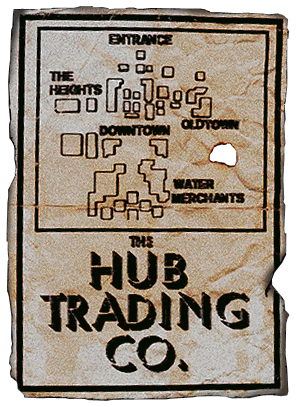
While a bloody and costly affair, the Great Merchant Wars served to inspire landmark reform within the Hub. The agreement organized by Roy Greene led to the creation of the Hub Trading Company, led by a Central Council which would be the main governing body of the city-state. This replaced the autocratic rule by a single governor with an oligarchy, with two representatives from each of the Hub's caravan companies including the Water Merchants, the Crimson Caravan Company, and the Far Go Traders. The resulting governing body maintained the status quo, but with time was also characterized by indecisiveness and inaction.
The most significant change from the pre-Merchant Wars era was the introduction of a price cap on potable water supplies, ensuring it remained accessible to all. In subsequent years since then, the decision to negotiate, rather than subjugate the warring merchants has been criticized, as it allowed the Water Merchants to remain firmly in control of the water tower and its place in Hub merchant society, even under the new price limits.
Sources
Adapted from the original article, under CC BY-SA 3.0.