Place
New California
New California, also referred to as the New West, Core Region, or simply, and…
New California, also referred to as the New West, Core Region, or simply, and more commonly California, is a loosely defined territory situated on the former American West Coast and Southwest, and is one of the most detailed and fleshed-out regions in the Fallout series, being the setting for the first two entries, Fallout and Fallout 2, and further expanded upon in Fallout: New Vegas.
At the furthest point of expansion in the timeline, New California stretches from Baja in the south to Klamath in the north and is said to cover most of the pre-War American states of California, Oregon and Nevada as well as northern parts of the pre-War Mexican territory. In 2186, five independent states that previously formed in the region: Shady, Maxson, Boneyard, the Hub, and Dayglow elected to join together as a new nation called the New California Republic, giving its name to the territory and going on to become one of the largest known factions in the post-War wasteland.
Post-War chaos
The nuclear fire of the Great War affected large swaths of the United States on the West Coast. Much of the coastline was devastated, particularly around San Diego and Los Angeles. Massive craters were created as a result of the bombardment, the largest one situated where Orange County used to be located.
The scale of the attack was not without reason, however. Before the War, many important facilities were located in the region. One such example was a West-Tek Research Facility, established in 2055 to research the New Plague (later becoming the birthplace of the Forced Evolutionary Virus). Other vital installations include the Mariposa Military Base (newly constructed as of January 2077) and the Sierra Army Depot (in operation since 1942, refitted in 2050 as a top-secret research base, and then converted in 2077 into an automated defense base).
The casualties caused by the nuclear weapons on the human population were severe, although many people managed to find safety in the underground Vaults constructed in the region, such as Vault 15 or Vault 8. Vault 13 was sealed with a high number of dwellers, thanks to its delayed construction that reduced the cry wolf effect. Even for those left outside the Vaults, the seeds of future wasteland powers were sown that day; within Mariposa for example, members of renegade Army units joined together under Captain Roger Maxson to form the Brotherhood of Steel. Smaller towns were seeded as well, as is the case with Junktown, founded by a U.S. soldier.
By 2080, the first mutations started to occur among the survivors and wildlife, creating new species practically overnight. The radiation and mutations flooding the wasteland eventually calmed down enough for the survivors to start forming new groups. The first group to emerge and found a new town were the ghoulified inhabitants of Vault 12 beneath Bakersfield. The Necropolis was founded in Summer 2083. Less than a year later, in 2084, Set wrested control of the settlement from the original overseer. The founding of Necropolis started a decade of development. In 2091, after receiving the all-clear signal, Vault 8 opened and Vault City was founded. A year later, the demonstration Vault in the ruins of Los Angeles opened. The inhabitants founded Adytum in what became known as the Boneyard.
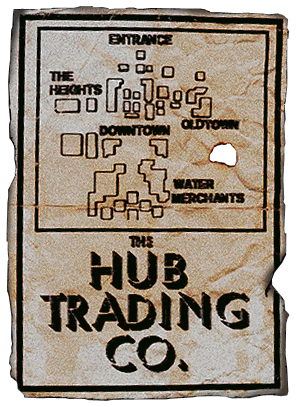
Two years later, in 2093, the future mercantile superpower was established around a filthy oasis in the desert. The founder and first mayor of the settlement, Angus, called it the Hub. Its central location soon attracted plenty of traders, including Harold, from Vault 29. Although he exited the vault in 2090, by 2096 Harold was a prospering caravan boss in the city. One of the landmark decisions that would shape the wastelands for decades was the Hub's adoption of bottle caps as currency. Within ten years of the city's founding in 2093,Fallout: New Vegas Official Game Guide Collector's Edition p. 41: "New California Republic The New California Republic was born from the remnants of the survivors of Vault 15 and the small walled community they founded, Shady Sands. Under the leadership of Aradesh, and with the assistance of the Vault Dweller (who saved Tandi, Aradesh's daughter and a future president of the NCR), the community prospered. Trade routes with other settlements allowed cultural exchange, and a movement to form a national entity gradually took root and won popular acceptance. In 2186, the town of Shady Sands changed its name to "New California Republic" and formed a trial council government to draft a constitution. Four more settlements joined the council, and in 2189 the NCR was voted into existence as a sprawling federation of five states: Shady Sands, Los Angeles, Maxson, Hub, and Dayglow. By post-apocalyptic standards, the NCR is a paragon of economic success and good ethical character: political enfranchisement, rule of law, a reasonable degree of physical security, and a standard of living better than mere subsistence are daily realities for its 700,000+ citizens. Currently, the NCR in a state of transition, with rapid economic growth and a sea change in political leadership endangering its grand humanitarian ideals. Nowhere is this more evident than in the Mojave, where the occupation of Hoover Dam has improved access to electricity and water, but at the cost of straining its budget and embroiling its armed forces in a morally corrosive imperialist project. The NCR government's aim is to annex New Vegas as the republic's sixth state. While it already controls Hoover Dam, its treaty with Mr. House and the three families compels it to allot one-fifth of the dam's electrical and water production to local use free of charge. Adding injury to insult, the NCR is locked into protecting New Vegas from invasion by Caesar's legion even as it receives not one cap in tax revenue from the Strip's highly lucrative resort operations. NCR citizens in the Mojave have largely come here for economic reasons, whether as paid citizen soldiers or as prospectors and fortune-seekers. " (Fallout: New Vegas Official Game Guide faction profiles) "caps" became the standard currency of the wasteland.
In the spring of 2097, Vault 15 opened. While a large portion of the vault inhabitants that left the overcrowded Vault would band into raider tribes as the winter of 2098 came (separately naming themselves the Khans, the Vipers and the Jackals), the remaining population of Vault dwellers founded the town Shady Sands in the Spring of 2098. The town was able to make a head start on living in the wasteland by using the G.E.C.K. they brought with them from the Vault. No one expected that these humble beginnings would eventually culminate in the formation of the New California Republic.
Rise of the Master
The wasteland seemed to be (relatively) peaceful for a time, with the occasional mutant attack on caravans. However, by 2102 these attacks intensified, causing significant losses in caravan trading. To find the source of the mutant threat, Harold joined forces with Richard Grey (an exile from Vault City) and formed one of the first adventuring parties in the wasteland in order to find the source of the mutants. The party, accompanied by several other adventurers, set out from the Hub on May 22. A month later, on June 23, they discovered the Mariposa Military Base. Although it was sealed up by the Brotherhood prior to their departure for Lost Hills, time and numerous attempted break-ins by salvagers had worn away its defenses. Exposed to the F.E.V. in the vats within the facility, a new breed of mutants had started spreading out to infest the wasteland. The expedition was routed by the mutants remaining at the base. Grey was accidentally knocked into the vats, while Harold was knocked unconscious, awakening outside the base hours later. He was rescued by traders and brought back alone to the Hub. The incomplete exposure to F.E.V. caused drastic mutations to affect Harold, who turned into a ghoul-like mutant. When he returned home, his caravan partners and employees abandoned him out of fear and prejudice, leaving the once-great caravan boss a pauper wandering the wasteland.
In the meantime, Grey suffered terrible mutations due to overdosing on F.E.V., more than anyone was ever meant to. He crawled out of the vats, suffering from the effects of mutation, fading in and out of consciousness. He did however manage to record his deteriorating state in the brief windows of conscious thought. Ultimately surviving the mutation process, Grey's condition eventually stabilized by the end of July. He began the first experiments with F.E.V. on animals in Mariposa. By November, he had formulated the cornerstone of the guiding philosophy of the Unity and the super mutant race. He abandoned his old name and took on the moniker of "the Master." Expanding his experiments to performing on humans that wandered into Mariposa allowed him to identify critical flaws in the mutation process and establish a more successful mutation procedure. The Master began building an army from the subjects his mutants captured, the Unity.
Continued development
While the Master developed his plans for improving the human race from Mariposa, life continued as normal around the rest of New California. By 2120, the Hub was rapidly growing. Angus, its founder, established himself as governor and enjoyed a prosperous reign until 2125 when the Hub was attacked in a failed raid by the Vipers, which he stopped almost singlehandedly. Angus was later murdered by an unknown party that winter, which threw the city into chaos. In the following year, a band of merchants joined together to seize the water tower and began charging for water, sparking the Great Merchant Wars. The conflict continued for two years; the Water Merchants controlled the town and the well source, but were greatly outnumbered. In 2128, Roy Greene managed to negotiate a settlement that ended the wars. His reforms included the establishment of the Hub's Central Council, staffed by representatives from the trade companies. The resulting merchant quasi-republic was plagued by indecisiveness, followed by frequent and frivolous meetings, helping to preserve the delicate balance of power in the town. The peace guaranteed that the town would survive the Great Winter of 2130.
That same winter brought to the fore a critical problem in the Master's plan: test subject supply. By the next spring, he ordered his super mutants to begin gathering human stock from caravans traveling around New California. The situation peaked between 2131 and 2135 as wastelanders blamed the disappearances on deathclaws and attacks by monsters in the desert, all while the Unity's numbers kept growing. By 2137, the dipping process was perfected and mass production of super mutants was in full swing. Despite the Master's advancements, however, the success rate of mutation was less than 20%, further troubled by only half of those who survived being viable as troops in his army.
Problems weren't unique to just the mutants. The Brotherhood of Steel, while a formidable force due to their technological advantage, couldn't fight nature. Their founder, Roger Maxson, died of cancer in 2135; his son ascended to the position of high elder, while his grandson became a paladin. The Hub had its own cause for concern as Decker formed the Underground, starting his rule as the criminal lord of the sprawling city in 2140.
By 2152, the mutant problem had escalated further in New California. The Master slowly spread his influence through the wastes over the years while building up his army up until a crucial piece of the puzzle fell into place: upon discovering a group of doomsday cultists led by a man called Morpheus, the Master decided to use them as spies in the wasteland, laying the foundations for the formation of the Children of the Cathedral. Three years later, in 2155, the Master's forces captured a caravan of vault dwellers traveling from the L.A. Vault. From them, the Master learned the location of the vault and decided to move his base of operations there. Once he learned more about the existence of other vaults in the region, the Master realized the separation of the vault dwellers from the radioactive wasteland meant they were perfect subjects for dipping. At his order, the Unity mutants began to scour the region for any vaults they could find. In 2156, the Master formally established the Children of the Cathedral as a benevolent cult, using Morpheus and his followers to establish outposts and spies in the various wasteland settlements to widen his test subject supply and keep watch for information on more vaults. A year later, the Unity finally located their first vault, Vault 12 within the Necropolis. The mutants' assault led to the deaths of many of the inhabiting ghouls before Set managed to negotiate peace with the super mutants. After being told by Set that the ghouls are indeed the vault dwellers, the mutants' recovery operation failed, but they still established a stronghold in the town to ensure Set's cooperation.
Even by the 2150s, the wasteland's inhabitants still largely remained oblivious of the growing threat of Unity and the Master. The Brotherhood of Steel became an uncontested power in the region after their extermination campaign of 2155 broke the back of the Vipers. The loss of their high elder to the raiders allowed his son John Maxson to assume leadership, with Rhombus taking his place among the paladins. While the extermination of the Vipers led to full trade relations between the Brotherhood and the Hub, tensions were present. The Water Merchants of the Hub attempted to barter a large quantity of water for a weapons stockpile and although the Brotherhood turned down the offer, the merchants attempted to take the weapons regardless. The thieves were caught, but the Brotherhood elders voted down a retaliatory expedition.
Peace and prosperity
Six years later, the Brotherhood discovered their first hint towards the existence of the super mutant threat from a corpse found in the badlands and taken back to Lost Hills for examination. The elder council, fearing a potential invasion, enacted several security decrees, including a moratorium on training new recruits until the threat passed. However, it wasn't until December 5, 2161, that a string of fortunate events began. On that day, the Vault Dweller was sent out from Vault 13 to recover a water chip for the water purification system after the Vault's old one became irreparable. In the course of his search, the Vault Dweller also became aware of the super mutant threat. Later joining forces with the Brotherhood of Steel he managed to locate and destroy the Master beneath the Cathedral on March 3, 2162. A little over a month later, he completed the destruction of the Unity by destroying the Mariposa Military Base, the source of the mutants. For his efforts, he was cast out of the Vault by the overseer when he returned there a week later, out of fear that his exploits would encourage more to leave the Vault. Despite the overseer's efforts, a group of Vault dwellers led by a woman named Lydia did leave a short time after, looking to reunite with the Vault Dweller.
Though shunned by their own people, the Vault Dweller's destruction of the Unity prevented the super mutants from destroying the fledgling human settlements, with the sole exception of the Necropolis, which was destroyed days after the Vault Dweller's departure. The mutant population dispersed, leading to a migration of the ghouls and the fleeing of super mutants to the east and the north. The Vault Dweller eventually reunited with the surface-bound group from Vault 13, who learned from him how to survive in the wasteland. Trekking to the inaccessible canyons in the northwest, they founded Arroyo on July 10, 2165 and by August 18, 2167, the settlement was complete.
In the summer of 2185, a former Unity soldier, Marcus, and a knight of the Brotherhood, Jacob, crossed paths. After a firefight and some hand-to-hand combat, they realized they could not best one another. With the stalemate obvious, they gave up and befriended each other instead. The two traveled together, soon attracting ghouls, humans and other super mutants as they figured that a Unity officer and a knight are about the safest way to travel. In fall that same year, they established the town of Broken Hills around an abandoned uranium mine, creating a place where humans and mutants could live side by side.
Apart from ending the Master's plans, the most important act of the Vault Dweller was the destruction of the Khans and the rescue of Tandi, the daughter of Shady Sands's leader, Aradesh. As a result of the hero's efforts in destroying most of the nearby threats, the small settlement enjoyed a period of peace, as raiders gave it a wide berth. Aradesh used this opportunity to develop the community and help the village thrive, eventually turning Shady Sands into an economic power within the Core Region. As trade routes developed, so did the cultural exchange with other towns around New California. This led to the emergence of a national identity movement which gradually gained popular acceptance. In 2186, the New California Republic was founded by Aradesh and Tandi. A trial council government was formed to draft a constitution. The ideals of the NCR would spread over the region steadfast, with Junktown becoming one of the first provisional states of the New California Republic, due to its status as one of Shady Sand's oldest and most trusted trade partners. Though the alliance causes some concern in the Hub, ultimately it had little effect on the relations. In 2189, the Republic was voted into existence as a federation of five states: Shady, Boneyard, Maxson, the Hub and Dayglow. Fallout: New Vegas Official Game Guide Collector's Edition p. 41: "New California Republic The New California Republic was born from the remnants of the survivors of Vault 15 and the small walled community they founded, Shady Sands. Under the leadership of Aradesh, and with the assistance of the Vault Dweller (who saved Tandi, Aradesh's daughter and a future president of the NCR), the community prospered. Trade routes with other settlements allowed cultural exchange, and a movement to form a national entity gradually took root and won popular acceptance. In 2186, the town of Shady Sands changed its name to "New California Republic" and formed a trial council government to draft a constitution. Four more settlements joined the council, and in 2189 the NCR was voted into existence as a sprawling federation of five states: Shady Sands, Los Angeles, Maxson, Hub, and Dayglow. By post-apocalyptic standards, the NCR is a paragon of economic success and good ethical character: political enfranchisement, rule of law, a reasonable degree of physical security, and a standard of living better than mere subsistence are daily realities for its 700,000+ citizens. Currently, the NCR in a state of transition, with rapid economic growth and a sea change in political leadership endangering its grand humanitarian ideals. Nowhere is this more evident than in the Mojave, where the occupation of Hoover Dam has improved access to electricity and water, but at the cost of straining its budget and embroiling its armed forces in a morally corrosive imperialist project. The NCR government's aim is to annex New Vegas as the republic's sixth state. While it already controls Hoover Dam, its treaty with Mr. House and the three families compels it to allot one-fifth of the dam's electrical and water production to local use free of charge. Adding injury to insult, the NCR is locked into protecting New Vegas from invasion by Caesar's legion even as it receives not one cap in tax revenue from the Strip's highly lucrative resort operations. NCR citizens in the Mojave have largely come here for economic reasons, whether as paid citizen soldiers or as prospectors and fortune-seekers. " (Fallout: New Vegas Official Game Guide faction profiles)
Following Aradesh's presumed death in 2196 while searching for Vault 13 to learn about the Vault Dweller's origins, his daughter Tandi was elected unanimously as the second president of the New California Republic. She continued to serve ten terms, winning all consecutive elections until her death by old age. As president, Tandi united the wasteland more than any other leader born after the Great War, including rebuilding the pre-War infrastructure to support the growing population, finding new forms of transportation and manufacturing, clearing roads and rail lines, building forts, fostering caravans and trade inside and outside of the republic, as well as dealing with threats swiftly and efficiently. By 2241, the republic was the largest economic and political power in the wasteland. Much of its power was provided by its vast brahmin herds, which provide meat, leather, beasts of burden and other goods for trade. With the situation south stabilized, President Tandi intended to expand New California and the republic's reach further north. However, the region ended up becoming an arena where the NCR struggled to dominate against its two rivals: Vault City and New Reno.
A new frontier
The struggle centered around the town of Redding, the region's primary supplier of gold ore. When the republic switched to dollars as currency, backing them with gold, the mining city became key to the trade in all of New California. Whoever controls the supply of gold, controls the currency. Redding was lucky enough to remain far away enough to make a military takeover uneconomic. The three powers instead decided to make the city align with one of them through agents operating in the city, either planted ones (Painless Doc Johnson) or voluntary supporters (Marge LeBarge and Dan McGrew).
In the background, other developments took place, including the foundation of the town of Gecko between 2235 and 2238, which created a haven for ghouls in Northern California, right on Vault City's doorstep.
By 2241, the conflict between the NCR, New Reno, and Vault City was slowly approaching a critical phase. In January, the first Jet batches began to arrive in Redding as part of a plan by the Mordino family to control the mining city through drugs. Vault City rejected an offer to ally with the Bishop family and the NCR in February, and mercenary-raider attacks designed to bully the city into the alliance began a month later. All this was set against the backdrop of the worst dry season in years caused a drought in North California, causing widespread food shortages in the less developed areas, such as Arroyo and Modoc.
Beyond grand politics lurked a more insidious threat. The Enclave, an organization formed out of the remnants of pre-War government and corporate officials, was plotting to wipe out humanity using a derivative of Forced Evolutionary Virus, the FEV Curling-13. Working from the shadows, the Enclave had ties to various slaving, drug running and arms dealing operations throughout northern California. They made a grave error, however: they raided Arroyo. The Chosen One, grandchild of the Vault Dweller, pursued their captive tribe to Control Station Enclave. Saving both Vault 13 dwellers abducted by the Enclave and their tribesmen, the Chosen One nuked the rig to prevent the genocide program from being carried out.
Throughout their journeys, the Chosen One also secured the republic's expansion in the north, such as by resolving the dispute for Vault 15 in the republic's favor, vindicating Tandi's expansion policies. Arroyo, Redding, would also become territories of the NCR. The republic would further secure its interests by attacking remnants of the Enclave within a few years of the destruction of the Enclave's oil rig in 2242. Navarro would fall to the republic's army and with it caches of weapons and numerous Vertibirds. Modoc would also at an unknown date become annexed by the NCR.
Expansion of the Republic
President Tandi died in 2248, after a period of illness. Her successors would dramatically change course, leading to a more aggressive foreign policy as the seeds laid by President Tandi yielded fruit, bringing the republic unprecedented prosperity and wealth. The drastic change in the foreign policy came as a result of the massacre of 38 NCR citizens in the Bullhead City area in 2253, resulting in the removal of Joanna Tibbett and ascension of Wendell Peterson to the office of president. The deployment of three battalions to the area began an age of expansionism for the republic. The deployment at Owen's Lake in 2269 led to the completion of the campaign in 2270. After seventeen years of warfare, the NCR completed the removal of tribes from the areas surrounding the Bullhead City. The campaign, known as the Pacification of the Mojave, elevated General Aaron Kimball to the status of a national hero. A year later, in 2271, the Rangers of the NCR and the Desert Rangers merged into a single entity after the Ranger Unification Treaty was signed. The NCR started focusing on the east as it continues to expand. In 2272, the Mojave Outpost was set up as NCR's first outpost in the Mojave Desert.
In 2273, General Aaron Kimball retired from the military to pursue a life in politics. After a successful run for the seat of a Hub congressman, he was voted in as president just two months into his term as congressman, replacing Wendell Peterson. Kimball solidified his power base in a number of ways. The most important one was ordering the occupation of the Hoover Dam as his first act of office in 2274. When electricity and water flowed into the republic eleven months later, his popularity among the citizenry soared. He also enjoyed great popularity among the wealthy, powerful men of the Stockmen's Association and Republican Farmer's Committee to grow even more powerful, the so-called Brahmin Barons and Agri-Barons. The reason for this was simple: Kimball overturned President Tandi's laws limiting the acreage of fields and the number of cattle heads a single man could own. As such, the prosperity and economic development were marred by an ever-increasing influence of the rich at the expense of the common man. However, it led to the development of new economic models. Most importantly, wage labor was reborn and a capitalist, free-market economy began to develop.
The annexation of the Mojave, originally intended to be quick and painless, proved to be the exact opposite. Faced by Caesar's Legion and an unexpected political rival in the form of Robert House, the NCR negotiated with the ruler of New Vegas and his employees, the Three Families. The resulting Treaty of New Vegas stabilized the situation in the Mojave, though it would prove stifling in the long run. By 2275, the NCR established Camp McCarran, deploying into the region in full force. Its new expansionism was openly criticized and opposed by the Followers of the Apocalypse, who helped the republic in the past. In response, the NCR leadership withdrew their support for the organization, choosing instead to rely on themselves. The Office of Science and Industry was formed as a result, with help from dissenting Followers.
The Brotherhood War
However, the expansion of the NCR did not go unchecked. Its rising power attracted the attention of dozens of parties, including the Brotherhood of Steel. As their power waned, the Brotherhood attempted to reclaim their place by adopting a policy of reclaiming tech from "lesser" people. The disagreements over the way technology should be handled eventually resulted in full out war with the New California Republic. The conflict proved disastrous for the insular order and the Brotherhood was eventually forced into retreat. Perhaps the most spectacular confrontation occurred after the NCR occupied Hoover Dam. The Brotherhood's two-year guerilla campaign culminated in Operation: Sunburst. Confronting a majority of the chapter at HELIOS One, the New California Republic broke the strength of the Brotherhood in a decisive battle. However, the Brotherhood War raged on in the West as late as 2281.
But despite numerous victories, the war took its toll on the NCR. Apart from losses in manpower and materiel, the greatest victim of the war was the republic's economy. The republic's gold reserves were destroyed by Brotherhood raids to the point where new gold coins could not be minted and paper money could not be properly backed with gold. NCR citizens panicked and rushed to reclaim the listed face value of currency from NCR's remaining gold reserves. Since the NCR was unable to realize these withdrawals, particularly towards the frontier, faith in their currency considerably dropped. To protect against actual economic collapse, the NCR government abandoned the gold standard and established fiat currency, not payable in specie. Since then, many wastelanders lost faith in it as a medium of worth, both as a result of it not being backed by anything but the government's word and the inevitable inflation. In response to the loss of faith, merchant consortiums of the Hub established their own currency, the veritable bottle cap, backing it with water (exchanging a standardized measure of water for caps). Joshua Sawyer: "It happened during the BoS-NCR war. I believe Alice McLafferty mentions it, but I'm not positive. She doesn't detail the events in this much detail, but here they are: The attacks caused NCR citizens (and others who held NCR currency) to panic, resulting in a rush to reclaim the listed face value of currency from NCR's gold reserves. Inability to do this at several locations (especially near the periphery of NCR territory where reserves were normally low) caused a loss of faith in NCR's ability to back their currency. Though NCR eventually stopped the BoS attacks, they decided to protect against future problems by switching to fiat currency. While this meant that BoS could no longer attack a) reserves or b) the source of production (all NCR bills are made in the Boneyard), some people felt more uneasy about their money not having any "real" (backed) value. This loss of confidence increased with NCR inflation, an ever-looming specter of fiat currency. Because the Hub links NCR with the Mojave Wasteland and beyond, the merchants there grew frustrated with NCR's handling of the currency crisis. They conspired to re-introduce the bottle cap as a water-backed currency that could "bridge the gap" between NCR and Legion territory. In the time leading up to the re-introduction, they did the footwork to position themselves properly. If some old-timer had a chest full of caps, they didn't care (in fact, they thought that was great, since the old-timers would enthusiastically embrace the return of the cap), but they did seek to control or destroy production facilities and truly large volumes of caps (e.g. Typhon's treasure) whenever possible. " (Forums at somethingawful
Fall of Shady Sands
In 2283, shortly after the Second Battle of Hoover Dam, Shady Sands was destroyed with a nuclear device by Vault 33 overseer Hank MacLean in order to prevent civilization from rising outside of Vault-Tec control. This was a massive setback for the New California Republic, with only minor remnants under pre-War scientist Lee Moldaver left occupying the Los Angeles area, fortifying Griffith Observatory as the new NCR headquarters in that region. The event sent the Republic into freefall and the majority of its forces retreated from Los Angeles. However, this tragedy also gave much needed breathing room for the Western Brotherhood, as they could now operate in the open once more, with at least one knight present at the ruins of Shady Sands immediately after its destruction, recruiting survivors into the Brotherhood. Other NCR survivors were taken in by Vault 4, where they took to religion to symbolically commemorate their fallen capital.
As a result of the Republic's decline in the region, much of New California reverted back to a lawless territory, with raiders and cannibal "fiends" becoming a common sight and many different groups rising to take the place in the power vacuum left by the NCR's retreat. Smaller towns like Filly became more prominent in trade, while one lesser faction, Sorrel Booker's "govermint," began to work nominally as a lawkeeping and bounty hunting organization (but functionally acting as racketeers, offering protection to "legitimate" criminal enterprises such as an organ harvesting business in a Super Duper Mart near Santa Monica Boulevard).
The leader of the NCR remnants in Los Angeles, Lee Moldaver, sought to finish her pre-War research into cold fusion to bring power try and shift the balance of political power back towards the NCR. In 2296, she led a crew of raiders disguised as Vault 32 residents to gain entry into Vault 33, with the goal of capturing Hank MacLean, as she needed a Vault-Tec employee to unlock the cold fusion technology, and as revenge for the destruction of Shady Sands. Her plan also required a key component developed by Enclave scientist Siggi Wilzig, who had defected and was fleeing towards Los Angeles to hand over the technology to her.
However, news of Wilzig's escape and his paradigm-shifting technology became publicly known, and a bounty on him was posted by all six agencies offering bounties in the region. The Western Brotherhood also sought Wilzig's technology, and that same year, they received a directive from their organization's East Coast division to hunt him down, as well as reinforcements in the form of the Prydwen, going on the offensive.
Though Wilzig died, his technology was delivered to Moldaver by Hank MacLean's daughter Lucy. However, the Brotherhood also learned of its destination and launched an assault on the NCR force. In the ensuing battle for Griffith Observatory, the Brotherhood suffered losses but ultimately wiped out the NCR remnants, with Moldaver surviving long enough to see her cold fusion reactor activate and bring power back to the Los Angeles ruins. With the Brotherhood effectively gaining control of the L.A. region by claiming the cold fusion technology, Moldaver's last words were to warn Maximus about the consequences of allowing them to get their hands on infinite power.
Environment
The Great War, brief as it was, caused significant climate changes, manifesting as extensive desertification, particularly in the New California area. Where once the region was one of the richest and most important agricultural regions, the decades following the war resulted in many aquifers drying up and vast stretches of arable land turned to desert. Nowhere is that more apparent than in the Central Valley. Once the largest and most fertile valley in California, it became a barren wasteland in the wake of climate change. Beyond the Brotherhood of Steel at Lost Hills, no one inhabits the Valley. Centers of human civilization developed in isolated oases and sheltered locations in the Sierra Nevadas and ruins of pre-War cities instead. The worst element of the new climate was environmental catastrophes. For example, the catastrophic drought that began in 2241 had long-lasting effects on the flora of the region and many communities throughout the wastelands.
Flora and fauna
The changes in climate led to widespread alterations in the ecosystem. The new climate meant that many plants could no longer grow or be cultivated, ranging from common vegetables to specialized crops such as coca plants or opium poppies. Due to necessity, crop variants mutated by radiation were adopted by survivors, including mutated cabbage and maize. These cultivars thrived in the warm weather of the Southwest, forming the agricultural backbone of communities such as Shady Sands, Hub, Adytum, Modoc and others.

Over the years, oases of other types of plant life developed in the wasteland. Vault City was one of the first cities to bring back grass and living, thriving trees, thanks to their use of the Garden of Eden Creation Kit and supplies from Vault 8 they emerged from. Extensive efforts were undertaken by the New California Republic also led to the recultivation of soil in their cities, such as the capital, where gardens and parks with green vegetation were present within city limits.
However, desert plants remain the dominating form of flora throughout the wastelands. Cacti and other succulent plants thrive in the hot climate, providing sustenance for many animals and human settlements, especially in the less developed corners of the region.
The effect of the Great War on the climate also affected wildlife in the area. The radioactive fallout in the air led to widespread mutation. One mutated species to emerge from this melting pot of genotypes is the brahmin. This mutated cattle variant is extremely well suited for the harsh conditions of the wasteland, requiring little water and relatively small grazing areas, while providing plenty in return, including milk, meat, leather, bone, transportation et cetera. As such, it rapidly became the most widespread livestock animal in New California and the backbone of many a wasteland economy. Fallout Bible 9: "Brahmin are mutated brahmin cattle with two heads. If you just said, "hell, I thought brahmin were something from India," well, you'd be right. A bunch of brahmin made their way to the states long ago[1] for crossbreeding purposes. When the bombs fell, brahmin grew two heads. They are quite hardy. They are also a delicious toasty brown, as you'll notice in the picture to the left. They attack by head-butting or trying to gore someone with their horns, so brahmin-tippers beware. For some reason, only the left-most brahmin head has horns, which raises some curious gender identity issues.[2] Brahmin serve a vital environmental niche in Fallout - they form the foundation of survival for many species in Fallout, most notably, humans. They also form the backbone of the NCR economy. They also form the backbone of the New Reno "NCR brahmin rustling" economy. Brahmin can pull carts, old cars, plows, and dead bodies. Brahmin can be driven into herds then used as stampedes on rival tribal villages which is better than a Delayed Blast Fireball any day of the week. Brahmin can be worshipped. Brahmin hair can be woven into bags and ropes. Brahmin hide can be stretched over wooden or metal rods to make canoes if you're into that sort of thing. Brahmin sinew can be used for bowstrings or thread for stitching. Brahmin shit is great fertilizer (and fuel for campfires). Brahmin meat is delicious - well, only because no one in Fallout knows what a succulent Pre-War steak used to taste like. Brahmin are a source of milk that is like modern-day milk, yet terrifyingly different. Brahmin can be tipped over. Brahmin bones can be used as clubs, knives, arrowheads, eating utensils, hoes, or even dice, and their skulls look really scary dotted all over the desert landscape. Their horns can be turned into drinking horns if you feel like getting medieval. Brahmin can be used to distract a hungry deathclaw. Brahmin fat makes decent soap. Their hide can be used to make tents (or tipis/teepees), clothing, belts, saddlebags, shoes, leather armor, or a bizarre brahmin-looking disguise so you can sneak up on other brahmin and listen to their conversations. You can also use their tails as fly brushes or paintbrushes, depending on your level of artistic talent. There are domesticated brahmin and wild brahmin. PCs are encouraged to approach wild brahmin like they would a domesticated brahmin because the end result is amusing for the Overseer. Wild brahmin can forage for themselves, and they can be found across the wastes, gathered into small herds, wandering here and there, munching on the dirty weeds scattered throughout the desert. Fortunately for the ecology of the wasteland (and the survival of their species), brahmin can go for long periods of time without water - they don't need much to survive. They have a strong sense of smell, and they don't hesitate to stomp over any wasteland predator that threatens them or their calves - well, except deathclaws, because no one messes with deathclaws. Brahmin are a great source of cattle drive and range war adventure seeds if you feel like getting your Louis L'Amour on for a few sessions. There are rumors that the smell of brahmin shit is highly addictive."
Other mutated animals that emerged include geckos, mutated lizards indigenous to the Oregon-California border regions. The mutation made them bigger, stronger, faster and definitely not sterile, leading to booming gecko populations in areas that can provide enough sustenance. Radscorpions are also a prevalent mutated creature, posing a significant danger to unwary travelers and untended livestock. The mutated mantis also pose a hazard. However, the most fearsome of those is the deathclaw, the result of a pre-War biological weapons program that continues to breed and spread throughout the wastes and remains one of the most fearsome predators of the wastelands.
Within New California, there are also animals that mutated little to none, such as dogs, rats, crows, rattlesnakes, vultures, and other animals. Domesticated canines are widespread, present wherever there is a human settlement. Rats, while commonly considered vermin have also found a niche. Their extremely high breeding rate led to their widespread adoption by impoverished humans as a source of protein for sustenance. The same is true for mutated species, too, as geckos provide leather, meat and eggs, while radscorpion venom sacks are a potent ingredient in antivenom concoctions. Even the mighty deathclaw is occasionally used as a source of eggs for foodstuffs.
Inhabitants
Prior to the formation of the NCR, the towns of New California were mostly isolated with the only interaction being in the way of trade. While the Hub and Junktown were welcoming to outsiders thanks to their size, smaller communities like Shady Sands and the ghouls of Necropolis were distrustful of those they do not know. Adytum was in the middle: While regular citizens were welcoming, the Regulators of the town were suspicious of newcomers. The Brotherhood of Steel was almost completely isolationist, and Lost Hills has not seen an outside recruit in decades by the time of the Unity. Even in 2161, law does exist. With Shady Sands creating a guard to defend against the Khans, Adytum trusting its safety to the Regulators and Junktown and the Hub creating police forces to fight the crime within their cities. The increasing commerce and density of population necessitated this: Some settlements were as little as 10 miles apart.

With the foundation of the NCR in 2186, the state of the law has expanded greatly. With the creation of the Army and the Rangers, the NCR has largely exterminated the raiders of New California and introduced the rule of law to the towns of the nation. However, loopholes do exist, as shown by the existence of a slave pen right outside the capital's walls, which is technically outside Republic's territory.
The most common forms of food are crops and brahmin. Shady Sands is self-sufficient with the other settlements trading with the Hub to get any food they need. Adytum was previously fed with its own hydroponic farms, but they ceased functioning by 2161. The Water Merchants of the Hub supply a large quantity of the water needed throughout the region. By 2281, the region continues to grow a great deal of food, but it's estimated that there will be food shortages by approximately 2291 due to growing populations. At the same time, water consumption and neglect have caused most of the lakes in the region to dry up.
By 2296 the region has suffered some decline as a result of the loss of Shady Sands, however towns such as Filly continue to operate as normal with many settlers and smaller communities sprouting around the Boneyard. Places such as Vault 4 admit wastelanders and even allow them to become permanent residents while other Vault's in the area remain closed as part of their experiments such as the case with 31, 32 and 33. Lawlessness is rampant in the ruins of Los Angeles, save for settlements such as the Griffith Observatory where the NCR still holds power.
Politics
The political landscape of New California evolved heavily over the years. After the collapse of the United States of America, it turned into a lawless wasteland torn apart by climate changes and fallout. The violent environment did not foster the development of communities and promoted a survivalist mindset. However, the emergence of the Hub around 2093 was one of the first seeds around which new political structures began to crystallize.
2161
The landscape of the wasteland, as far as politics go, was complex 84 years after the war. The Hub was an oligarchy, ruled by a council comprising two representatives from the three largest caravan companies (the Crimson Caravans, the Far Go Traders and the Water Merchants), holding immense sway over the region with its economic power. Law and order were enforced by the well-armed police force of the city.
Other communities throughout the wasteland tended towards meritocracy and a single leader. Such was the case with Shady Sands, Adytum, Necropolis, and other groups of people. Though customs varied, the law was usually enforced by a police force, rather than the entire community, though its size and level of refinement varied by settlement.
The two most organized groups in the wasteland happened to be the Unity and the Brotherhood of Steel. The former was a new society forged out of super mutant stock by the Master, with a philosophy and religion subordinated to survival. Their front, the Children of the Cathedral, became an influential political force in the region due to their capital and message of peace. The Brotherhood was a techno-religious military order focusing on survival and the preservation of knowledge, necessary in the barbaric environment of the wasteland.
2241
Eighty years later, the political landscape of New California changed immensely. The collapse of the Unity and destruction of raider concentrations allowed the survivor communities to flourish and develop. The largest development was the foundation of the New California Republic in 2186 and the unification of the cities of southern California into a democratic federal republic and the establishment of the rule of law under a constitution and codified laws. This represented a major leap in quality from the isolated, simple communities of the 22nd century.
The emerging NCR became the dominant political force in the region, but was firmly opposed by two other powers: New Reno and Vault City. The former was effectively an oligarchy, with power exercised by the heads of the crime families. It had no laws beyond those enforced by the families for their own benefit and no organized state structures. The latter was a high technology settlement that employed a doctrine best characterized as aristocratic, where the power is concentrated in the hands of the citizens and the laws passed by them serve to protect and support the ruling caste.
Settlements outside this power structure largely retained the simple organization of survivalist communities, with a single chosen leader and a police force enforcing law and order. Some settlements lacked even that, with power enforced by the strongest part (such as the Den).
The Brotherhood of Steel experienced decay and stagnation. Where the communities around them developed and flourished, the Brotherhood remained dead-set in their ways and mentality, refusing to adapt or change. A lifestyle that worked well and brought them to the apex of their power in the late 22nd century backfired when they applied it to the increasingly interconnected and well-developed future.
2281
By 2281, virtually the entire New California region became a part of the New California Republic, bringing the rule of law and its political system throughout. Although certain enclaves of independence continue to exist, New California politics are effectively Republic politics.
2296
Following the Fall of Shady Sands in 2283, the NCR had largely pulled out of at least the Boneyard region, with only a small band of NCR remnants maintaining control of Griffith Observatory and offering refuge to civilians. Small, now-independent settlements such as Filly continue to exist in the region. It is unknown if the NCR still holds control of other territories within and outside of New California, but it is possible that they continue to exist in a diminished capacity. Between 2283 and 2296, it is unclear if any particular faction was most influential in the L.A. region, although by 2296 a gang led by "President" Sorrel Booker styling itself a new "govermint" purported to maintain some degree of order in the Boneyard.
The NCR's pullback allowed the western chapters of the Brotherhood of Steel to resurface and operate in the open. In 2296, they received reinforcements from the Eastern Brotherhood and went on the offensive, conquering Filly and Griffith Observatory, effectively seizing control of the Los Angeles region.
2161
The economy of New California in the 22nd century was predominantly based on two elements: Agriculture and salvaging. Food and water were the primary trading commodities, leading to the spectacular rise of the Hub as a major center of commerce in the wasteland, thanks to its water pumps, vast arable fields, and large herds of brahmin. The Hub was also the economic power backing bottle caps, rapidly adopted by the wastes as common currency within ten years of the city's founding in 2093.Fallout: New Vegas Official Game Guide Collector's Edition p. 41: "New California Republic The New California Republic was born from the remnants of the survivors of Vault 15 and the small walled community they founded, Shady Sands. Under the leadership of Aradesh, and with the assistance of the Vault Dweller (who saved Tandi, Aradesh's daughter and a future president of the NCR), the community prospered. Trade routes with other settlements allowed cultural exchange, and a movement to form a national entity gradually took root and won popular acceptance. In 2186, the town of Shady Sands changed its name to "New California Republic" and formed a trial council government to draft a constitution. Four more settlements joined the council, and in 2189 the NCR was voted into existence as a sprawling federation of five states: Shady Sands, Los Angeles, Maxson, Hub, and Dayglow. By post-apocalyptic standards, the NCR is a paragon of economic success and good ethical character: political enfranchisement, rule of law, a reasonable degree of physical security, and a standard of living better than mere subsistence are daily realities for its 700,000+ citizens. Currently, the NCR in a state of transition, with rapid economic growth and a sea change in political leadership endangering its grand humanitarian ideals. Nowhere is this more evident than in the Mojave, where the occupation of Hoover Dam has improved access to electricity and water, but at the cost of straining its budget and embroiling its armed forces in a morally corrosive imperialist project. The NCR government's aim is to annex New Vegas as the republic's sixth state. While it already controls Hoover Dam, its treaty with Mr. House and the three families compels it to allot one-fifth of the dam's electrical and water production to local use free of charge. Adding injury to insult, the NCR is locked into protecting New Vegas from invasion by Caesar's legion even as it receives not one cap in tax revenue from the Strip's highly lucrative resort operations. NCR citizens in the Mojave have largely come here for economic reasons, whether as paid citizen soldiers or as prospectors and fortune-seekers. " (Fallout: New Vegas Official Game Guide faction profiles)
Salvaging of goods from pre-War cities was also a major source of income for wastelanders. As the ability to manufacture most more technologically advanced items was lost in the Great War, pre-War manufactured goods were as precious as they were sought after. Medicine, weapons, tools, laboratory equipment, everything the survivors could not manufacture became a sought-after commodity.
That's not to say that manufacturing was completely absent. It was uncommon, but not unheard of. Small, localized light industry centers developed in New California, such as Boneyard's Adytum and the Gun Runners, producing ammunition and weapons respectively. The bulk of ordnance manufacturing was handled by the Brotherhood of Steel, whose export of conventional weapons and ammunition provided the faction with a majority of its income.
While goods were available, it was trade caravans that were the primary driver of economic development. With the harsh wasteland and the deadly threats that inhabited it, settlements were scattered and largely isolated, with places as little as 10 miles away from each other having much different economic needs. Caravans carried everything, from water, food, guns, and ammunition, to brahmin, metal scrap and even dirt. In fact, these trade caravans would eventually help form the New California Republic and unite the region.
2241
By 2241, the economy of New California has blossomed, in no small part thanks to the rise of the New California Republic. Uniting the largest survivor communities of southern California, it was the most powerful and vibrant economy of the region, with much of its power provided by its vast brahmin herds, which provide meat, leather, beasts of burden, and other goods for trade. Although a large portion of the herds was controlled by the Stockmen's Association and the brahmin barons, anti-trust legislation enacted under Tandi's leadership limited their influence.
Salvaging was still fairly profitable, though it was mostly handled by large salvage companies in New Adytum and Hub. Partnerships with Dayglow ghouls provided the companies with very profitable contracts, especially when the excavation of the Glow began. However, under Tandi's reign, the manufacturing sector and the infrastructure grew tremendously. The NCR became a major exporter of mechanical equipment and manufactured goods, exchanging them for what they couldn't produce (such as medical technologies). It was effectively the economic hegemon of New California, with the powerful merchant houses of the Hub steadily expanding their influence. New modes of transportation such as trains, boats, and barges were sought by traders to carry large amounts of trade goods vast distances. The caravan houses, such as Crimson Caravan, were one of the biggest factors in the development of the republic.
Perhaps the most noticeable and revolutionary change was the reintroduction of a gold-backed currency. New California Republic dollars replaced the venerable bottle caps as the primary currency of the wastelands. Backed by Republic's gold reserves, it was the key to the booming trade in the region. As a result, the mining town of Redding gained prominence and became the center of a three-way struggle for control of Northern California between the Republic, New Reno and Vault City.
Rival economic powers
These two settlements were the Republic's primary rivals for control over New California. The anarchic Reno, controlled by crime families, was a major exporter and trade hub for alcohol, through guns, to hard drugs, slaves, and prostitutes. Its economy was based primarily on exporting drugs and luxury services, with peace enforced at gunpoint.
Vault City was a small, but powerful force. Vault City's advanced medical centers allowed it to produce large quantities of medical goods and technologies they traded with the outside, usually, for raw materials, gold and other goods it could not produce within city limits, although many of their services and goods are prohibitively expensive for most wastelanders.
Beyond these three powers, there were scores of smaller settlements dotting the economic landscape of New California. Their economies are typically specialized. Klamath was a major exporter of leather and leather products thanks to its trappers, while Modoc focused on agricultural exports (and was particularly affected by the drought). Broken Hills was a mining settlement exporting rare uranium ore to high tech settlements, such as Vault City. Finally, San Francisco was an independent center of high technology and fishing.
However, the explosive growth of the economy in the region also fueled less savory branches thereof. Although slavery was eradicated in republic territories, in the largely wild, tribe-inhabited north it was a booming trade. The Den was a settlement whose economy relied on the Slaver's Guild's business. Slaves were a particularly welcome type of stock, used for menial labor, prostitution, combat and even scientific experiments.
2281
The economic power of the New California Republic ultimately prevailed and became one of the key factors in the transformation of society between 2241 and 2281. The NCR expanded to incorporate the entire New California territory. The New Californian economy became the de facto republic economy. Survival ceased being a major concern for the vast majority of NCR citizens and the problem of collective welfare has been largely superseded by concerns about individual prosperity. People providing services free of charge are now the exception, rather than the rule, with skilled workers routinely charging for their services, from tailors to surgeons. Moreover, after over 80 years of scavenging, the wastelands of New California have been largely picked clean of salvageable goods. NCR citizens who can still make a living exclusively by scavenging and hunting are an uncommon sight. The combination of these cultural and economic factors led to the rebirth of wage labor; most citizens have to seek an employer at a mill, factory or farm and work to earn their keep and earn money necessary to survive, but these jobs are easy to find in one of the many mills and farms in New California.
The two resources that comprised the foundation of NCR's economy became even more important. Great brahmin herds and swaths of land restored to arable condition firmly established it as the greatest economic force in what was the southwest United States. Already influential before, ranchers and farmers now hold even greater sway in the republic. During Tandi's presidency, anti-cartel regulations were enacted to discourage the formation of oligopolies. However, pressure from the Stockmen's Association and the Republican Farmer's Committee, ultimately convinced President Kimball to overturn them completely. As a result, since 2241 much of the republic's farming and brahmin herding has been monopolized by brahmin and agricultural barons, incredibly wealthy individuals who exert a lot of influence thanks to their capital. Their success also led to the emergence of cottage industries, such as the rebirth of luxury goods manufacture and pseudo-journalism reporting on the latest purchases, commissions and life lessons of the newly rich and famous.Fallout: New Vegas Official Game Guide Collector's Edition p. 456: "Controversy over Economic Development "The NCR's economy is based on two resources: its great Brahmin herds, and swaths of land that have been restored to arable condition. These provide the nation with meat, leather, and starchy vegetables. During President Tandi's presidency, regulations limited the number of cattle head and the acreage of fields that could be owned by a single person. Despite constant pressure from the Stockmen's Association and Republican Farmer's Committee, such regulations loosened only a little so long as Tandi was in office. Following her death, however, they eroded until President Kimball overturned them completely. As a result, the past 12 years have seen the rise of the Brahmin Barons and Agri-Barons: captains of industry who are, by post-apocalyptic standards, spectacularly wealthy. This has given birth to a number of cottage industries, from the rebirth of luxury goods production to "journalism" that reports on the latest purchases, commissions, and "life lessons" of the newly rich and famous. The past 12 years has also seen a change in attitudes towards collective welfare. Citizens of the NCR rarely face significant dangers on a daily basis, and survival is an assumption rather than an aspiration. Citizens are far more reluctant to share food and other resources, and the person who provides services free of charge, whether it's something as quotidian as sewing or as rarefied as surgical expertise, are now the exception rather than the rule. An added economic strain is the scarcity of salvageable goods. Sixty-five years of scavenging has done a good job of picking clean the wastes of what was once Southern California. Rare are those individuals who can make a living by scavenging and hunting what they need. A consequence of these economic and cultural transformations has been the rebirth of wage labor. Whereas one's labor was until recently seen as benefitting and belonging to a collective (whether a family or small town), it has now become a commodity. To earn their keep, many citizens must seek an employer and trade the sweat of their brow for Caps. Citizens of the NCR hold a variety of opinions about these developments. Many boast of their nation's economic strength; others decry what they feel has been lost. Many curse the selfishness of their fellow citizens, usually while pursuing aims that will benefit only themselves or their families. Here in the Vegas wastes, however, nearly all citizens will agree on one matter: opportunity has dried up back home, and to earn a fortune, one must come East." (Behind the Bright Lights & Big City)
Other branches of industry have also developed. Light industry, including tools, textiles, and other manufacturing, form a significant part of the republic's industrial output. Another element of the republic's economy is its ordnance workshops, producing standardized weapons and armor for the New California Republic Army and Rangers. The ever-expanding trade routes led to the rise of powerful merchant houses, such as the Crimson Caravan Company, the Far Go Traders and the Gun Runners, which continue to all but completely dominate all trade within New California.
2296
The destruction of Shady Sands led to the return of a wasteland economy in the Boneyard region. Bottle caps, previously abandoned, returned to being the only currency guaranteed to be universally accepted in trade, with NCR dollars becoming all but worthless. Independent settlements like Filly began to grow as local trade hubs for wasteland travelers, farmers, and small merchants offering various goods and services. "Lead farming," the act of collecting spent bullets, is one practice taken up by independent settlers such as Adam for survival. Criminal elements have also become common again, including organ harvesting from unwilling victims and chem trading.
Sources
Adapted from the original article, under CC BY-SA 3.0.