Group
United States Space Administration
The United States Space Administration (USSA) was the agency of the United…
The United States Space Administration (USSA) was the agency of the United States responsible for the administration of the nation's space program.
Background
In the 1960s, the United States became involved in the Space Race. The U.S.S.A. quickly became the national authority for all endeavors related to spaceflight, with its headquarters in Washington, D.C.
Mr. Pebbles, a Persian house cat, was the first animal launched into space and brought back alive.
Captain Carl Bell was credited as the first human in space onboard the space capsule Defiance 7, making a full revolution around the Earth in twelve minutes and seven seconds. This claim was disputed by both the Soviet Union and China. Bell died on May 5, 1961 when the capsule crashed on its return.
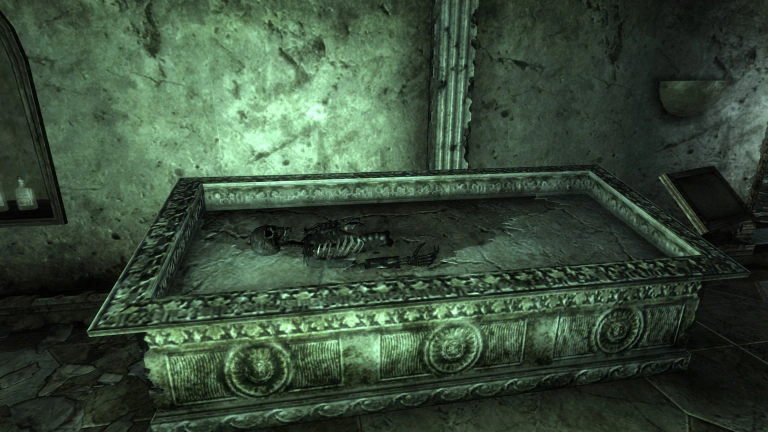
During the 60's Space Race, U.S. Air Force Colonel Hartigan and his ship Clarabella 7 were returning from a low orbit space flight when the alien crew of Mothership Zeta abducted them. Also around this time Holly Barrisford, a linguistics specialist for the USSA, was abducted as well. By 2277, Colonel Hartigan is found dead in a cryogenics pod by the Lone Wanderer and an alien captive recorded log detailing Holly Barrisford's interactions with the aliens is found onboard the mothership.
On July 16, 1969, the Virgo II lunar lander "Valiant 11," piloted by Captains Richard Wade, Mark Garris and Michael Hagen, became the first manned space vehicle to touch down on the moon. The astronauts became the first humans to walk on a celestial body other than Earth. On November 14, 1969, the Virgo III "Valiant 12" also landed on the moon, leaving behind its flag. Constructed with special materials to withstand the harsh environment, the flag survived on the surface until it was found in 2052 by the crew of the last manned flight to the moon's surface.
In 2020, the USSA commissioned the Delta IX rocket, one of the most successful rockets in the nation's history with over 77 successful launches. The spacecraft was developed entirely by USSA scientists and could hold two astronauts, sustaining them for up to 24 days. The longest recorded spaceflight in a Delta IX rocket was the 17-day Zeus 12 mission to the moon. The spacecraft was the last of the manned rockets to the moon, converted afterward for military use, removing the crew and instrument sections in order to hold a nuclear warhead.
The USSA sponsored the Museum of Technology's spaceflight gallery, which included an exhibit featuring a replica Virgo II lunar lander, G-force simulator, Copernicus Planetarium and Delta IX rocket, supported by a grant from the United States Department of Antiquities.
Around the 2060s-2070s, the USSA was planning for a Martian expedition by 2078. Delays and political pressures caused the USSA to fear that the mission may be delayed to the 2080s or later.
There were attempts at public outreach in order to rekindle public support for the Mars Mission, including collaborating with the popular Captain Cosmos franchise.
The following is based on Creations and/or Creation Club content and some details might contradict canon.
The following is based on Creations and/or Creation Club content and some details might contradict canon.
Valiant space station
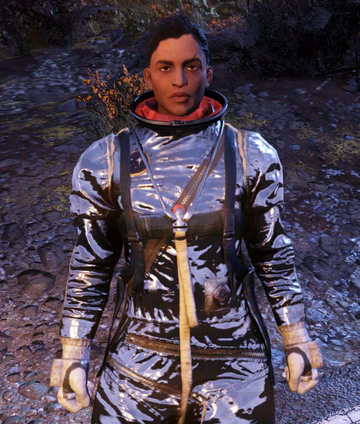
At some point prior to the outbreak of the Great War, the USSA participated in some capacity in the maintenance of the Valiant-1 space station, evidenced by the presence of USSA logos on spacesuits that can be found aboard the remains of the station in 2102. The station was forced back down to Earth to its final resting place in the Toxic Valley region of Appalachia. By 2103, the space station would become the base of the local raider faction and dubbed The Crater.
Deep Sleep project
The USSA Research and Development Department division worked on the Deep Sleep project, which launched in 2070. The project's aim was to test the viability of hibernation pods in outer space, with the project comprising four individuals, including Commander Sofia Daguerre. Dr. Emerson Hale accepted the government contract with Arktos Pharma to develop Project-Z. The project aimed to develop a serum derivation of Formula K, modified for Zero G efficiency in human subjects.
Naval Radio Station Sugar Grove served as a USSA installation. ATHENA, the Deep Sleep project AI, was located in the facility's data center. A U.S.S.A. console is a craftable workshop object used by Sofia.
Mars Shot
In the 2070s, the USSA planned the Mars Shot Project; an attempt to launch a manned mission to Mars by July of 2078. ArcJet Systems was contracted by USSA to produce the XMB booster engine and deep range transmitter for the Mars Shot Project. In early 2076, problems arose over the XMB's weight, however, these problems were eventually fixed shortly after the project went public. In September 2077, the USSA raised concerns over rising political tensions, estimating that the Mars Shot Project may be delayed for a year or more.
The following is based on Creations and/or Creation Club content and some details might contradict canon.
CC-00 power armor
The CC-00 model of power armor was created some time before the Great War by the USSA. Props of the armor and a fully functional model were lent to Hubris Comics for their finale of the live-action Captain Cosmos season. This was an attempt to create positive press coverage for the Mars Shot Project after the death of an interviewer at Arcjet Systems, however its filming was halted by the Great War and would never air on television.
Cosmic cannon
Like the CC-00 power armor, the cosmic cannon was a piece of USSA technology that was loaned to Hubris Comics for a live-action Captain Cosmos season finale. Unbeknownst to the filming crew, the weapon was a fully-functional rather than a prop. It led to the injury of guest-star Johnny Morton, and while his injuries were ultimately non-fatal the Great War would occur on the same day as the accident.
End of information based on Creations and/or Creation Club content
Spacecraft
• Defiance 7
• Clarabella 7
• Virgo II
• Virgo III
• Delta IX rocket
• Delta XI rocket
Named members
Captain Mark Garris
Captain Michael Hagen
Captain Richard Wade
Holly Barrisford
Rob
Sources
Adapted from the original article, under CC BY-SA 3.0.