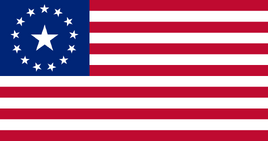
Group
China
Pre-War communist state in eastern Asia
China (中国), officially the People's Republic of China (PRC) (中华人民共和国), was a pre-War communist state in eastern Asia. In the setting of the Fallout series after the Divergence, China post-World War II grew rapidly and by the 21st century had become a global superpower and rival to the United States of America and the Soviet Union in terms of influence and wealth. Like the U.S., Chinese expansion during the 21st century was accomplished by annexing neighboring countries.
Although severely affected by the economic crisis and the Resource Wars in the mid-21st century, China was able to compete with the United States for control of the last remaining resources on Earth, even after negotiations dissolved and both countries entered into the Sino-American War where the Chinese waged war for eleven years in the occupation of Alaska while defending their mainland territory from American invasion later on. Even as late as 2077, in spite of crumbling supply lines and American warfare advancements including the first deployment of power armor, the People's Liberation Army remained one of the finest military forces in the world.
Background
During the 20th and 21st centuries, China and the Soviet Union competed with the United States. The space race was one particularly important field of competition in the 20th century. After the United States claimed that Captain Carl Bell was the first human in space in 1961, both the Soviet Union and China protested the claim. The United States never retracted its statement.
Resource Wars
However, hostilities would not escalate until a century later, as the global energy and resource crisis grew more and more severe. Heavily reliant on fossil fuels, the People's Republic of China was hit particularly hard. In 2060, the Middle East oil fields ran dry, triggering the collapse of the European Commonwealth and the Middle East oil powers. Traffic on the streets worldwide ground to a halt as fuel became too precious to waste on automobiles. Alternatives were explored, with limited success. Two years later, Chinese operatives would be found across Canada and the United States, running interference and gathering intel that could be used to balance the scales.
To counter communist interference, the next red scare was manufactured. As the situation across the United States worsened, both as a result of the deteriorating economy and the New Plague continuing to wreak havoc despite quarantine measures, the federal government used increasing national paranoia to try and control the situation, by discouraging assemblies, fueling anti-communist sentiment, and encouraging reporting subversive elements. The Vigilant Citizen's Hotline was even established to allow citizens to report neighbors to the government for any behavior that could be construed as supporting communism.
These fears were not unfounded, as Chinese infiltrators had indeed established themselves across the country, aiming to sabotage military and economic installations and sow dissent among the American people.
To stave off collapse on the domestic front, China launched campaigns to annex neighboring countries and provide resources for the starved economy. While successful, the strategy was only a temporary solution to a much larger problem: Dependency on fossil fuels. The People's Republic found itself on the border of collapse in the spring of 2066. Trade talks with the United States revealed it to be unwilling to export its own reserves of crude oil. Aggressive negotiations resulted in the talks breaking down completely.
According to the Sierra Depot GNN transcript, on July 24, the U.S. president declared that the last known supply of petroleum would be used exclusively by the U.S. and that America would not sell or trade any oil to foreign parties. However, the transcript is a generally unreliable source.
As if to insult the communist state further, the United States government revealed the first fusion power cell to the public.
The situation was dire. Although China was able to tap a large deep-sea deposit of oil below the Pacific, it was unable to make use of it due to sabotage. American interference was suspected.Fallout 3 Official Game Guide Game of the Year Edition p. 43: "Chinese Army (Simulated) U.S. Army (Simulated) With conditions deteriorating between the United States and China, a military presence in Alaska was established to prevent a possible invasion across the Bering Strait. With increasingly scarce oil reserves, a last deep-sea deposit below the Pacific Ocean was claimed by China before allegedly being sabotaged by American special operatives. Strained relationships spiraled downward into conflict as China marched on Alaska, and the Sino-American War of 2066—2077 erupted. Under the command of General Jingwei, the Chinese Army usurped control of Alaska's oil pipeline and reserves. In response, the Americans began what came to be called "The Alaskan Reclamation Operation" (2067—2077). Under the leadership of General Constantine Chase, the U.S. Army battled fiercely to the front lines of the conflict before Chase began deploying specialized Power Armor units that began pushing the Chinese back. Future Power Armor suits were further refined as the conflict dragged on, and the Trans-Alaska Pipeline was reclaimed. With resources flowing through Canada, strained diplomatic tensions between Canada and the United States becoming problematic, and Canadian forces attacking the pipeline, the country was annexed. A combination of inclement weather, constant American bombardment and trench warfare, and U.S. Powered Armor unit attacks sweeping through mainline China, the Chinese supply lines weakened and finally broke down completely. By the beginning of 2077, the city of Anchorage was finally liberated, the Chinese eradicated, and the operation deemed a success. A commemorative memorial was erected in Washington, D.C., in honor of the soldiers who fought and perished for the greater American good. Violence between America and pockets of Canadian freedom fighters continued throughout 2077, until the Great War obliterated almost all infrastructure, commerce, and human life." (Fallout 3 Official Game Guide faction profiles) Pushed up against a wall, Chairman Cheng decided on an ambitious and extremely dangerous plan: Invasion of Alaska and seizure of its natural resources by force. Chinese troops swarmed the state, with the primary push focusing on the city of Anchorage, necessary to maintain a link with the Chinese mainland. The Anchorage Front Line became a true battleground.
The invasion inadvertently triggered the gradual annexation of Canada, as the United States forced it to grant the right of passage to American military forces. The deployment of the T-45 power armor helped prevent Chinese tanks and infantry from overrunning Alaska. The situation rapidly deteriorated into trench warfare as neither side was capable of breaking the stalemate and forcing peace terms on the enemy and the resource shortage precluded large offensive operations by Chinese motorized forces.
The conflict raged for over a decade. The United States focused its attention on Canada, liberally exploiting its natural resources while ignoring protests made by Ottawan citizens. Riots and protests eventually culminated in a sabotage attempt on an oil pipeline in 2072. The United States military used the incident as a pretext to invade Canada outright and begin annexation. Meanwhile, China attempted to destroy American resistance with aggressive use of biological weapons, leading the U.S. government to commission West Tek with the development of a universal cure on September 15, 2073. The economy of the People's Republic relied heavily on fossil fuels, including uranium fuel, China having mined the most uranium in the world as of 2077. Despite this, the supply did not meet the demand and was the impetus for the invasion of Alaska, as it teetered on the brink of collapse due to the resource crisis.
War in China
Despite claims of fighting a defensive war, American infantry and mechanized divisions launched an invasion of the Chinese mainland in 2074. However, with its economy stretched to the breaking point by the war on three fronts, the U.S. was unable to overcome its foe. American units were bogged down on the Chinese mainland, putting a further drain on American resources and supply lines. By 2076, the war had raged for a decade with no end in sight. Both China and the United States suffered from war exhaustion. However, the U.S. gained an advantage to offset the problems and the introduction of the T-51 power armor in June helped to tip the scales in favor of the U.S. military. The next generation of power armor resolved problems existing in older generations of armor. Mechanized cavalry units outfitted with the T-51bs were sent to the Alaskan and Chinese fronts, carving a swath through Communist forces.

The Chinese economy crumbled under the onslaught as supply lines from nations annexed by the Beijing regime started falling apart. The American regime did not fare any better. In August, food and energy riots start in urban centers across the United States. A state of emergency and martial law was eventually declared, with U.S. military forces being deployed on the domestic front to fight their own countrymen. The United States became, effectively, a military junta.
2077 brought even worse news for the Chinese communists. The Battle of Anchorage ended with a decisive American victory on January 10, with Anchorage back under U.S. control and Chinese forces retreating across the front.
China was backed into a corner, as the United States could allocate its military resources to destroying resistance in mainland China. With the loss of Alaska, the disintegration of its supply lines, and a renewed American offensive on the Chinese front, spearheaded by the newest T-51b powered armor units, China could not defend itself. As if expecting immediate retaliation, the American elite retreated to their shelters, planning a contingency to maintain the war effort even if nuclear strikes occurred. Bases across the United States were sealed and troops redeployed to front line conflicts to maintain the American offensive with great difficulty.
The Great War
Nuclear weapons were launched on October 23, 2077. Vaults are sealed as the air raid sirens blare for the last time. Within two hours, both the United States and China ceased to exist as nations, their cities vaporized in nuclear fireballs. The nuclear exchange was believed to have kicked back communist China into the stone age by remnants of the American government.
Remnants of Chinese culture and individuals survive in the United States, of all places, through survivors of the Chinese war machine. For example, in Appalachia, while the PLA's infiltrators from Fujiniya Intelligence Base dispersed among the American survivors after the bombs hit, with some committing suicide, hardline loyalists refused to lay down arms and became holdouts, still fighting their secret war. Many became ghoulified. The Great War was seen as ultimate proof of American imperialism's failure. While not numerous, they would track down anyone breaking faith and coerce them to continue fighting the war, as with Agent Mochou a quarter of a century after the War. Some of these Chinese remnants survived as late as the 23rd century, eking out an existence in a fortified safehouse within the ruins of Washington, D.C. Misery wasn't the only fate, though: The Shi of San Francisco formed after survivors of a Chinese submarine crew that beached in the ruined city joined forces with San Francisco survivors, and by the 23rd century became one of the most advanced organizations in New California, even restarting high technology sectors.
The most common experience a typical wastelander will have, though, are various Chinese artifacts, either from infiltrator presence or as war trophies brought home by U.S. servicemen. These include radio stations, Type 93 Chinese assault rifles, Shanxi Type 17 Chinese pistols, Chinese officer's swords, and copies of the Chinese Army: Special Ops Training Manual.
Government
China was a single-party state, ruled by the Communist Party. The head of state was the Chairman (equivalent to the United States' president), with the last leader to hold this office being Chairman Cheng. The government was divided into ministries. The only known one is the Chinese Intelligence Ministry, responsible for special operations on American soil.
Like any sovereign state, China maintained embassies in foreign nations. In spite of the war, the Chinese embassy in Washington D.C. remained open, with Xiu-Ling serving as the last ambassador to the United States.
China used the yuan as currency, and Chinese notes were often considered a tell-tale sign of a Chinese infiltrator in America. The Chinese economy suffered throughout the war, to the point that strict rationing of resources was instituted, including food. The situation was so severe by 2077, that lotteries were used to allocate food rations to Chinese citizens and could be manipulated by the government to reward faithful service. China seemed to place little value on individual lives, and even its high-ranking infiltrators were subject to termination or expected to commit suicide once their missions were complete if extraction was unavailable or too costly.
Despite these difficulties, China managed to develop a number of advanced technologies, which made some of its citizens look down at the United States as downright primitive.
Military
The People's Liberation Army relied on its vast reserves of manpower and industrial capacity to maintain its edge, though unlike the United States, the focus was put on firepower rather than personal protection. Chinese soldiers were issued jumpsuits rather than hard combat armor, though the Type 93 assault rifles that were the workhorse of the army were significantly more powerful than standard American R91s. Tanks were key to the Chinese doctrine, used to support infantry operations during the invasion of Alaska. However, when they were countered by early power armor Americans deployed, China realized that it had no analog and rushed to create its own versions. Due to the handicap, it also intensively researched stealth technology as a counter.
China made aggressive use of advanced biological weaponry during the Resource Wars, which drove the United States to develop the Pan-Immunity Virion and later the Forced Evolutionary Virus as countermeasures.
Beyond stealth, the Chinese had an extremely effective intelligence and security apparatus. Apart from concealing its research, Chinese operatives infiltrated mainland United States and set up an extensive covert network of spies and intelligence operatives. The largest of their spy networks were located in and around Washington, D.C., with strongholds throughout the region. China even managed to set up regular patrols by Chinese submarines, such as SSN-37-1A.
Technology
Due to little success in creating a power armor of comparable performance, While their own version power armor was considered and saw some moderate development, Chinese researchers decided to focus their efforts elsewhere and managed to create practical active camouflage technology, commonly referred to as stealth technology. The development of Hei Gui stealth suits allowed for easy penetration of enemy lines. China's efforts continued apace and by 2075 was rumored to possess an entire fleet of stealth submarines, developed in the Shaanxi Province, nicknamed the "Ghost Fleet."
The United States had little success in their own stealth projects. Various reverse-engineering projects were undertaken. Big MT created stealth suits mark I and mark II based on technology from captured Chinese suits RobCo focused on replicating the modulating stealth field. Robert Mayflower's Stealth Boy 3001 was a portable, personal stealth device with a limited lifespan that could be used by anyone without the need for a full-body suit.
Chinese research into improving their stealth tech never ceased, and the Fujiniya Intelligence Base in Appalachia was on the cusp of a major upgrade in power efficiency for the stealth suit. The Great War interrupted the project, and it was eventually salvaged by Thomas Eckhart's Enclave to create Stealth Boy Mark IIIs.
The MEC Gauss minigun was designed by the Chinese. Atypical for an automatic weapon, it uses Gaussian technology in the form of multiple electromagnetic fields to fire 2mm EC ammunition at a rate of over 90,000 rounds per minute.
The following is based on information from Fallout Tactics and is not canon.
End of information based on information from Fallout Tactics
Sympathizers
Separate from the infiltrated agents of the People's Liberation Army, China also had a network of spies and communist sympathizers in mainland America, having infiltrated local civil society to spy on it while smuggling imported Chinese weapons. Such cells could be found in pre-War Pittsburgh, Old Olney and Point Lookout. In Appalachia, the secessionist militia known as the Free States was accused of being a communist movement by the US government during the propaganda war between both groups. Even in 2277, long after the end of the Great War and the collapse of the PRC, Irving Cheng was still sympathetic to the communist regime.
In an attempt to prove that the Chinese were using brainwashing technology on impressionable American youths, the American government attempted to replicate what they suspected were Chinese tactics of brainwashing at Camp Liberty in Shenandoah National Park. The program, known as Operation Sleeping Giant, was a success in radicalizing the scouts to embrace communism, and they formed a hostile commune following the Great War.
Sources
Adapted from the original article, under CC BY-SA 3.0.