Group
Cult of the Mothman
Cult
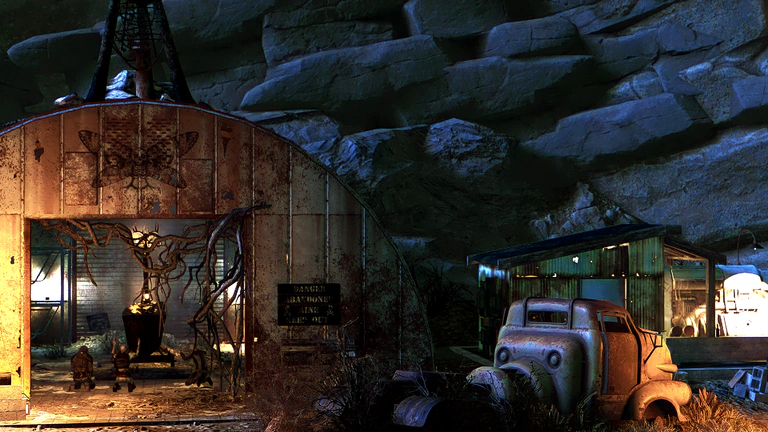
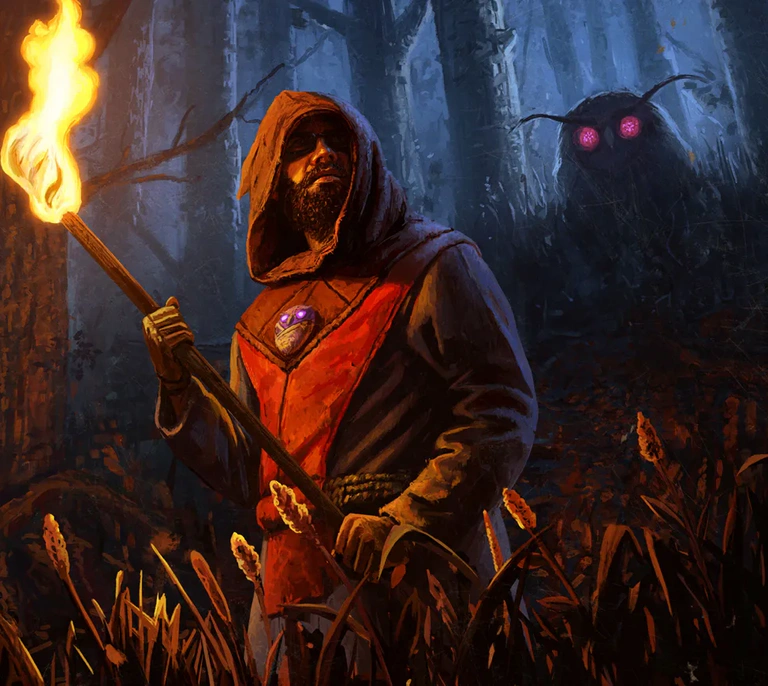
The Cult of the Mothman (or simply the Mothman Cult) is a religious movement in the region of Appalachia based in the exaltation of the Truth of the Mothman, though the term is often used by outsiders to refer to the largest faction, the Followers of the Winged One. Prior to the Great War, the faithful congregated in a small makeshift church under the Mothman Museum in Point Pleasant.
Mere days before the bombs fell, Brother Charles experienced a vision, which prompted the cultists to seek shelter in the faraway Lucky Hole Mine. Following the War, mutant creatures resembling the legendary Mothman were seen across Appalachia, and the cultists eventually emerged from the mine to engage with them in various ways.
The religion split into two major sects, which are bitterly at war;
The Enlightened, a relatively secular movement, were the first group to leave the mine. They fled Appalachia with the prophet Brother Charles to exalt the Wise Mothman, an individual mortal being, distinguished by its otherworldly fuchsia glow.
The Followers of the Winged One descend from those who remained in the mine (with the First Priestess of the Wood), and emerged later to carry out crusades, claiming considerable holdings in the region. Crazed and superstitious, they worship the numerous red-eyed "Holy" Mothman species as manifestations of their god of Light.
Pre-War history
The Bridge
Prior to the Great War, the Mothman was a mythical creature in Appalachian folklore, considered a "cryptid" in pop culture. Described as a terrifying half-man, half-moth hybrid, it was believed to haunt the area around Point Pleasant. It was feared as a herald of disaster, due to its historic 1967 appearance before the collapse of the Silver Bridge, which connected Ohio and West Virginia.
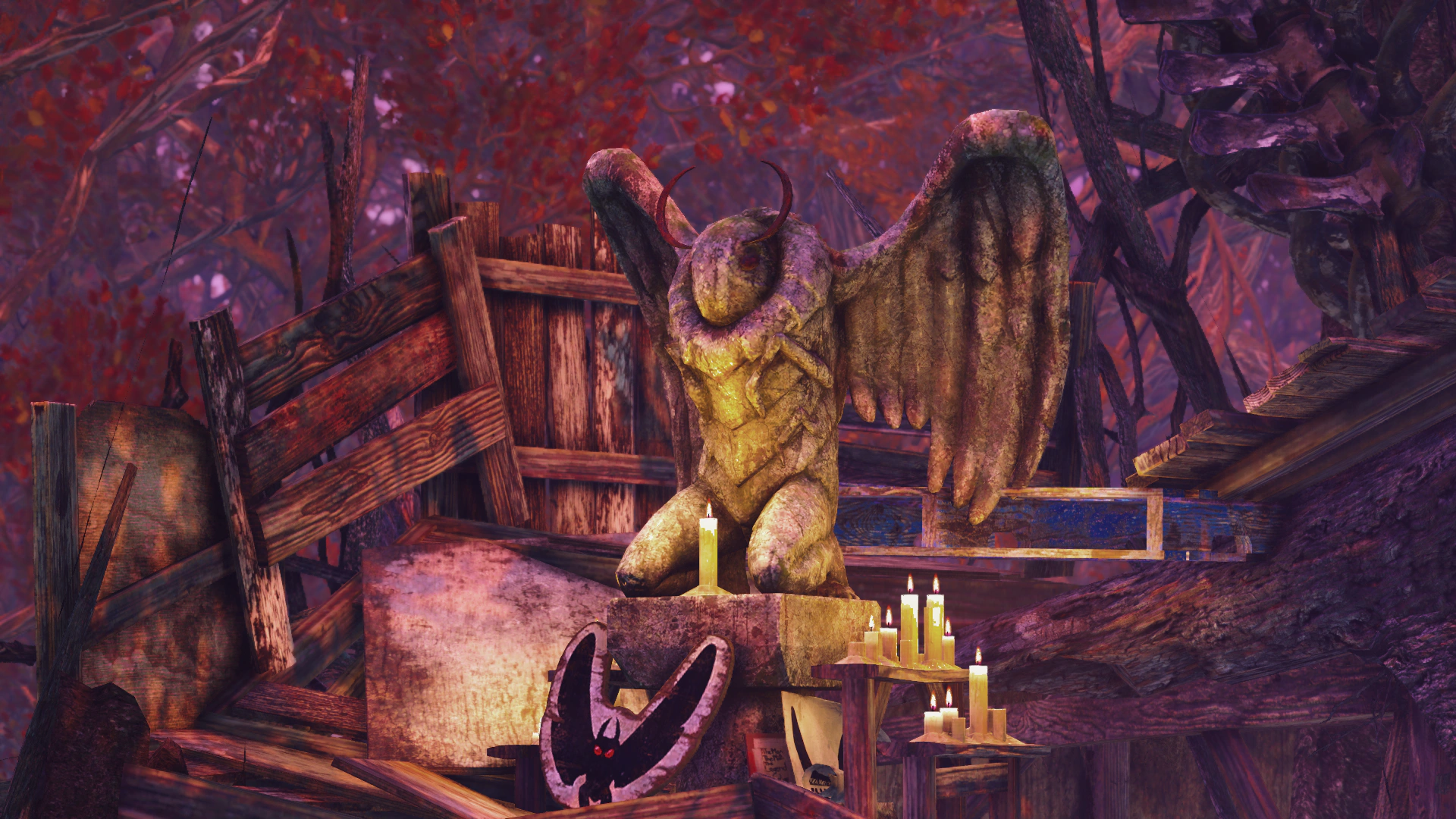
The story was a media sensation, and caught the attention of many people, ranging from eccentric paranormal hobbyists to obsessive conspiracy theorists determined to "uncover" some deeper meaning in the legend. The Mothman was embraced by the town for attracting tourists, prompting the creation of the Mothman Museum, which sold cryptid novelty goods such as pulp novels, magazines, and posters. Adjacent to the museum, a pavilion was built around a large Mothman statue, infamous for its prominent, muscular buttocks.
Long-term interest in Mothman sightings was generally insignificant, and the matter was not seen as worthy of genuine inquiry by the scientific community. However, the legend found enduring notoriety in the region, and left an imprint on pop culture which attracted sincere cryptid hunters and researchers. A clandestine organization coalesced in the quiet town of Point Pleasant, which hoped to directly interact with the Mothman through ritual.
The group congregated within the root cellar underneath the Mothman Museum, which was converted into a small chapel, where Mothman enthusiasts attended meetings and sermons. They grew fervent in their worship of the Mothman as a divine being. They believed they could predict future disasters by communing with the Mothman, and often attempted to summon him for this purpose.
The Summoning

On October 21, 2077, only two days before nuclear Armageddon was unleashed across the world, a service was held in the hidden church. The preacher was organizing a ritual to summon the Mothman, hoping to be warned of a coming danger.
Shortly thereafter, they conducted the ritual. One member, Brother Charles, believed he had seen the Mothman in the periphery of his senses, who delivered a message of great danger. The omen was communicated to the preacher. He called a second mass the following day, and read a sermon titled "Impending doom," advocating for Charles and relaying the warning to the group.
According to his sermon, the Mothman informed Charles that the cult must seek high ground, or they would perish in a flood on the following day. The preacher further proclaimed that the faithful must stand on the rooftops of Point Pleasant and wait for the flood, and ordered those present to spread the word. They planned to praise the rushing waters in the light of dawn as the faithless perished beneath them.
For reasons which went unrecorded, a large group then eschewed the plan declared by the preacher, and fled Point Pleasant with Brother Charles. They traveled across the state to the entrance of a decommissioned mine, perched upon on a cliff overlooking Watoga.
Decades later, the Enlightened would describe this event as a misguided ritual to the red-eyed "Pretender Mothman," yet attribute this revelation to the Wise Mothman. They also claim it was Charles who "guided his brethren to safety in the Lucky Hole Mine" by hearing the Whispers of the Wise One. Further, the Enlightened attest that the Wise One foretold of "fire and flood," while the preacher at Point Pleasant spoke only of a flood.
The Mine
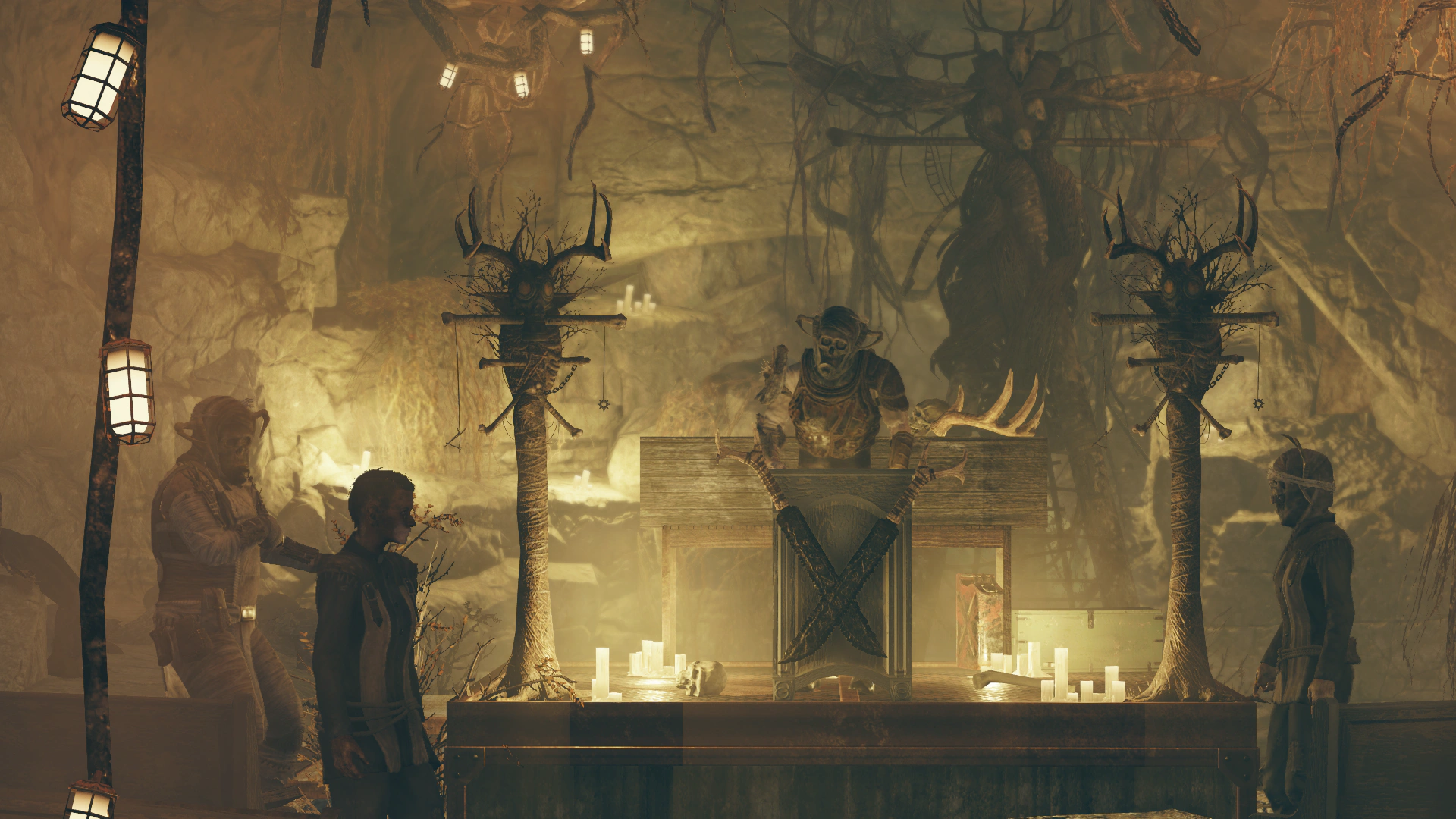
The sprawling Lucky Hole Mine features two major chambers of worship; a large church area where a natural spring of drinking water has formed, and the hidden lair of a creature referred to by the cult as "the Firstborn of the Wood." Both are marked by giant sculptures of faces of unknown origin, which appear to have been excavated. The cultists believe the spring was formed when their god collected their tears in His branches and spread them on the earth.
However, the Cult of the Mothman were not the first mysterious group to seek sanctuary here.
Some time prior, an old woman approached the under-staffed security team of the inactive Lucky Hole Mine, asking for a "tour." She was turned away. Shortly thereafter, the mine was ordered to permanently cease operations by its parent corporation. Immediately following this development, the old woman returned with a group of people. Again, she requested a tour of the mine, and again, she was turned away. After this, people were seen lurking around the premises at night, and locks were found smashed. Before long, the security team left an entry on their terminal explicitly surrendering the decommissioned mine to this unknown group out of fear.
Currently, the security terminal remains intact at the entrance of the mine, immediately next to the note He agrees. Per the corresponding note His home, according to the post-War dwellers of the mine, it was prophesied that the group would be denied a new home by the faithless three times before "He would open the way," which may refer to this historic incident.
The first time the old woman visited, a guard decided to call the nearby Allegheny Asylum to ask about escaped patients, which places the incident no later than March of 2061.
Fallout period
Shelter
The Cult of the Mothman arrived at the Lucky Hole Mine before the bombs fell on October 23, 2077, and took shelter inside. As nuclear shockwaves ripped across the surface of Appalachia, the group settled into their new home.
Meanwhile, in the years following complete societal collapse, there were frequent reports among the Charleston Emergency Government of people claiming to have seen Mothman. The creature was also documented by the Appalachian Enclave.
Jeff Lane and the Interloper
Jeff Lane was a man obsessed with the paranormal, who moved to Point Pleasant because of the town's historic connection to supernatural events. He lived in an apartment adjacent to the Mothman Museum, a business he either owned or worked for. He had a key to the bathroom of the Museum which concealed the entrance to their hidden chapel.
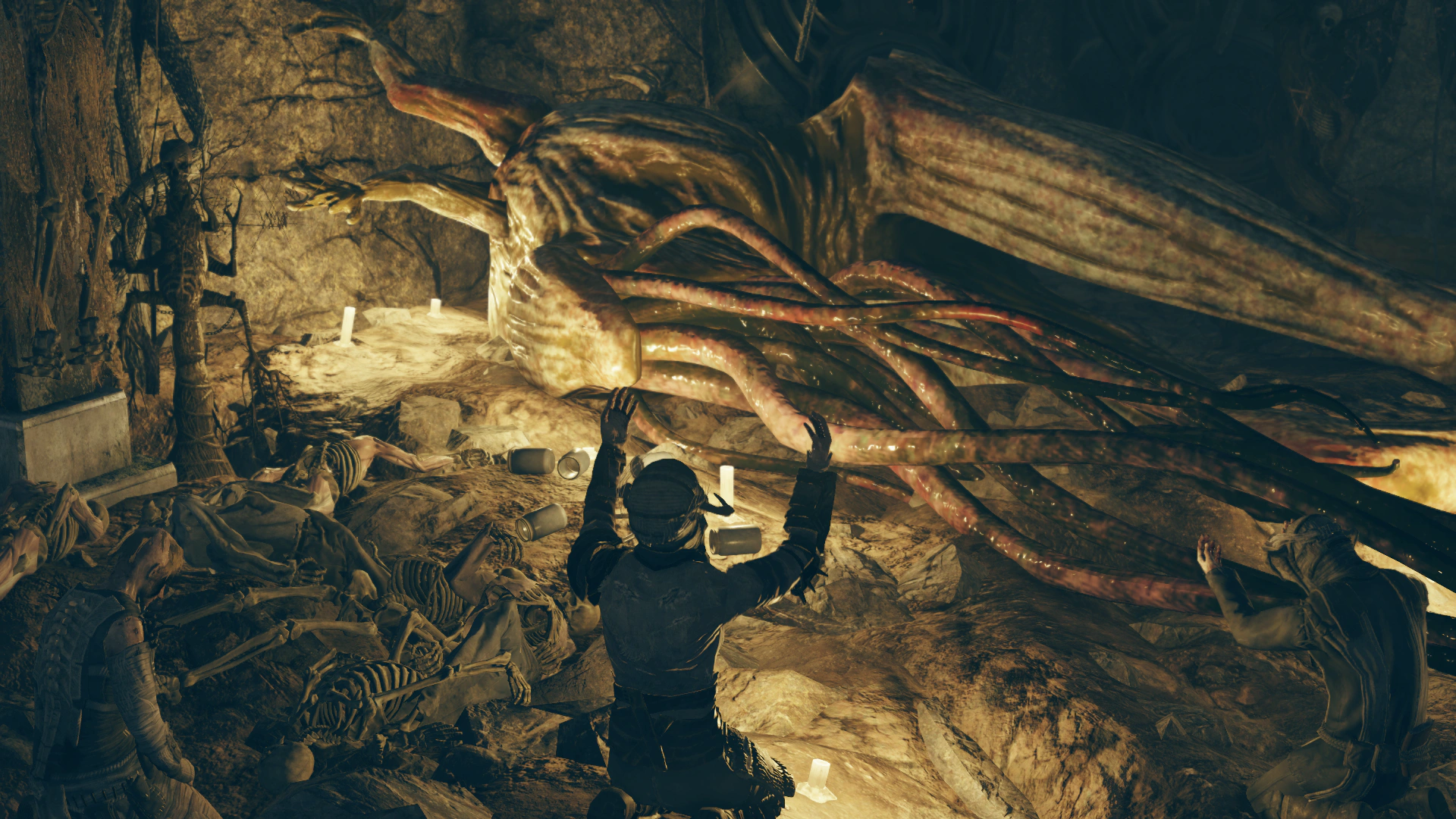
He remained in Point Pleasant after the War, and developed a fixation on an entity called "the Interloper," after encountering a "story teller" whom spoke of this entity waiting deep beneath the earth. Jeff described this man as "mad by any reckoning," but held his story to be "no less true," and became convinced that the Interloper was waiting for him. He described the Mothman as a mere "creature" and aspired to understand the horrors hidden in the periphery of the subconscious mind.
Jeff eventually left Point Pleasant and made his way to the Lucky Hole Mine. By this time, he was completely obsessed with the Interloper, believing it had chosen him for some higher cosmic purpose. He arrived alone, and was unaware that his former neighbors had taken shelter here, though he noted that "the signs are all around that I am not the only one to hear the call." At this time, Lane expressed his desire to act as a "vessel" and a "conduit" for the Interloper, and his belief that he was specifically ordained for this role. After recording this tape, Jeff Lane disappears from history. Beyond these scant facts, the nature of his relationship with the Interloper and its cult is unknown.
Schism of the Enlightened
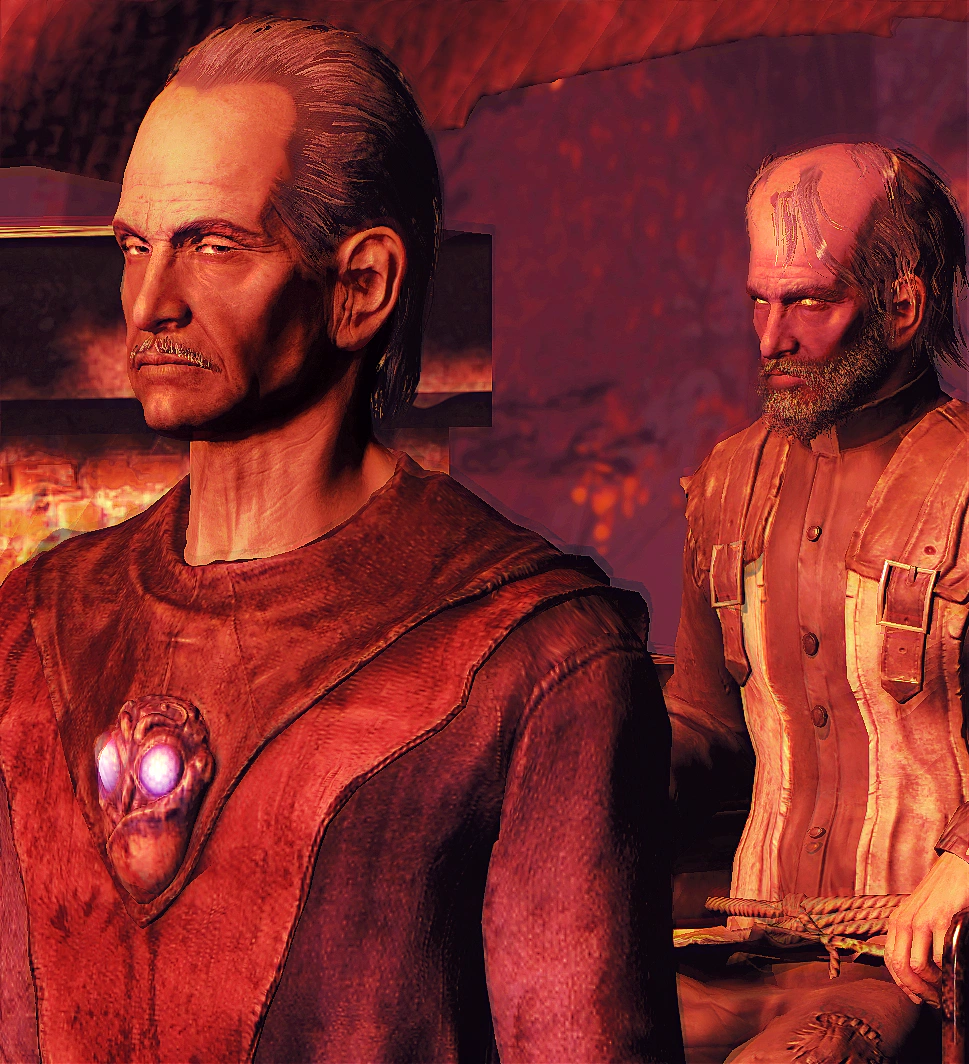
In the years following the War, some within the mine "turned to darker worship" under the guidance of a figure known as the First Priestess of the Wood. Many of the cultists within the mine began to worship the Firstborn of the Wood, to the disgust of others. When this perceived corruption of the religion became unbearable, a group fled the mine with Charles. They came to call this new sect "the Enlightened" and founded a church called the Lantern, somewhere beyond the hills of West Virginia, leaving those who exalted the First Priestess to dwell in the mine.
The Enlightened define themselves by their exclusive reverence for the Wise Mothman, an individual mothman with magenta eyes. They characterize this Wise One as a benevolent mortal messenger who does not ask to be treated as a god, only wishing to impart intellectual gifts upon mankind.
Pre-Plague period
On the surface
By 2088, groups of cultists began to emerge from the mine and settle Appalachia, building shrines in all regions of West Virginia except for the Cranberry Bog. They sought communion with the forces they believed dwelled in the forest. They also attempted to summon or encounter the Mothman and be blessed by his divine power. The cult consisted not only of individuals, but entire family units and communities. Some of their settlements appeared to be hatcheries for feral red-eyed mothmen.
They came to call themselves the Followers of the Winged One. They have also been known to refer to themselves, perhaps in certain contexts, as "brothers of the Wood" or "servants of the Wood." They seek to become one with "the Light." At some point, the Followers purged their enemies in an event called the Crusade of Light.
The First Priestess of the Wood eventually died, and her casket was enshrined in the chapel at Lucky Hole Mine, elevated prominently between the pulpit and the springs. A human skull was placed on this casket, neatly arranged with radstag antlers, evoking the form of an antlered human. Those loyal to the Priestess continued to address her and deliver blessings unto her posthumously.
During the pre-Plague period, raiders came to control Point Pleasant until power changed hands to the Responders, who eventually fell to the Scorched. A ghastly shrine by the water indicates cult activity in Point Pleasant at some point before or after these events.
Humanity abandons West Virginia
The Scorched Plague hit Appalachia in 2085. Eventually, all of the faithful left West Virginia or died there. The latest written evidence of human activity in Appalachia dates to 2097. By the time Vault 76 opened in 2102, none remained alive in the region.
In the wake of the Plague, Mothman stalked the ruins in silence. The cultists' distinctive remains were seen occasionally, especially near their abandoned settlements. Scores of scorched humans and feral ghouls were left milling about the region, but none have ever been spotted wearing cultist attire.
Current history
Reclamation period
When the 76 Dwellers emerged on Reclamation Day, the earliest among them reported seeing a friendly purple-eyed mutant moth in the wild, but sightings ceased by the end of the year. Outside of certain Enlightened summoning rituals, the Wise Mothman has not been spotted in the region since.
Over the next year, various people groups returned or migrated to the region due to the defeat of the Scorchbeast Queen. As they fought viciously to settle the corrupted forests of Appalachia, red eyes fell upon them, and the Mothman disturbed their dreams.
Return to the Holy Land

In 2103, the Followers of the Winged One returned en masse and thrived in West Virginia. Restored to their holy land, they resolved to drive out or destroy all within His domain who shun the Light of the Holy Mothman. The sect has maintained a mounting presence in Appalachia ever since. They began by fortifying and sanctifying positions across the state, including Clancy Manor, Ingram Mansion, Johnson's Acre, and their ancestral home of Point Pleasant. Shrines of various size can be found in any given forest in the region, and ephemeral ritual bonfires are constructed throughout the woods. Small bands of initiates and aspiring Mothman Priests freely camp in the wilderness by night and wander the country roads by day. High Priests are spotted in the region seasonally, some of them apparently caring for mothman eggs.
They settled the church at Kanawha County Cemetery, hoping to track down the works of a deceased entomologist by the name of Dr. Wallace. They sought his doctoral thesis on the moths of the Appalachian region. Additionally, a shrine called Blake's Offering appeared very close to the ruins of KMAX Transmission, a student radio station whose host was a conspiracy theorist with a cryptozoological interest in Mothman.
Further developments
During the seasonal Equinox, members of the Enlightened travel to Point Pleasant, driving away the Followers who normally occupy this location. This begins a two-week long ceremony in honor of the Wise One. The Followers attempt to sabotage the hourly rituals throughout the festival, and ultimately reclaim the town each year after the Enlightened leave. During the first festival, a throne was constructed on top of the Mothman Museum. They also attached Hornwright industrial fans to the roof, which they use to disperse neurotoxic dust into the air.
In 2104, a Follower named Brother Scarberry began socializing with the Dwellers of Vault 76. Meanwhile, a Smiling Man who seemed to have the shadow of a moth was seen wandering the wilderness. Shortly thereafter, the cult settled the Glade in Cranberry Bog, now known as the Sacramental Glade.
In 2105, the Followers were found to be living in the sprawling Organ Cave beneath the Forest, and came into conflict with the Responders in the area. Around the same time, they were driven from Ingram Mansion, and their occult structures were cleared away to make room for a new development.
Later in 2105, the cultists at Point Pleasant repaired the North Road Bridge, opening the way to Burning Springs in Ohio, under the direction of Father Lucas, who wanted to "expand the empire" and spread the religion further. However, any further advancement was stopped by the Rust King's Army, who fortified the canyon passageway on the other side of the Ohio River. The Rust raiders currently do not plan on invading further into Appalachia, but some members would enjoy hunting the "crazy bug worshippers."
Philosophical disputes
Each denomination decries the other as heretical servants of "the Pretender Mothman." The Followers hold their spiritual beliefs to be observable truth. In their parlance, the Enlightened have actually "left the Light" in their apostacy from the larger faith. They take great offense that the Enlightened still practice some of the same rituals in the name of a different benefactor.
In response, the Enlightened describe themselves as students of "the physical reality of the Mothman," and look down on the larger cult as believers in the supernal. They scorn these "Dim Ones" as heretics projecting mythology onto unthinking creatures, and condemn their red-eyed Holy Mothman icon as "the Deceiver." In the words of the Enlightened, their former peers have "succumbed to the delusion of Holiness" in heeding "the Call of a thing beyond." They hold the Wise Mothman to be "among us, and of us," and they claim to "know that he is more alike to us than not."
Both sects recognize the Mothman Equinox as a sacred cosmological event and claim ownership of the Mothman Museum. Both are interested in psychic phenomena, especially the ability to hear voices and remote viewing, though neither is known to use the word "psychic."
The Enlightened recognize and emphasize a distinction between voices associated with the Wise Mothman and those associated with the Interloper. The Followers are known to celebrate auditory hallucinations as "His voice" and "the voices of the Woods."
Tensions
The schism formally occurred when a group left the mine with Charles. The First Priestess of the Wood remained at the mine and eventually died there. As Interpreter Michaela tells the story in Exodus, the schism began when the entire cult began to hear the whispers of the Wise Mothman while living at the mine, filling many of them with fear. Conversely, Charles and some of the cultists focused on these whispers, and became "Wise" in doing so.
Upon learning that the Enlightened still practice traditional Mothman rituals, Brother Scarberry remarks "It seems that there is the need for another Crusade of Light," alluding to some organized campaign of mass violence the Followers once carried out, possibly targeting apostates specifically. The timeframe, location, and parameters of this Crusade of Light are unspecified. On the tape Cultist - Mind's Eye, a Mothman Priest uses the plural "crusades," either alluding to a multitude of previous events or plans for a second Crusade in the future.
Seasonally, the Enlightened wrest control of Point Pleasant from their adversaries for two weeks at a time, to conduct the Equinox festival. The Followers, in turn, attempt to disrupt their ceremonies until the festivities conclude and the Enlightened leave. The timing of the Mothman Equinox may or may not align with equinoxes observed by traditional astronomy.
Wallace
When the Followers returned to Appalachia in 2103, they were highly interested in the work of a long-dead entomologist known as Dr. Wallace, who had written a doctoral thesis on moths. In a tome titled On the Thesis of Wallace, author Wise Martin the Bearded pointedly criticizes this as an example of his counterparts exercising motivated reasoning and magical thinking. Additionally, during the Equinox festival, Charles can be heard whispering the name Wallace.
The Firstborn
Brother Scarberry is the only representative of the Followers sect with unique dialogue. When asked about "the Interloper," he will deny knowledge of to "whom" the term might refer. Then, visibly shaken, he begs the player character to stop looking into the matter. In a tome titled False Gods of Appalachia, an Enlightened scribe condemns the Interloper on behalf of Wise Pearl the Augur, as does Wise Hilary the Scourge in Catechism. Aside from Jeff Lane (and the unknown "story teller" he encountered), no other character mentions "the Interloper." However, a series of religious writings at the Lucky Hole Mine mention "The Firstborn of the Wood." Both terms are widely presumed to refer to the creature worshipped by the Followers within the Lucky Hole Mine.
Culture
This section primarily concerns the Followers of the Winged One. For more about the culture of the Enlightened, see their page.
Population
The Followers of the Winged One are numerous throughout Appalachia and the surrounding regions. They impede trade between other societies by maintaining territorial control over trade routes.
They have been recruiting individuals who were not at the Lucky Hole Mine at the time of the Great War. Ghouls are commonly seen among their ranks. The cult is stable enough that people have been born into it, and grown to adulthood in social isolation. Their structure includes Mothman Priests who preside over the disciples, as well as High Priests who have memorized sacred books, and other revered elders. Their society emphasizes the importance of crusades.
The Enlightened are only known to live at a mysterious church called the Lantern. The highest rank of their secular society is to be called Wise. These Wise persons work in tandem with Interpreters, who oversee the basic Observers and guide them in visions. Unlike their infamously territorial counterparts, this smaller, more secretive sect are not known to disrupt other wasteland societies, and seem to have gone almost entirely unnoticed in general.
Religion
Cosmology and rituals
The Followers of the Winged One believe that in death, the Holy Mothman will shepherd them into a divine, eternal Light. They fear the Mothman as a god. They believe He is attracted to light, as well as the glow of radiation. They are known to refer to the Holy Mothman with a capitalized He pronoun, and sometimes honor Him as the Great Moth or the Bright One. They seem to use numerous varied titles for their mythological figures. Very little is known about the nature of their god or gods, and what their different titles might signify. One note found at Blake's Offering begins by invoking two distinct figures; "bright winged one sleeps beneath the earth/the silent watching one sleeps beneath the sea."
The Followers extensively mythologize and deify various aspects of nature. They deeply revere the flora of Appalachia, and believe they are in direct contact with an entity they call "the Wood" or "the Woods," almost always capitalized, which they believe to have multiple voices and which brings them gifts in exchange for sacrificial offerings, including other humans. They also invoke this entity as "The Eyes of the Forest," "father of the Woods," and "the Harvester." They endeavor to "Grow out to Him." They worship Him at holy springs and even commit ritual suicide by imbibing poisoned drinks. They assign great spiritual significance to the entity's blood and the blood of the Firstborn of the Wood. The cult offers the "gift of the woods" to the faithful, and some cultists aspire to become a "child of the wood" themselves. The Followers of the Winged One were guided in their worship of this deity by a figure known as the First Priestess of the Wood.
At the pulpit of the converted church in Point Pleasant, a pencil can be found next to a ruined book, perhaps emphasizing the improvisational nature of their belief system.
The Enlightened dismiss the Followers' mythology, and preach only the importance of developing one's personal understanding of the Truth of the Wise Mothman. Both sects practice human sacrifice, though Observer Errol is confounded as to why the Wise One always leaves "when they begin to scream."
Offerings
Both sects fill troughs with albino radstag blood as a ritual offering to the Mothman. These blood troughs are generally wrapped in barbed wire, moss, or roots. In one blood trough on the North Road Bridge, a mass of bloodbug meat has been placed, and the hides of radstags and foxes rest at the foot of the altar. Additionally, the troughs throughout Point Pleasant are wrapped in moss which pulsates with a red glow.
Live humans are offered upon the spire at Moth-Home. The cultists who tend to the Interloper seem to engage in rituals involving bloodletting, but the specifics of this are entirely unclear. Jars litter the creature's lair, and a sickle can be found there.
Errol attempts to sacrifice humans to the Wise One, who has repeatedly rejected the offering. The Enlightened also present diverse arrangements of produce and flora to the Wise Mothman. A strangler pod grows within one of their offering baskets.
Lifestyle
Appearance
Cultists style themselves strangely in general. They wear loose, durable clothing, always either informal or ritualistic. Their hair is typically short and unkempt. Some have bizarre pointy beards or curly moustaches not typically seen in Appalachia. Many are missing patches of hair.
Most older members have a stern, serious look. Some younger congregants may have more relaxed demeanors and softer features. Occasionally a cultist may be spotted with some uncanny, egregiously distinctive feature, such as beady, unexpressive eyes, or a very large mandible and mouth.
They often bear facepant or facial tattoos. Some resembles war paint typical of raiders. Others appear to be intense ritualistic coloration, apparently having used their hands to smear a variety of pigments across the entire face. They may have symmetrical face tattoos resembling branches, or patterns around the mouth evoking large teeth.
Cultists tend strongly towards a muscular bodytype, and seem to clench their fists when idle and unarmed. Looking over a cultist, one may notice their damaged, sinewy hands. In fact, they have strange deterioration and scarring across their entire bodies, not normally visible during gameplay.
Ghoul men and women are a common sight among the Followers. These ghoul members are never seen with face paint, and none of them seem to have hair. They are otherwise no different from human members in any obvious way.
Sustenance
The dwellers of the Lucky Hole Mine were able to survive because an underground spring formed in the main chamber. The spring was not always present. The cultists believe it was created by their god when He gathered their tears in His branches and spread them upon the earth. The cultists at the Organ Cave drink from the blood-red water of the underground river, which may be the result of a natural iron deposit.
Soup is a staple of their diet. Underground, the cultists pick glowing mushrooms and cook them into stew. They also eat canned soups. The door guards of the Lucky Hole Mine may occasionally produce a large bowl of noodles and eat it standing up, as will revelers at Clancy Manor. The manor's kitchen is littered with a remarkable abundance of large pots, several of them filled with stew. Bowls of chicken noodle soup and vegetable medley soup can be found on tables here.
At their settlements, they hunt wild game, including radstags. Salt and sugar can be found at most cultist locations. Some also have spices. Although the Followers routinely capture and ostensibly butcher humans for ritual purposes, there is no clear evidence of them directly eating human meat. However, the Enlightened Observer Errol loudly implies a singular fascination with hunting individuals shown to him in visions and eating them.
Mind-altering substances
Chems are commonly found at cultist settlements. Buffout is most abundant, and a chalkboard in the Lucky Hole Mine suggests putting buffout in a syringe. In the chapel beneath the Mothman Museum, there is a chem within the pulpit, and in the side room. At the waterfront prayer circle in Point Pleasant, a cultist kneels with a random chem placed directly in front of them. Hallucigen gas canisters can be found near ritual spaces at Moth-Home and Hopewell cemetery, and could formerly be found at Ingram Mansion. Cultists also appear to drink coffee and beer.
The Enlightened use neurotoxic dust gathered from mothmen in their ceremonies, and believe it allows the imbiber to "see the world through His eyes." In Observations, the visions of an observer named Dave are dismissed due to their unusual nature and his heavy chem use.
Settlements and ritual spaces
Materials
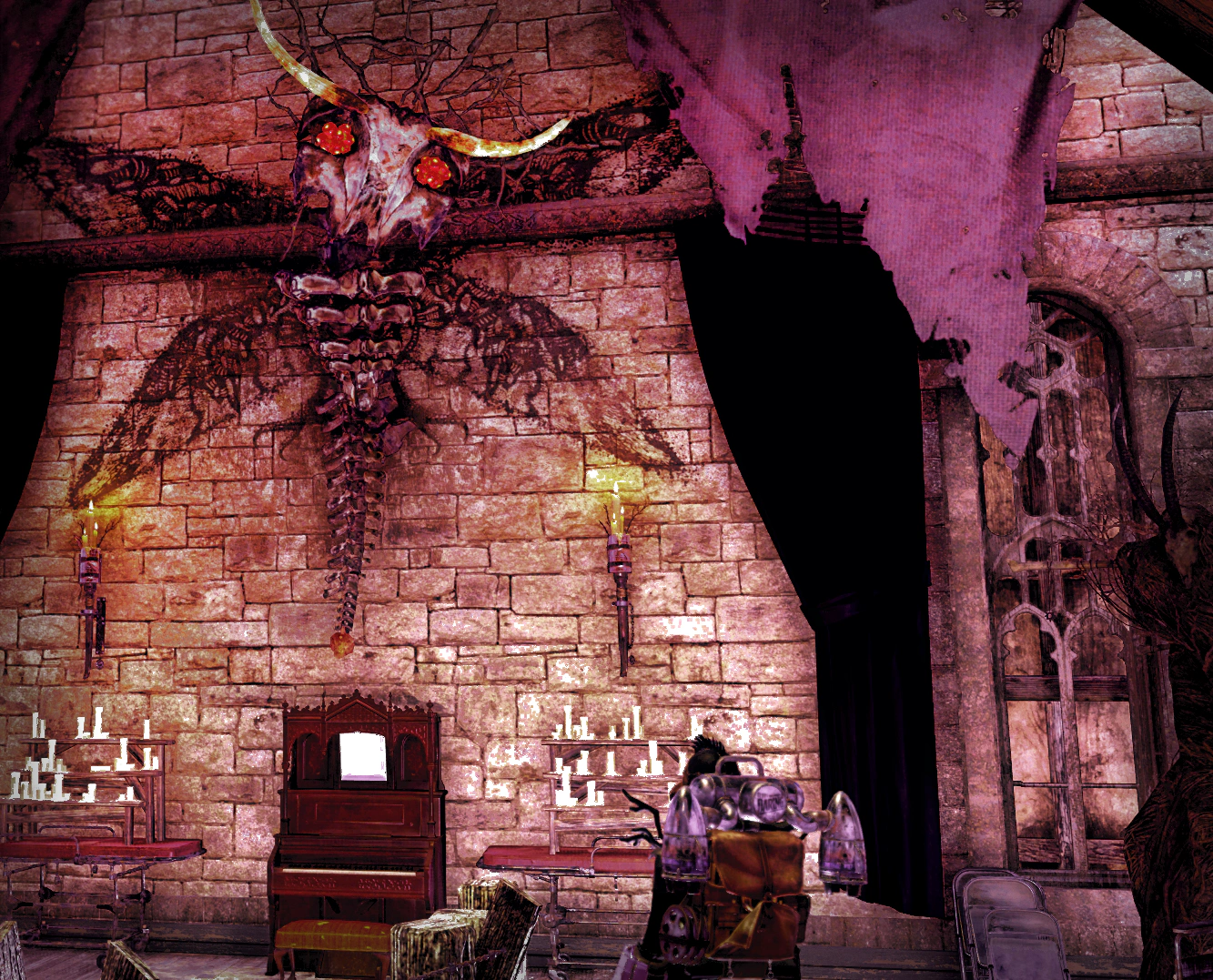
The Followers appear to value primitivism, using a combination of wood, bones, wire, leather, vines, and cloth to construct their armor and shrines. Their bases usually utilize pre-existing structures, modifying them with bones, vines, wood, and otherwise to create shelters, balconies, and altars. Their places of influence are overwhelmingly infested with overgrown roots and vines.
The distinctive bones of a large aquatic creature are universal to cultist architecture. The nature of this creature is unknown, but the remains of one rest underwater at the Big Maw. The cranium of this beast is commonly used to construct an effigy of the Holy Mothman. Glowing red mushrooms, berries, or candles are often placed in the eye sockets. The creatures' spines and ribs are commonly used to decorate structures.
They are especially interested in reclaiming pre-War churches, such as the ones at Helvetia and the Swallowed Town, as well as historical estates such as Clancy Manor and Ingram Mansion. Some strongholds, such as Sacrament and Moth-Home, appear to be newly assembled from natural materials.
Architecture and fortification
Recently-founded camps such as the one at Old Mold Quarry may make their presence known with simple canvas tents, torches, stakes, and a central bonfire. Blake's Offering is a large camp in the process of being fortified.
Nearly all of their settlements are built around a prominent spire, where mothmen can perch. Sometimes a human sacrifice is bound and offered up on the spire. The creatures do frequently visit these settlements at night, and almost exclusively leave their eggs in the care of the cultists.
When the Followers reclaimed Point Pleasant from the Scorched, they wove roots through the wreckage of the North Road Bridge, converting it into an enclosed worship space. The mutilated body of a Scorched hangs from a beam of lumber jutting over the entrance, In 2103, the Followers reclaimed Kanawha County Cemetery. They apparently guided the roots of a large tree to rapidly grow towards the church and infest the building. As the church broke apart, they reinforced the structure with massive animal bones and tangled roots, in support of a central spire. Kanawha remains a major cultist settlement, and church services are held in the desecrated stronghold.
The Followers can still be seen holding mass at the Kanawha church, as well as the church within the Lucky Hole Mine. They also occupy and meditate within original Mothman church in Point Pleasant.
A cultist furniture set can be unlocked through the Atomic Shop, which features a chair, small table, and elaborate bed fashioned from roots growing out of the ground.
Totems
Their totems are generally shaped from roots growing out of the ground, intertwined with human and animal bones. Most feature a single triangle prominently scratched into their surface or assembled from twigs. They also fashion sconces, chandeliers, and other strange displays purely out of human bones. At Kanawha County Cemetery, a cultist can be seen tending to an opened grave beneath a headstone (separate from the tomb of Dr. Wallace), indicating some of these remains are obtained by robbing graveyards. Cultist paraphernalia also exists at the cemetery above Hopewell Cave.
In 2102, these totems could be found in the chapel beneath the Mothman Museum. It's unclear if they were present before the War, nor how the human remains may have been obtained. A key to the chapel is found at Wilson Bros Auto, where another totem is found, with a post-War animal sacrifice laying at its base. When the Followers reclaimed Point Pleasant in 2103, they spread the vines to infest the entire town, and erected several new totems. In 2104, they elevated crucified remains beneath signs reading "abandon hope," creating Totems of Warding which the Enlightened find disturbing.
Nearly all of these effigies are topped with antlered radstag skulls, or the skulls of humans or brahmin affixed with tree limbs positioned to resemble antlers. Strangely, some appear to incorporate the skulls of gazelles, ibexes, or other creatures which are not known to live in the area, though they could have plausibly acquired these through trade, looting, or hunting in other territories. Some were fashioned from pre-war taxidermy, evidenced by fine wooden plaques. One variety of skull seen mounted at the Sacramental Glade and Organ Cave resembles a sheepsquatch, but not a sheepsquatch skull, and may have belonged to a mutant ram. The skull of a sheepsquatch or brahmin rests on a prominent casket at the Glade, much like the antlered skull laid on the coffin of the First Priestess. It cannot be interacted with.
One totem in the Forest seems to distort light around it. Some specific shrines are marked by strange ambient audio, or the sudden absence of normal ambient audio such as wind and wildlife. Their "bone-tree" totems are very similar to those built by the Swampfolk of Point Lookout. As they typically feature antlers, they could be likened to a verdant stag. A unique totem seen in the Organ Cave features a fresh red eyeball set into the right socket of an off-center human skull, crowning a tangle of roots which has bloomed through the left. Shelf mushrooms grow at its base.
Ritual objects
The holotape Chapter 7 describes the construction of a holy effigy using blessed implements and the entrails of a sacrificial beast, as well as a holy oil made from mothman eggs. Subsequent tape Chapter 8 refers to the completed effigy as a Divine Lamp and prescribes an incantation to be recited as it is burned on a pyre.
They repurpose fusion cores as candles, producing ritual objects identical to those later produced by the Atomites of the Nucleus. Like the Atomites, they also fill bottles with bioluminescent fluid, but other folk in Appalachia use these same glowing bottles as a light source.
The Followers have been known to hang wind chimes from the psychoactive strangler vines which infest the Mire, such as at Blake's Offering. Chimes also hang from the Towering Might totem at Big Maw and within the doorway of Kanawha Church.
An antler rests on a small altar at Lucky Hole Mine. When cultists held Ingram Mansion, one could be seen praying with an antler placed on the ground directly in front of them. Several coffins at Old Crimora Mines are topped with a human skull and a single antler.
Goods
Attire
Incidental Followers of the Winged One are often seen wearing pastor's vestments, flannels, or long johns, as well as many different types of gas mask, including several modified by the cult. They may wear incomplete wood armor or a complete set of leather armor. Practitioners have been known to wear ritual bindings featuring a mask with fake wooden antlers, as well as the antlered cultist incarnate helmet. The cultist neophyte, adept, and elder sets (the last of which sports antlers as well) are identical to various Treeminder robes. Prophets can be seen wearing ghillie suits and glowing red mothman glasses.
The Once in a Blue Moon update added a gazelle gas mask and rooster gas mask based on earlier cultist concept art.

Weaponry
The cultists' daggers and swords are fashioned from a sharpened scrap of black titanium, crudely fastened to a handle fashioned from a bone or antler. They use these blades to flay living people in ritual sacrifice. The Cultist Piercer is a pickaxe inscribed with strange runes.
Flamers are often wielded by Wrathwings. The Holy Fire is a flamer covered in cultist symbols. Similarly, the Elder's Mark is a tommy gun inscribed with runes.
Prophets have been known to wield gamma guns which emit the same sonic blasts as mothmen.
Society
Hardware and science
Despite their preference for natural materials, one cultist holotape advises that the cathode ray tube (commonly known as a CRT screen) is "the retina to the mind's eye," suggesting some understanding of and reverence for A/V hardware. Their ritual use of fusion cores also indicates some spiritual interest in modern technology. In late 2104, cultists styled as "sanctifiers" were seen utilizing raider-style power armor at the newly consecrated Glade.
There is a large chemistry lab hidden in the Lucky Hole Mine immediately before the lair of the Interloper. A chalkboard here indicates rudimentary experimentation with chems. Additionally, several functional lightbulbs within the mine appear to be hung from roots rather than wires, with no circuitry in sight. On the rooftop of the Mothman Museum, several lightbulbs sit at the base of a totem among a decorated shrine. They cannot be interacted with, indicating they are part of the ornamentation of the shrine, not loose junk.
Allegedly, a member of the Enlightened once attempted to clone the Wise Mothman, and was eaten by the infant creatures.
Relationship with pop culture
The original Mothman church at Point Pleasant was hidden beneath the active Mothman Museum, a popular shop where novelty goods such as posters and books were sold to cryptid tourists. Brother Scarberry, who was born after the War, expresses disdain for the meaningless display of Mothman iconography.
A comic book or pulp novel can usually be found on the lectern of the active church within the Lucky Hole Mine, suggesting their religious services sometimes involve directly discussing popular science fiction media, which is typical of real-life apocalyptic cults. Mythical reinterpretation of pop media is also a universal feature of fringe conspiracy theory, a topic the pre-War operators of the Mothman Museum showed interest in.
The aforementioned notion of a screen being the "retina to the mind's eye" is a quotation of the 1983 science fiction film Videodrome.
Capabilities
The Enlightened believe the Followers of the Winged One have the power to send vines to harass them.
Brother Scarberry twice implies he can see literally see radiation as a hallucinatory glow, both on a person and ambiently. Further, he voices disapproval if the player character has been blessed by the Wise Mothman, apparently able to detect a "lilac glow" not visible to the player.
The Followers deploy large numbers of newborn mothmen when attacking locations. The full-grown creatures will fight alongside their human sycophants if provoked, exhibiting the ability to distinguish between friendly and hostile humans. Grown mothmen attack the Equinox ceremony alongside cultists.
The events of the Mothman Equinox would suggest their high priests have the power to possess people and creatures, influencing their behavior. The effect is visible, as small glowing red moths seem to orbit such NPCs. This power extends to deathclaws. Brother Scarberry dismisses these claims, attributing such incredible notions to the high levels of neurotoxic dust in the air. As there was an abundance of neurotoxic dust in the air, producing psychedelic hallucinations, this gameplay event may not reflect the objective reality of the situation being depicted. However, high priests roam across Appalachia throughout the annual event, exhibiting this power wherever they go.
Locations
The following is a list of sites containing evidence of cult activity, sorted by the time at which they were discovered by the Vault 76 surface empire.
Plague period
The following sites were discovered between Reclamation Day and 2103. It's theoretically possible some of the lesser shrines may have been constructed after Reclamation Day.
A major contingency of the Cult of the Mothman survived the Plague by retreating to unknown territories they established somewhere outside the state at an unclear time.
Helvetia church
Hopewell Cave cemetery
Abandoned sacrificial altar southwest of Vault 76
Small totem east of Vault 76
Large shrine west of Marigold Pavilion
Large totem east of Bleeding Kate's Grindhouse
Abandoned altar south of Abandoned mine shaft 1
Altar within the sunken church
Abandoned shrine south of the crashed space station
2103
Humans returned to Appalachia at this time, including the cult.
Lucky Hole Mine (reclaimed)
Point Pleasant (reclaimed)
Kanawha County Cemetery (reclaimed)
Active sacrifice altar west of Billings homestead
Active shrine east of transmission station 1AT-U03
Active shrine near Brim Quarry
Active shrine in the swamp near Ella Ames' bunker
Active bonfire west of the Crater
Active bonfire south of Watoga
Active camp at Old Mold Quarry
2104
In 2104, the Enlightened began visiting Appalachia seasonally to celebrate the Equinox.
Point Pleasant (Enlightened seasonal occupation)
The Lantern
2105
The cult abandoned Ingram Mansion early in the year.
Shrine near the crashed plane
Sacrifice site in the Shenandoah region
Unseen shrine south of Cranberry Bog
The Followers of the Winged One
The Followers are a violent sect who thrive throughout the hills of Appalachia and hold several large settlements. They are headquartered at the Lucky Hole Mine, where they care for and worship the Firstborn of the Wood. Their religious practices were shaped by the First Priestess of the Wood. Although she has since passed away, her followers continue to exalt her even in death. They have been known to address each other as brothers/servants of the Wood.
Brother Ryan
Elder Adelaide
Father Lucas
First Priestess of the Wood
Roland
Sawyer
Sage (formerly)
The Enlightened
A relatively peaceful and reasonable offshoot of the Cult. Headquartered at a faraway church called the Lantern, the Enlightened have no permanent presence in Appalachia, but occupy Point Pleasant seasonally. They follow the Wise Mothman rather than worshipping mothmen in general. For a list of members, see their page.

Unspecified affiliation
Roles (Followers)
• Brother/Sister
• Father
• Cultist
• Prospect
• Ascender
• Seeker
• Disciple
• Elder (gender neutral)
• Awoken
• Chosen
• Wrathwing
• Destroyer
• Sanctifier
• Mothman Priest
• High Priest
• High Priestess
• Prophet
• First Priestess
Roles (Enlightened)
• Observer
• Interpreter
• Wise
As a faction
Initially, sites of the cult's influence could be found across Appalachia, especially in regions such as the Forest and the Mire. Many small unmarked shrines and ritual spaces dotted the map. The ritual bindings and ritual mask are clothing items of the cult's make, and can commonly be found in areas of their influence. The cultist dagger and cultist blade are weapons of similar origin. The only interior cell associated with the cult was the Lucky Hole Mine.
Cultists arrived in Appalachia with the Wastelanders update. They can be seen at many small shrines and camps across the map, and densely populate Point Pleasant and the Lucky Hole Mine. They will attack Vault Dwellers and Settlers on sight. There is no way for player characters to join the cult.
NPC behavior
They perform various animations depending on their location. Many of them actively prostrate before a totem, icon, or visiting mothman. They can often be seen peering off into the distance with binoculars, or staring attentively in a certain direction, even as they turn their bodies. They also perform normal NPC behaviors like warming themselves near fire, sitting in chairs, sleeping in bedrolls, and leaning.
Some random encounters involve cultists fighting a creature or another faction, or the appearance of a temporary cultist bonfire. Random encounter spots in any region may also spawn a group of cultists who will attempt to walk to the nearest cultist settlement.
There is a random encounter spot adjacent to a pair of cultist bonfires south of Watoga. When the crashed satellite event occurs here, the cultists will abandon the bonfires to patrol near the satellite. If approached at night, there may be a mothman inspecting it. Like its cultists, the mothman will pace back and forth, periodically stopping to stare at the wreckage. The cultists may walk alongside the mothman. Alternatively, this spot may spawn a third bonfire, and there will be five cultists around it, replacing the usual three. Other random encounters, such as the vertibird crash or lemonade stand, will be ignored by the cultists.
A cultist at Moth-Home may peer into a trough of blood for minutes at a time. At Organ Cave, cultists can be seen maintaining equipment, rummaging through storage, foraging for mushrooms, cooking, and digging. The Followers occupying Point Pleasant occasionally play an upbeat, jaunty tune on the piano there, like any NPC. Those at the Kanawha church do not interact with the central piano. When cultists patrolled Ingram Mansion, they would occasionally do push-ups on the back patio, or pray towards the foliage in the courtyard.
One NPC within the Lucky Hole Mine mine performs an unusual animation, excitedly pouring over a scripture while glancing up at a totem, as if comparing the two. A cultist within the mine's hidden laboratory is using a chemistry station. In the chapel, a cultist can be seen leaning over the pulpit and glaring down at the congregation, but this apparent preacher speaks no more frequently than other cultists.
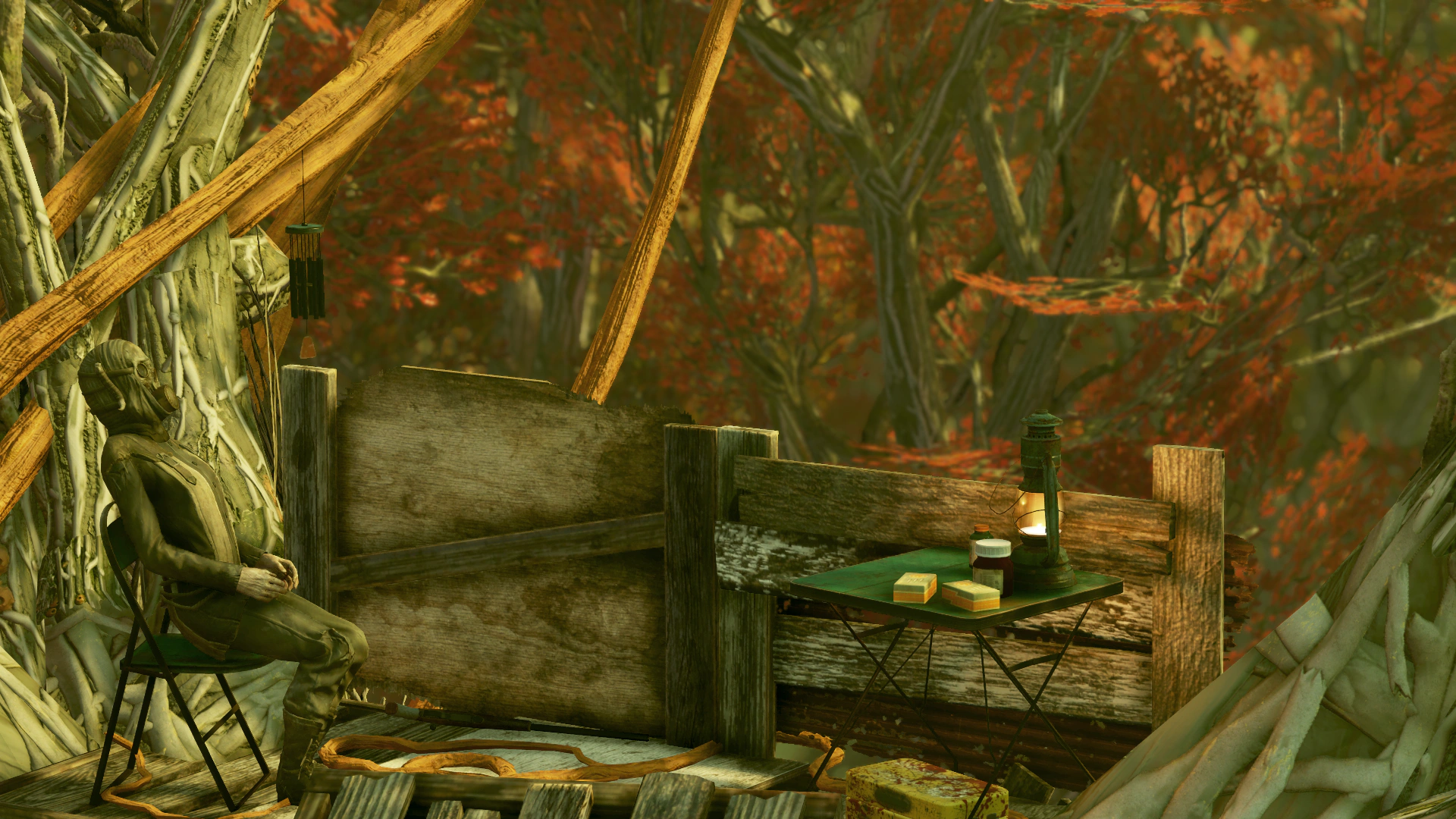
Some cultists may be encountered lying by a bonfire in pain, apparently dying, but they will get up and fight when a threat approaches. Cultists at most locations may spontaneously die at night. Multiple NPCs may die simultaneously, especially at the Kanawha church, where ten cultists gather around ten empty glasses and a box of rat poison. There may also be multiple separate deaths over the course of the night. Occasionally, when a player arrives at a cultist location, some or all of the NPCs will already be dead in their normal idle spots, even sitting upright in chairs. Cultists will never drop dead during combat, but may drop dead upon killing an enemy and returning to idle status.
All cultist NPCs regularly pray aloud to the Holy Mothman, and call for divine aid in combat. Eavesdropping on cultists, they can be heard asking the Mothman to give them its strength and punish the non-believers, and pleading to be saved when the day of reckoning comes. Cultists are never heard conversing in the game. Upon death, they deliver a final utterance, such as "I go to the divine light," "The divine light...I can see it," "More will come to take my place," or "I regret nothing."
Post-Wastelanders content
Cultists were added to Daily Ops in the Locked & Loaded update, which introduced Cultist Prophet NPCs and mothman hatchlings. Both would later be seen in The Mothman Equinox seasonal event, added in the Night of the Moth update, in which players help the Enlightened summon the Wise Mothman while the Followers try to intervene.
Steven Scarberry is a lite ally who grew up within the Followers sect. He is the only NPC affiliated with the sect who will speak with the player, and was added in the Mutation Invasion update. The Followers also serve as the antagonists of the Beasts of Burden public event, which debuted in the Once in a Blue Moon update.
When the game progressed into 2105 with Expeditions: Atlantic City, the Organ Cave location was added, a cultist cavern connecting several entrances throughout the Forest. The cultists also left Ingram Mansion at this time. Additionally, asset records indicate that several unmarked shrines may have been added throughout the map.
Sources
Adapted from the original article, under CC BY-SA 3.0.