Lore
Radiation
Term used for any form of radiation
Radiation, specifically ionizing radiation, is the term used for any form of radiation that can detach electrons from atoms or molecules, ionizing them. Radiation is made up of energetic subatomic particles, atoms moving at high speeds, and electromagnetic waves on the higher spectrum of energy. Due to its microscopic nature, radiation cannot be detected by human senses and requires the use of special instrumentation. The study of radiation also carries with it significant risks, as exposure to ionizing radiation, specifically gamma rays, typically results in damage to living tissue or hazardous mutations. The danger it poses has led it to be nicknamed by some as the Phantom Death, while it is instead worshiped as Atom's Glow by the Children of Atom.

The alternate history of the Fallout series starting from the Divergence highlights the ramifications of radioactive nuclear energy becoming a powerhouse in society and industry, and of its widespread usage in a variety of applications, both civilian and military–the latter of which culminates nuclear weapons being used to destroy the world.
Background
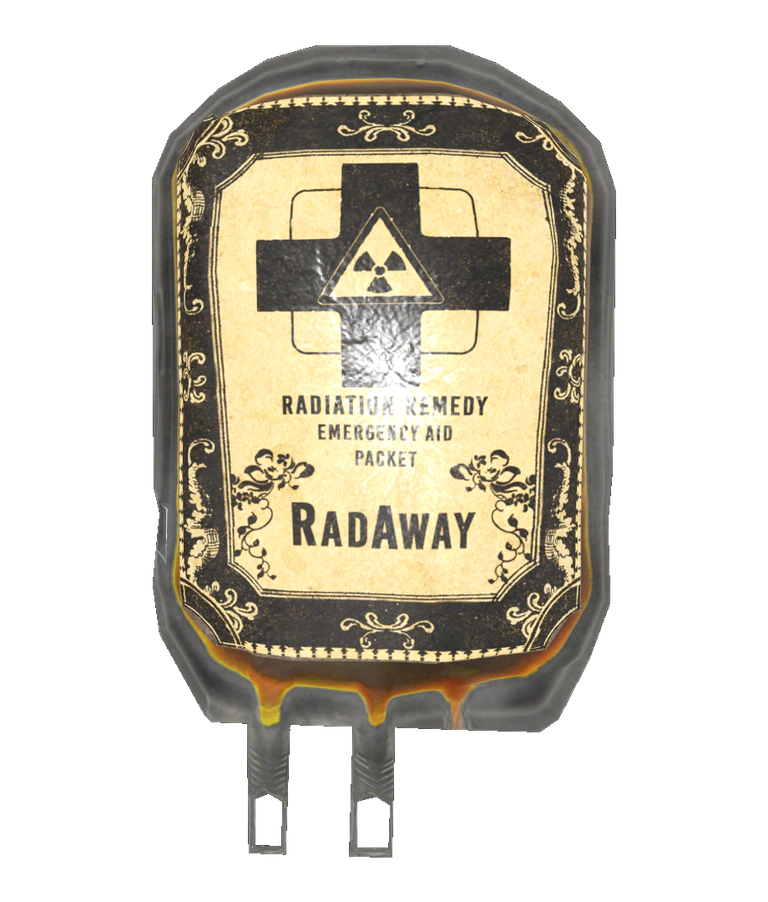
A key product of the processes of nuclear fission and nuclear fusion, in the history of the Fallout setting, radiation became an increasingly common hazard in the post-World War II industrialization in major nations like the United States of America due to the proliferation of nuclear energy as a compact, cheap source of energy. Ionizing radiation of various types was also used in medical, scientific, and military applications, and its widespread use directly caused the increased focus on development of countermeasures to protect humans from harm, such as the brand-name anti-radiation medicines Rad-X and RadAway.
Commercial products based on the use of radioactive material were widespread before the war despite the risks of the technology. Products that included radioactive material ranged from more practical uses, such as automobile propulsion, rocketry, high-powered magnets, and fission batteries, to less practical uses, such as board games and soda drinks. These uses were often justified by weighing the benefits that nuclear-derived products brought to the consumers' lives. Even after the world was scorched by nuclear fire, fringe groups like the Children of Atom held radiation up as a benefit and a "gift" to surviving inhabitants of the Earth.
Conversely, the loosening of corporate regulations in America as the globe-spanning Resource Wars grew in intensity led to an increase in illegal dumping as a way for corporations such as the Massachusetts-based Mass Fusion to increase their bottom line without regard to, and at the expense of the environment and the rest of society.
Measurement
The rad is a real-world scientific unit of measurement (an acronym standing for "Radiation Absorbed Dose), equal to 0.01 gray. 1 gray is equivalent to 1 joule of ionizing radiation that was absorbed by 1 kilogram of matter, so 1 rad means 0.01 joules of radiation was absorbed by 1 kilogram of matter. Sieverts, another scientific unit of measurement, are also related to radiation but are less frequently used.
The proliferation of radioactive elements and products has lead to a wide variety of tools being created to monitor the presence and intensity of radiation fields. The Wattz Electronics C-Radz Geiger counter is one of the oldest and most reliable methods, with Geiger counters of similar quality being included by default in newer models of the Pip-Boy personal information processors created by RobCo Industries and distributed to most, if not all residents of the Vault-Tec Vaults.
Nuclear fallout
Radioactive contamination is the chief delayed effect of nuclear weapons, as it results in the creation of radioactive material with half-lives that range from days to millennia. When atoms fission, they can split in some 40 different ways, producing a mix of about 80 different isotopes. These isotopes vary widely in levels of stability; some are completely stable while others undergo radioactive decay with half-lives of fractions of a second. The decaying isotopes may themselves form stable or unstable daughter isotopes. The mixture thus quickly becomes even more complex, some 300 different isotopes of 36 elements have been identified in fission products. Furthermore, a significant secondary source is neutron capture by non-radioactive isotopes both within the bomb and in the outside environment.
Fission products initially have a very high level of radiation that declines quickly, as short-lived isotopes decay rapidly, emitting intense radiation, with only a fraction of the isotopes continuing to emit radiation over a longer period of time. However, as the intensity of radiation drops, so does the rate of decline. A useful rule-of-thumb is the "rule of sevens." This rule states that for every seven-fold increase in time following a fission detonation (starting at or after 1 hour), the radiation intensity decreases by a factor of 10. Thus after 7 hours, the residual fission radioactivity declines 90%, to one-tenth its level of 1 hour. After 7*7 hours (49 hours, approx. 2 days), the level drops again by 90%. After 7*2 days (2 weeks) it drops a further 90%; and so on for 14 weeks. The rule is accurate to 25% for the first two weeks and is accurate to a factor of two for the first six months. After 6 months, the rate of decline becomes much more rapid. The rule of sevens corresponds to an approximate t^-1.2 scaling relationship.
The Great War
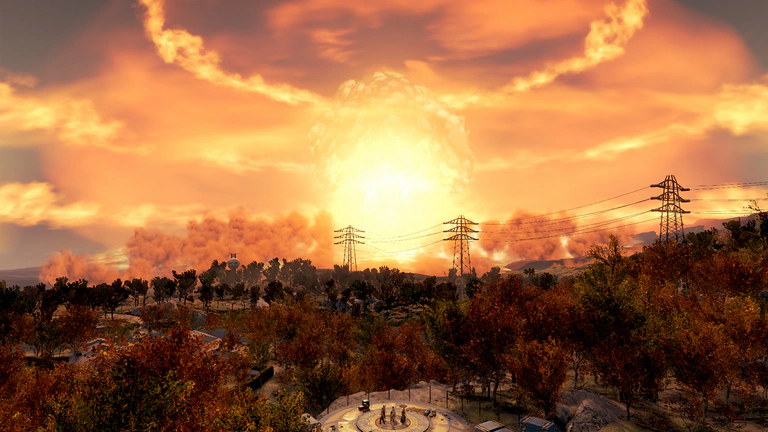
The prevalence of radiation in the wasteland is the result of the nuclear fallout spread across wide swaths of the North American continent, originating from the nuclear detonations that occurred in the two-hour span of the Great War on October 23, 2077. Fission products and irradiated particulates were lifted into the atmosphere by the rising fireball from each strike, and whether they were deposited locally or globally depended on the degree of the weapon's yield and the location it impacted; at yields of less than 100 kilotons (kT), the fireball would not reach above the troposphere and would instead remain within precipitation regions.
As such, nuclear fallout was on average deposited completely upon the ground within months at the most. Explosions in the megaton range, however, would cause the fireball to reach the stratosphere, and thus the elevated fallout would be carried globally and continue to be deposited for months or even years after detonation. Although most of the short-lived isotopes would have decayed by then, such long-lived fallout would still remain dangerous for a long time. Furthermore, the closer an explosion happens to the ground, the greater the amount of fallout generated, as these groundbursts typically elevate a large amount of newly contaminated dirt and other debris into the atmosphere. The displaced soil would not be vaporized, but would instead be aerosolized by the explosion, creating a heavy particulate matter that deposits within minutes or days, with downwind contamination spreading it across hundreds or even thousands of kilometers depending on local weather patterns. A groundburst would also result in neutron radiation absorbed by the soil, contributing to the development of a secondary source of lingering radiation.
Although the megaton-class nuclear weapons were largely retired by 2077, their capability to destroy remained as many were replaced in nations' nuclear arsenals with much smaller-yield warheads. The yield of these modern strategic warheads was, with few exceptions, typically in the range of 200-750 kT; this reduction in yield resulted in a much larger proportion of the fallout produced being elevated into the lower atmosphere, and a much faster and more intense deposition back to the earth below than had been assumed previously.
Contamination
Although the United States Armed Forces taught their soldiers that nuclear fallout would clear out of affected areas within two to four weeks after detonation, the reality showed that the lingering fallout of the Great War persisted for far longer, staying for weeks or more, even up to decades in some cases.
Despite this, the Great War's devastation was not evenly spread across the continent, and in some of the less affected areas, radiation had decayed to a habitable level by the turn of the 22nd century. Conversely, severely devastated locations such as a West Tek research facility near San Diego and an industrial municipality near Boston continue to suffer from intense irradiation and remain uninhabitable by humans for centuries after the war. These areas became heavily contaminated due to a combination of nuclear strikes, damage to nuclear power facilities, and environmental factors that caused the natural radioactive decay rate to be greatly reduced and the deadly effects to remain for longer.
This secondary cascade radiation has resulted in heavily contaminated locations gaining an infamous reputation for being near-inhospitable deathtraps. In the case of the former West Tek research facility, infamously known as "the Glow," the radiation there was known to quickly overwhelm and kill anyone without the proper precautions. By the late 22nd century, unchecked leaking of radioactive material had caused the entire region surrounding the Glow to be contaminated, as discovered by a Hub trader who tried to explore the region around 2158, only to suffer a slow, painful death from radiation poisoning upon his return.
Effects on living organisms
In humans, unprotected exposure to radiation almost invariably causes severe health complications, with the degree depending on the level of exposure. Physical symptoms include blood pooling in the gums, anemia, fatigue, nausea, vomiting, violent hemorrhages, loss of hair, teeth, and skin, gastrointestinal bleeding, bloat, diarrhea, and ultimately, death. Even if treated by professional medicine, radiation exposure can also lead to persistent mutation at a genetic level, and to complete infertility.
Mutations
The amount of radiation and biochemical agents released into the environment before, during, and after the Great War has led to major changes in the biosphere, impacting the genetic makeup of plants that grow in the landscape as compared to those of the pre-War era. The significant proliferation of uncontained radiation has induced widespread mutations in flora and fauna, with both experiencing the emergence of gigantified versions of their pre-War ancestors. Radiation-induced mutations serve as the root cause for the appearance of many of the species of wildlife regularly encountered by wastelanders, such as geckoes, brahmin, radscorpions, and deathclaws.
Ghoulification

Although it is the case that most humans ultimately die after prolonged radiation exposure, a combination of factors can instead lead to the transformation into a ghoul, alternatively referred to as a "necrotic post-human." Ghoulification typically results in an extended lifespan (if not functional immortality), enhanced regeneration of wounds such that severed limbs can be reattached and maintain full function, and a natural immunity to physical damage from radiation exposure. Conversely, their condition renders them infertile and changes their appearance, described as resembling rotten flesh, burn victims, or walking corpses.
Despite their relative immunity to physical decay, their minds can further degenerate until they eventually become a feral ghoul, meaning a ghoul that has lost all ability to reason and regresses to animalistic instinct, attacking all non-ghouls on sight; this phenomenon fuels xenophobic rhetoric against ghouls, where people refer to all ghouls as zombies. Long-term exposure to intense levels of radiation has a chance to transform a ghoul further into what is known as a glowing one, where they essentially become a walking source of radiation, emitting low levels of it at all times. Aside from glowing ghouls, most mutated lifeforms are similarly immune or resistant to radiation, but may become "glowing" through exposure to radioactive sources, gaining a distinct green glow and an omnipresent "cloak" that poisons their surroundings.
West Coast
The Glow - Former site of a West Tek research facility near the city of San Diego, California.
Open-air toxic waste dump somewhere in California.
Poseidon Oil Plant #5 - Nuclear power plant formerly owned by the pre-War energy titan Poseidon Energy. Serves as the power source for the town of Gecko.
Camp Searchlight - Maximum of 28 rads/second in the town center.
Jack Rabbit Springs - Occupied by super mutants and centaurs; maximum of 10 rads/second when swimming in the springs.
Cottonwood Cove (if radioactive barrels are dumped from the overlook) - Exterior areas emits a constant 1-2 rads/second; interior areas are not irradiated.
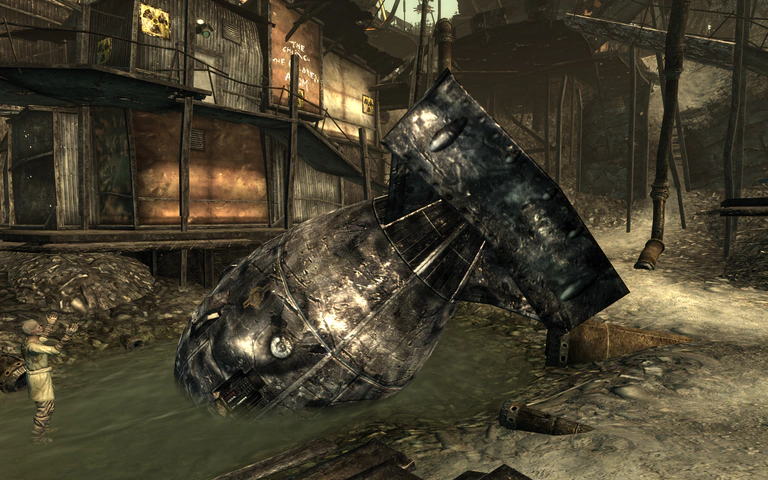
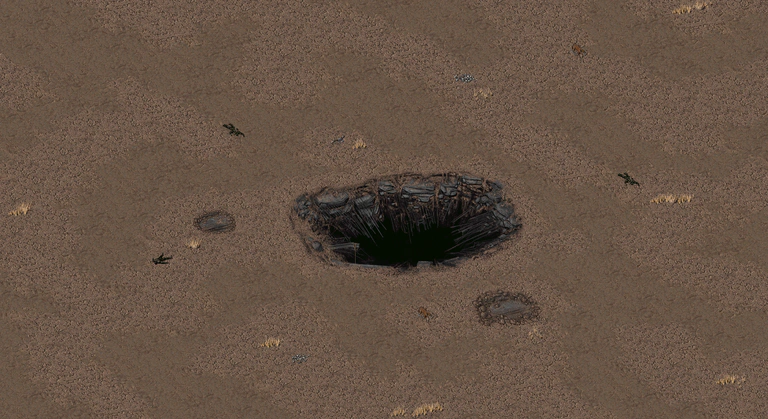
Cottonwood crater - Warhead impact site south of Cottonwood Cove. Water pools reach 7 rads/second.
Crescent Canyon - Dump site for radioactive waste barrels between the east and west ends. Maximum of 5-6 rads/second.
Vault 34 - Interior emits a constant 1 rads/second, reaching up to 5 rads in the lower levels and 13 rads near the barrels at the cave entrance.
The Devil's Throat - 6 rads/second near the barrels and water pools.
Black Mountain - Around 4 rads/second near the impact crater on the mountain peak.
Mesquite Mountains crater - Around 4-6 rads/second.
Powder Ganger camp west - Has a puddle with many toxic barrels. Maximum of 3 rads/second.
Perimeter of the old nuclear test site - Around 20 rads/second.
Toxic dump site - Down the road from Novac. Maximum of 4 rads/second near the container.
Poseidon gas station - Covered in large patches of toxic barrels and irradiated mud. Maximum of 13 rads/second.
Long 15 (if the missiles hit NCR territory) - Edge of the impact crater emits 20 rads/second.
Dry Wells (if the missiles hit Legion territory) - Epicenter of the impact crater reaches 250 rads/second, with the crater's edge emitting 35 rads/second.
Epicenter of the Courier's Mile emits 25 rads/second.
East Coast
Surface entrance to Vault 87 - Epicenter achieves a maximum 3933 rads/second.
Containment room for the G.E.C.K. unit in Vault 87 - 1-400 rads/second.
Crashed Delta IX rocket near the Statesman Hotel - Rocket front end achieves around 40 rads/second.
Project Purity control chamber post-capture by the Enclave - Around 17-30 rads/second.
Perimeter of the Megaton ruins (if the bomb was detonated) - 1-13 rads/second.
Main building of the Wheaton Armory - Maximum of 13 rads/second in the silo room.
Perimeter of the White House - Around 8 rads/second.
The Monongahela River - Between 200 and 800 rads/second near the bridge; maximum is 2,665 rads/second in the river east of the bridge.
The Hole - Around 17 rads/second.
Holy Light Monastery and Olney Powerworks (if the radiation traps are active) - Around 9-15 rads/second.
Glowing Sea - Exterior area emits a constant 2-3 rads/second, with around 5 rads in glowing pools and maximum of 300 rads/second in the epicenter of the Crater of Atom (near-constant radstorms increase the radiation level further).
Decayed twin nuclear reactors near County Crossing - Maximum of 57 rads/second when standing between the doldrums.
Boston Common - Close to Swan's Pond, in the open shed and the gazebo, toxic waste barrels emit up to 40 rads/second in the shed, and up to 70 rads/second in the gazebo. The pond itself emits 10 rads/second.

Main reactor in the Mass Fusion building - Up to 153 rads/second in front of the beryllium agitator. Standing in the coolant pool below the agitator device can emit up to 45 rads/second.
Wearing the Robes of Atom's Devoted outfit, becoming fully radiated beforehand (with this, the Robes grant the wearer immunity from dying to radiation exposure), and then drinking the coolant water at the bottom of the reactor causes the Pip-Boy's Geiger to display 9999 rads/second; this implies the actual levels of radiation could be much higher.
Hugo's Hole - Stack of mined stone close to Dunwich Borers. Pathway lined with toxic waste barrels emits a maximum of 60 rads/second.
Mass Fusion containment shed - Around 67 rads/second.
Institute reactor interior (if it was upgraded) - Maximum of 90 rads/second.
Cambridge crater - Around 23-35 rads/second from the edge to the center water pool.
Radstorms - Maximum of 5 rads/second.
Crater house - 1-7 rads/second from the edge to the center glowing pool.
Quincy Quarries - Consistent 10 rads/second.
Pockets of hard Fog around the Island emit 4-6 rads/second.
Interior of the Nucleus, with the water below the submarine emitting 6-8 rads/second.
Any area affected by a nuke.
Most places within the Toxic Valley region
The crater near the monorail elevator.
During a radstorm.
The reactor rooms at Site Alpha, Site Bravo, and Site Charlie
Within The Pitt
Fallout, Fallout 2, Fallout Tactics
HR HP ¹ ST PE EN CH IN AG - 0-149 very nauseous - 150-299 slightly fatigued -1 - 300-449 vomiting does not stop -3 -1 -1 - 450-599 hair is falling out -5 -5 -2 -1 -2 - 600-999 skin is falling off -10 -15 -4 -3 -3 -3 -1 -5 - 1000+ intense agony -10 -20 -6 -5 -5 -5 -3 -6
¹ Current Hit Points
The character has a hidden radiation ("Rad") count that can be checked with a Geiger counter. This rad count causes the "radiated" effect to appear. As the count increases, further radiation poisoning occurs. Merely being "radiated" incurs no penalty, but if the rad count gets high enough, S.P.E.C.I.A.L. stats begin to drop, and if any of these drop to zero due to poisoning, the character dies. Also, should the character survive to maximum irradiation (1000 rads) without their S.P.E.C.I.A.L. stats reaching zero, the character will die after 24 hours unless they use enough RadAway to get themselves below 1000 rads. Radiation can be healed by RadAway and Rad-X, and Vault City Inoculations can modify Radiation Resistance.
Fallout 3
- 0-199 No Effect - 200-399 Minor Radiation Poisoning -1 END - 400-599 Advanced Radiation Poisoning -2 END, -1 AGL - 600-799 Critical Radiation Poisoning -3 END, -2 AGL, -1 STR - 800-999 Deadly Radiation Poisoning -3 END, -2 AGL, -2 STR - 1000+ Fatal Radiation Poisoning DEATH (HP: -10,000)
Eating and drinking most food items or entering an irradiated zone gives the Lone Wanderer rads. S.P.E.C.I.A.L. attributes drop at certain thresholds, and radiation poisoning kills the Wanderer at 1000 rads. Radiation does not directly affect hit points, but Maximum Health may be lowered due to radiation penalties lowering the Endurance stat.
The Pip-Boy 3000's dosimeter will appear in the upper right during exposure. There are five major ticks (200, 400, 600, 800, and 1000 rads), with minor ticks at multiples of 66.67, e.g., 67, 133, 200, 267, 333, 400, etc. The rad status can also be checked in the Pip-Boy to see rad resistance and rad level. There is also a dial in the upper-left of the Pip-Boy that shows the approximate radiation level. This meter can be difficult to read due to the needle's constant movement.
Rad exposure is usually limited; only very rarely will zones be so irradiated that venturing into them results in a quick death. One needs to stand in +1 rad water for a significant time and more generally it is possible to move through radioactive water dozens of times before reaching the 200 rad threshold.
Rads can be flushed by:
Radiation can be resisted by equipping certain types of apparel, such as radiation suits or power armor. A dose of the chem Rad-X also grants the player character radiation resistance based on their Medicine skill, but the effects do not stack. This resistance is applied to all sources of radiation, from the external environment to irradiated consumables.
The Lead Belly perk halves the rads taken from any irradiated water drank while the Rad Resistance and Cyborg perks raise the overall radiation resistance. Also, if completed the 'contract radiation sickness' part of Wasteland Survival Guide with a reading of 600 rads or more (the optional objective), the Rad Regeneration perk is given.
All non-player characters are immune to radiation. This explains why non-player characters like Confessor Cromwell (who stand in irradiated water at almost all times) do not die from radiation poisoning. Certain enemies, such as glowing ones or centaurs, have radiation-based attacks that can give the player character rads. Nearly any puddle of filth-infested liquid will contain at least some rads per second, while most of these similar puddles in Fallout: New Vegas do not contain any rads at all.
Accessing the Pip-Boy to eat or drink anything that will make the rad level cross the 1001-Rad death threshold will trigger a notification that will mention being affected by "fatal rad poisoning." At this instant, it will not kill but exiting the Pip-Boy without using any item that would lower the radiation below 1001 will be instantly fatal.
The add-on The Pitt introduces the most irradiated food item in the game, Slop, having 25 rads per serving. Eating 40 servings of Slop, without some form of rad-cleansing in-between meals, is lethal to the consumer.
Paying 100 caps to a doctor to remove all rads.
Using a RadAway; depends on Medicine skill (max -150 rads).
Using the personal infirmary to remove all rads.
The Rad Absorption perk slowly decreases the radiation level.
The Nuclear Anomaly perk gets rid of all rads upon activation.
Consuming certain foods, such as cave fungus or wild and refined punga fruit.
The VR simulator at the Outcast compound in the Operation: Anchorage quest also completely flushes the user of radiation.
Fallout: New Vegas
Fallout: New Vegas uses the same radiation mechanics as Fallout 3, keeping some perks that help against radiation, such as Lead Belly, Rad Resistance and Rad Absorption, while adding two new perks, Rad Child and Atomic! that grant benefits from being irradiated.
Ways to remove radiation poisoning include:
Fallout 4
The radiation system has been retooled so that radiation decreases maximum health as radiation poisoning rises. The rate is 1% of HP per 10 rads; this means that 1000 is still the fatal level as in previous games. The game UI shows radiation decreases as a red bar within the health bar. In addition, Fallout 4 features radiation damage as a damage type that can appear on weapons. This is actually composed of two different types of radiation damage, one of which will be referred to here as "poisoning" and the other as "damage" for clarity.
Radiation poisoning is the more common type; for example, it is the effect on all "irradiated" legendary weapon prefixes and the gamma gun. This functions exactly like environmental radiation in Fallout 4: 10 points of radiation poisoning will reduce max health by 1%. This gets reflected as actual damage, even if a character is at full health. Moreover, since this directly affects maximum health, this is damage that can't be healed. Even legendary enemy mutations or the console command will restore health only up to any limits from radiation poisoning.
Health loss from radiation poisoning as well as the radiation poisoning itself is unaffected by difficulty settings. This has the side effect that radiation damage on weapons becomes much more useful on Very Hard or Survival (since normally weapons will only do half damage, but health loss from radiation and the radiation poisoning itself is still at full effect) and less useful on Very Easy (since the base damage of a weapon will likely dwarf whatever the radiation poisoning can do). Radiation poisoning is not influenced by damage bonuses (such as from taking Psycho). Only Nuclear Physicist appears to increase radiation poisoning.
The game distinguishes between radiation immunity (present on e.g. super mutants) and radiation resistance (present in high quantities on e.g. feral ghouls). This is important because some weapons do pure radiation damage that ignores radiation immunity. These weapons are still affected by radiation resistance, so they will do more damage to an "immune" target than one with high resistance. Groups such as the Children of Atom have weaponized radiation to create traps and even handheld weapons ranging from improvised pistols to automatic rifles and grenades.
Pure radiation damage is rare. For example, Lorenzo's Artifact has a radiation damage component that does pure damage. It will not inflict radiation poisoning on the enemy unless it is Irradiated.
Ways to remove radiation poisoning include:
RadAway, amount cured varies with the Medic perk (from 0 to 4 ranks: 300, 400, 600, 800, 1000) and the Astoundingly Awesome Rank 11 perk (+50).
Refreshing beverage, cures 1,000 rads.
X-111 compound, cures 700 rads.
Ware's brew, cures 100 rads.
Nuka-Grape, cures 400 rads.
All Nuka-Cola mixes using Nuka-Grape which can be made at a Nuka-station, except Nuka-Cide, also share this effect.
Mutant hound chops, cures 50 rads.
Mysterious serum, cures 10 rads per second for 3600 seconds (60 minutes, 1 hour). 100 seconds will cure any amount of poisoning provided you are not incurring additional poisoning during that time.
Visiting a doctor.
Having rank two of the Solar Powered perk.
By using a decontamination chamber such as inside the Mass Fusion building.
Having rank four of the Ghoulish perk.
By using a decontamination arch.
Fallout 76
Fallout 76's rad system is much the same as Fallout 4, apart from the fact that the more irradiated the player character is, the higher chance they have of getting a mutation. For human players, radiation can be removed by:
If a player decides to become a ghoul, radiation takes on new effects, healing the player instead of harming them and allowing for an added health bar.
• Using RadAway
• Using a Decontamination arch
Fallout: The Roleplaying Game
Similar to Fallout 4's radiation mechanics, radiation damage in Fallout: The Roleplaying Game decreases the total maximum HP pool of the character when they have taken radiation damage. If a character's maximum HP is reduced below their current HP total, then their current HP is reduced as well. Radiation damage also cannot heal naturally and does not reduce over time.
Reaching 0 HP with radiation damage means the character is dying from radiation poisoning and cannot be stabilized until radiation damage is removed. RadAway (or another chem that reduces radiation damage) must be applied using the First Aid action first before anything else can be done. Food items or beverages that reduce radiation damage cannot be applied using First Aid.
Radiation damage inflicted by weapons can be reduced by locational radiation damage resistance.
For environmental radiation damage that would affect the whole body, the lowest locational radiation DR is used to reduce the damage.
Radiation damage inflicted by food or drink cannot be reduced by location DR.
If a weapon applies radiation damage and another type of damage (such as with the Radioactive damage effect), resolve the other type of damage first and then resolve radiation damage.
All human origins start with 0 radiation DR and some origins, such as super mutants, ghouls, and robots, are completely immune to radiation damage. Ghouls are also uniquely healed by radiation damage.
Ways to prevent/remove radiation poisoning include:
Aquaboy/Aquagirl: Rank 1 prevents radiation damage from irradiated water.
Lead Belly: Rank 1 re-rolls radiation damage from ingested food and water. Rank 3 prevents radiation damage entirely.
Rad Resistance: +1 Radiation DR to all hit locations per rank.
Solar Powered: Removes 1 point of radiation damage for every hour spent in the sun.
Astoundingly Awesome Tales - Giant Insects Invade!: +2 Radiation DR
Baked Bloatfly: +2 Radiation DR
Brahmin milk: Heals 2 radiation damage
Glowing Blood Pack: +5 Radiation DR
Mutant Hound Chops: Heals 2 radiation damage
Rad-X: +6 Radiation DR
Rad-X (diluted): +3 Radiation DR
RadAway: Heals 4 radiation damage
RadAway (diluted): Heals 2 radiation damage
Refreshing Beverage: Heal 10 radiation damage
Vegetable soup: +2 Radiation DR until end of scene
Armor mods (Treated, Resistant, Protective, Shielded) offer increasing Radiation DR.
Fallout Shelter
Dwellers automatically accumulate radiation over time if the player character's water supply dips low or if they are exploring the wasteland/questing, and will do so until their water is replenished or they return from the wasteland/a quest. Being attacked by radscorpions and ghouls will also inflict radiation damage. RadAway will remove all radiation from the player character instantly, while a steady supply of clean water will reduce it over time.
Radiation is represented as a red bar on one's HP bar, going from right to left. Radiation damage cannot be healed by normal methods of HP recovery, but cannot kill a player character, and thus acts as a limiting factor to their max HP until healed.
Fallout: The Board Game
When passing through a radioactive zone, or being attacked by an enemy with a radiation attack, the players can obtain rads, except for The Ghoul who instead heals HP equal to Rad damage. The Super Mutant works differently also, as he gains 1 XP per point of radiation he takes, but still takes the rad damage. When a player's Rad's damage is higher than the player's current HP, the player is dead. Radioactive zones deal 1 Rad damage upon entering the space, and enemies with radioactive damage will deal rad damage times their level.
Sources
Adapted from the original article, under CC BY-SA 3.0.