Creature
Ghoul
Ghouls are living creatures that have been mutated by exposure to radiation…
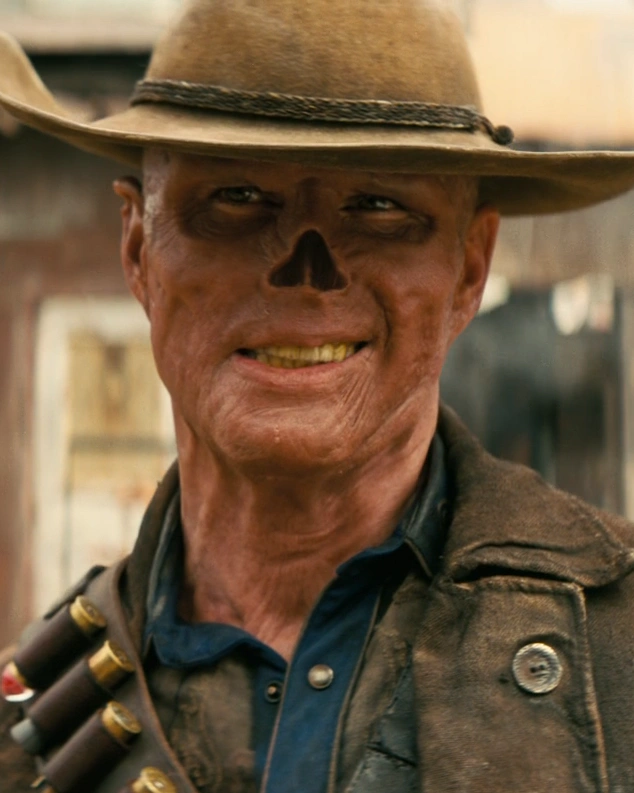
Ghouls are living creatures that have been mutated by exposure to radiation, rather than killed by it. This mutation process, referred to as ghoulification, has demonstrated different effects depending on the subject's species and their individual circumstances. In humans, ghoulification typically results in an extended lifespan (if not functional immortality), enhanced regeneration of wounds such that severed limbs can be reattached and maintain full function, and a natural immunity to physical damage from radiation exposure. Conversely, their condition renders them infertile and changes their appearance, described as resembling rotten flesh, burn victims, or walking corpses.
As a result of their mutation, ghouls are commonly considered a separate species and thus a frequent target of discrimination in the wasteland, especially in areas of dense human population. Many are driven to madness by their physical transformation and the suffering they endure because of it, becoming feral ghouls that have lost all sense of rationale and regressed to animalistic instinct, attacking any non-ghouls they come across. Many non-feral ghouls prefer to live in their own communities away from humanity, though will still refer to themselves as ghouls. Doc Barrows, a ghoul doctor and scientist from the ghoul settlement of Underworld in the Capital Wasteland, expresses preference for the term "necrotic post-humans" to refer to his own kind. Xenophobic rhetoric against ghouls has included the use of the word "zombie" as a pejorative referring to their appearance.
Ghouls were first introduced in Fallout and have made an appearance in every subsequent entry of the Fallout series, though their physical characteristics have differed, and the exact nature/cause of ghoulification is subject to multiple interpretations. Furthermore, the process of ghoulification, while most prominently displayed with humans, is not exclusive to them and has been observed in other species, such as bears and gorillas.
Fallout 76 introduced playable ghouls in the Ghoul Within update. Previous series entries Fallout Tactics and Fallout: Brotherhood of Steel both featured pre-made playable ghoul characters (ghoul recruits and Cain, respectively). Fallout: The Roleplaying Game allowed players to create a ghoul player character through a character origin and was the first Fallout game to do so, while Fallout 76 was the first video game to allow a player character initially depicted as human to transform into a ghoul.
Background
Ghouls are unique post-humans with a variety of advantages and disadvantages. The bulk of their population was created by the radiation unleashed during the Great War or exposure to high levels of radiation in subsequent generations. While certain pre-War researchers, such as Platt, theorized that radiation could lead to the evolution of mutants such as ghouls, the process of ghoulification was generally not known to the public before the War. Pre-War popular media depicted creatures similar to ghouls, including zombies in monster films, as well as at least one zombie film that used the term "ghoul," Glow of the Ghoul.
Some individual ghouls did in fact exist before the Great War as a result of isolated medical experimentation. This allowed controlled exposure to radiation to ghoulify pre-War people identified as capable of going through such a change, first experimentally, then as a means of obtaining immortality and radiation immunity in anticipation of the new world. Beyond controlled irradiation, it is known that research was conducted to create a biochemical means of transformation; an unspecified company located in or near the Commonwealth of Massachusetts successfully created a one-of-a-kind "radiation drug" that could induce a state very similar to that of other cases of ghoulification, along with an intense psychedelic state as a side effect. By the mid-2280s, only one sample of this drug remained when it was acquired by John McDonough, who apparently learned of its existence and the effects it produces at some point and which inspired him to seek out and imbibe it out of emotional instability and self-hatred. John had deliberately sought to turn into a ghoul as a means of "reinventing" himself, before he later went on to take over the town of Goodneighbor as its mayor "John Hancock."
New California
In California, ghouls were the first group of survivors to begin rebuilding civilization; the survivors of Vault 12 beneath Bakersfield, who had been mutated into ghouls, founded Necropolis in the summer of 2083. Less than a year later, in 2084, Set wrested control of the settlement from the original overseer and instituted his own reign, characterized by delusions of grandeur. The city would eventually decline, starting with the attack by the Master's Unity in 2157, who expected to find an unopened Vault in the ruins of the city. After many ghouls were killed in the assault, Set negotiated peace with the super mutants after explaining that the ghouls were indeed the vault dwellers. The recovery operation failed, but the Unity established a stronghold in the town to ensure Set's cooperation and watch for humans.

Necropolis would eventually be destroyed and most of its population killed in a retaliatory expedition by the super mutants, sent to the city after the Vault Dweller raided the Vault and recovered the water chip, eliminating the super mutant garrison in the process. This led to a great migration and the eventual founding of a number of ghoul and ghoul-friendly settlements, including Broken Hills in 2185, the NCR state of Dayglow around 2189, Fallout: New Vegas Official Game Guide Collector's Edition p.41: "New California Republic The New California Republic was born from the remnants of the survivors of Vault 15 and the small walled community they founded, Shady Sands. Under the leadership of Aradesh, and with the assistance of the Vault Dweller (who saved Tandi, Aradesh's daughter and a future president of the NCR), the community prospered. Trade routes with other settlements allowed cultural exchange, and a movement to form a national entity gradually took root and won popular acceptance. In 2186, the town of Shady Sands changed its name to 'New California Republic' and formed a trial council government to draft a constitution. Four more settlements joined the council, and in 2189 the NCR was voted into existence as a sprawling federation of five states: Shady Sands, Los Angeles, Maxson, Hub, and Dayglow. By post-apocalyptic standards, the NCR is a paragon of economic success and good ethical character: political enfranchisement, rule of law, a reasonable degree of physical security, and a standard of living better than mere subsistence are daily realities for it's 700,000+ citizens. Currently, the NCR in a state of transition, with rapid economic growth and a sea change in political leadership endangering its grand humanitarian ideals. Nowhere is this more evident than in the Mojave, where the occupation of Hoover Dam has improved access to electricity and water, but at the cost of straining its budget and embroiling its armed forces in a morally corrosive imperialist project. The NCR government's aim is to annex New Vegas as the republic's sixth state. While it already controls Hoover Dam, its treaty with Mr. House and the three families compels it to allot one-fifth of the dam's electrical and water production to local use free of charge. Adding injury to insult, the NCR is locked into protecting New Vegas from invasion by Caesar's legion even as it receives not one cap in tax revenue from the Strip's highly lucrative resort operations. NCR citizens in the Mojave have largely come here for economic reasons, whether as paid citizen soldiers or as prospectors and fortune-seekers." (Fallout: New Vegas Official Game Guide faction profiles ) and Gecko in 2235. Though problems with equality in New California continued, ghouls were increasingly seen as equal members of society through the 23rd century, though their numbers steadily dwindled.
In 2277, in the Divide, nuclear warheads triggered by the Courier's delivery of an automated nuclear launch device exploded and triggered rapid ghoulification of the Legion and NCR forces engaged in battle there. The Divide flayed them alive, causing them to become dead men walking, marked for death, sustained only by the intense radiation that permeates the area. As they never appear outside the Divide, due to the necessity of staying near radiation sources to remain alive, the marked men became a legend in the wasteland, like the Sierra Madre, the Burned Man or the Big Empty.
In the Mojave Wasteland of 2281, ghouls can be found in small amounts throughout the region, but no town is completely dedicated to them. There are usually a few ghouls living among humans in various communities performing jobs in order to survive, such as the guard Beatrix Russell and the comedian Hadrian, both of which are in Freeside. The only known community of ghouls in the region is the Bright Brotherhood, a religious faction founded and led by an intelligent glowing one named Jason Bright, who has prophesied a land called the "Far Beyond" where the ghouls will be free from bigotry; they wish to use the rockets in the REPCONN test site to reach this land. There are also several ghoul rangers occupying Ranger Station Echo, implying some level of acceptance of ghouls serving in the NCR military. In contrast, Caesar's Legion does not allow ghouls (along with other mutants) within their ranks, but do allow ghouls to live in their territory, such as Raul Tejada, who traveled from Two-Sun to the Mojave. To Caesar, ghouls and other mutants are irrelevant to his plans to push westward due to their small population sizes.
In the core of New California, attitudes towards ghouls may have deteriorated after the collapse of NCR governance in Los Angeles in the 2280s: the settlement of Filly was known to discriminate against ghouls, and ghouls were also preyed on by organ harvesters in the region. However, the NCR remnant settlement at Griffith Observatory continued to accept ghoul inhabitants.
East Coast
The densely urbanized East had a great concentration of American population and was strongly affected by the nuclear fallout. People who took shelter in affected areas experienced radiation poisoning; those who did not die became ghouls. Within a year, the first ghouls began to appear and with them, the first fledgling settlements, like Underworld in Washington, D.C., which existed as late as 2277. Although in areas like Appalachia, ghouls were quickly sought out and exterminated, no matter what relation they may have had with others before they became ghouls. Another population of ghouls, transformed Chinese operatives stranded on American soil, chose to sequester themselves from the wasteland at Mama Dolce's.

In other areas, like the Commonwealth, ghouls cohabited with humans. The most noticeable example was Diamond City. Ghouls were a part of the city's population from its foundation in the 2130s to the 2282 election. Diamond City was gripped by a wave of racism, thanks to a candidate by the name of McDonough. He ran for the city's mayor on the Mankind for McDonough platform and won the election thanks to the votes of the Upper Stands citizens. After his election, ghoul citizens were evicted. Entire families were thrown out of the city by their human neighbors, straight into the surrounding ruins to perish without a cap to their name.The Sole Survivor: "Thanks. You're not so bad yourself." Hancock: "I never get many complaints. It's just real rare these days, find someone who's not just willing to take things the way they're handed to them. Too many good folks not willing to get their hands dirty and too many assholes taking advantage of it. Look at what happened to Diamond City. Before McDonough took over, it was a half-decent place to live. A little stricter than I usually go for, but not terrible. I thought he and I had a pretty happy childhood. But then he decides he's gonna try and get elected with his anti-Ghoul crusade - 'Mankind for McDonough.' Before ya know it, you got families with kids lining up to drag folks they called 'neighbor' out of their homes and throw 'em to the ruins." The Sole Survivor: "How could they do something like that?" Hancock: "There'd always been a pretty big gulf between the folks living in the stands and folks down on the field. McDonough ran on it because he thought enough of those Upper Stands assholes would vote for him. Guess he was right." The Sole Survivor: "It could have gone worse. At least they left with their lives." Hancock: "And how long do you think those folks lasted in the ruins? The city condemned those Ghouls to die. Cowards just got someone else to pull the trigger. I remember storming into his office above the stands after the inauguration speech. He was just standing there, staring out the window, watching as the city turned on the Ghouls. He didn't even look at me, just said: 'I did it, John. It's finally mine.' Should have killed him right there, but I don't think it would have changed anything. Instead I pleaded with him, begged him to call it off. He said he couldn't. He had nothing against the Ghouls. He was just carrying out the will of the people. And he couldn't betray the voters. And then he smiled. That hideous, fucking mile-long smile. He never smiled like that when we were kids. I didn't even recognize him." (Hancock's dialogue) Those that survived scattered across the region. A refugee called Wiseman founded the Slog, the foremost tarberry farm in the Commonwealth. Many found refuge in the settlement of Goodneighbor.
Appalachia
After the War, a pre-War mall known as Valley Galleria became a haven for ghouls in Appalachia, referred to by survivors as "the Changed." Led by Lucy Harwick, ghouls sheltering in the Galleria welcomed others like them to travel there and be accepted with "open arms, and more importantly, open hearts." However, because of his experiences with feral ghouls, Duncan McKann would murder Lucy Harwick and several others in a single-minded pursuit for revenge, eliminating one of the only havens before human extinction in the region due to the Scorched Plague at the turn of the century. The only known survivors of this community were ones who split off from the group when McKann began hunting them: Elmira, Maddox Mullen and Kevan Asherton chose to head east instead of following the group, forming a gang of survivalist raiders known as the Revenants in order to survive. Although Elmira died during a raid, the rest of the group were able to take refuge in a former nuclear silo in the far north of Appalachia, where they have lived as isolationist survivalists (and occasionally, raiders) ever since.

Due to persecution by humans, many ghouls organized and made an expedition to the Capital Wasteland prior to 2102 to join a settlement of other ghouls.
After the mass migration and resettlement of Appalachia in 2103, ghouls returned alongside other humans, working with them to rebuild. Some examples include Eugenie, who worked for the Blue Ridge Caravan Company as a guard. Mordecai McCoy found steady work entering radioactive areas to scavenge goods and a general handyman around The Wayward. Gunther Jenkins and Betty Hill worked for Patricia Myers at Nuka-World on Tour. However, due to the prevalence of ferals, ghouls still faced discrimination. Two of Appalachia's main settlements, Foundation and the Crater, had their own reasons; the Settlers came from the destroyed northwest and accordingly had a shoot on sight policy (which would be readily amended once a ghoul was identified as sentient, which would require one to mask up to enter the town). The Crater Raiders were more open on account of Lucky Lou, but he had to deal with Lev's enmity; the Russian raider despised Lou and manipulated him into suicide attempts, taunting him by suggesting that he'd inevitably go feral.

One of the largest concentration of ghouls in Appalachia was not American, but Chinese. Unlike the Morgantown facility, infiltrators based in the Deep escaped the notice of Enclave forces in the Whitespring bunker. Despite surviving the War in the cave system beneath Whitespring, they underwent ghoulification, allowing them to continue Operation Trinitite indefinitely, operating in hostile territory with no hope of resupply. These communist soldiers remained loyal to the People's Liberation Army, in particular due to the influence of a pre-War commander as loyal as they were terrifying. Despite being trapped thousands of miles away from home, they continued their mission to acquire the Motherlode mining robot, presumably to tunnel into the Whitespring bunker and capture it for the People's Republic of China. The mission was ongoing as of 2103, though with limited success.
Another community of ghouls formed in Vault 63, stretching beneath the Skyline Valley region. The Vault was left unfinished by the time of the Great War, which resulted in many of its inhabitants dying from radiation poisoning and the rest being turned to ghouls. As the single largest ghoul community in Appalachia, it has suffered greatly from the issue of feralization, focusing research on trying to find a cure. Due to a lack of success, many of the dwellers were either sedated or put in a state of suspended animation. Hower, feralization soon became a secondary concern. The pride of the Vault's overseer, Hugo Stolz, has led to the emergence of the Lost, a unique ghoul variant formed by a combination of ghoulification and weather experiments conducted in Skyline Valley. Circumstances in 2105 resulted in the Lost breaking through to the surface when they had previously been kept contained, creating a new threat to the people of Appalachia, and the Vault 76 dwellers had to work with the leaders of Vault 63 to address the threat.

In 2105, the Vault Dwellers began to interact with the Revenants, the isolationist ghoul community founded by survivors of Lucy Harwick's group. With their efforts to conceal their identities, they have developed a reputation as masked bandits, and incidents of violence from their members have led outsiders to brand them as a raider gang. While members freely admit they have engaged in raids, they are more focused on survival and self-preservation, rather than wanton cruelty, and they have also been spreading rumors of a radiation specialist at their facility to attract new ghouls. Parthenia Blankenship, the Revenants' aforementioned radiation specialist, had developed a concoction taken through inhalation that, when combined with radiation, can transform humans into ghouls.
Ghoulification
Ghouls are created when a human with a compatible biology is exposed to high levels of ionizing radiation of the right type (eg. gamma radiation) and in the correct amount. Precisely what determines which humans undergo ghoulification is not known, even centuries after the Great War. Many people who suffer radiation poisoning die a horrifying death due to a combination of violent hemorrhaging and widespread necrosis. Ghouls suffer the same effects, but also develop a mutation that results in super-powered regeneration of their bodies, allowing them to survive damage that would kill regular humans. This also results in their monstrous appearance; exposure to radiation still damages their bodies, leading to exposed muscle, flaking skin, and damaged connective tissue, including the loss of nose and ears.
The more violent the exposure, the worse the effects; ghouls who are created as a result of surviving nuclear blasts will usually be twisted by burns and other damage caused by the explosion, resulting in a generally much more horrifying appearance, with exposed bone, asymmetric deformations, and extensive, seemingly rotting wounds. The actual transformation can take anywhere from hours, to weeks, to as much as a year or longer, depending on exposure levels. Age is also a non-factor, as people with the capacity to become a ghoul can change from as early as childhood into old age.
Although some ghouls were created before the War, the majority of ghouls were created by the Great War and resulting exposure to nuclear blasts or nuclear fallout, with some created over the subsequent centuries by exposure to high levels of radiation; for example, at Camp Searchlight in 2281, an attack resulted in the town becoming blanketed by intense radiation, turning a majority of the NCR troopers stationed there into ghouls. Camp Searchlight also demonstrated the role of trauma in the effects of the transformation; it can cause a mental breakdown in the victim, causing a rapid degeneration of higher thought processes, and leading them to become feral. Particularly severe irradiation can lead to the creation of glowing ones.
In contrast, controlled mutation can result in a much better survival rate. Controlled irradiation still damages the appearance, but doesn't seem to trigger the risk of going feral. Biochemical means allow for the preservation of a ghoul's appearance, at least in the short term. An experimental radiation drug can trigger rapid mutation in a human, but without changing their appearance. However, the accumulating damage will change the ghoul's appearance over time, especially as the regeneration overcorrects and leads to scarring and other cosmetic damage. However, this does depend on the type of the drug.
Non-human ghouls

Ghoulification is not unique to humans and is a possible mutation for various families of animals. Animal ghouls seem to share all the disadvantages and advantages of becoming a ghoul as a human does, this includes rapid hair loss, the deterioration of the epidermis, severe cataracts and glaucoma of the eyes, elongated life-spans, as well as transforming into glowing ones through extended exposure to radiation.
Examples of affected species can be found throughout post-War America from New California to the East Coast. Even non-native species such as gorillas may become ghoulified. It is also believed by some caravan guards that ghoulified blue whales exist.
Species that may experience ghoulification include:
Extended lifespan
Due to a mutation within the autonomic nervous system following exposure to gamma radiation in specific combinations (technically, ionizing radiation with wavelengths below ten picometers), the normal process of decay in the neurotransmitters along the spinal cord is disrupted. The effect of the mutation is an extended lifespan. Ghouls can be considered functionally immortal, as unless they are killed due to violence or in accidents, they can live for centuries. A significant number of ghouls remains alive as late as 2296, nearly 220 years after the Great War, though many run the risk of feralization.
As ghouls retain their normal cognition and are generally no different than humans in terms of intellect, many ghouls benefit from their extreme lifespan and are capable of amassing skill and knowledge far beyond the ability of regular humans, especially when they combine their original skills or education with this experience; The Ghoul combines his Marine training with two hundred years of working as a bounty hunter, though at the cost of carrying the most traumatic memories with them for the entire duration.
Supercharged regeneration
The mutation also greatly increases the regeneration rate of the ghoul body, allowing it to heal even the most complicated wounds, such as a foot crushed to a pulp by a power armor's foot, and even lethal injuries like an arrow to the neck, as long as the nervous system remains intact. The altered ghoul physiology is boosted in the presence of radiation, resulting in a rate of regeneration pushed even further. Ghouls may still use stimpaks for healing, but regular medical care combined with their natural regeneration makes them optional. In theory, a ghoul could survive anywhere, which is what made Set proclaim them the next step in human evolution. However, ghoul regeneration cannot heal all conditions: for example, Hugo Stolz, who was born blind, remained blind after becoming a ghoul.
Regardless, the regeneration is strong enough to allow for lost body parts to be reattached even long after they were removed from the ghoul. Once fixed in place, the ghoul's body will simply regenerate the tissue and restore functionality. While a medical professional is usually preferred, even simple needle and thread is enough to ensure a lost finger will knit itself back with a ghoul's hand. Ghoul organs may even be compatible with regular humans due to this regeneration, leading to some being captured, sold, and slaughtered for their organs.

The regenerative effect of ghoulification also allows for further mutations and changes to occur. The marked men of the Divide became sustained by radiation, allowing them to survive being flayed alive by Divide storms, but without descending into a feral state. An even more dramatic change occurred when the ghoul residents of Vault 63 were exposed to the meteorological experiments of Hugo Stolz; rather than being killed by striking lightning, their altered physiology allowed them to contain the energy of the lightning, permanently trapping it within their bodies. This changed them on a fundamental level, causing them to perceive the world as pulses and wavelengths. While this has restored a form of eyesight for Hugo Stolz, other victims were rendered psychotic, likely as a result of the mental stress of their altered worldview and the pain of the electricity they were charged with.
Immunity to radiation and disease
Ghouls are immune to the direct degenerative effects of radiation, allowing them to stride through even the most intense pockets of radiation without issue (although it is considered a possible risk factor in feralization). This does not mean radiation doesn't affect them; ghouls still accumulate it and may even begin to glow at sufficient concentrations. Glowing ghouls directly experience radiation as warmth, and lower levels of background radiation are considered chilly, with some joking they may develop frostbite.
A ghoul is also immune to most common diseases that affect unmutated humans. However, that doesn't mean ghouls are immune to all diseases, and diseases of the mind (not just feralization) can still affect a ghoul.
An indirect benefit is that ghouls have no need for most medicine, especially Rad-X and RadAway, allowing them to freely use such goods for trade or payment for services rendered.
Food and water consumption
Ghouls' mutated physiology still requires them to provide adequate nourishment for their body, especially water and food. The loss of smell allows ghouls to eat food humans would consider repulsive, which, coupled with the resilience of their digestive tract, allows them to subsist on any edible items. The ability to ignore taste resulted in some ghouls engaging in cannibalism, consuming the flesh of other humans and even ghouls, with one of these being the Ghoul's "ass jerky."

However, their mutated physiologies have drawbacks; recreational drugs like Jet have a diminished effect on their physiology, requiring double doses or increased potency to work. The neurotransmitters that would be firing at an accelerated rate during the use of a drug like Jet in a normal human would be quickly dealt with in the ghoul's body.
There are exceptions to the need for food and water; the regenerative properties of ghouls' mutated bodies can sustain them in the absence of either. While this is consistent with feral ghouls, who are technically dead, sustained only by radiation, there have been four confirmed cases of ghouls over nearly 220 years after the Great War, who experienced deprivation of food, water and even air for extended periods of time and came out no worse for the wear. This sliver of the ghoul population includes:
The precise reasons for this ability are not understood, but they may be connected to a form of hibernation. All four of these ghouls still retain the requirement for nourishment under normal circumstances and experience thirst and hunger like any other ghoul.
Coffin Willie, buried in a coffin for several months in 2241,
Woody, who was exhibited as a mummy for weeks while in a state of deep sleep that same year,
Billy Peabody, who survived the Great War trapped inside a refrigerator, surviving for 210 years until 2287,
The Ghoul, who survived being repeatedly buried in a chained coffin for up to a year at a time.
Appearance
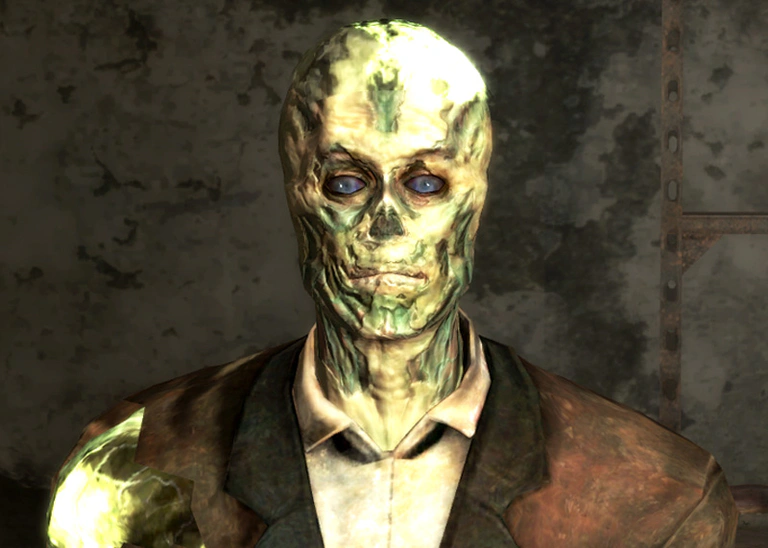
A significant drawback of ghoulification is the changes in appearance. Ghouls are disfigured by radiation, at a rate influenced largely by the manner of their exposure; the more radiation received in a short amount of time, the more drastic the changes. Outward symptoms of ghoulification are more gradual with chronic exposure. In general, ghouls experience loss of skin and connective tissue in a manner similar to leprosy. Their outward appearance may end up looking like a noseless mutant with skin resembling tanned leather, a burn victims, or a rotting zombie with exposed muscle, blood vessels, and in extreme cases even bone and internal organs.
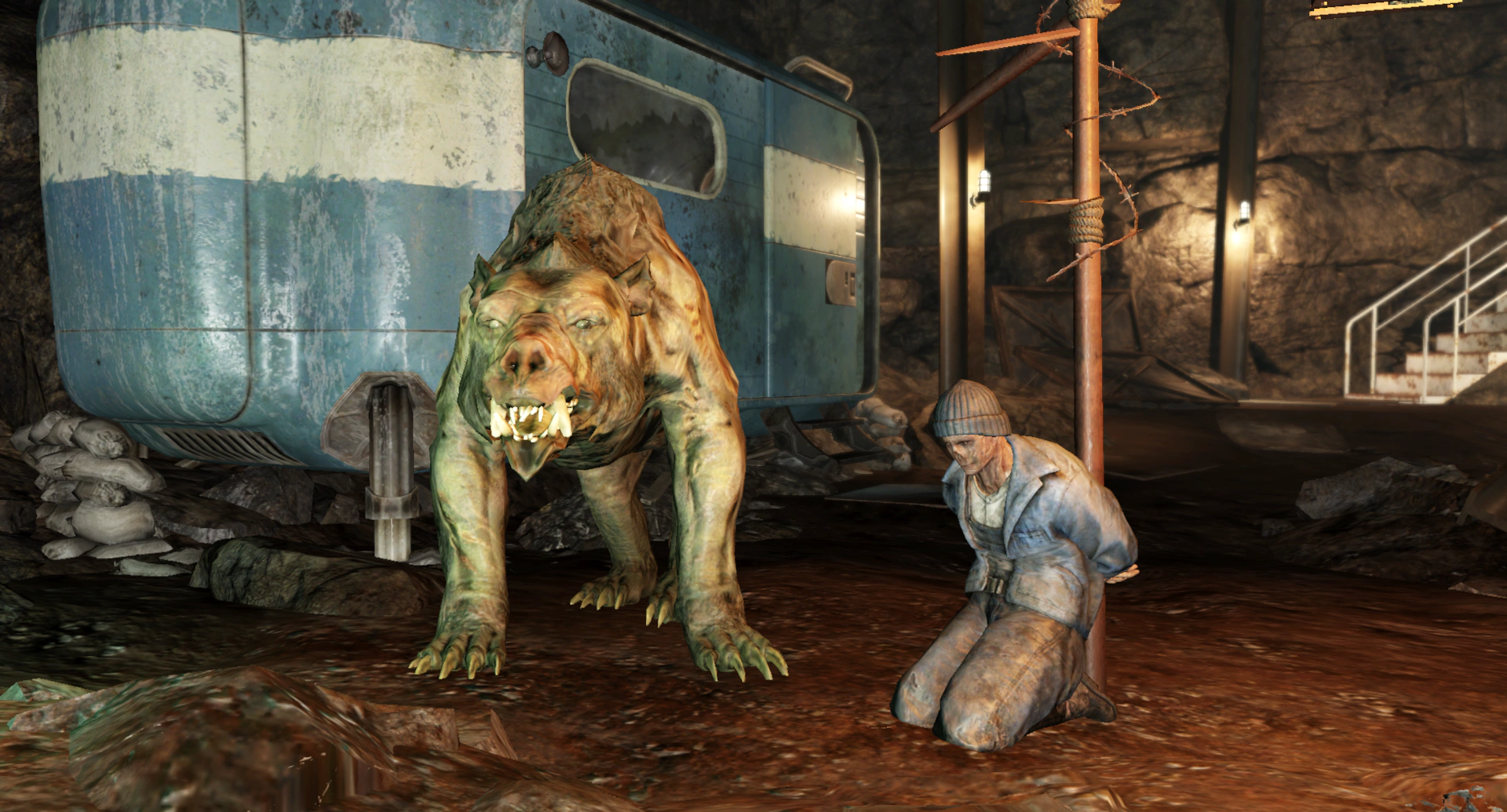
Ghouls frequently vary in appearance between regions (the out-of-universe reason for this is artstyle differences between games). Some are more grotesque, with rotting and missing parts and melted skin (such as the case with Set); others have patches of skin missing with what remains being leathery and/or patchy, as with many seen in the Mojave and the Capital Wasteland. Some also have more wrinkled skin whereas others appear more burned, as seen in the Commonwealth and Appalachia. In unique cases, the skin can be flayed off or have glowing elements such as with the glowing ones or the Lost, and in rare cases some ghouls may appear smooth. Ghouls' body color can vary from light to dark and in some cases glowing, and their eye color can also range between black, faded or hazy, and red. Ghouls generally lose hair along with the skin, though this varies due to the unpredictable nature of the change. Some may retain their head and facial hair, even allowing it to be stylized. It is also possible that some retain their hair only for it to gradually fall out over time. The loss of the nose in particular greatly limits their ability to experience smell. The lose of their noses is a trait all ghouls seem to share.

Vocal cords and the larynx are also usually affected by the change, resulting in a raspy voice; though again, this varies, such as the vocal cords experiencing only minor degradation when ghoulification begins, resulting in a far less raspy voice, compared to those who have experienced it for far longer. It is also possible that some ghouls start out with less raspy voices only for that to change over time. It appears that a ghoul's pre-transformation occupation and its impact on their health may play a role, as performers like Cooper Howard or Dean Domino retained mastery of their voices without significant degradation.
Health issues
Other results of the change are widespread necrosis, rot, and other degenerative conditions like arthritis, cataracts, and glaucoma. Feralization and dementia can happen immediately. In fact, this necrosis can be exacerbated by a phenomenon whereby rotting flesh around sweat glands exudes macronutrients, which attract flies that further digest and consume the tissue of the ghoul.
Feralization
The greatest complication a ghoul can experience is feralization, described by Barrows as ferocious post-necrotic dystrophy. This process results in the atrophying of higher mental functions, leading to an irreversible degeneration into a feral creature that attacks living beings on sight, with the sole exception of other ghouls, feral or not. The mechanism of degeneration is a degeneration of brain functions (which is affected by standard regeneration, but not the mutation of the spinal cord) and their atrophy, leading to an increased level of aggression and appetite. When the loss of capacity for thought is complete, a ghoul becomes feral. The long-term effects destroy the body, which may alternatively bloat or waste away, as a feral ghoul no longer experiences normal physiological processes, sustained entirely by accumulated radiation. As a result, they emit no body heat and take on ambient temperature.
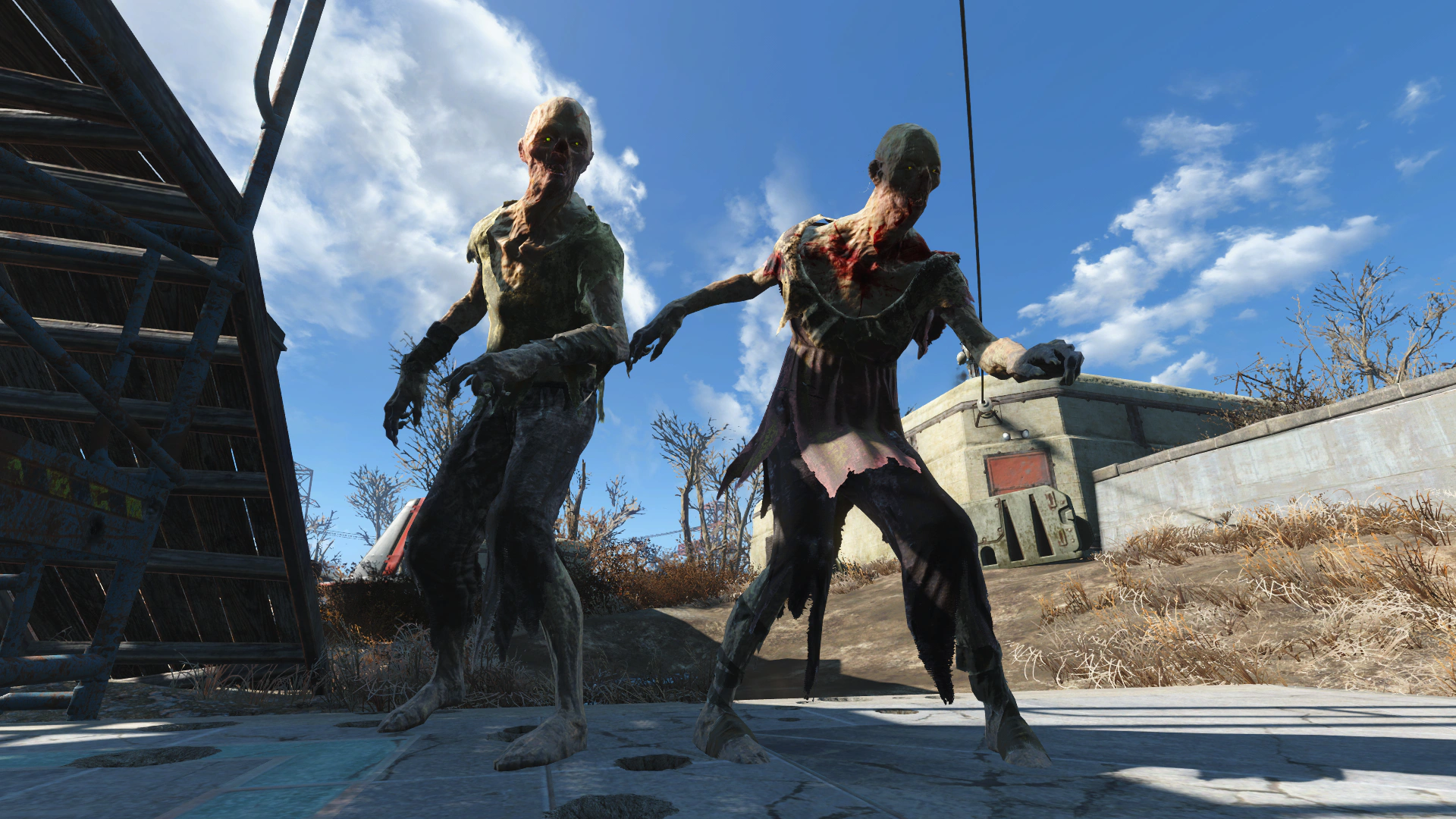
While the mechanism of feralization is well understood, the precise factors that cause it are not. This has been a problem for ghouls over the centuries, with numerous attempts to figure out a way to prevent feralization or cure it once symptoms of its onset were identified. If possible, ghouls were placed in suspended animation pending research. Risk factors that may increase the rate of a ghoul going feral include:
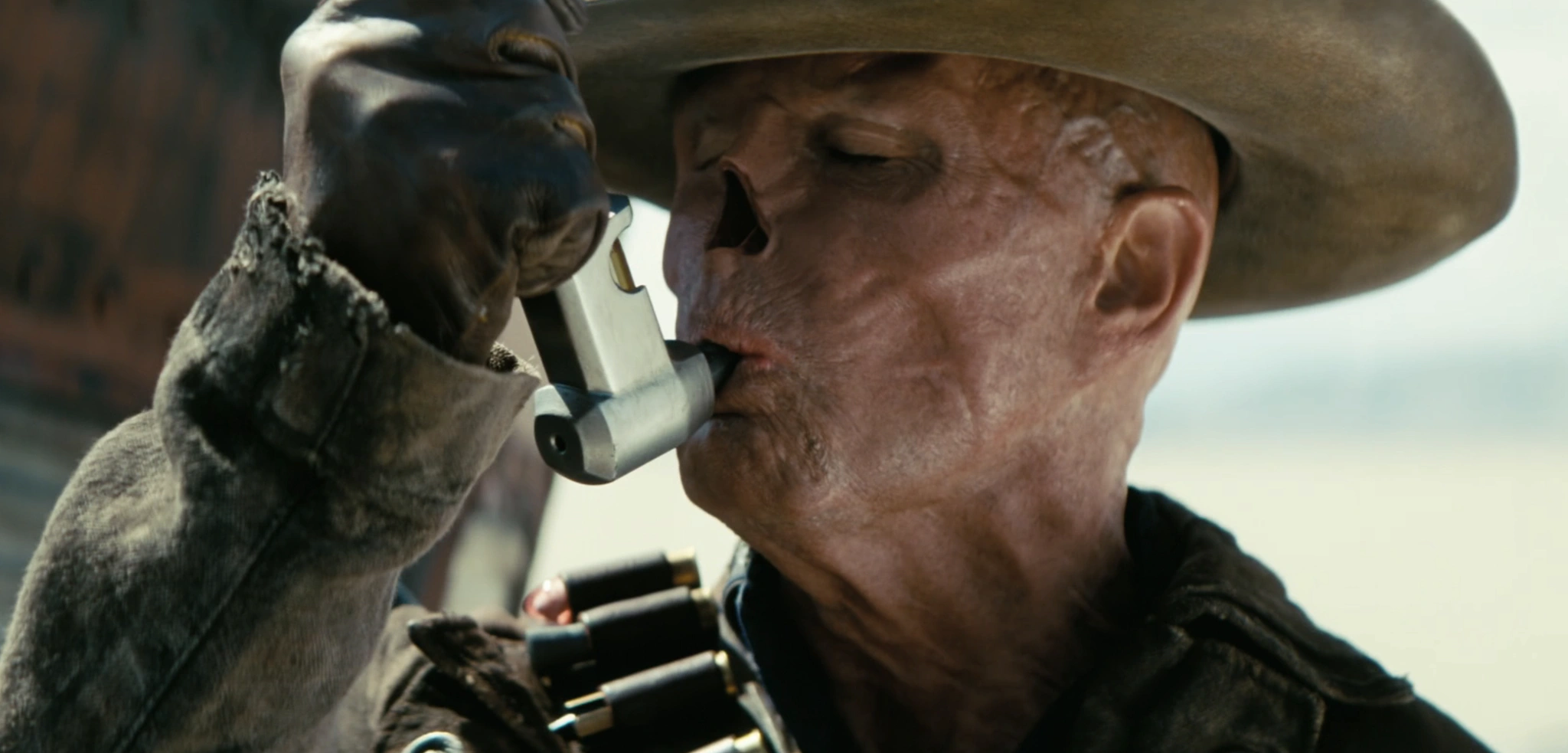
In Appalachia in the early 22nd century, a chem called "The Fix" was used to prevent ghouls from becoming feral. By the late 23rd century, a drug was created that allowed ghouls to stop the degenerative processes. Administered orally, the drug would immediately bring the ghoul back to their normal self. Properly medicated, a ghoul can live for decades with access to the medication. However, it is both expensive and rare, in particular in New California after the fall of Shady Sands. Isolated groups have continued to manufacture it in limited quantities, and making bank on desperate ghouls in the absence of law and order. A ghoulification serum, or "elixir," shared the same appearance with the contents of the inhaler vials, and may be connected to ghouls in some fashion.
Social isolation: Anti-social or isolated ghouls are more susceptible to it, however, even communities of ghouls may succumb to it. Several examples of individuals living in groups yet still transforming include the co-workers and partner of Oswald Oppenheimer, while he himself did not transform. The crew of Captain Zao succumbed to turning feral aboard the Yangtze while the captain retained his faculties.
Lack of focus or poor mental state: Ghouls of exceptional willpower or with an intense focus may retain their faculties, even if others around them succumb to feralization. Likewise, the trauma of ghoulification can cause a mental breakdown in the victim, causing a rapid degeneration of higher thought processes, causing them to become feral. Highly intelligent individuals and highly motivated ones may also experience lower risk of feralization.
Exposure to intense radiation: While ghouls are immune to radiation, extensive exposure may contribute to the degeneration of mental state, if not directly affecting the brain matter.
Individual genetic factors: Some ghouls may also be simply immune to feralization; despite being one of the most dangerous and single-minded ghouls in existence, The Ghoul still started manifesting symptoms of feralization.
Glowing
The transformation of a ghoul into a glowing one (luminous necrotic post-human), occurs when the organism of a ghoul ceases filtering radioactive particles from the blood, resulting in bioaccumulation and the gradual appearance of bioluminescence as a result. Luminous ghouls are usually feral, due to the damage to their nervous system and the time it takes to accumulate the radiation, though ghouls may develop luminescence before degenerating into a beast-like state, like the glowing ones of Necropolis, the Gecko reactor, Jason Bright, Oswald Oppenheimer, and Hank.
Sterility
Ghouls retain their genitals, which includes the penis and testicles in male ghouls. They also retain their sex drive and capacity for engaging in intercourse and some humans have a ghoul fetish. However, ghouls are sterile and cannot procreate like humans. Any children they may have are either adopted or were mutated into ghouls alongside their parents.
This was well known, and formed a basis for the religious tale of Saint Monica, reported to be an unmutated child of ghoul parents.
Discrimination
The attitude towards ghouls in the wasteland varies from acceptance, through indifference, to outright hostility. This is predicated on a variety of factors, though a lot of anti-ghoul sentiment is caused by inexperience and ignorance. For example, in New California of 2161, ghouls were almost legendary creatures, as their population had isolated itself within Necropolis, leading to the rise of rumors about terrifying zombies living within its borders. However, some daring souls (like Keri Lee of Crimson Caravan) managed to make inroads and secure lucrative trade relationships with the ghouls of the city (or skags, as the Hubbers referred to them), managing to overcome their prejudices. Others believe ghouls to be carriers of disease, without ever having examined one, while others believe that all ghouls are inevitably bound to become feral and pose a threat to people around them, though this sentiment has some truth to it. This was the basis for the eviction of ghouls from Diamond City and the driving force behind McDonough's bid for mayor. His first act of office was issuing the Anti-ghoul decree of 2282, leading to a pogrom and the expulsion of the ghoul population of the City.
Broken Hills was an ambitious example of radical acceptance; an experimental community founded by Marcus, a former Unity soldier, in order to try and establish a way for mutants and ghouls to live side-by side. However, the largest systemic effort to accept ghouls was implemented by the New California Republic, which extended legal protection to mutants, including ghouls, in 2205, and included Dayglow, a predominantly ghoul state as part of its federation. Laws also allowed a significant number of ghouls of both genders to serve in the ranks of the New California Republic Rangers, with the bulk of them being accorded veteran status due to their resilience and experience in combat. While some retrenchment happened after the Fall of Shady Sands and withdrawal of the NCR from New California, with towns like Filly banning ghouls, the tolerant attitudes persisted in areas of significant NCR presence, like Griffith Observatory.
On the opposite end was, Vault City a textbook example of hostility towards ghouls, rooted in racial prejudice. Since the atomic reactor in Gecko had damaged shielding, waste from the power plant started leaking into the local groundwater around 2239 and it eventually led to serious poisoning of the whole reservoir. Harold learned that a hydroelectric magnetosphere regulator was needed for the repair job, but no such part could be found in Gecko, so attempts were made to contact Vault City. However, the messengers were shot on sight by the Vault City Guard, marking the beginning of an official policy to shoot all ghouls on sight.
The situation worsened when Vault City residents started to believe that the ghouls had deliberately poisoned the groundwater, accusing them of terrorism against Vault City and demanding that they should be punished. The first citizen of Vault City, Joanne Lynette, even tried to hire someone who was willing to help stop the Gecko problem by any means necessary. As a result, while both communities had something the other wanted, power in Gecko and medical facilities that could help ailing ghouls, perhaps even fix some of the changes they experience in Vault City, the situation was at an impasse due to prejudice.
In regions away from New California, ghouls likewise experience a variety of attitudes. For example, in the Mojave Wasteland, ghouls are generally seen as equals and share both the misery of poverty and the prominence of the stage on equal terms with humans. Of course, not everyone is as egalitarian as the people of Freeside and New Vegas. The New Vegas Strip doesn't permit the entrance of ghouls or other mutants unless under the supervision of a human visitor, or with permission from a higher-up. The Bright Brotherhood is a cult centered around Jason Bright, formed in response to suffering its members experienced at the hands of humans. In some areas, ghoul lynchings also happen, while in others ghouls are considered a possible threat and are fired upon, like in Washington, D.C., where Lyons' Brotherhood of Steel members will routinely open fire on ghouls sighted in the city.
Ghoul attitudes
The situation is not helped by the ghouls themselves at times. Ghoul minds are fundamentally human, which includes developing misconceptions and prejudices of their own. While a majority of ghouls learned to live with their mutations, some don't get along with humans due to persecution and become belligerent. Even in the tolerant Underworld, some inhabitants have threatened Doctor Barrows over his research into ghoulification and its causes, claiming that "ghouls are ghouls and humans are humans." The harshest example was Set, the leader of Necropolis, who purposefully had most of the patrols entering the city killed, as was the case with two patrols Killian Darkwater sent into it, and practiced cannibalism. Roy Phillips, a disgruntled ghoul from the Capital Wasteland, obsessed with seizing Tenpenny Tower for himself. His increasingly threatening behavior when refused entry by Chief Gustavo led to suspicions that he might attack the Tower directly, only confirming the security chief's belief that all ghouls are walking ticking bombs.
Necrotic post-human (ghoul)
Commonly referred to as ghouls, these men and women are no different from regular humans when it comes to intellect or personality. Ghouls possess the ability to talk, and they normally wear clothing, as well as carrying and using weapons. Ghouls often refer to humans as "smoothskins."

These ghouls also find terms such as "shuffler" and "zombie" to be offensive. The phrase is also used to threaten ghouls. Those bigoted towards ghouls use the two phrases interchangeably, stating that ghouls should be killed before they "go zombie" due to radiation destroying their brains. Some ghouls have embraced the phrase, such as those in Set's Zombies gang. Similarly, Raul Tejada uses the word zombie when referring to a nickname of his, "Raul the Ghoul, the zombie vaquero of Mexico City."
Of course, being people, hostile and murderous intelligent ghouls do exist, for the same reasons hostile and murderous intelligent humans exist.
Luminous necrotic post-human (glowing one)
A highly irradiated ghoul that has absorbed enough radiation to develop bioluminescence, glowing a ghastly green color that's especially visible in the dark. They are colloquially known by most as "glowing ones," and are often considered outsiders even by other ghouls. Glowing ones are predominantly deranged or feral, especially considering the prolonged isolation usually necessary to acquire that much radiation. See this section for more details.

The original glowing ones of Fallout are seen in two places. Most are the remaining dwellers of Vault 12, hidden beneath Necropolis. This Vault population are able to speak articulately, but have been driven mad. They are not hostile unless provoked. Additionally, several glowing ones can be seen in cages at the church above ground, where they are not known to speak. Both groups are ostensibly under the protection of Necropolis. In Fallout 2, most of the technicians at the Gecko power plant are glowing ones.
From Fallout 3 onwards, glowing ones are almost always feral. They are particularly difficult in combat due to their resilience, as well as their ability to suddenly discharge radiation from their body in a burst that heals ghouls and harms their enemies. The Sun of Atom is a glowing one worshipped by the Children of Atom in Broken Steel. Jason Bright from New Vegas and Oswald the Outrageous from Fallout 4 are intelligent glowing one characters. Oswald is capable of resurrecting ghouls as well as teleportation, and attributes both abilities to magic.
Ferocious necrotic post-human (feral ghoul)
These are ghouls who have irreversibly transitioned to a feral state, sustained only by radiation they absorb. Ferals are invariably hostile to living creatures (with the exception of other ghouls) and tend to cluster together in packs. Feral ghouls are among the more unfortunate mutants whose minds have deteriorated from prolonged radiation poisoning, becoming instinct-driven savages, attacking anyone and anything relentlessly, save for other ghouls. They are roughly divided into groups according to the danger they pose:

Regular feral ghouls wear torn, shredded civilian clothes and are very easy to dispatch.
Feral ghoul roamers and stalkers are often wearing rags or no clothes at all. They are considerably tougher than a normal feral ghoul and considerably more dangerous with their attacks.
Feral ghoul reavers are the most deteriorated form of a feral ghoul, wearing bits of metal armor and metal flight suits. Radiation has melted and fused entire segments of their body, making them incredibly tough to dispatch. In Fallout 3, even worse is the fact that reavers have no self-preservation instinct and will readily rip out its radioactive guts and throw them at their targets.
Withered, gangrenous, rotting, and charred feral ghouls are the rarest of feral ghoul subtypes and the most dangerous given their resilience to being dispatched and considerably deadly attacks.
The Lost
The Lost were created in 2095 as the result of the first activation of the Vault 63 weather machine. Because Vault 63 was not fully complete when the Great War struck, its inhabitants were exposed to radiation, with those that survived becoming ghouls. Over time, the ghoul inhabitants began to go feral and sought to reverse the process with experimental science. By pure chance, the Vault researchers discovered that the weather machine in the meteorology sector was able to temporarily alleviate, if not reverse, the effects of feralization.

Marked men
A unique subtype of the ferocious necrotic post-human, marked men are indigenous to The Divide area. Wounded by the subterranean nuclear detonations of 2277 and flayed alive by the resulting storms of the Divide, marked men are sustained only by the high background radiation that permeates the area, which keeps the regeneration going despite otherwise fatal damage to their bodies. As a result, the marked men cannot leave the Divide, and have developed a unique culture due to retaining a semblance of cognition. Despite still being cognitive enough to carry weapons and utilize advanced tactics such as constructing outposts and utilizing guard towers, they are still immediately hostile to any and all outsiders that venture near.
Chinese remnants
Chinese remnants, Chinese spies, soldiers, and special forces units trapped in the United States following the Great War. Some may believe that they are still in a state of war, continuing to follow old objectives sent to them pre-War by the People's Liberation Army. Some fight for survival. Among the remnants of Appalachia, non-feral ghouls are occasionally seen working with apparently feral ghoulified countrymen, even coordinating with them in combat.
Noteworthy ghouls
Fallout - Garret Set Mindless ghouls - Glowing Ones - Fallout 2 - Brian Coffin Willie Eric - Festus Gordon Hank - Jeremy Lenny Lumpy - Percy Crump Phil Set - Skeeter Typhon Woody - Wooz Zomak - Fallout: Brotherhood of Steel - Blake Cain Giese - Hieronymous Salieri - Fallout 3 - Ahzrukhal Argyle Barrett - Doctor Barrows Bessie Lynn Carol - Charon Mister Crowley Ethyl (feral) - Gallo Gob Nurse Graves - Greta Jaime Palabras Miss Jeanette - Mr. Keller (feral) Meat (feral) Michael Masters - Moira Brown (optional) Murphy Patchwork - Quinn Roy Phillips Samuel (feral) - Snowflake Stefan (feral) Tulip - Wastelander Willow Winthrop - Desmond Lockheart Plik Atom's Champion (feral) - Badger Carl Connelly - Mother Curie III (optional) Dunbar Brother Gerard (optional) - Griffon Kidd Novice - Sanders Sun of Atom (feral) Wint - Fallout: New Vegas - Andy Scabb Beatrix Russell Bert Gunnarsson - Calamity Dennis Ghoul prisoner - Grecks Hadrian Harland - Jason Bright Keely Private Kyle Edwards - Raul Tejada Rotface Doctor Rotson - Dean Domino Number 27 Number 34 - Beast (Marked man) Blade (Marked man) Blister (Marked man) - Bonesaw (Marked man) Gaius Magnus (Marked man) General Martin Retslaf - Colonel Royez (Marked man) - Fallout 4 - Arlen Glass Bethany Billy Peabody - Bob Stanson (feral) Bobbi No-Nose Bradley Ramone (feral) - Carol Peabody Daisy Deirdre - Edward Deegan Edward "Eddie" Winter Yangtze First Mate (feral) - Father Gabe Ham Holly - John "Hancock" McDonough John Hatfield (feral) Jon Elwood (feral) - Jones Kent Connolly Matt Peabody - Pre-War Sanctuary residents (ferals) Rags Sinjin - Slim Slough Theodore Croup - Tim Shoots (feral) Tommy Lonegan Trish - Vault-Tec rep Wayne Gorski (feral) Wiseman - Captain Zao Frederick Gibbons (feral) Patrick Gibbons (feral) - Steven Gibbons (feral) Victoria Gibbons (feral) Oswald "The Outrageous" Oppenheimer - Rachel Watkins Security Chief Andersen (feral) Julian (feral) - Overseer Valery Barstow Candace "Candy" Isola Johnny Morton (feral) - Mercy Murderer Phil Goodman - Raymond Rod Stoddard (feral) Roy Baker (feral) - Wally Mack (feral) - Fallout 76 - Freddie Lang (feral) J47 (feral) Lucy Harwick - Sara Samir Harvey Tinley (feral) Billy (feral) - Cole (feral) Lucas (feral) Red (feral) - Agent Mochou Bethy Mangano Chase Terrier - Eugenie Frida Madani Agent Kensington (feral) - Lou Mordecai "Mort" McCoy Penelope Hornwright - Tommy Ten-Toes Xerxo Dentist - Longing refugee Thirsty refugee Betty Hill - Gunther Jenkins Leo Petrov Ticket clerk - Alex Guerra Alfie (feral) Audrey Stolz - August Stolz Cassidy Stolz Daniel Smith - Disciple Blair Hilda Stolz Hugo Stolz - James Oberlin Julio Laurence - Margaret Theodore Dave - Ernie Navarro Guy Jaye Vo - Jess Kevan Asherton Leamon Price (optional) - Maddox Mullen Parthenia Blankenship Regular Debbie - Vault Dweller (optional) Dottie The Exec - The Ghoul - Fallout television series - The Ghoul (Cooper Howard) Martha Rose MacLean - Roger Freed ghoul - One Man, and a Crate of Puppets - One-armed ghoul
Notable quotes
"The future. Survival anywhere. We surpass the norms." – Set talks about ghouls, Fallout
"There ain't any ghouls but old ghouls. We're all sterile, see, but we're incredibly long-lived. We're the first and last generation of ghouls." - Typhon, Fallout 2
"Without medical technology, all of us ghouls are going to die off in the next 20 years, anyway." - Gordon, Fallout 2
"With silver-bells and cockleshells and… Boy, you are dumb, aren’t you? Severe radiation. That’s how. How do you think? You know, many bombs go boom, flash of light and heat, flesh burns off, but you don’t-quite-die-type severe radiation?" - Wooz, Fallout 2
"Not bad, still in one piece... well except for that one that got away, but I'll find it, no worries." - Patchwork, Fallout 3
"Well, now that's a surprise! I'm used to every asshole smoothskin in this town giving me shit 'cause I look like a corpse." - Gob, Fallout 3
"Hey! Who you callin' a zombie?" - Roy Phillips, Fallout 3
"I don't have to tell you that Bright's group has got some fine-looking ghoulettes in it! Eh... or maybe I would have to tell you." - Harland, Fallout: New Vegas
"Well, I mean, I didn't always look this good. The drug that did this to me, that made me a Ghoul, I knew what it was going to do" - Hancock, Fallout 4
"We tried it the nice way! People died. Ghouls. On account of nothing but our "loosely attached skin"". - Kevan Asherton, Fallout 76
"By any measure, becoming a ghoul is a net benefit." - Parthenia Blankenship, Fallout 76
Sources
Adapted from the original article, under CC BY-SA 3.0.