Place
Boston
Boston was the capital city of the former state of Massachusetts in the New…
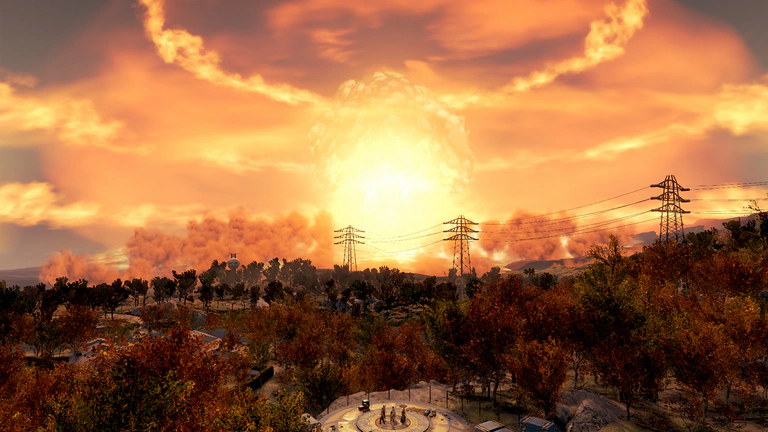
Boston was the capital city of the former state of Massachusetts in the New England Commonwealth until the nuclear holocaust of 2077.
As one of the birthplaces of American independence, Boston features countless major landmarks, including Bunker Hill, Massachusetts State House, the Old North Church and many more, complemented by remnants of American corporate glory, such as the Mass Fusion Building. Unlike many other cities, Boston also features one unusually successful Vault in the form of Vault 81, found at the westernmost limit of the city. Though it suffered due to the passage of time, it became a prominent settlement by the year 2287. The much larger Vault 114, located within Park Street station underneath Boston Common, was not completed by the time of the Great War.
Over 200 years after the Great War, the downtown core of Boston is fought over between various raiders, Triggermen gangs, super mutants, and even the occasional group of Gunners.
Background
One of the oldest cities in the United States, Boston was founded in the 1600s by settlers from the Kingdom of Great Britain. It was the scene of several key events of the American Revolution, such as the Boston Massacre, the Boston Tea Party, Paul Revere's "midnight ride," the Battles of Lexington and Concord, and the Battle of Bunker Hill, among many others. Upon American independence from Great Britain, the city continued to be an important port and manufacturing hub, as well as a center for education and culture. Boston's many firsts include the United States' first subway system and first public park.

Its rich history attracted tourists despite the overall economic deterioration of the U.S. The city was home to many attractions, such as the Charles River Esplanade, Boston Common, Bunker Hill, the Dorchester Heights Monument, the Museum of Freedom, the USS Constitution, and Fort Independence. Marked largely with brick, the Freedom Trail winds between Boston Common and the Bunker Hill Monument in Charlestown, linking historical sites and museums significant to the history of the United States, such as Faneuil Hall, the Old State House and the Paul Revere House. For those who liked sports, there was Fenway Park, which, since 1912, had been home to America's favorite pastime, baseball. Boston's baseball team, the Swatting Sultans, was set to compete in the annual 2077 World Series at Fenway Park in late October -- a game which, if they won, would have given Boston its first series win in over a century.
Prior to the nuclear holocaust, Boston had a thriving tech industry. The Commonwealth Institute of Technology (CIT) was a prestigious university located in Boston, contributing heavily to the city's research sector, with its staff affiliated with various labs, companies, and even the United States Armed Forces. Industry titans like Robert House were counted among the CIT's alumni. During the Great War, a number of CIT personnel survived by taking refuge in the underground levels of the campus. In 2110, the survivors and their descendants founded the Institute, an organization dedicated to furthering pre-War science according to their mantra "Mankind - Redefined." The artificial race known as the synths are one of the most significant creations to come out of the Institute.
During the resource crises of the late 21st century, Boston-based energy providers sought to corner the market by transitioning the city into running on nuclear power. Municipal plutonium wells were installed across the city, with Mass Fusion being among the first to commercialize such affordable energy sources. Their early-stage fusion distribution boxes were installed in many areas including residential streets. However, the design made it so that the customer had to open the lead-shielding panel in order to do a manual reset, which resulted in many complaints from customers suffering from radiation poisoning. Seemingly aware of this, Mass Fusion wrote their consumer contracts to include a clause absolving them of responsibility in these cases. The resulting waste production from Mass Fusion's market rush rapidly outpaced the company's ability to properly dispose of it, causing a crisis where their disposal sites were holding onto massive stores of nuclear waste for longer than was safe. From this, illegal dumping carried out by Mass Fusion and other companies such as Corvega and Saugus Ironworks gradually poisoned the environment around Boston.
The radiation seepage would creep into the rivers, lakes, and the harbor like the sewage of old. While citizens took both legal and physical action against the detritus, the local crustaceans would be the first to grow ever larger and poisonous. All of which would be ignored by the Boston Port Authority and the media; the former of who stopped taking calls from activists, particularly of the Nahant Oceanological Society, while the latter would spin the stories relayed to them into pro-government propaganda.
Corrupt to the core, the local municipal services of the Greater Boston area would routinely flout basic safety protocols and misallocate funds, such as the case with the entire municipal water system. Despite a decade-long (c. 2050—2060) plan of modernizing the city's aged sanitation systems, the new equipment procured and updated facilities was of poor quality and use. Such as the case of the Weston water treatment plant, with the catastrophic and systematic failures of the equipment, the facility was forced to compensate both in man-hours and even "experimental" waste water recycling. This lead to a cholera outbreak in 2077; to cover for this, the facility staff and regional municipal utility services would collude with other plants to swap out tainted water for clean, known as the "Weston WELLness press initiative."
As the Resource Wars continued, the food supply started to dwindle. Rationing sites were set up around Boston, including the Boston Police rationing site. In October 2077, an unknown person smashed the glass of the Roxbury food bank. Soldiers opened fire on civilians, with at least four confirmed dead and eight injured. This incident became known as the Roxbury Food Riot. Food riots started over the city, like in Denver.
The Great War
At least two nuclear missiles were launched against the Boston area during the Great War. One strike occurred in the region southwest of Boston proper, slightly limiting the damage to the surrounding area. Ground zero of the missile, however, became a highly dangerous area filled with high levels of radiation and lightning storms, and has in the post-War years become known as the Glowing Sea. A lower-yield missile struck nearby Cambridge, leveling an entire neighborhood and leaving a radioactive crater. As a result, Boston survived the war relatively intact compared to areas like Washington, D.C., with places such as Fenway Park having provided safety from the bombs. However, the loss of government and infrastructure led to societal collapse, with looting and violence occurring across the city. Surviving military forces attempted to restore order but ultimately failed.
Over the ensuing centuries, survivors reestablished pockets of civilization throughout the urban ruins of Boston. Fenway Park became home to Diamond City in 2130, which quickly grew to become the largest and most prominent settlement in the Commonwealth. Goodneighbor was subsequently founded in Scollay Square in 2240 by criminals exiled from Diamond City, becoming a haven for those with nowhere else to go. At some point, the Bunker Hill Monument also was resettled as the hub of a regional caravan trade network. However, these settlements are forced to coexist with the many dangers also plaguing the city: gangs of raiders, super mutant warbands, hostile Gunners mercenaries, Triggermen gangsters, and more, all carving out their own pockets of territory and all seeking to take more.
Cambridge
Cambridge is located on the north side of the Charles River, bordering Charlestown to the east.

Before the Great War, it was famous for the Commonwealth Institute of Technology and numerous prominent R&D centers nearby, such as Greenetech Genetics and Cambridge Polymer Labs. The Red Line of the MTA provided metro service from Cambridge to downtown Boston via College Square station, while several bridges such as Longfellow Bridge and Ivy League Bridge connected the district to the roads of downtown.
When the Great War brought devastation to the world, Cambridge received a direct hit which leveled an entire block and left a sizable crater in its wake, although much of the district was spared from the devastation. Among the survivors were staff and students of CIT, who eventually founded the Institute in 2110 beneath the CIT ruins, and permanently sealed themselves off from the surface in the 2180s after failed attempts to coexist with the surface and the creation of the molecular relay. Since then, Cambridge has been left to its own devices, divided between feral ghouls clustering around the crater, raider gangs operating along the Charles River, and the odd super mutant warband. Around 2287, Recon Squad Gladius arrived in Cambridge as the third long range recovery expedition sent by the Brotherhood of Steel, but they have fared poorly due to relentless attacks by local wildlife and other inhabitants, human or otherwise.
Charlestown
Charlestown is located on a peninsula north of the Charles River, across from downtown Boston, and adjoins the Mystic River and Boston Harbor. It also separated from Cambridge to the west by an elevated freeway. In 1775, Charlestown was the site of the Battle of Bunker Hill, a key battle in the Revolutionary War.

Prior to the Great War, Charlestown was also home to the regional office of the Bureau of Alcohol, Drugs, Tobacco, Firearms and Lasers, a federal agency involved in a massive investigation of organized crime around Boston.
Charlestown's old wooden row houses and colonial architecture are still present in 2287. The neighborhood is primarily controlled by raiders, with scavengers to the south and along the river. It is dominated by two old monuments: Bunker Hill and the U.S.S. Constitution, the former of which has since become a hub of regional trade and the latter of which is now crashed atop the Weatherby Savings & Loan building, its robotic crew intent on completing its voyage into the seas.
The Fens
West of Back Bay, this neighborhood was originally a parkland and urban wild within the heart of Boston. By the 2070s, the neighborhood was connected to MTA's Green Line via Fens Way station and was patrolled by Precinct 8 of the Boston Police Department. A serial killer known as the Fens Phantom operated in the neighborhood, making his lair in its sewers, killing dozens of civilians and leaving several holotapes addressed to the detective assigned to the case. Fenway Park, home to Boston's baseball team, the Swatting Sultans, was located in the neighborhood and was to be the site of the last game in the 2077 World Series, which was interrupted by the bombs falling.

Currently, the Fens is home to Diamond City, "the Great, Green Jewel of the Commonwealth," the largest settlement in the Commonwealth, built within Fenway Park. Diamond City security also maintains a relatively safe radius around the settlement's exterior. The rest of the neighborhood, however, is occupied by various gangs of raiders and super mutants.
East Boston
East Boston is a neighborhood that was created by using land fill to connect several small islands. It is separated from the rest of the city by Boston Harbor and is bordered by Revere and the Chelsea River. Directly west of East Boston, across Boston Harbor, is the North End and Boston's Financial District. A vehicular tunnel was constructed at some point to connect East Boston to the rest of the city.
Before the Great War, East Boston Preparatory School, originally a Catholic prep school, was converted into a secular institution by local activists aiming to serve the local immigrant population. East Boston was also home to Boston International Airport, a major East Coast transportation hub located on the southern end of the peninsula. The airport was connected directly to Downtown via the MTA Blue Line. Another major construction project in the neighborhood was RB-2851. Jointly operated by General Atomics and the U.S. Army, this massive underground facility was a clandestine experimental Robobrain production site, with its main entrance hidden as a humble RobCo Industries service center.
When the nuclear weapons were launched, East Boston was spared from a direct hit, but not the immediate effects. Numerous planes flying to and from Boston Airport crashed. Many of the neighborhood's lower areas flooded, a problem exacerbated by rising sea levels. The tunnel crossing the harbor between East Boston and central Boston have also collapsed as a result of the devastation.
As of 2287, East Boston is mostly uninhabited, though not completely. The Triggermen have repurposed Easy City Downs, a former horseracing track, into a robot racing track. A significant raider gang in the area is based out of East Boston Preparatory School, and is known for harassing traders from Bunker Hill to the west. Boston Airport is plagued by feral ghouls, but is quickly secured by the Brotherhood of Steel once they enter the Commonwealth. Finally, RB-2851 has been reoccupied by a costumed character who made it her lair with the intention of using its long-dormant mechanical production lines to help bring order to the chaotic wasteland.
Esplanade
Part of Back Bay, the Charles River Esplanade was a park along the bank of the Charles River. Commonwealth Avenue is the main east-west thoroughfare along the southern edge of the neighborhood, parallel to the riverfront Storrow Drive. It runs from the Holy Mission Congregation church in the west to Boston Common in the east. The thoroughfare is divided by a wide median planted with trees, and is lined by pre-War mansions.

Two centuries after the Great War, the Esplanade's waterfront mansions still exhibit the faded grandeur of times gone by. In 2287, control of the neighborhood is contested by raiders and Gunners, the latter of which are intent on exploring HalluciGen, Inc., the headquarters of a pre-War biochemical research firm which has since begun leaking chemicals. Meanwhile, a secret society calling themselves the Pillars of the Community has made their home within the Charles View Amphitheater.
Back Bay
Originally a tidal bay that was later filled in, Back Bay technically includes the Esplanade to the north. Otherwise, the neighborhood is bounded to the west by the Fens and to the east by Boston Common and the Theater District. The Massachusetts Turnpike, a major interstate highway, forms the southern boundary of the neighborhood from the eastern terminus of Mass Pike Tunnel.
This neighborhood was once known for its numerous brownstones, considered one of the best preserved examples of 19th-century urban design in the United States, as well as individual architecturally significant buildings and cultural institutions such as the Boston Public Library and Trinity Church. This, however, did not stop new construction, such as that of Trinity Tower, which came to dominate the skyline as one of Boston's tallest skyscrapers (second only to the Mass Fusion building). Prior to the Great War, the corporate HQ of Wilson Atomatoys was located here. Another notable storefront was that of Hubris Comics, which doubled as a television studio for the planned adaptation of the locally popular franchise The Silver Shroud.
Trinity Tower survived the Great War relatively intact, but other structures were not so lucky. By 2287, the neighborhood is now divided between bands of raiders, super mutants, feral ghouls, and packs of wild mongrels.
Beacon Hill
Beacon Hill is one of the most desirable and expensive neighborhoods in the city. It became home to affluent citizens of Boston such as the Cabot family, who built their ancestral manor in Louisburg Square in 1711.
Beacon Hill continued to be known for its historic architecture, pleasant quality of life, and its status as the "gateway to the Financial District" through the pre-War era. The neighborhood also housed the regional headquarters of the Vault-Tec Corporation, as well as the Boston Bugle building, home of the Boston Bugle newspaper.
Two centuries later, Beacon Hill is a far less desirable place, with bands of raiders jostling for control and many structures decimated by the ravages of war and time. Cabot House, on the other hand, appears almost untouched by the war, and is still occupied by the reclusive Cabot family.
North End
The North End is one of Boston's original neighborhoods. Some of its historical buildings were preserved even after the Great War, such as the Paul Revere House and the Old North Church, the latter of which used in 1775 by Paul Revere and Robert Newman to warn about the British advance on Lexington and Concord. The Freedom Trail, a tour walking route for historic landmarks of Boston, also ended in the North End, originating from Boston Common and culminating in a stop at the Old North Church.

The North End remained largely unaffected by Boston's later modernization, living in the shadow of the elevated highways cutting through Boston and the Financial District's massive skyscrapers reaching towards the sky. The wharf continued to serve shipping interests, and life went on all the way until the Great War.
In the 2070s, the Italian mafia under Sal Barsconi controlled criminal enterprises in the North End and northern Boston. They briefly collaborated with the South Boston Irish mafia under Eddie Winter in the interest of improving relations, but this soon fell through and only widened the divide. Furthermore, this was actually a trap by Winter, directly implicating Barsconi and his associates as part of a federal investigation. This was part of Winter's manipulation of Operation Winter's End, a task force originally set up to bring him down, ending in its complete subversion.
Despite superficial damage, the North End weathered the nuclear holocaust rather well. Even two centuries after the War, most of its buildings remain standing and in habitable condition, including the Old North Church, which the Railroad has moved into after the loss of its former headquarters, the Switchboard. The district's densely packed alleyways are also a haven for roving bands of super mutants and raiders, concealing the Railroad from prying eyes. However, other clandestine creatures stalk the night here, such as Pickman, a killer preying on the hapless raiders.
Boston Common
Boston Common has been called the oldest public park in the United States. Established in 1634, Boston Common started as a communal grazing ground for cattle before being made a public park. Directly prior to the Revolutionary War, Boston Common was used as a camp by the British infantry, from which they left to march on Concord (leading to the Battles of Lexington and Concord and the start of the Revolutionary War).

Other structures on the Common's perimeter included the Boston Public Garden, a public botanical garden, as well as the Massachusetts State House, completed in 1798 to house the state government (replacing an earlier building in the Financial District).
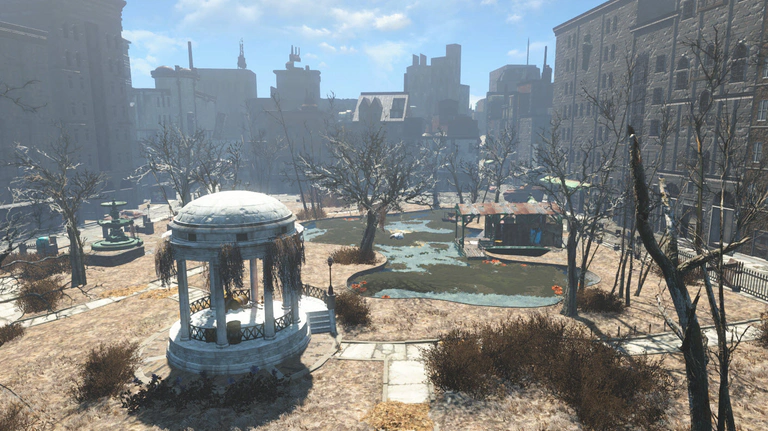
As time marched on and Boston grew, the Common became the nexus of the city south of the Charles River, an idyllic park surrounded by historic mansions. The Common's main attraction was its swan pond, which featured ornate swan boats which could be used by parkgoers. Another major tourist attraction was the Freedom Trail, a walking route to tour various historical sites around Boston. The trail's origin was at the Common, with its first stop at the State House before continuing further into the city.
The Common changed over the years with the advance of time and technology. Some of these changes were beneficial, such as the construction of Park Street station to provide metro service to the area, and the installation of a Protectron tour bot for historical engagement and directions for tourists following the Freedom Trail. Others were less so: the city sold so much of the surrounding land to property developers that the Public Garden was forced to merge into the Common. Consequently, the size of the swan pond was reduced several times to become that of a "glorified puddle," to the chagrin of the groundskeeper, who lamented the disappointment to tourists.
Park Street station remained in service well into the 2070s, when it was purchased by the Vault-Tec Corporation to serve as a pre-excavated site for one of their Vaults: Vault 114 would house Boston's upper class, including its business and government elites, but in secret, it was an experiment to test said affluent residents' reactions to a Vault with cramped, communal spaces and none of the amenities that might be expected by the upper class. However, the Vault remained unfinished by the time the Great War struck, whether intentionally (perhaps as a product of corruption, a scam job putting union workers on payroll for a project intended to go nowhere) or not. With the Great War, the Common itself was left to decay, abandoned like much of the rest of Boston. This was the state of things until the arrival of Edgar Swann, an Institute worker turned FEV test subject who was exiled to the Commonwealth following undesirable test results. Swann made his home in the groundskeeper's shack near the swan pond. He eventually lost his mind to the effects of the FEV exposure, and by 2287 has mutated into a super mutant behemoth, wearing the former swan boats as armor.
Since Swan's arrival, Boston Common has developed a fearsome reputation as a place to be avoided at all costs (ironically making it appear as one of the most peaceful places in the city). There are widespread stories that no one who enters the Common ever comes out alive, though not many know that Swan is the cause of the danger, and even his existence is subject to rumor. This reputation is so strong that even the raiders who dominate the surrounding neighborhoods won't follow their prey into the Common, and various groups including the Railroad have since built numerous signs around the Common warning visitors to stay away. This has not stopped people from trying, whether they are simply uninformed, out of options, or overly daring (one raider group even set up fortifications in an attempt to take out Swan); their remains are strewn around the Common, a morbid sign of the danger within.
The Common has not remained totally abandoned. For one, the Freedom Trail has been co-opted by the Railroad, who use it to make contact with outsiders trying to seek them out. By 2287, despite its unfinished state, Vault 114 has since become the hideout of Skinny Malone's crew of Triggermen, who discovered the Vault after being muscled out of Goodneighbor, their old territory.
Financial District
The Financial District was the commercial center of Boston, and one of the city's most modernized districts prior to the Great War. Despite the heavy development, some vestiges of historical Boston can still be seen in the district: the Old Corner Bookstore, home to the historic publishing house Ticknor and Fields and visited by many eminent authors of the mid-19th century; Faneuil Hall, a colonial-era merchant hall and a stage for protest activities during the Revolutionary War; and the Old State House in Scollay Square, the oldest public building in Boston and the former seat of Massachusetts' government before the construction of the "new" Massachusetts State House. Each of these landmarks became tourist stops on the Freedom Trail, which runs south-to-north through the Financial District, entering from Boston Common and continuing to the North End.

Surrounded by the elevated freeway (and monorail) providing access through and between downtown Boston, the Financial District was home to some of the tallest skyscrapers of Boston's pre-War skyline. The tallest skyscraper in Boston by height (with Trinity Tower coming close second), the Mass Fusion building (headquarters of Mass Fusion) dominated Boston's skyline with its unique architectural design, accompanied by other, smaller corporate towers such as the Baxter building or 35 Court built along Congress Street. The district was also serviced by two metro stops: Scollay Square Station and Postal Square Station.
Many of these structures did not survive the Great War intact. Over time, parts of buildings if not entire buildings have collapsed, littering the streets with their rubble. What structures are left standing often have gaping holes and whole missing sections, the tallest of which are sometimes no more than skeletal. The result is that enterprising explorers are just as likely to fall to death as they are to succumb to the hostile super mutants, raiders, or Gunners competing for territory. Much of the elevated freeway has survived, and provides vertical access to the rooftops and upper floors of various buildings, as well as a relatively safe method of cutting through the city center.
Meanwhile, the historic Scollay Square has become the site of another settlement, Goodneighbor, founded in 2240 by criminals exiled from Diamond City. It has since grown to be the second-largest settlement in the Commonwealth, home to ghouls, drifters, and outlaws who just didn't fit anywhere else.
Theater District
One of the theaters in this district was the Orpheum Theatre. By the 2070s, the district was connected to the MTA's Orange Line via the Medical Center metro, located next to the Mass Bay Medical Center. After the bombs fell, the Mass Bay Medical Center was quickly commandeered by the remnants of the U.S. military to treat victims of the nuclear detonations and resulting fallout.

Since the war, some entertainment has been revived by Southie ghoul Tommy Lonegan, who turned the Orpheum Theatre into a public cagefighting arena called the Combat Zone; it was taken over by raiders in 2285 and has been exclusive to them ever since. Meanwhile, Bosco's gang of raiders, who control much of downtown Boston, are headquartered in D.B. Technical High School. Much of the rest of the district is divided between Gunners and super mutants battling each other for territory, while other locations are quieter but no less dangerous. An example is Hester's Consumer Robotics, an old robotics store close to the freeway, which is avoided by scavengers, who believe it to be a "deceptive trap."
Boston Harbor/Waterfront
Boston Harbor was the site of the Boston Tea Party, a protest against British taxation of the colonies and a key event in the buildup to the Revolutionary War. In time, the waterfront district came to feature many landmarks of its own, such as Long Wharf; the Shamrock Taphouse, a bar rumored to have been patronized by Paul Revere; and the Custom House Tower.

By pre-War times, the harbor was widely used for both recreational and commercial activities, such as swimming and fishing. However, this was perhaps ill-advised: the citywide adoption of nuclear power, plus unrestricted industrial activity and illegal dumping by companies such as Mass Fusion, Corvega, and Saugus Ironworks, had led to radiation and heavy metals contaminating lakes, waterways, the harbor, and even the oceans at large. Municipal officials turned a blind eye. Although environmental groups such as the Nahant Oceanological Society took legal or physical action to spread awareness of how radiation was mutating marine wildlife, the Boston Port Authority simply stopped taking their calls, while Galaxy News Network spun their warnings into positive news for fishing.
Since the war, Boston Harbor has become littered with the hulks of wrecked ships amid other flotsam and jetsam. Now, past its shallow waters, the harbor is among the most dangerous (and soggy) neighborhoods of Boston, inhabited by mirelurks, super mutants, raiders, and scavengers. There have also been stories of a sea monster lurking in the harbor, which is actually the Yangtze-31, a Chinese submarine that fired its warheads at Boston during the nuclear onslaught and has since been stranded by a naval mine. Over the centuries, its ghoulified captain has come to regret the suffering he helped cause.
South Boston
South Boston, nicknamed Southie, is separated from the rest of the neighborhoods by the elevated freeway to the west and the bay to the east and north.

The Castle is a historic landmark in South Boston, dating back to the pre-Revolutionary period; by 2287, the site is more than 600 years old. Built on Castle Island, it was one of the first forts in the United States, and provided harbor defenses for the city of Boston. The final iteration of the fort was built in the early 19th century, also to provide maritime defense. The fort's name also changed over time; it was originally named Castle William before being renamed to Fort Adams, and was then renamed to Fort Independence in 1797 during a ceremony presided over by President John Adams. In the 19th century, Edgar Allan Poe was stationed at Castle Island and was inspired to write "The Cask of Amontillado" based on an early Castle Island legend. Since the Great War, the name of Fort Independence has fallen out of favor, with most residents of the Commonwealth referring to it simply as the Castle.
By the 2070s, the neighborhood was serviced by the MTA via Andrew station and its locale patrolled by the Boston Police Department from its local precinct.
At this time, the neighborhood was a rough one, with military blockades keeping order. Its police were known to be trigger-happy, and looming over it all was the local Irish mafia, controlled by the infamous and monstrous Eddie Winter. At that time, the relationship between his and the North End Italian mafia was sour. Under the guise of improvement, they would operate a job as a joint enterprise, its failure would accelerate the deterioration of their relations and implicate them directly as a part of a federal investigation. This was a part of Winter's manipulation of Operation Winter's End, ending in its complete subversion. His victory was short lived, as not long afterward, the Great War would occur.
Nearly two centuries later, the neighborhood would have different power brokers. The Castle was the headquarters of the Commonwealth Minutemen. They would be driven from their stronghold by mirelurks in 2240. By 2287, the neighborhood is home to raiders (with Chancer's gang in particular operating from Andrews station), super mutants and mirelurks. A different syndicate, Marowski's, would be operating a chem lab in the Four Leaf Fishpacking plant.
Sources
Adapted from the original article, under CC BY-SA 3.0.