Thing
T-51 power armor
The T-51 power armor series was the pinnacle of mechanized protection before…
The T-51 power armor series was the pinnacle of mechanized protection before the Great War, providing a valuable balance of protection and mobility. Formally designated Powered Infantry Armor Model T-51, it was created by West Tek under contract from the United States government, and represented the company's single largest contract. Following a ten year development cycle, the T-51 finally entered service in June 2076, after final testing at Fort Strong. The newly equipped units proved incredibly effective against People's Liberation Army forces, and were instrumental to the success of Battle of Anchorage, commonly thought to be the series' debut on the battlefield. In particular, their use minimized casualties sustained by the military in the attack. It remains prized after the Great War for its protective qualities.
It is also the very first type of power armor introduced in the Fallout series, prominently displayed on the cover of the first game, and featuring in virtually every game since.
Background
Following the successful deployment of the first operational power armor in 2067, the T-45 power armor model, West-Tek began development on an improved model. By 2069, it was the largest defense contractor of the United States government, with the T-51 series development their largest contract.
The development of T-51b prototypes hastened as the T-45 series underperformed in mainland China after the 2074 invasion. Test models were trialed in combat conditions at Fort Strong in Massachusetts from 2075 onwards, providing essential data to finalize the design. A prototype tested in September 2075 had the desired mobility and protection but landing tests proved the armor lacked stability. Gyroscopic stabilizers and shock absorbers were subsequently added to rectify the situation. The first production run of T-51b suits was sent to China in June 2076, immediately outperforming the T-45.
Their impact was tremendous, with some Chinese troops eventually surrendering as soon as they spotted soldiers wearing T-51b, carrying 5mm miniguns. The renewed American offensive caused Chinese supply lines to break down. However, the T-51 demonstrated the full scope of its abilities in January 2077, when General Constantine Chase secured victory in Anchorage Reclamation, thanks to his mechanized troops equipped with winterized T-51b power armor and spearheading the assault. Their deployment significantly reduced casualties once past the Chinese pulse field, despite issues with adapting them to the cold. The operation was considered a full success, reclaiming Alaska for the United States after eleven years of war.Fallout 3 Official Game Guide Game of the Year Edition p.43: "Chinese Army (Simulated), U.S. Army (Simulated) With conditions deteriorating between the United States and China, a military presence in Alaska was established to prevent a possible invasion across the Bering Strait. With increasingly scarce oil reserves, a last deep-sea deposit below the Pacific Ocean was claimed by China before allegedly being sabotaged by American special operatives. Strained relationships spiraled downward into conflict as China marched on Alaska, and the Sino-American War of 2066—2077 erupted. Under the command of General Jingwei, the Chinese Army usurped control of Alaska's oil pipeline and reserves. In response, the Americans began what came to be called "The Alaskan Reclamation Operation" (2067—2077). Under the leadership of General Constantine Chase, the U.S. Army battled fiercely to the front lines of the conflict before Chase began deploying specialized Power Armor units that began pushing the Chinese back. Future Power Armor suits were further refined as the conflict dragged on, and the Trans-Alaska Pipeline was reclaimed. With resources flowing through Canada, strained diplomatic tensions between Canada and the United States becoming problematic, and Canadian forces attacking the pipeline, the country was annexed. A combination of inclement weather, constant American bombardment and trench warfare, and U.S. Powered Armor unit attacks sweeping through mainline China, the Chinese supply lines weakened and finally broke down completely. By the beginning of 2077, the city of Anchorage was finally liberated, the Chinese eradicated, and the operation deemed a success. A commemorative memorial was erected in Washington, D.C., in honor of the soldiers who fought and perished for the greater American good. Violence between America and pockets of Canadian freedom fighters continued throughout 2077, until the Great War obliterated almost all infrastructure, commerce, and human life." (Fallout 3 Official Game Guide faction profiles)
Military units equipped with the T-51 were also deployed to quell resistance fighters in occupied Canada, following the U.S. annexation. Soon, they were also deployed against Americans: On January 22, 2077, the first domestic use of power armor occurred, in order to break protests and enforce quarantine. Veterans of China and Alaska faced themselves fighting their own countrymen, leading to a string of desertions across North America, as food riots escalated.
Although recognized as the peak of power armor design and associated with U.S. victory at Anchorage, the T-60 power armor series, which was deployed after the Battle of Anchorage and became a common sight in U.S. military engagements before the Great War, was ultimately the most advanced power armor series to see production and deployment on a mass scale. After the Great War, the T-51 was utilized by various wasteland factions, including the Brotherhood of Steel, mercenaries, and the Enclave.
Design
The T-51 power armor was considered the pinnacle of mechanized protection before the Great War, designed using the latest in passive defense features to create a versatile, adaptable design capable of excelling in multiple combat situations. Its key advantages include greatly increased strength, a high degree of protection, and relatively light weight, giving it excellent speed. To achieve optimal performance, the armor has to be custom-fitted to each operator. A properly fitted armor worn by a well-trained operator feels like an extension of one's body.
The base frame uses a back-mounted TX-28 MicroFusion Pack outputting 60 kilowatts of power, powering the HiFlo hydraulic systems providing increased strength to the user. These systems allow the operator to handle miniguns and other crew-served weapons like small arms. The protective armored shell is made from poly-laminate composite capable of absorbing over 2500 joules of kinetic energy, and is covered with a 10 micron ablative silver coating, for protection against lasers and ionizing radiation. The shape is also rounded, improving deflection. The armor's properties can be further increased through a special hardening process. The helmet is highly protective, enclosing the head in an armored shell with a bullet-resistant visor mounted. Although it can be effectively bulletproof against low-powered cartridges, it can still be penetrated by higher powered cartridges.
In terms of utility, the ear ports provide mounting points for accessories, with a drop-down visor available as standard. The head-mounted light provides illumination in low light conditions. The armor can be made airtight, with the resulting seal allowing the operator to operate in contaminated or irradiated areas for extended periods of time. The armor is also fitted with a recycling system, recycling urine into drinkable water, allowing a user to theoretically survive for weeks without water supplies.
T-51b power armor
The most ubiquitous model of power armor typically features a solid olive green livery on the breastplate and pauldrons, with the base light gray on the limbs and helmet.

Winterized T-51b
A pre-War variant of the T-51b power armor adapted for fighting in Arctic environments. The most noticeable difference is that the armor is painted a pale blue hue to blend in with the snowy environments and bears explicit livery of the United States Army (Army stars on the pauldrons and the national flag below the TX-28 fusion pack. The serial number is also printed on the left side of the chest plate.

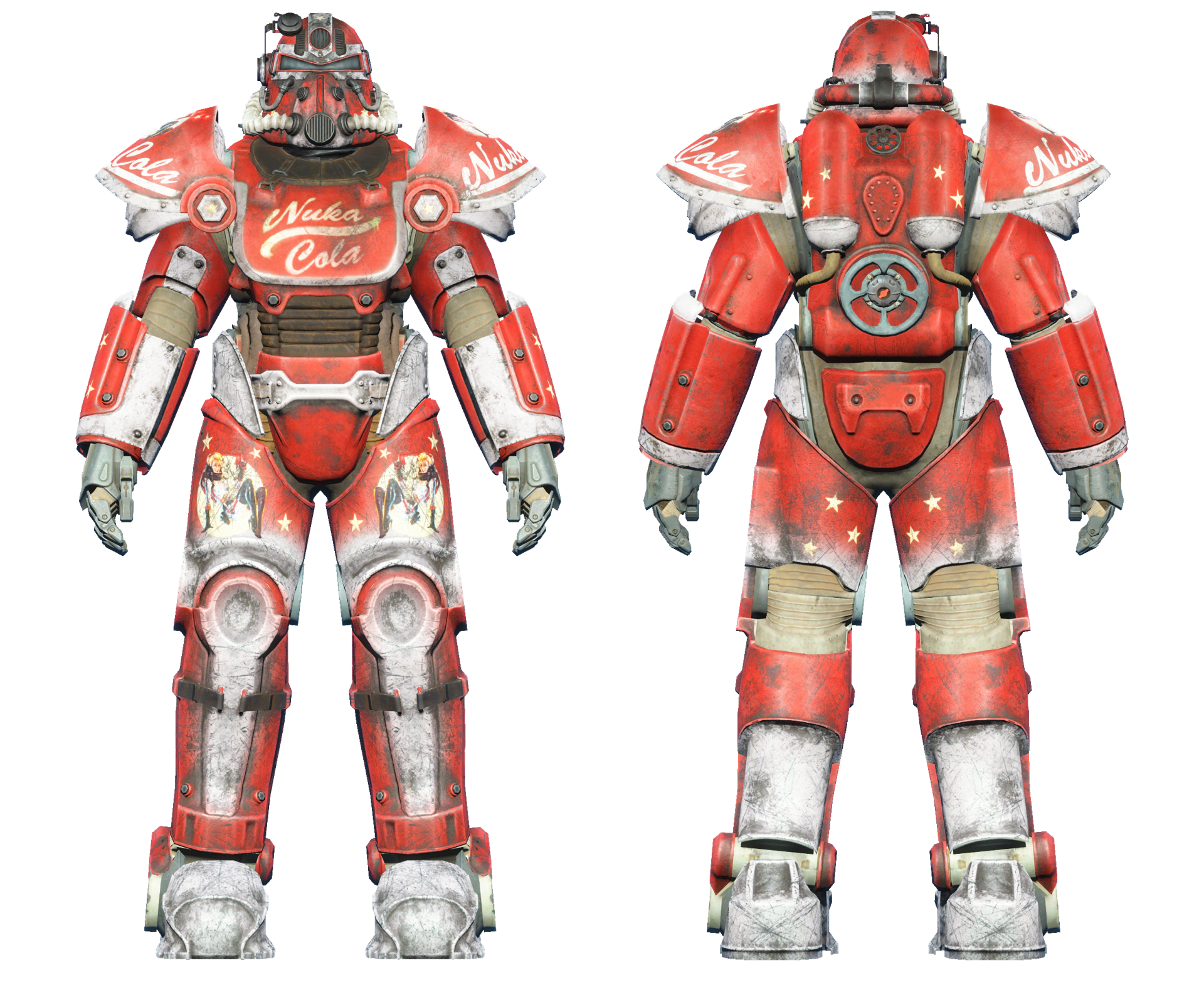
Nuka T-51
Branded with Nuka-Cola Corporation logos and colors, this set of T-51 was put on display in the World of Refreshment boat tour ride at Nuka-World.
Brotherhood T-51b
A post-War variant of the T-51b, used by the Brotherhood of Steel as its service armor in New California and children chapters of Lost Hills. The olive green coloring of the armor has faded entirely and was replaced with a pale gray color overall. Brotherhood suits are kept in a state of good repair, with the usual streaks of rust and damage found on suits in the wasteland noticeably absent. The Brotherhood sigil is painted on the left pauldron, as per standard practice.

Ultracite power armor
This power armor was based on the T-51b while using Ultracite for the armor plating. The Ultracite power armor was a post-War creation developed by the scribes of the Brotherhood of Steel in Lost Hills and in Appalachia. Intended as a tool to help the Appalachian Brotherhood fight the Scorched Plague, no production models were created as the Appalachian Brotherhood was ultimately overwhelmed by the Scorched, and the Brotherhood in California lacked any ultracite to manufacture it.

Strangler heart power armor
This is a suit of Ultracite power armor that was consumed by a strangler heart, but is otherwise functional. In fact, its envelopment by the strangler heart has actually strengthened its resistances.

Grafton Steel prototype steel mill helmet
An experimental offshoot of the T-51b built by Grafton Steel as part of a federal contract, Project Phoenix. Intended to act as a form of civilian power armor for industrial use, it never moved past the prototyping stage, and only the helmet was produced.

Sources
Adapted from the original article, under CC BY-SA 3.0.