Group
People's Liberation Army
Military wing of the Chinese Communist Party
The People's Liberation Army was the military wing of the Chinese Communist Party and the armed forces of the People's Republic of China, comprised of both the ground units of the Chinese Army and the Chinese Navy. It was the principal foe of the United States Armed Forces during the Sino-American War of the Resource Wars, and may have been the first to unleash nuclear weapons during the Great War, pressed against the wall by the United States. Despite the defeats suffered, it was considered to be one of the best fighting forces on Earth as late as 2077, by foes no less.
The PLA is referred to by a number of alternative names, such as the Chinese Red Army or just Red Army. A fictionalized version of the People's Liberation Army, renamed to the Red Vipers, are the antagonists of the American Armor Ace and the Power Patrol television cartoon, led by the Subjugator, the "Secretary of Oppression."
Background
Answering to Chairman Cheng, the People's Liberation Army played a crucial role in maintaining the nation's influence worldwide. They played a pivotal role in the Resource Wars, responsible for fighting the United States and its armed forces during the Sino-American War, from the initial invasion and occupation of Alaska in 2066 to a defensive war in mainland China in the wake of the 2074 American invasion.
Great War
When it became apparent that the United States would not stop until China was completely destroyed, China launched its nuclear weapons. At 09:13 EST, the Integrated Operational Nuclear Detection System detected the first four missile launches and the United States went to DEFCON 2. Four minutes later, NORAD confirmation sealed the fate of the world. At 09:26 EST, the President ordered a retaliatory strike according to scenario MX-CN91. As American weapons were launched, Chinese nukes hit Pennsylvania and New York at 09:42 EST. By 09:47 EST, most American facilities started going offline. Submarines that penetrated coastal waters also launched their SLBMs, such as the Yangtze-31. The East Coast had minimal advance warning, as nuclear strikes first hit the West Coast.
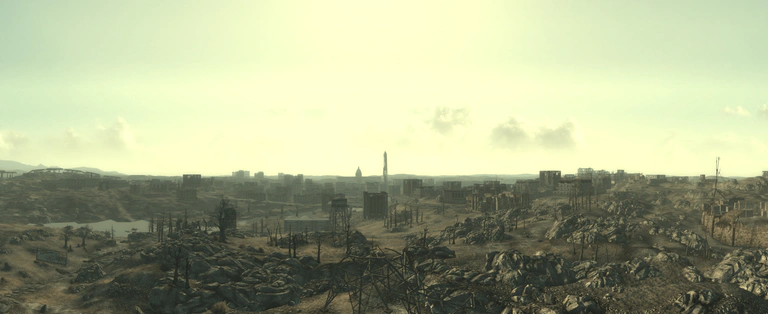
The attack took the United States by surprise, resulting in mutually assured destruction. Both sides ceased to exist, with the nuclear bombardment devastating American cities and states. Most of the East Coast north of West Virginia was turned into a blasted, lifeless wasteland, with strategic locations like industrial Pittsburgh turned into hellish landscapes plagued by nuclear fallout and chemical contamination. The PLA's strategic forces focused in particular on Washington, D.C., the American seat of power, with the severity of the bombardment leading to rumors that it was nuked flat. Within two decades, the region became known only as the Capital Wasteland, known for its poisonous mists, and utter desolation that managed to drive even the most loyal soldiers to flee. Other targets that suffered particularly hard were Los Angeles, the Californian West Tek research center, and Salt Lake City, hit with 13 warheads and turned into an unrecognizable moonscape. In a particularly severe case, California's Orange County was obliterated and turned into a coastal bay.
Some secondary targets, like Las Vegas and the adjacent Nellis AFB, escaped destruction. The PLA's nuclear arsenal was unable to overcome the missile defense set up by Robert House and centered in Lucky 38; 68 of the 77 warheads aimed at the Mojave were disabled or shot down.
Aftermath
The War severed contact between PLA forces outside China and their command. Covert operations on American soil found themselves leaderless and without a clear purpose. Some, like Chief Station Xi of the Fujiniya Intelligence Base, ordered his men to leave and assimilate with the local population to continue their struggle independently. Some took their own lives, deserted or went rogue, and others continued the secret war against what remained of the United States and capitalism. Chief among these were members of Operation Trinitite in Appalachia and the Chinese remnants in the Capital Wasteland, who became ghouls in the aftermath of the nuclear war. Led by a mysterious pre-War agent described only as "very loyal to the cause", they were someone Americans did not want to meet. They survived even the wide-reaching sweeps of the Appalachian Enclave under President Thomas Eckhart, which caught remnants of Fujiniya in their dragnet, with predictable results. The Enclave actually restarted production and deployment of Liberators, in a bid to convince the Appalachian Automated Launch System and SAC that a Chinese invasion was in progress and restart nuclear missile silo operation to sustain nuclear bombardment of the Chinese mainland.
Over the next 200 years, what remained of the PLA slowly withered away. The most successful and non-ghoulified surviving community, the Shi of San Francisco, shed their PLA roots, instead embracing a quasi-Imperial identity built around the Emperor (an ancient mainframe salvaged from the Shih-huang-ti nuclear submarine that had beached in the ruined city). Beyond that, only artifacts remained; traces of the PLA's covert operations in the Capital Wasteland, including the Chinese Army mobile HQ, weapons and uniforms, and the occasional nuclear submarine stuck for two centuries in a bay, captained by a remorseful Navy captain, or other small fortified holdouts.
Army
The army was responsible for land operations, ranging from conventional warfare on all fronts of the war to subterfuge and infiltration in mainland America. The People's Liberation Army focused on firepower rather than personal protection: Chinese soldiers were issued jumpsuits rather than hard combat armor, though the Type 93 assault rifles were more powerful than the American equivalent R91s. Less commonly seen were Red Victory grenade rifles, which were faster to reload but did less damage than American Great Bear grenade rifles, even being used by American personnel for that very reason. Chinese tanks were an integral part of the doctrine, used to support infantry operations during the invasion of Alaska. However, when they were countered by early power armor Americans deployed, China realized that it had no analog and rushed to create its own versions.
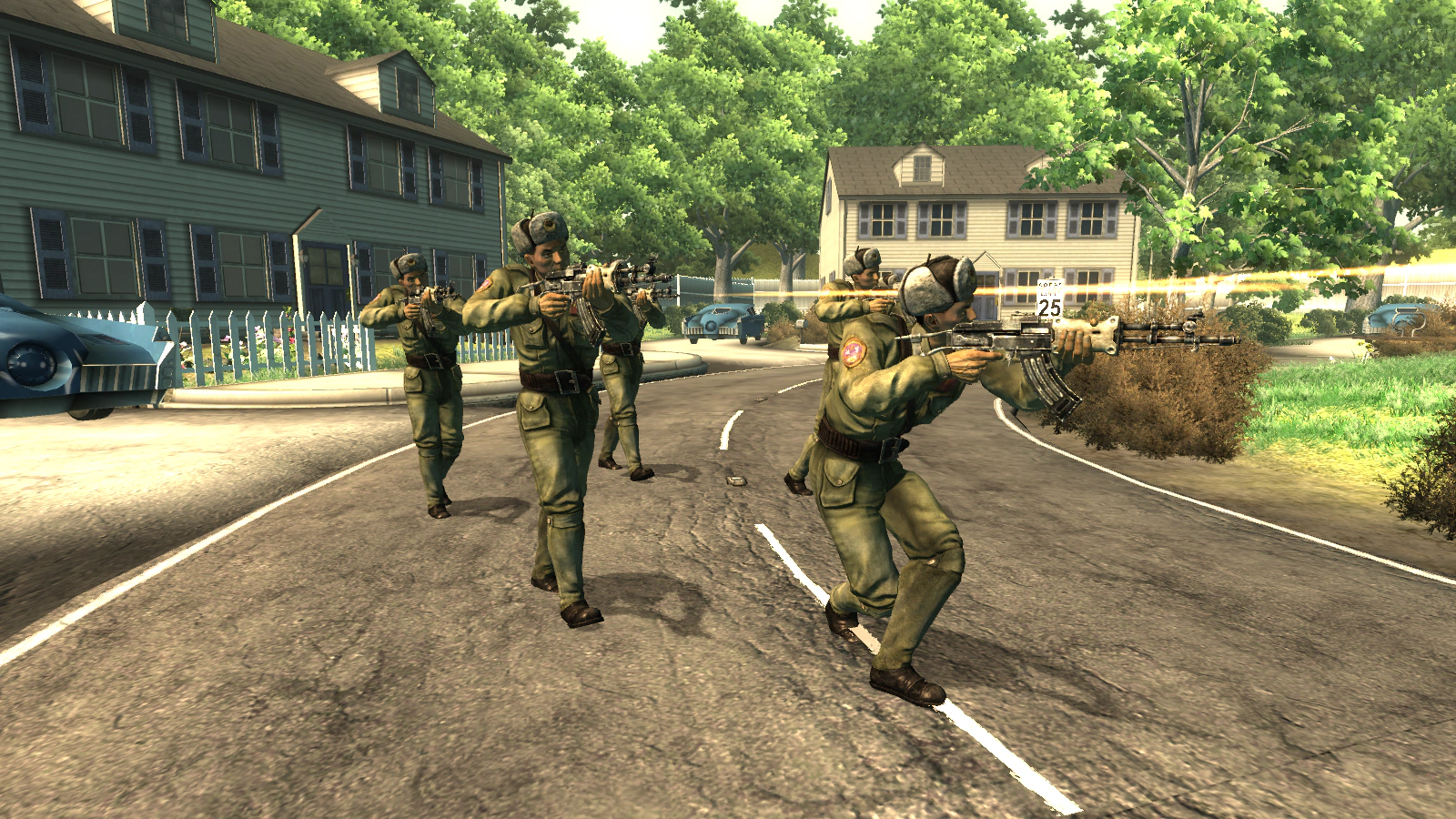
The Chinese had an extremely effective intelligence and security apparatus. Apart from concealing its stealth research, Chinese operatives infiltrated mainland United States and set up an extensive covert network of spies and intelligence operatives. China even managed to set up regular patrols by Chinese submarines, such as the SSN-37-1A. In an Operation: Anchorage cut note, there is mention of Chinese saboteurs attempting to sabotage the Hoover Dam in Nevada.
The largest of their spy networks were located in and around Washington, D.C.; Soldiers, operators and spies from the elite Iron Army operated out of a fake food processing factory in Arlington under Mama Dolce's. Apart from intelligence and assorted military operations, the network engaged in psychological warfare, through the People's Republic of America and its radio. Further safehouses and field operations established at various locations, including a listening post in the Taft Tunnel, the bunker at broadcast tower KT8 and an abandoned safehouse in the Pitt's abandoned apartments. Chinese spies also had a strong presence in Point Lookout, especially in the abandoned Chinese intelligence bunker, and around strategic locations like the Mount Desert Island Naval Base. The PLA had also commandeered American robots, such as Protectrons, utilizing them as clearance points for undercover agents.
The army also maintained a covert intelligence network in Appalachia, codenamed Operation Trinitite. Fujiniya Intelligence Base was originally tasked with identifying and destroying alleged factory cities located in Appalachia, but after these rumors proved untrue, it shifted to intelligence gathering on the Appalachian Automated Launch System, stealth tech research, and refining the infamous Liberator robots. At the same time, a detachment of infiltrators was operating covertly beneath The Whitespring Resort. Their mission was the acquisition and operation of a Motherlode drill, presumably to tunnel into the Whitespring Congressional Bunker, in an attempt to capture it and its secrets. However, the Great War brought a halt to the mission. As of 2103, the operations are still ongoing despite a lack of success, with ghoulified remnants pursuing other targets of opportunity under communist commissars and a mysterious, incredibly loyal leader.
Navy
The Chinese Navy played a crucial role in maintaining the Chinese ability to wage war, prowling the Atlantic and the Pacific in search of American shipping, warships and allowing Chinese infiltrators to land on American shores undetected. Infiltration submarines like SSN-37-1A patrolled coastal waters and monitored enemy activity, while nuclear ballistic missile submarines ensure first and second-strike capability, even in the face of impending defeat.

The Yangtze-class submarines carried Submarine Launched Ballistic Missiles and were capable of launching nuclear strikes at American cities and military bases with impunity. At least one, the Yangtze-31, fulfilled its mission and delivered a strategic nuclear strike to Boston, though it suffered a collision with a mine and remained stuck in Boston Harbor for the next two centuries. Another submarine, the Shi-Huang-Ti, washed ashore in San Francisco and gave rise to the Shi.
Air force
The PLA had a functional air force, including bombers and Xian-85 fighters.

The PLA also had its own surveillance satellite network. At least one satellite remained functional as late as 2277, monitoring Point Lookout for evidence of scuttling the SSN-37-1A by what was assumed to be Chinese intelligence operatives.
Equipment
Equipment - Firearms - Melee - Apparel - Robots - Vehicles - Technical manuals
Chinese grenade launcher
Chinese pistol
Zhu-Rong v418 Chinese pistol
Chinese Gauss rifle
General Chao's Revenge
Zao's sword
Chinese jumpsuit
Chinese power armor
General Jingwei's uniform
Red Star pin
Submariner uniform
Communist spy outfit
Communist militant outfit
Chimera
Xian-85 fighter jet
Chinese bomber
Chimera tank
Yangtze-31
SSN-37-1A
Chinese Army: Special Ops Training Manual
Characters
Forces - Named - Other
General Jingwei — Commander of forces during the Anchorage campaign.
Captain Huang — Leader of Chinese infiltrators sent to Mama Dolce's in Arlington before the Great War, now the ghoulified leader of the Chinese remnants there.
Chief scientist Quao — Former head of research and development at Mama Dolce's in Morgantown.
Captain Zao — Captain of the Yangtze nuclear submarine.
First mate — An officer aboard the Yangtze, now a glowing one.
Chief Engineer Sato — Chief engineer aboard the Yangtze.
John Doe — SSN-37-1A crew, detained at Turtledove Detention Camp.
Wenjie — A soldier deployed during the Anchorage campaign.
Commando
Technician
Known
People's Liberation Army
Iron Army
Crimson Dragoons
Operation Trinitite infiltrators

Suspected
• Navy
• Ghost Fleet
Sources
Adapted from the original article, under CC BY-SA 3.0.