Group
Nuka-Cola Corporation
The Nuka-Cola Corporation was a pre-War beverage corporation founded and led by…
The Nuka-Cola Corporation was a pre-War beverage corporation founded and led by its CEO John-Caleb Bradberton, best known for its flagship product, Nuka-Cola. By the time of the Great War it was the single largest beverage corporation in the United States, recognizable worldwide. Beyond the family-friendly façade, it was a cutthroat entity that had perfected corporate espionage and also gotten involved in joint weapons research projects with the United States military through its world-class team of organic chemists, the Beverageers, emblematic of the ruthlessness of pre-War corporate America.
Background
A publicly traded company, the Nuka-Cola Corporation entered the beverage market in 2044, with the invention of the signature soft drink by the chemist John-Caleb Bradberton after two years of experimentation. Though strictly unhealthy (containing 120% of the recommended daily allowance of sugar), it took the United States commercial market by storm and within a year, stores were selling the soft drink nationwide. Its popularity rapidly increased and within several years it was the most popular beverage across the country and eventually the globe.
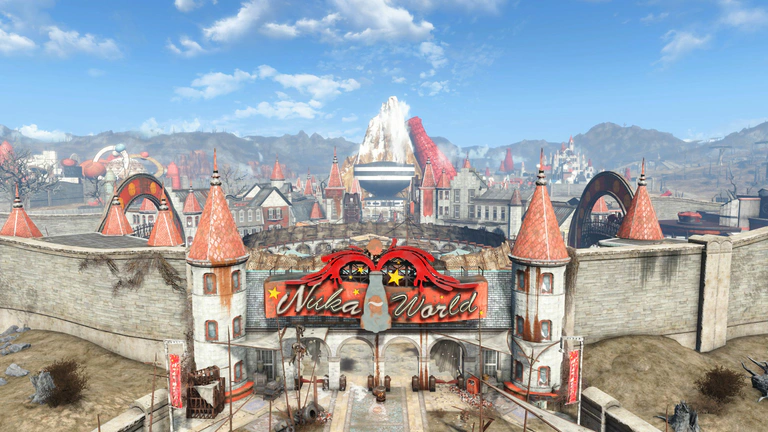
Inspired by his brand's success, Bradberton decided to invest his business' fortune into opening an amusement park dedicated to the soft drink. The Nuka-World park opened on May 1, 2050, less than a year after ground was broken for its construction. Initially opening with just two sections: Kiddie Kingdom and Nuka-Town U.S.A., more were added as visitor numbers increased, with 6 sections as of 2077, including Safari Adventure, Dry Rock Gulch, the World of Refreshment, and the Galactic Zone.
The constant drive to improve and innovate the formula resulted in numerous flavor variations, with the most popular ones like Cherry, Grape, and Orange released just a few years after the corporation was founded. Behind the scenes, whenever Nuka-Cola encountered competition expanding into local markets around the country, it would attempt to deal with it aggressively. The Cherry and Grape variants were originally patented creations acquired after identifying individual competitors and attacking their bottom line to force a sale. In other cases, the corporation would attempt to buy out competitors, as was the case with Sunset Sarsaparilla in 2058 and Vim! Pop Incorporated in 2077. Failing that, it would attempt to release a competing drink accompanied by a massive promotional campaign. After attempts to acquire Sunset Sarsaparilla commercially failed, Nuka-Cola attempted to directly compete with it through the root beer-flavored Nuka-Cola Wild and the opening of Dry Rock Gulch at Nuka-World. Though the new drink gained a respectable popularity in the American Southwest, it failed to match that of Sunset Sarsaparilla, which still remained the most popular soft drink there up to 2077.
Despite the setbacks, the popularity of the brand only continued to grow as time went by. For example, when the Nuka-Girl rocketsuit was released in 2062, the costumes sold out immediately and stores couldn't keep up with the demand. By 2067, Nuka-Cola was omnipresent, available from vending machines on almost every street in the United States. Even the outbreak of the Sino-American War failed to stop the Nuka-Cola Corporation's expansion. In fact, it continued apace, with a fourth park opening on schedule in Nuka-World. Safari Adventure was commonly considered at the time to be a crowning achievement of Bradberton's company, having taken seven years to build and housing several hundred exotic animal specimens from around the world, including polar bears, alligators, gorillas, and venomous snakes. The completion of the park also marked the start of covert experimentation at Nuka-World. The underground facilities of Safari Adventure contained an in-house "Nuka-Gen" genetic replicator unit, capable of creating perfect genetic copies of animals or even growing new creatures based on the genetic sequence provided (in which faulty genetic sequences were accepted, but often resulted in creatures coming out inside out and then exploding).
In 2072, Nuka-World opened its last attraction, Galactic Zone, a space-themed amusement park. While ostensibly showcasing the future of the United States and all the technologies that would usher it in, Bradberton used the Zone as a bargaining chip to turn Nuka-World into a refuge in case of the looming nuclear war. Through a sponsorship deal with the military and cooperation with RobCo Industries at the Battlezone exhibit, Nuka-World was permitted to use military-grade robotics at the Galactic Zone, ranging from the humble Protectron to the sentry bot and assaultron series, disguised as demilitarized replicas. Every robot was controlled by a cutting-edge STAR mainframe, which would allow Bradberton to maintain a robotic army to defend Nuka-World and himself from outside forces. To bolster his personal security, a private sanctuary was built beneath Nuka-Town USA by Vault-Tec, using the latest in vault construction technology.
Towards the latter half of the 21st century, Bradberton went beyond the world of corporate deals and favors, focusing only on ensuring his own survival. On March 13, 2076, when General Braxton of the Army Research Laboratory requested the services of Bradberton's Beverageers, a team of world-class organic chemists developing new tastes and additives to the soft drink, the CEO made a bargain: In exchange for his chemists aiding the military's chemical weapons program, he would be provided with access to the experimental Life Extension And Prolongation Program (LEAP-X). Bradberton's backdoor deal led to the joint project known as Project Cobalt. For his part, Bradberton pooled his immense fortune and embezzled funds from Nuka-World's immense budget to cover the expense of the LEAP-X project, including the salaries of the researchers he hired to ensure the prototype device worked. Though the park staff complained about the cutbacks and the resulting decrease in safety measures, Bradberton prioritized his own safety over that of the visitors or staff. The military did not complain about his methods, and by October, the lead Beverageer Rex Meacham reported that his team created an isotope of strontium-90 that could be reliably weaponized, serving such uses as a coating for power armor, a custom munition for the prototypical M42 Fat Man, or even an area effect weapon that could be safely deployed from something as simple as a Thirst Zapper. In the corporate sense, they also found it "somewhat safely" for use as a component of a new kind of Nuka-Cola. Bradberton ordered the new flavor variant to be put into production as Nuka-Cola Quantum (named by Rex Meacham).
After its development, Quantum was fast-tracked through the approval process, presented as the culmination of a three-year research program. To create an isotope safe for human consumption, focus groups were used to test various variants of the Quantum isotope. After numerous casualties (at least 62 test subjects died as a result of organ failure, with many more hospitalized with radiation burns; their families were provided with Nuka Condolences Fruit and Cheese Packages that contained liability waivers), a safe isotope was created and the first cases of Nuka-Cola Quantum hit the market in select cities on the East Coast, including Boston and Washington, D.C.. As the latest soft drink from his company landed on the shelves, Bradberton took the last step in attaining his coveted immortality: losing his head. As the military's researchers discovered, the LEAP-X program could only reliably preserve up to 15 pounds (roughly 7 kg) of organic mass, corresponding to the weight of a human head. Sometime prior to October 2077, Bradberton went through with the procedure and had his head and brain removed from his body to be placed into the LEAP-X equipment suite installed in his private vault, with the now immobile Nuka-Cola CEO handing over corporate affairs to Peyton Huxley, his executive assistant.
The Nuka-Cola Corporation ceased to exist six months later when the Great War broke out and ended the world, although its legacy would live on for decades after, as Nuka-Cola would continue to be the most popular soft drink on the North American continent, available in almost limitless quantities. Despite being flat and usually warm after most means of refrigeration were lost, it holds the allegiance of many and continues to inspire serious addiction in many wasteland denizens, such as Dugan, Zip, Sierra Petrovita, and Sheffield.
Soft drink acquisition
Nuka-Cola, the company's flagship soft drink, was commonly considered to be the most popular drink in the United States before the war. The bottle, originally a curved shape, changed to a rocket shape after a rival corporation successfully sued for patent infringement. This change proved to be even more popular with consumers. The company also purchased patents, rebranding and repackaging them as new Nuka-Cola flavors, such as Nuka-Cherry (originally Merle's Very Cherry Soda by Merle Haverston), Nuka-Grape (Grape-Pearl Soda by Joannie Cheng), Nuka-Cola Clear (Sharon's Downhome Country Lemon by Sharon Lawrence), and Nuka-Boost (Packed Full of Joe by William Lee).
When Nuka-Cola was unable to acquire patents, the company would attempt to compete or engage in hostile takeovers. In the case of Sunset Sarsaparilla, when negotiations with the southwestern United States company fell through in 2058, Nuka-Cola attempted to compete by launching a rival soda, Nuka-Cola Wild. Conversely, to handle Vim! Pop Incorporated's competing Vim! soda, Nuka-Cola executive Vernon Conroy hired mercenaries to start targeting Vim operations after CEO Doyle Reed refused to sell the family-owned business. This included sabotaging the production line at Southwest Harbor in Maine, stealing trucks, and targeting workers in an attempt to acquire the company and products.
Marketing
Nuka-Cola's marketing strategies positioned the soft drink and its variants as a cultural symbol of America, often appealing to regional culture if not the national consciousness itself. For instance, Nuka-Cola Victory was released around early January 2077, coinciding with the U.S. reclamation of Anchorage and appealing to the patriotic fervor of the time. John-Caleb Bradberton also cultivated connections with the U.S. military, loaning the services of Nuka-Cola's Beverageer Division—its premier organic chemistry team—for weapons research: Project Cobalt, a project to create chemical weapons and high-energy explosives for the military. This project resulted in a major boon for Nuka-Cola: isotopes created during the research led to the development of Nuka-Cola Quantum, while Bradberton himself gained longevity through the military's LEAP-X program. While the military never got to make use of the project's developments, Nuka-Cola itself also gained a suit of Nuka-Cola branded Quantum X-01 power armor, kept on display in Nuka-World as an advertising item of sorts. The company also had another branded Nuka T-51 power armor suit on display in the World of Refreshment, possibly also a product of its military connections.
Despite publicly being a commercial soft drink company, Nuka-themed paint schemes including their logo were produced for certain combat-ready weapon types, particularly ones associated with the Wild West due to Bradberton's childhood fascination with cowboys.
The Nuka-Cola Corporation would often enter promotional deals with other companies or businesses for marketing purposes. It entered agreements to use local shops for product sales test sites, as with Nuka-Cola Quantum in select supermarkets around Washington, D.C. A larger-scale example was that of the Whitespring in Appalachia, which negotiated a full sponsorship deal: Nuka-Cola would fund them in exchange for being allowed to use the resort to promote Nuka-Cola Quantum. However, financial difficulties at the resort meant this was far more beneficial to Nuka-Cola than to the Whitespring.
Nuka-Cola promotional programs were not limited to the business sector. In 2077, the corporation had a national educational literacy program, Zap It, in which students who read over 10,000 books could be "rewarded with sugar." On the other hand, it had also taken to defacing public landmarks, modifying the Hollywood Sign with a giant "Sponsored by Nuka-Cola" sign beneath.
Nuka-World
Inspired by his brand's success, Bradberton decided to open an amusement park dedicated to the soft drink. Nuka-World opened on May 1, 2050, less than a year after ground was broken for its construction. The first two sections in the park were the Kiddie Kingdom and Nuka-Town U.S.A., but more were added, with six sections as of 2077. Safari Adventure, Dry Rock Gulch, The World of Refreshment, and Galactic Zone were all added later.

A fourth park opening on schedule in Nuka-World, Safari Adventure was commonly considered at the time to be a crowning achievement of Bradberton's company, having taken seven years to build and housing several hundred exotic animal specimens from around the world, including polar bears, alligators, gorillas, and venomous snakes. The completion of the park also marked the start of covert experimentation at Nuka-World. The underground facilities of Safari Adventure contained a laboratory capable of cloning creatures.
In 2072, Nuka-World opened its last attraction, Galactic Zone. Bradberton was determined to turn Nuka-World into a refuge in case of nuclear war. Through a sponsorship deal with the military and cooperation with RobCo Industries at the Battlezone, the newest zone featured a robotic security force comprised of military-grade hardware. Bradberton also commissioned a vault built beneath Nuka-Town USA by Vault-Tec and committed to the military's LEAP-X program to extend his life indefinitely, leaving the management of his affairs in the hands of executive assistant Peyton Huxley.
Nuka-World was incredibly popular with the American public, and as of 2077 it had been breaking its visitor attendance records for four consecutive years, which was attributed to Galactic Zone. The company raised ticket prices that year, expecting the trend to continue. Its popularity was such that, later in 2077, the Nuka-World on Tour traveling carnival was created, functioning as a mobile mini-version of the park. Its attractions included the Nuka-Cade, Nuka-Coaster, the Tunnel of Love, Most Wanted, and Spin the Wheel.
The corporate mascots of Nuka-Cola, Nuka-World's Bottle and Cappy, were deemed popular enough to the point that the company entered an agreement with California Crest Studios to produce a series of seventeen animated movies featuring them. Promotional products such as toy trucks were also ubiquitous across the nation.
Other
Nuka-Cola was a publicly traded company. Nuka-Cola also had a dedicated atomic research division. In 2077, this division became a full corporate entity with SEC approval.
Employees
A. Buckley
Alexis
Andre
Aubrey Copland
B. Ross
Barb
Boone
Bradley Benson
C. Carlson
Caleb
Carol
Casey
Claire Simonson
Clara
Dean Becker
Derek Larson
Dougie
Dusty Polanski
Edgemont
Edmund Medford
Ernie Messinger
Evan Barnes
Fran Fowler
Goodwin
Gordon Mackey
Hayward
Heidi
Herman Benson
Hoffman
Ingrid Suvenstein
J. Crosby
J. Hodgson
J. MacDonald
Janelle Cooke
Jenny
Jesse McDaniel
John-Caleb Bradberton (CEO)
K. O'Rourke
Kenneth Wenzel
Kristy Green
L.B. Shelton
Larry
Leo Mendoza
Maja Adams
Mark Reisman
Michaels
Milo
Mitchel Sikes
Muriel Myers
Myra Stone
P. Reading
Pat Walker
Peyton Huxley
Randal
Randall Myers
Raul
Rich Taylor
Rob
Ryan Penning
Sabir
Saunders
Seth
Sven
T. Fremke
T. Larson
T. O'Connor
T. Reynolds
Thomalson
Tim Wittingstone
Troy
Vernon Conroy
Vinny
Locations
Nuka-World amusement park - Massachusetts (west of Boston)
Nuka-World on Tour traveling carnival - West Virginia
Products
The constant drive to improve and innovate the Nuka-Cola formula resulted in numerous flavor variations, with the most popular ones like Cherry, Grape, and Orange released just a few years after the corporation was founded. Nuka-Cola Quantum was the result of a research program undertaken at Nuka-World's Beverageer Division and the Washington, D.C. Nuka-Cola plant, focused on creating an isotope safe for human consumption; sources differ on the length of its development time.
Nuka-Cola also sold a wide array of memorabilia that would be purchased by fans and collectors. A variety of offshoot products proved successful, such as the Nuka-Girl rocketsuit released in 2062. The costumes sold out and stores couldn't keep up with the demand. The company also offered a very broad catalog of corporate merchandise, including toys, clothing, fridges, stools, banners, clocks, lamps, posters, models, and the Thirst Zapper. Nuka-Cola branded clothes, armor and even weapons also existed.
Nuka-Cola
¹ Unreleased
Nuka-Boost¹
Nuka-Cherry
Nuka-Cola Black¹
Nuka-Cola Clear¹
Nuka-Cola Cranberry
Nuka-Cola Dark
Nuka-Cola Orange
Nuka-Cola Quantum
Nuka-Cola Quartz
Nuka-Cola Twist
Nuka-Cola Victory
Nuka-Cola Wild
Nuka-Grape
Various Nuka-Cola mixes
Clothing
• Bottlecap sunglasses
• Bottle shirt & jeans
• Bottle and Cappy jacket & jeans
• Bottle and Cappy shirt & jeans
• Cappy glasses
• Cappy jacket & jeans
• Cappy shirt & jeans
• Nuka-Girl rocketsuit
• Nuka-World geyser jacket & jeans
• Nuka-World geyser shirt & jeans
• Nuka-World jacket & jeans
• Nuka-World shirt & jeans
• Nuka-World jumpsuit
Toys
Nuka-Cola toy truck
Appliances
• Nuka-Cola fridge
• Nuka-Cola vending machine
Weaponry
Nuka-nuke
Nuka Quantum grenade
Nuka T-51 power armor
Quantum X-01 power armor
Burning Love
Gunther's Big Iron
Love Tap
Nuka-Launcher
Western Spirit
Whacker Smacker
Sources
Adapted from the original article, under CC BY-SA 3.0.