Group
Free States
Secessionist movement
The Appalachian Free States (often shortened to the Free States) were an anarchist, secessionist militia movement around the late 21st century, primarily consisting of Appalachian survivalists. Following the Great War, they attempted to reorganize and create a new society in their home region, but by 2102, they had been completely wiped out by the Scorched Plague.
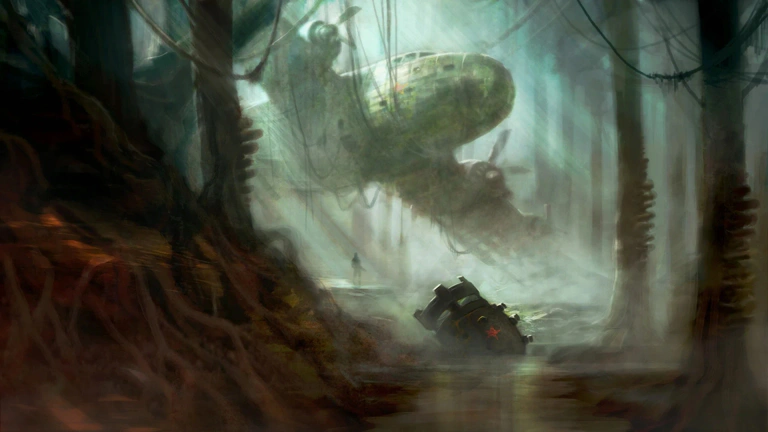
The Free States are the third faction introduced in Fallout 76 if the player follows the main story, right after the raiders and followed by the Brotherhood of Steel, and associated locations of theirs are predominantly found in The Mire. For a detailed breakdown of their appearances, see this article.
Origins
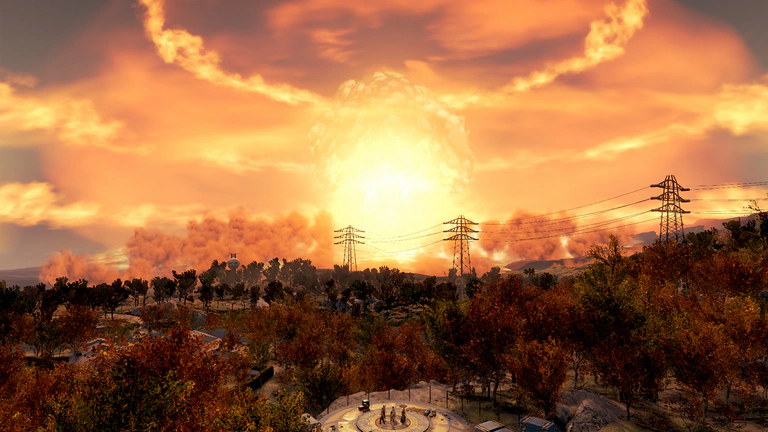
The Free States started as a group of pre-War anarchists hailing from the region around Appalachia. Fearing imminent nuclear carnage and distrusting the government's ties to Vault-Tec, members constructed bunkers to survive a potential nuclear holocaust. Although largely diffuse, the Free Staters used the town of Harpers Ferry as a staging area and supply point for the bunkers they were building. Harpers Ferry was not appreciative of the anarchist's usage of their town, however, as it was largely built on tourism and the Free States movement was scaring away visitors. Before the war, most residents of Appalachia viewed the Free States movement as little more than extremists and traitors, particularly Raleigh Clay and Senator Sam Blackwell; those who survived the nuclear apocalypse in 2077, now realizing that much of the Free States' paranoia was justified, eventually sought the well-prepared movement for aid and safety.
Road to secession
The situation steadily escalated as the Sino-American War deteriorated. In late 2076, the Free Staters started buying up supplies at stores throughout the Ferry, ranging from canned goods to camping gear. Although the shopkeepers found it a little strange, they paid in cash and that was all that mattered (although it did scare some of them when they realized just how much ammunition the Free Staters were buying up). The situation rapidly deteriorated in early 2077, as the divide between the Free Staters and the denizens of Harpers Ferry grew. Street fights between Staters and "patriots" became disturbingly common, tearing the Ferry apart and attracting government attention. At first, the interest was limited to surveillance and documenting Free States membership and their associates. Secret policemen visited Ferry vendors and coerced them into handing over names and addresses, winning a battle and losing the war, as the shopkeepers started to realize that the Free Staters may, in fact, be right about the government. However, the visits also had a notable chilling effect, as, by May, many started outright refusing to provide services to Free States members.
By June, the United States military launched a propaganda campaign against the Free States followed by the seizure of property belonging to members of the movement due to "seditious activity." Midway through June, the public prosecutor pressed charges against Raleigh Clay, prompting Blackwell to call for an investigation into the movement leader's alleged wrongful imprisonment. In response, the Free States openly seceded from the United States by September 2077, retreating to their concrete bunkers and isolating themselves from the outside world while waiting for the bombs to drop. The military, lacking the resources to fight a prolonged counterinsurgency campaign, decided to cease focus on the faction.
Fighting the Scorched
The Staters weathered the nuclear war and remained in their bunkers until roughly July 2079. After the all-clear, they moved quickly and retook Harpers Ferry, turning it into a major fortress and trading post near the heart of the Mire. Using salvage and scrap gathered from the surrounding area, they established fortifications to protect themselves and people under their care - many of whom used to despise them for their convictions. By 2084, the town was a prosperous outpost, providing support and food to those in need.
The Grafton Dam outpost, in particular, shielded their western flank and allowed traders and travelers to move safely through the Savage Divide to the ferry. It was also a key route connecting the Free States with the Responders in Charleston, at least until the town was destroyed by raiders in 2082. However, this prosperity would not last. The situation deteriorated after the release of the scorchbeasts by President Thomas Eckhart. The monstrosities wreaked havoc on the region, bringing the Scorched Plague in their wake. Harpers Ferry held out until 2086 when the scorchbeasts nullified seven years of hard work overnight. Raleigh Clay issued a general order banning all recovery efforts, as the Free States were forced back to the drawing board.
Although the Mire offered enough cover to allow them to escape the scorchbeasts for a time, the incredibly hostile environment was taking its toll. Abigayle Singh, the States' resident genius, worked hard to create countermeasures and a detection network that would help turn the tide. The Scorched Detection System, as it was called, became operational after the loss of Harpers Ferry, to provide an early warning network.
However, the biggest asset at the Free States' disposal came after the fall of the Appalachian Brotherhood of Steel in August 2095. Using information salvaged from their abandoned forward camps, the Free States managed to combine it with the SDS to create scorchbeast lures, capable of attracting the monsters, disorienting and trapping them, so that the Free States can wipe them out. The Free States could fight back and the Responders desperately reached out through Hank Madigan, who realized the potential lying in the technology and decided to combine forces. However, it was too little, too late. Without the Brotherhood and their AA perimeter, the scorchbeasts and their minions had free reign over Appalachia and could spread without any barriers. Although Madigan aided Abbie Singh with the SDS, the entire system, which could provide respite from the scorchbeasts, was ruined by David Thorpe and his raiders, who imprisoned Madigan, trying to ransom the uplink. Instead of money, they received attacks from the Scorched. The Free States, too, were eventually overwhelmed by them.
Organization
The Free States were a loose confederation of people bound by the skepticism of United States government intentions and its plans for the citizenry in the event of a nuclear war. This loose organization made them resilient and diffuse, helping weather the propaganda attacks from the military and "patriotic citizens." The second aspect was strong political backing. While Raleigh Clay was the public face of the Free States, his arrest would reveal U.S Senator Sam Blackwell to also be a driving force behind the movement.
Iconography
Perhaps the only standardized element of their organization was the Free State iconography: A five-pointed star bisected into fields of black and light blue, typically surrounded by a broken chain. The star is representative of American spirit and culture, with the broken chain representing the break the Free States had with the US government. As such, the black and blue on their iconography can be seen as their primary colors.
Technology
Free Staters emphasized resilience and survival in any condition. While lacking the refinement of military technologies used by the Brotherhood of Steel in Appalachia or the combined training and discipline of the Responders, the Free States made up with ingenuity and resourcefulness. Their talented mechanics and gunsmiths created a variety of rugged weapons, repurposing hunting gear, old weapons, and various civilian items like tools or even musical instruments as weapons of war. They also made extensive use of salvaged gear, such as military-grade body armor and other armor salvaged from the nearest available resources. To add, it seems the Free States had an access point to military armament, with many Free States members and locations bearing military technology, including turrets using high-grade explosive rounds As well as military robots.
Unlike the raiders, the Free Staters heavily invested in self-sufficiency, establishing farms and harvesting the bounty of the Mire, trying to survive in the strange new world that emerged in the wake of the Great War.
The Free States had no unified uniforms, but many of their members are seen wearing civilian workmen’s clothing, like miner uniform, fisherman’s outfit, and fisherman’s overalls, as well as salvaged military gear like the forest camo jumpsuit and military fatigues.
The Free States were able to engineer new equipment to deal with the threats of the Scorched Plague. One of these was a radiation suppressor called RadShield that was superior to Rad-X. Another was a modification to wood armor to make it lighter and stealthier. As part of "Operation Cooldown," the Free States, in cooperation with the Responders, built the Scorched Detection System (SDS) within the Mire to track the faint radiation signal of scorchbeasts to act as an early warning system, though it was unable to reach full completion.
Related quests
An Organic Solution: RadShield can be obtained by the player character after learning about Ella Ames' research.
Always Vigilant: The player character may assist the Free States' robot Rover in rebooting the "Scorched Detection Communications" Protocol at various relay towers across Appalachia.
Tracking Unknowns: The fate of a missing hunting group searching for ghouls can be discovered.
Heart of the Swamp: A strangler heart can be killed after hearing a priority message from Raleigh Clay which starts the event.
It's a Trap: Utilize the Free States scorchbeast lures scattered across Appalachia to ground and kill a scorchbeast during the event.
Sources
Adapted from the original article, under CC BY-SA 3.0.