Place
Alaska
State of the pre-War United States of America
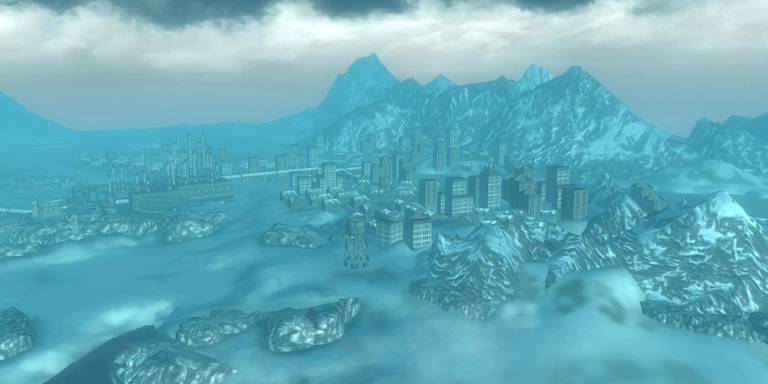
Alaska was a state of the pre-War United States of America.
Pre-War
Alaska is located on the northwest corner of the North American continent, with Canada to its east and the territories of the Soviet Union in Russia to the west across the Bering Strait. The moose came to be considered an iconic native creature of the state.
By the mid-21st century, as global relations began to fragment amid the start of the Resource Wars, Alaska gained on a new importance as the site of the last easily accessible reserves of crude oil. The United States invested heavily in the exploitation of these reserves, creating all-terrain mining rigs to drill deep into the landscape, and executing large-scale military buildup to fortify the state's borders and protect its interests. The Anchorage Front Line was established close to the namesake town in 2059, as part of these efforts. The US also began pressuring the allied nation of Canada to permit the deployment of American troops through their borders to more efficiently guard the pipeline delivering precious oil back home, though this caused tensions to begin brewing between the national neighbors.
Sino-American War

Later on in the 2060s, these heavy-handed preparations proved to be warranted. As the Resource Wars engulfed humanity in a global struggle, the communist nation of China's socioeconomic reliance on fossil fuels forced them into negotiations with the United States about exporting their supplies of oil. However, unwilling to share its reserves with a rival superpower, the U.S. broke off talks in the spring of 2066. In response, China mobilized the People's Liberation Army across the Bering Strait and launched a full-scale invasion of Alaska in winter of that year, starting the Sino-American War that would last for the next eleven years. U.S. forces were pushed back by the initial assault, though not all casualties were due to the efforts of Chinese forces; the USS Ebon Atoll, a cutting-edge Navy missile cruiser, was accidentally sunk off the coast of Alaska with all hands lost by the nuclear submarine USS Interference, who mistook it for an enemy vessel during radio silence. The sinking of the cruiser with a nuclear torpedo ranked as one of the most tragic U.S. wartime disasters since World War II.
Mobilizing their own forces to repel the enemy invasion, the U.S. responded to Chinese military strategy by accelerating the development of power armor to create armored infantry units. The first working model, the T-45, was deployed en masse in 2067 and proved to decisively counter Chinese infantry and armored vanguards, bringing the frontlines of the Alaskan battlefield to a rough stalemate. The Chinese military soon rushed to produce their own power armor units but suffered from a gap in technological advancement compared to the Americans. By the time the tide turned, with armored infantry pushing them back, the PLA's incursion into American territory had reached the Yukon River nearly three hundred miles inland, but had yet to secure the state in its entirety.
Despite the decisive advantage of power armor, American counteroffensives could not break the stalemate. For years on, the Alaskan campaign bogged down, with neither side able to conclusively defeat the other. General Constantine Chase spearheaded what became known as the Alaskan/Anchorage Reclamation Operation in 2072, including the commission of a joint project between RobCo Industries and General Atomics International to design and build a superweapon to finally defeat the Chinese incursion, naming it Liberty Prime. Chase believed the mere threat of a ten-ton war machine bearing down on them would produce a shock-and-awe effect that would force the Chinese to surrender their territory gains in Alaska, akin to the US' triumph over Imperial Japan with the nuking of Hiroshima and Nagasaki in 1945. However, this backfired significantly when the contractors responsible for the robot's manufacturing simply could not deliver a war-ready product in time, and the public announcement became an embarrassment.
While the U.S. was seeking ways to turn the tide fully in their favor, the situation took another hard turn in 2072; an attempted sabotage of the Alaskan Pipeline by Canadian resistance fighters opposed to the American military presence in their nation spurred their southern neighbor to fully commit to military annexation, confronting an increasingly hostile Canadian public with military power and culminating in the dissolution of its sovereign status. Despite this, the situation did not change in Alaska; it became even worse after U.S. troops were deployed across the Pacific Ocean to carry out an invasion of the Chinese mainland in 2074, causing American military capacity to become stretched thin and bogged down on all fronts. At the same time, however, China was also beginning to feel the strain of sustained and costly warfare, faced with the combined pressure of inclement weather, years of unstable trench warfare and the increasing sophistication of U.S. military technologies. The situation shifted decisively in June 2076, as the improved T-51 power armor entered service, rolled out in great numbers to both the Asian and Alaskan fronts. Outperforming its older sibling, the T-51's enhanced capabilities allowed power armor units to make deep tracks into Chinese territory on both sides of the globe, straining the PLA's resources to the breaking point and causing their supply lines from neighboring nations that China had annexed to break down.
Left unable to utilize an automaton superweapon as a death blow to the invaders in Alaska, General Chase's special forces relied on the effectiveness of power armor units to push the PLA back. Over the next six months, the combined might of the US Army's "Alaskan Reclamation Operation" retook numerous key points and redrew the map on large swaths of Chinese-occupied Alaska.Fallout 3 Official Game Guide Game of the Year Edition p.43: "Chinese Army (Simulated) U.S. Army (Simulated) With conditions deteriorating between the United States and China, a military presence in Alaska was established to prevent a possible invasion across the Bering Strait. With increasingly scarce oil reserves, a last deep-sea deposit below the Pacific Ocean was claimed by China before allegedly being sabotaged by American special operatives. Strained relationships spiraled downward into conflict as China marched on Alaska, and the Sino-American War of 2066—2077 erupted. Under the command of General Jingwei, the Chinese Army usurped control of Alaska's oil pipeline and reserves. In response, the Americans began what came to be called 'The Alaskan Reclamation Operation' (2067—2077). Under the leadership of General Constantine Chase, the U.S. Army battled fiercely to the front lines of the conflict before Chase began deploying specialized Power Armor units that began pushing the Chinese back. Future Power Armor suits were further refined as the conflict dragged on, and the Trans-Alaska Pipeline was reclaimed. With resources flowing through Canada, strained diplomatic tensions between Canada and the United States becoming problematic, and Canadian forces attacking the pipeline, the country was annexed. A combination of inclement weather, constant American bombardment and trench warfare, and U.S. Powered Armor unit attacks sweeping through mainline China, the Chinese supply lines weakened and finally broke down completely. By the beginning of 2077, the city of Anchorage was finally liberated, the Chinese eradicated, and the operation deemed a success. A commemorative memorial was erected in Washington, D.C., in honor of the soldiers who fought and perished for the greater American good. Violence between America and pockets of Canadian freedom fighters continued throughout 2077, until the Great War obliterated almost all infrastructure, commerce, and human life." (Fallout 3 Official Game Guide faction profiles) This culminated in the Battle of Anchorage on January 10, 2077, where American forces were able to decisively oust embedded Chinese military forces, including assassinating General Jingwei, commander of the PLA invasion forces, and return the Anchorage region to US control. Mop-up operations to remove lingering enemy presence in the reclaimed state continued for the next three weeks, with the all clear finally sounding on January 28.
Though it ended in U.S. victory, the long campaign to reclaim the northwestern state from Chinese invasion became a symbol of the brutal circumstances surrounding the Sino-American War, particularly for those who participated directly in the long struggle to liberate Anchorage, in both American and Chinese publications and propaganda. However, while groups like the People's Republic of America used it as an example of the pointlessness of continued global conflict, media outlets like Hubris Comics instead used Alaskan defiance as an inspiring example; their summer 2077 lineup included an issue focusing on Alaskan determination, called Tales from the Front: Alaska Unbowed.
While the Army officially declared the Chinese threat removed following the liberation of Anchorage, hostilities within the state continued for months, with General Chase remaining in charge of operations to fight against the invaders' remnants and dealing with persistent supply shortages. Not all of these shortages were caused by the enemy, either; U.S. logistical infrastructure had deteriorated to the point that civilian structures had to be converted into wartime facilities stockpiling ammo, instead of sending it to Alaska. The ability of the Chinese to penetrate defenses and enter deep into American territory also remained a major problem for the military's image in the public consciousness, amplifying tensions and contributing to the fraying social fabric of the nation, on par with the circumstances of the automation riots in West Virginia.
On October 23, 2077, Alaskan Air Force patrols were the first to spot Chinese bombers off the Bering Strait, at 3:37 a.m. Romeo. Six hours later, the global thermonuclear devastation of the Great War brought America and its states to ruin.
Post-War
Very little is known about the status of the region post-War, and much of the knowledge about events relating to the Sino-American War and the liberation of Anchorage was lost to time. Parts of the Alaskan frontier adjacent to the former Canadian territory seemingly retained a degree of human habitation well into the 23rd century, as Marge LeBarge mentions that she was born on the shores of Lake LeBarge and appears to lack any form of mutation.
Locations
Calliway Ridge
Juneau
Lake LeBarge
Sources
Adapted from the original article, under CC BY-SA 3.0.