Event
NCRCF prison break
The NCRCF prison break, or the NCR Correctional Facility uprising, was a…
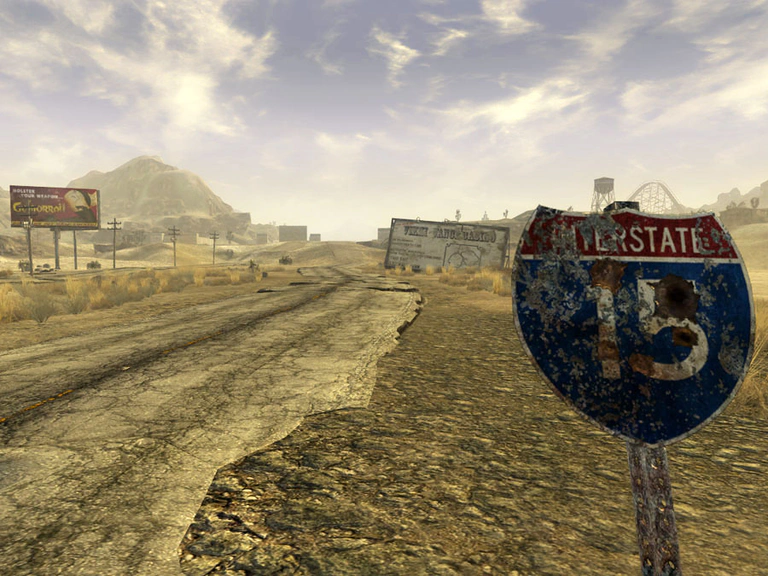
The NCRCF prison break, or the NCR Correctional Facility uprising, was a pivotal event in the Mojave Wasteland in September 2281, when incarcerated convicts at a pre-War correctional facility co-opted by the New California Republic staged a mass breakout led by an anti-NCR revolutionary, Samuel Cooke. After overrunning the NCR staff, the convicts took control, with some fleeing into the wasteland and others staying behind to form the gang known as the Powder Gangers, going on to terrorize communities along Interstate 15. Occurring within the scope of the Mojave Campaign, the event is mentioned as a minor story element in the NCR faction quest arc in Fallout: New Vegas.
Background
In the latter 23rd century, the NCR adopted an agenda of major eastward expansion, especially under the administration of Aaron Kimball. During Kimball's terms, the NCR pushed into the Mojave and other parts of the eastern frontier, with the intent of annexing it as their own territory.
To that end, soon after reaching the town limits of Primm and scouting the nearby ruins of Jean, the NCR discovered the intact Jean Conservancy, formerly a low-security all-female prison before the Great War. The NCR quickly re-established the prison as the NCR Correctional Facility, becoming an extension of their judicial system as convicted felons were sent east from the Core Region to serve out their sentences under the blazing Mojave sun. The NCR Army was sent to manage the prison, with its soldiers acting as prison guards.
The facility's proximity to old rail lines parallel to Interstate 15 prompted an initiative to repair and expand them, but rather than invest significant resources and manpower from dedicated workers, the NCR chose to have its NCRCF convict population serve as hard penal laborers, calling it a prison "work-release" program. According to former inmates of this system, the "Correctional" part of the name turned into a bold-faced lie: there was no correcting of the convicts, only the gradual physical beatdown of constant manual labor, under what they compared to be slave-like conditions, working on the rail lines.
By the early 2280s, as tensions in the NCR's conflict against Caesar's Legion began turning towards another titanic battle since the last one in 2277, General Lee Oliver began gradually siphoning away guard troopers posted at the Correctional Facility, redeploying them to patrol along the Colorado River and shore up the main military garrison at Hoover Dam.
Day by day, the convicts took notice of the staff's weakening control and began planning to take matters into their own hands; the warden predicted something would happen, but was unable to convince the military to stop the removal of his staff in time. Among the dissenting convicts, Samuel Cooke, an anti-NCR revolutionary doing time for conducting a one-man terror campaign in the Core Region, emerged as a guiding voice and became the lead architect of the mounting uprising. To prepare, Cooke and a trusted circle of fellow inmates began stashing small amounts of blasting powder and dynamite the convicts had been given for railroad work, as well as pilfering weaponry and protective armor where they could.
Event
Sometime in September, following another selection of guards' departure on General Oliver's orders, Cooke's group saw their opening and took it. Cooke and his men used the stolen explosives to blow open the doors in their cell block, freeing many prisoners. They proceeded to overwhelm the warden and remaining guards, killing them all and taking back their freedom. Most of the other convicts outside of Cooke's group joined in once they realized what was happening. Any guards who didn't manage to escape the prison in time were killed.
Aftermath
Once they had killed or run off the NCR occupation, the newly freed convicts were split on what to do next: one group under an ambitious thug named Eddie wanted to stay and take control of the prison for themselves, while the breakout's masterminds including Cooke wanted to head out to continue warring against the NCR, and the rest just wanted to leave. Eventually, the convicts went their separate ways, with Cooke and his group abandoning the NCRCF and traveling north into the Mojave, where they eventually ended up taking over the abandoned Vault 19 close to Bonnie Springs.
Powder Gangers' rise
Meanwhile, the convicts who remained formed ranks under the leadership of Eddie, utilizing the prison as their fortress. They started carrying out raids on traders and local settlements, calling themselves the Powder Gangers after their affinity for using explosives such as dynamite and powder charges. The speed at which Eddie was able to organize the highwaymen in the wake of Cooke's departure came as a surprise to the NCR forces who showed up to reassert control. The Gangers' effective resistance, combined with bureaucratic red tape strangling their ability to acquire proper reinforcements, left the NCR's military response hanging in the wind for weeks.
Conversely, by late October, the Powder Gangers rapidly became the largest organized group of highwaymen west of the McCullough Mountains, turning stretches of I-15 heading to New Vegas into a treacherous journey for caravaneers and NCR citizens alike, forcing them to pay tolls or just raiding them by force. The NCR sent the 1st Company of its 5th Army Battalion under Lieutenant Hayes to push back the threat, but proved unprepared for how well-organized the Powder Gangers were and have been limited to containment.
Aside from what they picked up from the prison's armory, the Powder Gangers were also quick to bolster their supply of weapons and explosives from outside sources, including at least one raid against the nearby mining town of Sloan to acquire its supply of dynamite. This inadvertently resulted in a further escalation of trouble since, while the quarry workers were unable to work and had to wait for NCR reinforcements, Quarry Junction became infested by a pack of deathclaws, effectively shutting down all traffic heading north from the Mojave Outpost.
One crew of Powder Gangers led by Joe Cobb also began harassing the town of Goodsprings, as its residents had been harboring a trader named Ringo who fought back when the Powder Gangers attacked his caravan. Though Cobb's crew has done little more than damage some of the town's appliances so far, they are likely to escalate the situation, as the townspeople refuse to give up Ringo, and Cobb is willing to sack the town as revenge for their lack of cooperation.
Primm's problems
A small group of unaffiliated convicts also left on their own and traveled south, where they harassed the town of Primm, driving locals away; one such case is Samuel and Michelle Kerr, who closed up shop at Primm and traveled as far as the opposite side of the McCullough Mountains to settle down and form the 188 Trading Post at the intersection between the old Highway 93 and Highway 95. The move proved fortuitous, as the combination of the Powder Gangers' activities in the month since the breakout and the deathclaws in Quarry Junction resulted in traffic along I-15 being forced to reroute east through Nipton and up along Highway 95, bringing big business to previously floundering locations like Novac and the 188.
Primm's residents have since been left trapped in their own town, with all business shut down due to the rampaging convicts. Several townspeople and travelers were killed by the convicts, including a Mojave Express courier named Daniel Wyand. All law in Primm was lost when the convicts killed Sheriff McBain and his wife in their sleep and took Deputy Beagle hostage. Although Lieutenant Hayes' unit of the NCR Army is camped just outside of town, on the other side of the highway, they are unable to protect Primm due to a lack of manpower and supplies, and are stuck containing the threat and warning travelers away from the town. The surviving townspeople are all holed up in the Vikki and Vance Casino and have successfully resisted any attempted attacks by the convicts, but they are running low on supplies and cannot last much longer without help.
Sources
Adapted from the original article, under CC BY-SA 3.0.