Group
New California Republic Army
Standing army of the New California Republic
The New California Republic Army (often abbreviated as NCRA) is the standing army of the New California Republic and one of the largest military forces in the wasteland. Its reputation and ability were forged in the constant conflicts with raiders such as the Great Khans and Fiends, as well as conflicts with established polities, like the Enclave, Brotherhood of Steel, and Caesar's Legion.
Background
The origins of the army are not detailed, but by 2241 it was the largest standing army in New California, composed of several divisions (not comparable to pre-War military divisions; "several factors smaller"), including (mechanized) cavalry and other mechanized units. The New California Republic Rangers, originally an independent paramilitary force, were incorporated into the military in subsequent decades, becoming an indispensable element of its operations. Until the containment operations against the Enclave at Navarro, following the destruction of their headquarters, the Army's primary foes were raiders, such as the Fiends, Vipers, and Great Khans. Decades of fighting an asymmetric war against them turned the Army into a powerful instrument of foreign policy. The Army has continued to grow and serve NCR's interests, securing its expansion and protecting territories under its control. Following the death of President Tandi, it has also became an instrument of expansion, further developing its numbers. In 2253, the retaliatory Pacification of the Mojave was carried out by an overwhelming force of three battalions, in a protracted war that lasted seventeen years. Soldiers of the army distinguished themselves, including future President Aaron Kimball.
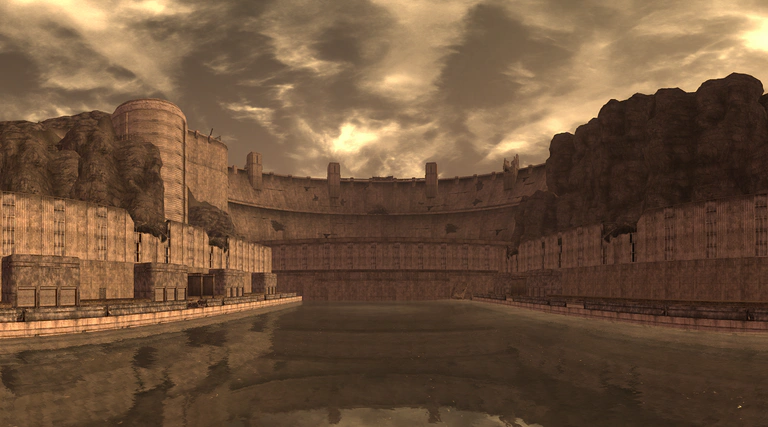
Other notable campaigns that shaped the modern NCR Army were the removal of long-standing raider tribes such as the Vipers and the Jackals at Owen's Lake in 2269, the Brotherhood War that raged from the late 2250s/early 2260s for over two decades, and the confrontation at Hoover Dam in 2277, commonly known as the First Battle of Hoover Dam.
By 2281, the NCRA was the single largest military force in the wasteland, rivaled only by Caesar's Legion. Organized into regular Army divisions and battalions, specialist units like a sharpshooter-skirmisher battalion, and additional Ranger battalions, the NCRA has thousands of troops at its disposal, enough to absorb the continued loss of one thousand troops each year in the Mojave Campaign alone and still retain operational capability. However, the effectiveness of its operations was hampered by the influence of brahmin barons. Although they only had one vote at the ballot box, their wealth made it easy for them to influence decision makers to protect their interests at the expense of the general population or ongoing military operation's: Heavy infantry units, soldiers with normal and salvaged power armor suits, were deployed on the home front to protect the barons' ranches from small-time raiders, while rank-and-file troops are sent to the Mojave to maintain the occupation, often without proper service rifles or body armor.
The ongoing occupation of the Mojave coupled with the Legion's deliberate lack of activity resulted in negligence. The quality of training among soldiers deployed to the theater deteriorated: fresh recruits are shipped out to the frontier with merely two weeks of training and often just to maintain the occupation, with many cases of poorly trained conscripts being routinely subjected to harsh disciplinary measures rather than competent command. As a result, when the Legion did start launching operations to secure beachheads on the western bank of the Colorado River ahead of the Second Battle of Hoover Dam, Army installations had few resources with which to respond, allowing for strategic losses to pile up such as the Searchlight Sabotage, and the subsequent fall of Nelson and the destruction of Nipton. It was only once another all-out war with the Legion became a certainty that the Army's command finally wrangled enough support to redeploy heavy infantry and veteran Ranger units to the frontline
Organization
The units of organization are battalions, divided into companies, platoons, and squads. Typically, they are led by a sergeant or other non-commissioned officer. The Mojave Campaign began with the deployment of three battalions of infantry to the desert at the behest of President Wendell Peterson. Military bases of the army (typically called camps) are always under the command of a commissioned officer (usually a major, e.g. Polatli or Knight at Camp Forlorn Hope and Mojave Outpost, respectively). Larger field camps are under the command of a colonel (e.g. James Hsu and Cassandra Moore at Camp McCarran and Hoover Dam, respectively). Under the Kimball administration, male military officers have been promoted disproportionately to females.

Chain of command
The NCR Army has chosen to emulate the rank and file of the pre-War United States military, as well as the division into officers, non-commissioned officers, and enlisted personnel. Advancement can be swift, especially in active combat zones. It usually takes four years for a soldier to reach the rank of captain, but a vacancy may result in an early promotion. Going beyond the call of duty and demonstrating exceptional leadership may also result in accelerated promotion.
Non-commissioned officers are officers who have not chosen to pursue a commission and promotion to higher levels of authority. In the Mojave Campaign, many NCOs are career soldiers, and frequently are on their second tour. Sergeants typically assist commissioned officers, such as their company and platoon commanders, in their duties, including disciplinary action. In some contexts, a sergeant's rank is a formality, bringing with it no extra responsibilities or powers (e.g. Sgt. Bitter-Root in Alpha Team).
Enlisted ranks form the bulk of the New California Republic Army:
General. The highest rank in the Army, responsible for commanding entire theaters. For example, General Lee Oliver commands the Mojave Campaign.
Colonel. These officers typically command entire portions of the region, delegated by superior officers, and not always neatly delineated. For example, Colonel Cassandra Moore commands the garrison stationed at the Hoover Dam, while James Hsu is responsible for troops in the New Vegas area, operating out of Camp McCarran. Their areas of responsibility overlap and Moore may deal with security threats in areas formally under Hsu's command, like Freeside.
Major. These officers may lead large combat operations (such as the ill-fated Bitter Springs policing action), forward operating bases (eg. Camp Forlorn Hope under Major Polatli), strategic outposts (eg. Mojave Outpost under Major Knight), and special assignments, like relief for refugees or bounty missions.
Captain. Typically commanding full companies, captains may also assist superior officers in various affairs, such as overseeing logistics (e.g. Cpt. Ronald Curtis), enforcing discipline among troops (such as Captain Pappas of the military police), and commanding refugee camps (such as Captain Gilles and Captain Parker).
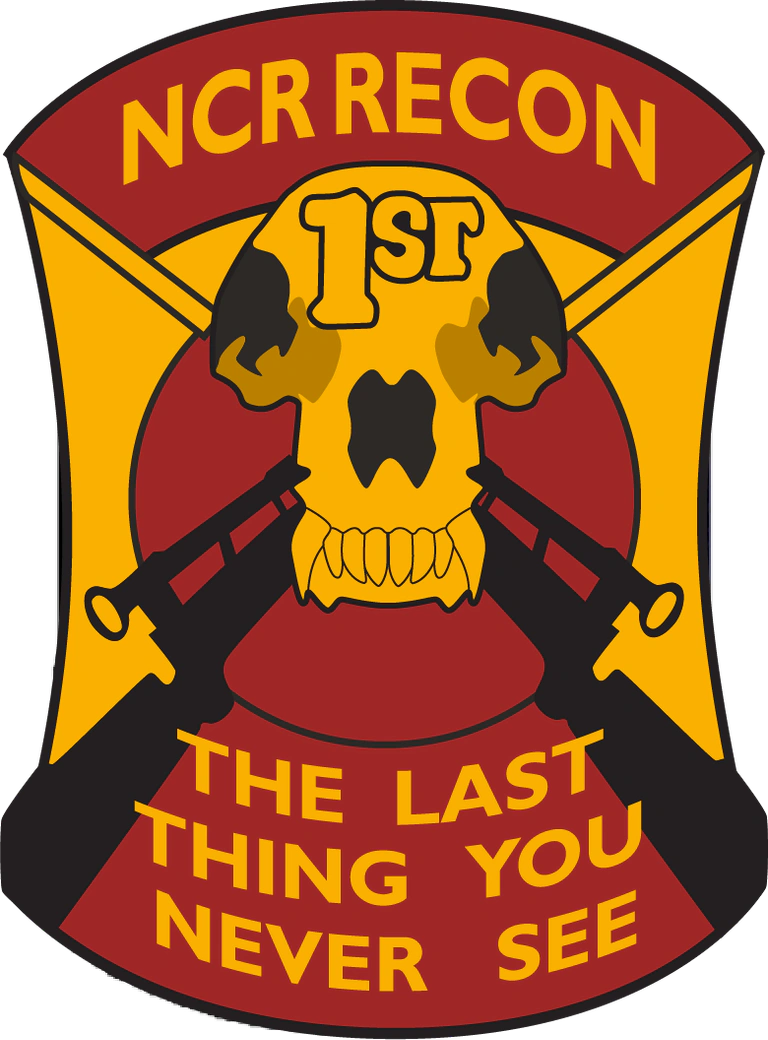
Lieutenant. Divided into a "full" lieutenant and the junior second lieutenant, officers bearing this rank lead NCR Army units in battle, ranging from specialist squads (such as Lieutenant Gorobets who is in charge of 1st Recon's Alpha Team and other Camp McCarran sniper teams), to entire companies and garrisons (such as Lieutenant Hayes and Lieutenant Haggerty) Lieutenant officers may also be assigned to specific duties, such as policing, internal security, and patrols (such as Lieutenant Boyd, Lieutenant Romanowski, or Lieutenant Monroe ). Medical officers may also be granted the rank of lieutenant (such as Lieutenant Markland).
Master Sergeant.
First Sergeant.
Staff Sergeant. Aside from assisting officers (including carrying out disciplinary punishments like flogging), staff sergeants may also be responsible for compiling reports.
Sergeant. Sergeants are the most common non-commissioned officers. Like other grades of sergeants, they assist commissioned officers in the field, and may also be assigned squads to carry out specific assignments, such as establishing forward camps (Sergeant Banner ), managing supplies (Sergeant Contreras), or leading squads in combat operations (Sergeant Lee ). Some sergeants may exercise authority comparable to a commissioned officer: Sergeant McCredie at Camp Golf leads the Army component of the garrison, in lieu of a lieutenant or captain, with the authority to issue dispatch orders for soldiers to other garrisons.
Technical Sergeant. A high enlisted rank, technical sergeants may be responsible for operation of sensitive equipment and compiling reports, without subordinates (such as Technical Sergeant Reyes).
Corporal. Senior enlisted troops, corporals are leaders responsible for their squads, ensuring their readiness and executing orders from non-commissioned officers. As senior personnel, corporals may also be assigned to positions of special responsibility, such as that of a mess officer (Corporal Farber). In some contexts, the rank carries no extra powers, beyond indicating seniority (such as Corporal's Sterling and Betsy).
Private First Class. The rank signifies an experienced enlisted soldier.
Private. The most basic and most numerous rank in the New California Republic Army. Privates make the bulk of the Army, bearing the brunt of the risk associated with its operations. This is compensated for by Army benefits. While monthly pay is low, a completed tour of duty and honorable discharge entitles a veteran to various Army benefits and makes securing a job easier. The Army distinguishes between two Private ranks: PVT and PV2.
Components
The New California Republic's military is predominantly an infantry force, with a number of specialized divisions. Light infantry form the basic component of the Army, relying on large units of troopers deployed against the enemies of the Republic, from raider gangs and mutants to the Brotherhood and the Legion.

The infantry have numerous specialized battalions and units exist, including:
First Recon, sharpshooters
Heavy infantry units equipped with salvaged nonfunctional and functional power armor, used as shock troops,
Medical units, including field medics specializing in battlefield trauma and medical doctors for more comprehensive medical care.
Field Preparations Division, field construction and logistics unit
Supply corps, logistics and civilian relief unit
NCR Military Police, responsible for law enforcement within the Army and areas remaining under the Army's jurisdiction, such as military bases and the Strip.
Other logistics and support units, including quartermasters and mechanics.
Rangers
Originally an abolitionist paramilitary force under Chief Elise, the Rangers became a part of Republic's military operations by 2271 and the signing of the Ranger Unification Treaty, which extended NCR jurisdiction into southern Nevada. Rangers serve as the Republic's special forces and elite light infantry units, and Army soldiers can voluntarily transfer to the Rangers either at their own initiative or by invitation from Rangers. They are formally separate, using their own ranks and distinctive equipment (such as the patrol armor or the venerated Black armor), but in practice they are folded into the Army's military command. Aside from typical military operations, they are routinely used for tasks outside the purview of the Army, such as internal investigations, or assassinations.
Air force
The NCR has limited airpower, with a fleet of captured Vertibirds for special missions (with some of them stationed at border outposts, such as the one on the Long 15), with at least one Vertibird being reserved as the president's personal vehicle ("Bear Force One").
Mechanized units
The New California Republic has a motorized vehicle division, employing refurbished United States Army trucks for transport, as well as a mechanized cavalry force consisting of a small number of scavenged jeeps and tanks. Camp McCarran, as a regional hub, has a repair depot for the maintenance and service of the army's trucks. The primary limitation for the force is the supply of tires and other degradable parts that greatly limit the possibility for fielding any larger scale vehicle fleet.
Personnel
The Army has an eligible age of 16 for military service, although volunteers this young are rare. Competence is rewarded with swift promotion, and exceptional soldiers can reach officer ranks within a year. Volunteers already in the service may elect to transfer to the NCR Rangers or even be invited to join.
However, despite the prospects, the Army draws most of its manpower from NCR states through conscription. A majority of the troopers, especially in the Mojave theater, are drafted, due to the need to maintain a front line along the Colorado against the Legion and against other enemies of the Republic elsewhere. Conscription is egalitarian and both men and women are drafted, resulting in a rough 50/50 division of sexes among active duty troopers, in stark contrast to the exclusively male slave warriors of Legion.
Training in general tends to be limited to essential military skills. Many draftees and volunteers come from farming and ranching backgrounds, and learn to handle firearms at a very young age. Some go on to become elite sharpshooters. However, this has drawbacks: A significant number of draftees receiving just two weeks of training before being shipped out to the frontier. Predictably, this results in disciplinary problems particularly among troops stationed in reach of the New Vegas Strip.
The NCR promises that no deceased soldier is ever left behind, but this is not always true, as seen with the case of Ranger Morales.
Discipline
While modern in terms of organization, corporal punishment is still used within the NCR Army. Flogging can be used as a punishment for desertion and suspected desertion. The war with the Legion and the fall-off in training levels result in it being used too liberally at times.
Depending on circumstances, desertion in the face of the enemy is a capital offense, with the penalty being hanging. Desertion under other circumstances or severe dishonorable conduct, such as armed robbery by active soldiers, can be punished through execution by firing squad.
Pay
The pay in the army's service varies greatly. Enlisted troopers are frequently paid poorly, with privates receiving less than 200 caps in monthly wages. On the other hand, the army does offer generous benefits and financial security. Good readiness evaluations can result in the army giving raises to well-performing soldiers.
Foreign relations
As the military arm of the NCR, matters of diplomacy are left to be decided by the civilian branch of the government, (the president and the congress). Outsiders' view of the military depends on their relationship with the NCR.
With laws enacted during President Tandi's administration, the NCR recognizes the rights of prisoners of war and approaches their care humanely and free from abuse. Most officers find these laws to be constricting, but resourceful officers find ways around it by employing the service of outside consultants.
Technology
The Army uses computer software to coordinate and evaluate its troops, with radio and satellite communications providing real-time coordination of its military operations. The Gun Runners are the primary contractor responsible for supplying the army with weapons and ammunition. Caravans deliver weapons and ammunition in bulk from factories in the Boneyard to wherever the Army needs them. Other companies supply the army's body armor, with the principal contractor being the Crimson Caravan company, competing with Far Go Traders.
Personal armaments
NCR troopers use mass-produced weapons made from common materials that perform reliably and can survive harsh treatment. The basic service weapon is a semi-automatic 5.56mm service rifle, supplemented by 9mm submachine guns, hunting rifles, varmint rifles and even caravan shotguns. High-end firearms such as marksman carbines, assault carbines, riot shotguns and .308 sniper rifles are commonly issued to veteran units, particularly in strategic locations such as Hoover Dam. A limited supply of energy weapons, such as laser rifles, Plasma Defenders, tri-beam laser rifles and multiplas rifles, is also available, though restricted to rear echelons.

The M&A 9mm pistol is the standard sidearm of both officers and soldiers, though some can be found carrying 10mm pistols. All of these weapons are provided by the Gun Runners, who handle a majority of the weapons contracts of the Army. The standard armor consists of a metal breastplate and backplate supported by leather straps with leather shoulder protectors worn over brown fatigues. The NCR is also known to use mine tactics; Chief Hanlon is famous for it.
The heavy infantry shock units are specialized units provided with heavy weapons and salvaged power armor. Non-functional suits of T-45 power armor captured during the war with the Brotherhood of Steel and confer superior protection. At least one suit of functional power armor was known to be in service with the colonel of a rear echelon unit along the Long 15. They carry heavy weaponry such as light machine guns, hunting shotguns and even heavy incinerators. Rear echelon units are also provided with a limited supply of Gatling lasers and plasma casters.
In addition to the regular infantry, there is an entirely separate special forces branch known as the NCR Rangers. Most Rangers wear NCR-designed Ranger patrol armor, while veterans opt for the so-called "Black Armor": a traditional Desert Ranger trenchcoat worn together with a pre-War 3rd generation combat armor and matching helmet. They also have access to weapons such as trail carbines, Ranger Sequoias, anti-materiel rifles and brush guns.
The NCR makes use of salvaged pre-War weapons and equipment as well; Hoover Dam is protected by an anti-aircraft gun capable of firing flak shells to bring down aircraft. The NCR remnants at Griffith Observatory also made use of both mounted and portable anti-air missile launchers. The NCR Army also has at least one functional Robobrain which is stationed at Hoover Dam.
Sources
Adapted from the original article, under CC BY-SA 3.0.