Group
New California Republic
Federal republic
The New California Republic (NCR) is a post-War federal republic founded in the namesake territory of New California in 2189. At its peak, its territory comprised five contiguous states located in southern California, with additional holdings in northern California, Oregon, Nevada, Arizona, and northern Mexico.
Officially, the New California Republic stands for democracy, personal liberty, and rule of law; these values have been upheld unevenly both within and without. The NCR grew through imperialistic expansionism, both to acquire resources and pacify border regions, benefiting its citizens at the cost of established residents. After the death of its second president Tandi, these policies intensified, and the Mojave Campaign was used as a vehicle to annex the Mojave Wasteland, but led to high casualties and financial costs. Though many supported this, it also drew criticism both inside and outside of the NCR.
While many theorized that the annexation of the Mojave would be the death of the New California Republic, its downfall was caused by a wholly separate event; following the Second Battle of Hoover Dam, Shady Sands, its first capital, was destroyed by a nuclear detonation in 2283, with the NCR's presence collapsing in southern New California. In 2296, a faction of NCR remnants in Los Angeles, operating out of Griffith Observatory and led by the pre-War scientist Lee Moldaver, was wiped out in a battle with the Knights of San Fernando over Moldaver's cold fusion technology.
Despite the loss of Shady Sands, the NCR is not gone for good. As of 2296, members of the NCR remain scattered throughout the wasteland — including one battalion of soldiers and Rangers still holding out in the Mojave — all working to survive and protect those who believe in their cause for democracy and the rule of law.
The New California Republic was first mentioned in certain endings of Fallout, and grew to become a major faction in two subsequent installments: in Fallout 2, it competes with New Reno and Vault City for control over northern New California; in Fallout: New Vegas, it opposes Caesar's Legion in a war for the Mojave Wasteland and Hoover Dam. The NCR also plays a significant role in the Fallout TV series, where the fall of Shady Sands and subsequent deterioration of NCR control is a pivotal element of the show's storyline.
For game-specific endings related to the faction, see this article for Fallout 2 and this one for Fallout: New Vegas. For a list of characters related to the faction, see this article. For a list of conflicts involving the faction, see this article.
Background
The history of the New California Republic dates back to the survivors of Vault 15 who emerged from the shelter around 2097, founding the town of Shady Sands. With the assistance of the Vault Dweller, who destroyed the Khan raider tribe, Aradesh and his daughter, Tandi, led the community into prosperity. With expanding trade routes came cultural exchange, eventually culminating in a movement aiming at forming a national entity. The idea resonated with other wastelanders and won popular support, leading to the formation of the New California Republic in Shady Sands in 2186, with a trial council government established to draft the constitution. Three years later, in 2189, the republic proper was voted into existence as a federation of five states organized around major settlements in the wastes. The states are Shady, Los Angeles, Maxson, Hub and Dayglow.
Within a century of its founding, the NCR became a model example of post-apocalyptic success and good ethics. Steady expansion and development led to widespread political enfranchisement, the establishment of rule of law and its enforcement, security from threats within and without (to a reasonable degree) and standards of living above mere subsistence became a reality for its massive population of over 700,000 citizens. Fallout: New Vegas Official Game Guide Collector's Edition p. 41: "New California Republic The New California Republic was born from the remnants of the survivors of Vault 15 and the small walled community they founded, Shady Sands. Under the leadership of Aradesh, and with the assistance of the Vault Dweller (who saved Tandi, Aradesh's daughter and a future president of the NCR), the community prospered. Trade routes with other settlements allowed cultural exchange, and a movement to form a national entity gradually took root and won popular acceptance. In 2186, the town of Shady Sands changed its name to 'New California Republic' and formed a trial council government to draft a constitution. Four more settlements joined the council, and in 2189 the NCR was voted into existence as a sprawling federation of five states: Shady Sands, Los Angeles, Maxson, Hub, and Dayglow. By post-apocalyptic standards, the NCR is a paragon of economic success and good ethical character: political enfranchisement, rule of law, a reasonable degree of physical security, and a standard of living better than mere subsistence are daily realities for its 700,000+ citizens. Currently, the NCR in a state of transition, with rapid economic growth and a sea change in political leadership endangering its grand humanitarian ideals. Nowhere is this more evident than in the Mojave, where the occupation of Hoover Dam has improved access to electricity and water, but at the cost of straining its budget and embroiling its armed forces in a morally corrosive imperialist project. The NCR government's aim is to annex New Vegas as the Republic's sixth state. While it already controls Hoover Dam, its treaty with Mr. House and the three families compels it to allot one-fifth of the dam's electrical and water production to local use free of charge. Adding injury to insult, the NCR is locked into protecting New Vegas from invasion by Caesar's legion even as it receives not one cap in tax revenue from the Strip's highly lucrative resort operations. NCR citizens in the Mojave have largely come here for economic reasons, whether as paid citizen soldiers or as prospectors and fortune-seekers." (Fallout: New Vegas Official Game Guide faction profiles) The situation improved even further with the Mojave Campaign and the flow of electricity and water from Hoover Dam to the Republic. However, the protracted campaign has come at a cost.
The NCR entered a period of transition after the death of President Tandi, experiencing rapid economic growth and dramatic political changes, endangering its original grand ideals. Beginning a policy of expansion under successive presidents, the single greatest example of this change was the morally corrosive, imperialistic Mojave Campaign. Championed by President Aaron Kimball, it aimed for the unilateral annexation of New Vegas and surrounding territories as the sixth state of the NCR. Years of campaigning led to a stalemate, with the Treaty of New Vegas locking NCR as the protector of New Vegas from Caesar's Legion, without a single cap in tax revenue from the New Vegas Strip or concessions from Robert House, proprietor of the New Vegas Strip. The war with the Brotherhood of Steel and the Caesar's Legion stretched the NCR thin, with extended supply lines, profiteering and political maneuvers limiting its ability to respond to emerging threats, all while New Vegas benefited from commerce brought in by tourists, traders, fortune seekers and NCR soldiers. Additionally, a massacre perpetrated by the NCR at the settlement of Bitter Springs during their conflict with the Great Khans cast a dark shadow over the republic and their military, with men, women, and children being killed alike, without going reported in the NCR press.Fallout: New Vegas Official Game Guide Collector's Edition p. 458: "Important Dates "2248 President Tandi takes ill and dies at the age of 103. Her presidency has lasted 52 years. Vice-President Joanna Tibbett assumes office." "2253 President Tibbett is removed from office by a vote of no confidence following her "timid" response to the massacre of 38 NCR citizens at the hands of Mojave raiders. Her replacement, President Wendell Peterson, orders three battalions of NCR infantry into the Mojave." "2270 The extirpation of tribals in the area of present-day Bullhead City is complete. "The Pacification of the Mojave," as it comes to be known, makes General Aaron Kimball a national hero." "2273 Aaron Kimball retires from the NCR military and runs for office as one of Hub's political representatives (or "governors," as Hub idiosyncratically calls them). Less than two months into his term, Wendell Peterson is voted out of office and Aaron Kimball becomes the NCR's next President." "2274 NCR forces move east and occupy Hoover Dam. The NCR reluctantly signs the Treaty of New Vegas recognizing Mr. House and his stewards, the Three Families, as the rightful owners of the Strip. The Strip opens for business." "2275 Camp McCarran is established as NCR Headquarters in the Mojave. Sporadic fighting begins with the Mojave Brotherhood of Steel. The NCR government withdraws official support from the Followers of the Apocalypse and founds The Office of Science and Industry." "2276 Conflict with the Brotherhood of Steel escalates, culminating in decisive victory at HELIOS One. The Mojave Brotherhood is considered "neutralized."" "2278 Following the abduction and killing of four soldiers, NCR troops assault the Great Khans' settlement at Red Rock Canyon and massacre several dozen men, women, and children. This event goes unreported in NCR press." (Behind the Bright Lights & Big City) Note: the Guide states that Red Rock Canyon, rather than Bitter Springs, was attacked by the NCR. Despite that, the campaign was supported by a majority of the NCR citizens due to it greatly improving access to electricity and water via Hoover Dam. However, the Mojave Campaign did receive criticism from a vocal minority that includes the Followers of the Apocalypse.
However, it was not the Second Battle of Hoover Dam that threw the NCR into a crisis, but rather the unexpected and unprecedented destruction of Shady Sands in 2283. The loss of the capital city, including key government branches such as the NCR Senate, NCR Council, and OSI sent the NCR into freefall. By 2296, their presence in the Boneyard was reduced to a military unit and civilian refugee settlement under the command of Lee Moldaver based at Griffith Observatory, which was destroyed in an assault by the Brotherhood of Steel. Up to this point, the legacy of the NCR lived on through different smaller groups in New California, such as NCR refugees in Vault 4, or a Los Angeles gang styling themselves as "the Govermint."
NCR forces also persisted in the Mojave, though they had abandoned many of their former encampments within the region. As of July 2296, the largest known NCR remnant consists of a single battalion of surviving NCR Army troopers and NCR Rangers who have since established a presence in Freeside, and seemingly is making efforts to rebuild the NCR from within that community.
Society
Abstractly, the NCR represents progress; while disorganized wastelanders and tribals rely on subsistence farming and face hardship in their daily lives, citizens of the NCR have gained access to luxuries that few others in the wasteland have available to them: a large-scale steady economy, healthcare, laws and organized stable government, not to mention the largest known military in the post-War world. At its peak, every citizen of the Republic had a decent chance at living a life that's more than just survival. The sheer size of the NCR also resulted in a diverse population, including affluent merchants, educated urban inhabitants, soldiers and settlers expanding the nation's borders, and farmers and ranchers underpinning its economic might.
That economic power was one of the key factors in the transformation of society between 2241 and 2281. As survival ceased being a major concern for the vast majority of NCR citizens, the problem of collective welfare was largely superseded by concerns about individual prosperity. People providing services free of charge became rarities, with skilled workers, from tailors to surgeons, routinely charging for their services. Moreover, after over 80 years of scavenging, the wastelands of New California were largely picked clean of salvageable goods, making it much rarer to be able to make a living exclusively by scavenging and hunting. The combination of these cultural and economic factors led to the rebirth of wage labor; most citizens were forced to start seeking a job from an outside employer to earn the money necessary to survive. Such jobs may be easy to find in one of the many mills and farms in New California, but citizens seeking to start their own farms or businesses may face challenges due to unequal market power and outsized influence of large competitors.
The citizens themselves held a variety of opinions on these developments. While many praised the NCR's growing economic strength, many others decried the loss of communal spirit. Some even cursed the selfishness of other citizens, usually while pursuing goals just as selfish. One thing was common, the belief that opportunity has largely dried up at home and real fortunes awaited further east. This became fact after the destruction of Shady Sands, which forced the NCR to retreat from Los Angeles, with the heartland becoming once more a lawless expanse, and even the coveted Black Armor of the NCR veteran Rangers became just part of a salvager's equipment in the region. However, the dream of the NCR remained alive, especially in the minds of the youngest New Californians, who desired more than just digging through the dirt.
Iconography
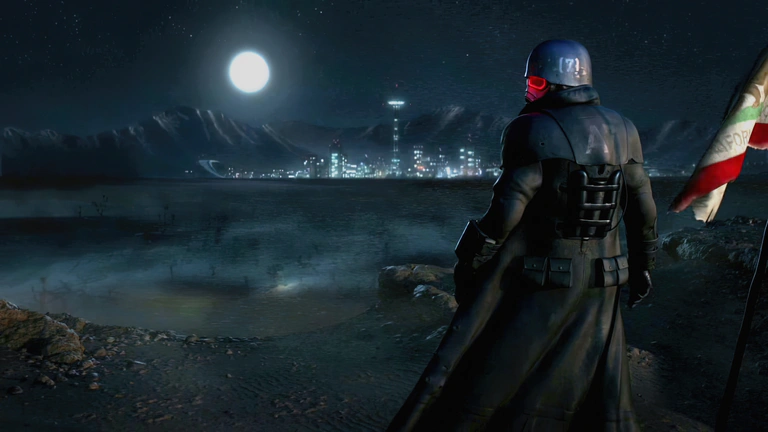
The flag of the New California Republic is directly inspired by the state flag of California, which depicts a California grizzly bear on a patch of grass.

The NCR adopted a version of this flag during its formative years as a nation. The first iteration of the flag was largely different, but similar in design to the California state flag. The first flag of the NCR, seen in 2241, depicted a California grizzly bear with two heads, superimposed on a silhouette of the state of California and capital letters "NCR" in the background, with a single red star in the upper left and a red bar at the bottom. By 2281, a simpler design more directly resembling the California state flag is used, the chief differences being the two-headed grizzly bear and the amended caption of "New California Republic."
For its great seal, the NCR used two different designs: A silhouette of a bear superimposed on a red-and-black field with three stars on the bottom, used at least until 2241, later switching to a more conventional design, with the double-headed bear from the flag standing on grass beneath the Californian red star, surrounded by text identifying the great seal and the New California Republic's foundation date at the bottom.
In general, the NCR uses some American motifs in their iconography, reinforcing their perception as the inheritors of Old World democracy (theory, not the practice of the United States). Instead of futurism prevalent in the pre-War world, most of their aesthetics invoke the mythologized Wild West era. The variation of the California flag featuring the two-headed bear is an example of that. The bear is one of the symbols of the NCR, as a symbol of strength and resilience (though detractors may say the two heads are fighting one another), and the presidential vertibird is identified as Bear Force One to reinforce that nature.
Other symbols of the Republic include its major cities, its founders, and, of course, the NCR Rangers and Army soldiers, citizens willing to serve the Republic and fight for it. Several elements of Ranger equipment, such as their iconic attire and weapons, are also used in propaganda materials to appeal to population within and without.
NCR uniforms often come with a distinct early 20th century look, usually coming in dull faded army-greens, and equipped with a leather breastplate. There is some variation in uniforms, with some coming with an extra bandolier, or cloth shoulder covering, with simple flat metal helmets that typically come with a pair of goggles to shield the eyes from sandstorms. NCR Ranger Uniforms are old Pre-War LAPD riot armor with the addition of a leather duster.
Equality
Founded on principles of freedom and liberty, the Republic has been putting these into practice over the years. The most important achievement was the banning of slavery in NCR territories, thanks to concerted efforts of influential politicians and the Rangers. One exception was penal labor, which remained on the books and undermined this grand achievement.
Under President Tandi, the NCR also passed laws that limited the number of cattle head and the acreage of fields that could be owned by a single person, limiting the power of the Stockmen's Association and the Republican Farmer's Committee. Her presidency also saw the passage of laws prohibiting persecution and discrimination on the basis of gender, ethnicity, sexuality or religious belief (so long as said religion did not advocate violence). In 2205, protection was extended to ghouls and other mutants, though such protections were not heavily enforced.
Enforcement of these laws varied over time. The NCR was generally successful in creating a more egalitarian society, although the results varied. Economic regulations enacted by Tandi were slowly eroded after her death and finally overturned during the presidency of Aaron Kimball. As a result, wealthy farmers and ranchers (commonly known as brahmin barons) were able to exert a disproportionate amount of influence, despite having just one vote on paper. The reactionary undercurrent amplified under his presidency, especially among males, led to a disproportionately high number of promotions for male military officers, while discourse arguing the differences between males and females has reappeared. The ongoing war with the Legion and the fate of women captured by legionaries has also led to the NCR redeploying female troops away from high alert combat zones like Camp Forlorn Hope, inadvertently providing ammunition for this undercurrent. Homosexuality was generally accepted in the core states of the NCR, though frontier territories away from the more affluent center tended to show prejudice.

Enforcement of mutant protections was the most uneven. While Dayglow was a state of the NCR, as late as 2281 super mutants could be tortured by NCR citizens with impunity while politicians ran on anti-mutant platforms. However, even with the destruction of Shady Sands in subsequent years, the tolerance for ghouls persisted in NCR-controlled areas. While Filly reverted to anti-ghoul bigotry, forces around Lee Moldaver continued to work alongside ghouls as late as 2296.
Economy
Since its inception, the NCR's market economy based on two resources: Great brahmin herds and vast swaths of land restored to arable condition, providing meat, leather, milk and other goods. As a result, ranchers and farmers held great sway. Aforementioned anti-cartel regulations enacted by Tandi prevented concentration of wealth. Their weakening and overturning by President Kimball resulted in much of the NCR's agricultural production being concentrated in the hands of brahmin barons and agricultural barons: Wealthy capitalists whose money allowed them to exert outsized influence over their competitors. Their advent also led to the re-emergence of sizable cottage industries, restarting the production of luxury goods for newly wealthy patrons and pseudo-journalism reporting on the latest purchases, commissions and life lessons of the new rich and famous.Fallout: New Vegas Official Game Guide Collector's Edition p.456: "Controversy over Economic Development The NCR's economy is based on two resources: its great Brahmin herds, and swaths of land that have been restored to arable condition. These provide the nation with meat, leather, and starchy vegetables. During President Tandi's presidency, regulations limited the number of cattle head and the acreage of fields that could be owned by a single person. Despite constant pressure from the Stockmen's Association and Republican Farmer's Committee, such regulations loosened only a little so long as Tandi was in office. Following her death, however, they eroded until President Kimball overturned them completely.

As a result, the past 12 years have seen the rise of the Brahmin Barons and Agri-Barons: captains of industry who are, by post-apocalyptic standards, spectacularly wealthy. This has given birth to a number of cottage industries, from the rebirth of luxury goods production to 'journalism' that reports on the latest purchases, commissions, and 'life lessons' of the newly rich and famous. The past 12 years has also seen a change in attitudes towards collective welfare. Citizens of the NCR rarely face significant dangers on a daily basis, and survival is an assumption rather than an aspiration. Citizens are far more reluctant to share food and other resources, and the person who provides services free of charge, whether it's something as quotidian as sewing or as rarefied as surgical expertise, are now the exception rather than the rule. An added economic strain is the scarcity of salvageable goods. Sixty-five years of scavenging has done a good job of picking clean the wastes of what was once Southern California. Rare are those individuals who can make a living by scavenging and hunting what they need. A consequence of these economic and cultural transformations has been the rebirth of wage labor. Whereas one's labor was until recently seen as benefitting and belonging to a collective (whether a family or small town), it has now become a commodity. To earn their keep, many citizens must seek an employer and trade the sweat of their brow for Caps. Citizens of the NCR hold a variety of opinions about these developments. Many boast of their nation's economic strength; others decry what they feel has been lost. Many curse the selfishness of their fellow citizens, usually while pursuing aims that will benefit only themselves or their families. Here in the Vegas wastes, however, nearly all citizens will agree on one matter: opportunity has dried up back home, and to earn a fortune, one must come East." (Behind the Bright Lights & Big City) Note: The cited excerpt was written when Fallout: New Vegas was still set in 2253. Dates were updated to match the current date, 2281.
Other elements of pre-War industry have also redeveloped over time. Light industry and some limited heavy industry, including the large-scale manufacturing of tools, clothes and basic consumer goods, metalwork and other forms of mass production in mills and other factories, form a significant part of the NCR's industrial output. Another sector of the NCR's economy were its ordnance workshops and industrial plants, producing standardized weapons and armor for the New California Republic Army and Rangers. These remained in the hands of merchant houses, who competed for ever more lucrative government contracts. Coupled with the ever-expanding trade routes, powerful merchant houses emerged, many of them rooted in pre-NCR New California: Crimson Caravan, the Far Go Traders and the Gun Runners, which all but completely dominated all trade within New California. Lucrative government contracts for weapons, ammunition, armor and other necessities fueling the NCR's expansion solidified their position in the economy. The Mojave Campaign and related expansionist conflicts shaped the direction of these industries' growth. By 2281, most funding was being funneled into industries and research that could affect the war effort, and projects without a clear military application were left as secondary.
Population
Since 2241, New California has been radically growing in population. This growth allowed the NCR to become the largest known post-War country, with a total population number above ~700,000 (excluding transients and people without citizenship) by 2241 (40 years before the events of Fallout: New Vegas). The NCR's massive population has meant a diverse range of commerce and the development of sprawling urban centers. The NCR's sheer number of citizens gave its armed forces a large pool of manpower the NCR Army could conscript at any time. When properly armed and led, the NCR defeated even the Enclave and the Brotherhood of Steel without suffering Pyrrhic victories, by withering limited enemy numbers through a combination of ranged fire and giving ground as necessary. This was the favored tactic of Chief Hanlon when fighting the Legion in the First Battle of Hoover Dam, securing victory through tactical use of the surrounding terrain and forcing the enemy to suffer extreme attrition. However, when led by sub-par officers, the Army suffered: General Lee Oliver, wanting a decisive victory over the Legion to eclipse Hanlon's ingenuity, planned to amass troops at Hoover Dam and outfight Caesar's Legion in a pitched battle (the Second Battle of Hoover Dam), hoping to rout, pursue and destroy any remaining Legion forces after the initial victory.
Pitching a battle was possible due to the manpower at the disposal of President Kimball, which allowed him to send Rangers into parts of Baja, while the Brotherhood War continued and the second confrontation over Hoover Dam loomed. The sheer amount of soldiers and citizens in the NCR allowed these decisions, as even sworn enemies like the Brotherhood of Steel and the Van Graffs were hesitant to retaliate against the NCR, because of the number of troops the NCR had at any given time and many more that could be raised in crisis.
The burgeoning population was also a drawback that likely factored into the expansionist politics of its leaders after Tandi: The growth pushed the NCR's agricultural capacity to its limits. Without acquiring new territories and sources of food, the NCR risked suffering food shortages by 2291, and eventually famine. The Office of Science and Industry started research projects to address the matter and improve agricultural capacity, including computerized farm management and salvage operations to find any Old World research to address its food problems. The government also enacted the Thaler Act to incentivize farmers to move east and work farms to increase agricultural output, on top of migration eastwards in pursuit of opportunities that seemed to have dried up in the heartland. That is, unless someone was willing to perform wage labor in the NCR's numerous farms, ranches, factories or mills. The only way to strike gold is to make for the frontier.
Though seen as necessary from a strategic perspective, expansionism led to problems. Key among these was supplying the NCR's armed forces. Units and armaments were shifted according to strategic needs, and areas of relative peace, such as areas around New Vegas and the Mojave Wasteland after 2277, were not considered a priority. The occupation was maintained by conscripts and green recruits, armed with surplus weapons and whatever gear the quartermasters issue them. Some recruits did not even receive body armor.
Politics
The New California Republic is a federal republic based on the principle of representative democracy, established as the successor of the pre-War United States.

The executive branch is the Council, headed by the president of the New California Republic and their vice president, elected by representatives of the NCR Congress. When elected, the president and their cabinet serve a term of five years before elections are to be held again. Effectively, a president can serve for life as there are no term limits to the presidency as there was with the United States. Powerful and charismatic presidents can dominate NCR politics, with Tandi selected unanimously for each term and implementing out her policies without obstruction, due to their effects (for example, Tandi's success at negotiating with Vault 15 ensured her policies were implemented; failure to do so would result in her removal from office in favor of Roger Westin or Frank Carlson).
The New California Republic Senate (originally the NCR Congress), forms the legislative branch and is staffed by representatives. Each state sends multiple representatives to sit in the Hall of Congress, and towns joining the NCR may negotiate to be granted a seat in the Hall of Congress as one of the conditions for joining, as was the case with Reddings. Members of Congress are elected in popular elections by NCR citizens, as the NCR has universal suffrage, and depending on the territory may be called "councilor," "counselor," "councilman," "senator" or even "governor," like in The Hub. The NCR Congress is responsible for selecting the president to lead the NCR council, passing laws, carrying out congressional hearings on a broad variety of matters, including investigation into criminal actions and profiteering, and acts as an advisory body to the government of the NCR.

The judicial branch is composed of courts and judges ruling in accordance with NCR's law and each citizen has the right to vote for a representative of their choice to sit in the Hall of Congress. The courts are known to be slow, but once action starts it is difficult to stop and may bring even great merchant houses to heel.
Territory
The New California Republic was founded as a federation of five states, but additional territories were acquired over the decades since its founding, reaching as far as Oregon in the north, Baja in the south, and the Mojave in the east.
Other cities also joined the NCR between 2241 and 2281, as territories were incorporated into the existing five states. No new states were formed after the initial foundation, with New Vegas and the Mojave being the only prospective territory poised for becoming the sixth state of the union after its potential annexation.
States
Shady, incorporating Shady Sands, Vault 15, Junktown, and other neighboring NCR settlements.
Los Angeles, incorporating Adytum and other settlements in the Boneyard area.
Hub, incorporating the Hub and other towns.
Maxson, originally including Lost Hills as an independent enclave. The status is unknown, due to the ongoing NCR-Brotherhood war.
Dayglow, incorporating towns south of the Angel's Boneyard.
New Vegas (potentially), incorporating New Vegas and the surrounding Mojave Wasteland. Requires the NCR to depose Mr. House and win the Second Battle of Hoover Dam.
Locations
The Fallout: The Roleplaying Game sourcebook Royal Flush introduces a number of NCR-aligned settlements in the region around northern New California, the Sierra Nevadas, and the northern Mojave Wasteland. However, the book uses an expansive definition of the Mojave region which stretches as far north as New Reno. As such, the locations in the book will be temporarily listed separately.
In New California:
Arroyo
Anza-Borrego
The Divide (formerly)
New Reno (nominally)
Oak Creek
One Pine
Owen's Lake
Sac-Town
In Arizona:
Arizona Spillway (formerly)
Willow Beach (formerly)
In Baja:
Rattletail (formerly)
In the Mojave Wasteland:
Camp Guardian (formerly)
Camp Searchlight (formerly)
Freeside (2281)/(2296)
NCRCF (formerly, optional)
Nelson (formerly, optional)
New Vegas (partially, optional)
Primm (optional)
In indeterminate locations:
Fort Aradesh (formerly)
In Royal Flush:
Arsenal
Carson
Hawthorne
MarCo
Markleeville
Silver Springs
Tahoe
Virginia City
Legal system
Civil law
As mentioned above, NCR citizens have the right to vote for their representatives to sit in Congress. Both citizens and non-citizens enjoy the protection of NCR's courts (although courts tend to favor citizens in disputes). Freedom of religion is considered a right within the NCR, as long as the religion is not violent or psychotic. At the same time, it enforces a strict separation of church and state thanks to Tandi's policies. Equality legislation is a prohibition of discrimination based on gender, ethnicity, sexuality or aforementioned religious beliefs. Mutants are also protected since 2205, but enforcing this part of the law has been spotty.
Intellectual property laws have been enacted and remain a source of ongoing controversy, particularly patents. The Followers of the Apocalypse are particularly staunch critics of the latter. Marriages and divorces are likewise handled by the courts.
Immigration laws
Immigration into the NCR is open to both humans and mutants, provided they are law-abiding and peaceful. The process is simple. The person in question moves to an NCR territory, presents their claim for immigration, undergoes citizenship training and once their application is processed, is granted the status of a provisional citizen (PC). Full citizenship is granted shortly afterward. All registered citizens are required to pay any appropriate and associated taxes.
Territories can petition the NCR for annexation. Once the petition is accepted, the NCR grants the town territorial status and establishes the police and army presence in the location to establish the rule of law and eliminate law-breakers. Once this process is completed, the territory can apply for full statehood. Between 2241 and 2281, no new territory has been granted full statehood. The frontier New Vegas was the closest to becoming the sixth state of the union.
Criminal law

The NCR dedicated itself to bringing peace, security and justice to the people within and without their borders. Common criminal laws in the NCR include:
Penalties are generally proportional to the offense, with capital punishment reserved for serious offenses. Murder may, but does not necessarily carry with it a capital sentence. Punishment for criminals inside NCR proper means serving prison time at any number of correctional facilities and penal labor as part of the NCR's work-release program.
Law enforcement to become more relaxed on the frontier. One major exception to this rule is the pursuit of former Enclave members. Due to their involvement in various atrocities and attempted genocide, membership in the organization is grounds for arrest, trial as a war criminal, and life imprisonment. Failing that, NCR Rangers and bounty hunters are authorized to pursue targets. The policy was adopted after the Enclave's defeat by the NCR's government under the left-leaning President Tandi.
Outside the NCR's territory is a different story. The NCR Army isn't keen on peacekeeping activities and usually swiftly punishes crimes committed in and around New Vegas with death. Part of this includes the setting of bounties and delegating the responsibility of capture to able civilians that can bring in criminals that have eluded NCR lawmen or military. At least for the military, bounties require proof in the form of an intact head; anything less conclusive results in a fraction of the bounty being rewarded.
A ban on slavery (with the exception of penal labor), gambling, and prostitution
A ban on open carry of weapons (although concealed carry is permitted)
A ban on public drunkenness and drug use
Dismissing caravan members suspected of theft without pay, as per NCR caravan bylaws.
Military law
With laws enacted during President Tandi's administration, the NCR also recognizes the rights of prisoners of war and approaches their care humanely and free from abuse. Most officers find these laws to be constricting, but resourceful officers find ways around it by employing the service of outside consultants.
Laws pertaining to soldiers are quite severe. Cowardice before the enemy, especially desertion, is punished with death by hanging or to be shot on sight. Dishonorable conduct usually leads to a court-martial and may result in execution by firing squad for particularly severe crimes.
Internal conflicts
In theory, the NCR relies on a sound and well-balanced system. In practice, every state tried to assert its independence and work towards furthering its own agenda. For example, there was much friction between the states of Hub and Shady Sands, usually related to trade rights and caravan routes. The president was the biggest factor in deciding on the course the NCR should take; Under Tandi (who served over ten terms as president, something Caesar mocks as indicative of monarchy, rather than democracy),The Courier: "What do you think of the NCR?" Caesar: "Do you want my opinion as a former citizen, or future conqueror? Actually, my opinion's the same either way. As a young man I was taught to venerate President Tandi of Shady Sands. 'The Founding Mother of the New California Republic.' Did you know her Presidency lasted 52 years? And that her father, Aradesh, was the Republic's first President? Does that sound like democracy to you, or a hereditary dictatorship?" The Courier: "President Tandi was voted into office each time." Caesar: "Because the council didn't dare oppose her. She was too popular. She had the people's love. So things ran smoothly, more or less. And as soon as she was gone, as soon as there really could be 'democracy' - what happened then? Ever since losing its queen, the NCR has been weaker, more diffuse. Democracy has been its weakness, not its strength." The Courier: "How is the NCR weak?" Caesar: "Greed runs rampant. The government is corrupt, accepting bribes from Brahmin barons and landowners, to the detriment of citizens. The NCR is a loose conglomerate of individuals looking out for themselves. It's lost virtue. No one cares about the collective, the greater good. It's not built to last. I'm just hastening the inevitable." The Courier: "Surely, the NCR is a powerful foe?" Caesar: "Of course. The most powerful my Legion has faced. Also the first to which I am ideologically opposed. Until now, every tribe I've conquered has been so backwards and stunted, enslavement has been a gift bestowed upon them. My conquest of the Mojave will be a glorious triumph, marking the transition of the Legion from a basically nomadic tribe to a genuine empire. Just as my namesake campaigned in Gaul before he crossed the Rubicon, so have I campaigned, and will cross the Colorado." (Caesar's dialogue) the NCR developed substantially, focusing efforts on rebuilding the pre-War infrastructure and restarting technological development, before expanding into Northern California using a combination of diplomacy and subterfuge to overcome Vault City and New Reno. Under Aaron Kimball, the NCR became more imperialistic and expansive, pursuing a foreign policy of expansion by force of arms, all the while overextending itself in the process thanks in no small part to General Oliver's incompetence and bureaucratic red tape.
However, presidents don't enjoy immunity. The most obvious example is Wendell Peterson, voted out of office for his failure to react to the deaths of NCR citizens in the Mojave region. However, the most precarious position was that of President Tandi. Though remembered as a landmark figure in the NCR's history, in 2241 she headed a tenuous coalition with the right-wing Frank Carlson as her vice president. Her plans for northward expansion hinged on the diplomatic annexation of Vault 15, and failure of this policy would be an embarrassment sufficient enough to remove her from office, replaced by Roger Westin, a prominent councilor and brahmin baron. The Bishops of New Reno, while negotiating for Reno's membership in the NCR, were also attempting to create a more favorable environment, with Westin marked for assassination by John Bishop. His death would allow Carlson to force Tandi into retirement, claiming her involvement in Westin's assassination, lining his own pockets and leading the NCR to stagnation. And if Carlson was assassinated by the Bishops, the death of such a popular figure would have galvanized right-wing elements, leading them to seize control of the Congress, which would set the NCR on the path to military rule and providing a safe haven for Enclave survivors in the ranks of the NCR military.
Beyond politics, significant pressure was also exerted on the political and economic direction of the NCR by a variety of private interests; in particular, the aforementioned brahmin barons and other rich, whose wealth gave them disproportional influence among politicians seeking support in their political ambitions. With regards to the armed forces, the Gun Runners were granted special privileges as the primary suppliers of their arsenal. Monopolies like the Crimson Caravan and similar trading families dominated the trade routes to the detriment of the NCR, using their wealth to influence government policies and squeezing smaller competitors out, unable to compete with both the oligopolic competition and NCR taxes.
Military
Subordinated to the president and the Congress, the military of the NCR was one of its most distinguishing elements. The core component, the NCR Army, had thousands of servicemen at its peak, drawing from both volunteers and conscripts. They were organized into divisions and battalions, equipped with standardized weapons and armor, and represented a diverse range of training and competence. They were the proverbial sledgehammer, a tool used to crush enemies of the NCR and build order in the lands under its control, and a shield protecting them from harm that may come from its numerous enemies. Supported by the industrial might of the Republic and unique technologies reclaimed from the wasteland (like vertibirds confiscated from the Enclave), the Army was the foundation of the security policy of the NCR, with uniformed police formations responsible for enforcing the law within the territory of the NCR. The NCR made no special distinction between the genders when it comes to serving in the military. Super mutants and ghouls are also known to serve in the elite Rangers.

Military honors were commonly awarded for acts of valor, such as the Star of Sierra Madre. However, the most coveted honor was serving with the elite of the Republic's military: The New California Republic Rangers, who grew out of a paramilitary abolitionist militia dedicated to the eradication of slavery in New California. They have grown into one of the most professional and deadly military outfits in the wastes and were folded under the military command of the army. Commonly respected for their valor and skill in battle, Rangers were commonly folk heroes, with an unblemished, heroic reputation and access to top of the line weapons and armor, often coming from recovered and restored pre-War goods.
Foreign relations
The NCR was one of the only known entities after the War to have their own division dedicated to foreign relations, the Department of State. It was responsible for the country's embassies and also held the power to empower individuals with the authority to act on behalf of the government.

While generally respected, many people in the western wastelands had mixed feelings about the NCR. Some people strongly support the NCR's goals of spreading democracy and the rule of law, while others vehemently oppose their methods of "controlling" everything they come into contact with. Wastelanders who were used to having no more than a mayor or sheriff and who suddenly became part of a complex political structure (including taxes) were the most vocal, with some view it as a loss of the frontier lifestyle. As the NCR's power and territory grew, it made progressively stronger enemies who would test the resolve of the NCR.
Under President Tandi, the NCR made slow but sustainable territorial expansion, allowing towns and other small communities, who were impressed by the principles of the NCR, to join of their own volition while defending their borders from hostile raiders like the once legendary Vipers and Jackals, who would be ravaged by the NCR's military until they became broken shadows of their former glory. Eventually taming southern California, these achievements would garner such respect for President Tandi that the people would come to adore her, and tribals outside the NCR's borders would refer to her as the "Great Mother."
Viewing the NCR's growth and success as a threat to their already stagnating power and influence, the Brotherhood of Steel launched a military campaign with the goal of pacifying the NCR and asserting its dominance over the wasteland and its technology. The NCR would ultimately prevail and force the Brotherhood into retreat and hiding. The NCR had defeated their strongest opponent yet.
After the death of President Tandi, her successors would gradually change the direction of the NCR. Rapidly expanding the NCR's borders in every direction in a more imperialistic fashion, they sacrificed some of the NCR's principles and moral high ground in the process. Tribals that once revered the "Great Mother" began to become "domesticated" as the nation sweeps through tribal lands. Under President Aaron Kimball, the NCR's expansion has led it to the Mojave Wasteland, where it would encounter the impressive city of New Vegas, and the even more promising Hoover Dam. However, it would also encounter its greatest enemy to date, Caesar's Legion, across the Colorado River.
The NCR initially had great success in the Mojave Wasteland, setting up bases and an embassy on The Strip. The front line of the new conflict between the NCR and Caesar's Legion moved towards the Colorado River. The Legion attacked the NCR with its full strength during the First Battle of Hoover Dam. The NCR successfully repulsed the Legion's assault on Hoover Dam, devastating the Legion's elite forces by luring them into a trap at Boulder City in the process. After their defeat, the Legion regularly conducted raids on the west side of the Colorado River, even creating permanent bases at Cottonwood Cove and sacking towns like Nipton and Nelson with little response from the NCR. Known wars and military conflicts in which the NCR was involved include those with the Enclave, Brotherhood, Great Khans, Legion and the Raiders.
Technology
Overall, the NCR can be readily described as the most advanced entity in post-nuclear North America at its peak. While smaller organizations possessed more advanced weapons, armor or tools (like the Enclave, Free Economic Zone of New Vegas or the Shi), no one could rival the NCR's agriculture, industry, economy and military strength, with the sole exceptions of the Caesar's Legion and Brotherhood of Steel in terms of firepower. Aided strongly by the Followers of the Apocalypse, the NCR thrived and harnessed its greatest resources. When the shift in foreign policy occurred with Kimball's election, the relations soured and the NCR eventually lost the Followers' support. However, disillusioned Followers flocked to the government and formed the Office of Science and Industry in 2275, becoming a dedicated, NCR-aligned research and development agency. By 2281, their achievements included implementing computer simulations to aid with agricultural planning and cultivation, maximizing the output of Hoover Dam and restoring the power grid between the Mojave and Shady Sands, and even developing solutions for a famine projected to affect the NCR in 2291.

However, the technology was not limited to just agriculture. The Hoover Dam powered every city and major settlement in New California, while the OSI continued to (re)develop and implement new technologies in fields such as medicine, engineering and biology. Building on the strong infrastructure established during the 52 years of President Tandi's rule, which includes roads, railways, transportation, manufacturing, forts and more, the OSI increased the NCR's technological advantage over its competitors. By 2281, the NCR's powerful merchant companies established access to facilities and materials allowing them to manufacture standardized armaments, weapons and ammunition to fully outfit the largest standing army in the wasteland, to the point of different companies actively competing with each other for supply contracts (such as the Crimson Caravan and Far Go Traders), and the military's top supplier (the Gun Runners) effectively becoming an unofficial branch of the Army.
Advanced technologies were also harnessed by the NCR for the benefit of its citizens. The annexation of Vault City granted the NCR access to advanced medical and scientific technologies, including organ cloning, performance-enhancing implants, armor grafts and other refined procedures. Other advanced technologies utilized by the Republic included satellite communications, power armor taken from the Brotherhood, and even global positioning system satellites. The NCR also had the ability to construct concrete bunkers on vital frontlines, such as the Colorado River, and restored railroads into full use, with refurbished vertibirds salvaged from its war with the Enclave providing a fledgling air force. One example of this was Bear Force One, the personal transport of NCR presidents.
Sources
Adapted from the original article, under CC BY-SA 3.0.