Event
First Battle of Hoover Dam
Major military conflict
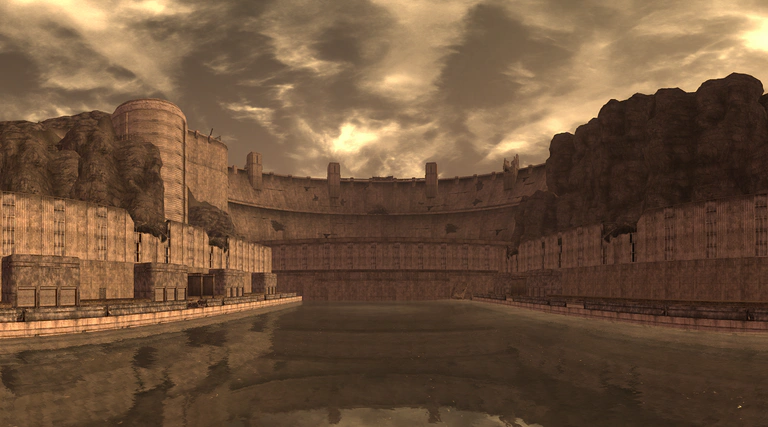
The First Battle of Hoover Dam is a major military conflict that occurred in the Mojave Wasteland in 2277, fought between a combined force of Army troopers and Rangers of the New California Republic against Caesar's Legion, vying for control of the eponymous Hoover Dam. One of the biggest conflicts within the scope of the NCR-Legion War and the precursor to the Second Battle of Hoover Dam in 2281, the event is mentioned as a major story element of the NCR and Legion faction quest arcs in Fallout: New Vegas and as a minor element in its add-on Honest Hearts.
Background
The course of history in the Mojave Wasteland first turned towards open war sometime around 2274, when frumentarii scouts of the Legion, including a former tribal of the Twisted Hairs, discovered the intact structure of the Hoover Dam - along with the NCR flag being flown over it after the formation of the New Vegas Treaty between the NCR and the Free Economic Zone of New Vegas ruled by Mr. House. A former Follower of the Apocalypse and citizen of the NCR himself, Caesar came to view their coming conflict as inevitable, a textbook case of Hegelian dialectics that will bring about a better wasteland - one ruled by him, that is. From that point on, his vision of the future narrowed considerably and the Legion's forward momentum became focused on taking control of the dam as a symbolic "Rubicon" to be crossed on the way to conquering New California, along with the conquest of New Vegas as its "Rome." In the years leading up to the battle, deep raids on NCR territory were carried out by small groups of skirmishers, as well as sabotage campaigns by frumentarii.
On the other hand, the NCR had found great difficulty in pacifying the Mojave over time, in no small part due to frequent skirmishes with local tribes and substantial resistance from other established groups; one such being Operation: Sunburst, a battle to seize the HELIOS One power plant from the Mojave Brotherhood of Steel that ended in the Brotherhood's defeat, though not without cost to the republic's military position.
These problems were further amplified by weakened supply lines: along with the main trade route of Interstate 15, the republic found another stable route passing through a remote community called the Divide. Their subsequent rush to garrison the new route into the Mojave also attracted the attention of the Legion, who sought to cut it off. The events that followed proved disastrous for both sides, as by coincidence, a package was brought to the Divide by a courier, one that unknowingly contained a device with launch codes for the pre-War nuclear missile silos in Hopeville and Ashton. Once it got in range of the siloes, the device activated, triggering the missiles' launch right into the walls of the long-sealed silos. The resulting cataclysm turned the entire region into a deathtrap for years afterward. The loss of the Divide not only cost the NCR and Legion a moderate amount of soldiers, the impassable geography left in the aftermath prevented military reinforcements and vital trading outfits from taking the 127 to reach the Mojave.
With the NCR in a weakened position as the Legion approached, Caesar took proactive steps by ordering a series of flanking attacks against the republic's forward operating base at Camp Golf, along with skirmishes against other NCR outposts along the Colorado River. Once they had seized a base of operations by taking Fortification Hill, the bulk of the Legion's forces were set to march on the dam itself.
Battle
Under the leadership of Joshua Graham, the "Malpais Legate" and first of his station, the Legion opted for a direct attack using overwhelming force. Upon first contact, with casualties manifesting on both sides, General Lee Oliver ordered his troops back to the middle of the dam; Graham responded by pushing all his forces onto the dam's crossway, low-ranking recruits upfront, experienced prime legionnaries in the middle, and long-serving veteran warriors at the back in accordance with the Legion's military doctrine.The Courier: "So what happened at Hoover Dam and Boulder City?" Hanlon: "In big battles, Caesar deploys his legionaries in waves. Recruits up front, prime soldiers behind the recruits, old guard bringing up the rear. Opponents wear themselves out dealing with the first two waves if they survive that long. When the veterans step up, there's not much fight left. Caesar can adapt, though, and when required, he can run any mix of legionaries as skirmishers and still retain order in the ranks." The Courier: [Continue] Hanlon: "Joshua Graham, Caesar's old legate, he's wasn't so flexible. When the Legion attacked Hoover Dam, General Oliver ordered his troopers back to the middle ground just after the first contact. Graham pushed all of the legionaries onto the dam, filling the east side with recruits up front and veterans in the back, by the book." The Courier: [Continue] Hanlon: "But once they were in, they were stuck there. Oliver's troopers were entrenched and wouldn't give a foot. That's when we ordered the rangers and 1st recon sharpshooters to start picking off veteran legion officers from a high ridge west of the dam. That only lasted about a minute before Graham ordered the back ranks to push through to the front and rush the ridge." The Courier: [Continue] Hanlon: "Caused total chaos among the younger legionaries, and Oliver's troopers fell back to the side walkways and stayed out of the veterans' way. By the time the veterans got to the ridge, we were already in Boulder City. They followed us down there, but we were out before they realized what was happening." The Courier: [Continue] Hanlon: "We had packed the old city with C4 and dynamite. Crude, but it did the job. Those who didn't die in the blast were in no position to mount a defense. The ones left on the dam didn't know what to do. The troopers routed them. Graham pulled the remaining legionaries back, but the battle was over. He went south, back to the Grand Canyon, back to Caesar. And that was the last we saw or heard from Joshua Graham." (Hanlon's dialogue)
Consequently, however, this slowed the Legion's advance with so many bodies packed into a narrow space. Furthermore, Oliver's entrenched troops put up fierce resistance against the enemy. From range, NCR First Recon sharpshooters and Rangers were given the order by Ranger Chief Hanlon to pick off veteran Legion officers. After a minute of such an attack, with their veteran casualties mounting and chaos sown among the front ranks, the Legate ordered the rear guard veterans to push through to the front and rush the ridge where the sharpshooters were located. This move only caused further chaos among the younger legionaries and a total breakdown in the chain of command.
Seeing the change in tactics from the enemy, Oliver's troops fell back to the side walkways, letting the veterans pass through to the ridge. By the time the legionaries reached that point, the sharpshooters had also fallen back to Boulder City west of the dam. Thinking they were retreating in fear, the veterans pursued them. But this was the intention: the Legion was being led into a trap. Once the Legion's best reached the streets of Boulder City, First Recon and most of the Rangers had already pulled out, leaving behind a "gift" of several tons of explosives packed into the surrounding buildings, which they promptly detonated.
The blasts themselves and the resulting storm of concrete shrapnel decimated most of the legionaries within Boulder City, while the survivors were left in no shape to defend themselves. Without the field direction of their officers, the legionaries at the dam were left disorganized and disoriented, allowing the NCR's forces to come back and rout them. Seeing the tide had turned against them, the Legate withdrew the remaining legionaries and retreated back to Caesar in defeat.
NCR forces could potentially have pursued after the retreating Legion, but the ramifications of the Divide's destruction and the loss of its supply route limited the ability to get reinforcements from the Core Region, ultimately leading NCR military command to decide against further action. The choice to break off pursuit allowed the Legion's core members to escape and live to fight another day; otherwise, the First Battle of Hoover Dam would have been their last.
Rebuilding the Legion
When Graham returned to Caesar with the news of the Legion's defeat, the Son of Mars was enraged and decided to make an example of Graham, to show that failure will not be tolerated even at the highest levels. Returning to the Grand Canyon in Legion-occupied Arizona, Caesar had his surviving forces watch as the Praetorian Guard covered the ex-legate in pitch, set him ablaze, and threw him over the cliffs to the canyon floor far below. Graham's position as the legate was then filled by Lanius, a former warrior of the Hidebarks, an Arizonan tribe conquered by the Legion. Under Lanius, the Legion temporarily held back from returning to the Mojave, instead expanding further into areas such as Utah to claim more tribes for Caesar and rebuild their military strength.

Though their primary focus for the intervening years was assimilating more tribes, Legion skirmishers continued to harass NCR forces on both sides of the Colorado River. By 2281, 4 years after their first loss, the Legion began marching back west, engaging in separate battles like the Battle of Willow Beach and the Battle of Arizona Spillway to secure the eastern banks of the Colorado for themselves. Bolstered by the addition of 14 newly conquered tribes, Caesar's Legion is preparing to finally complete their conquest of the Mojave during the Second Battle of Hoover Dam.
NCR preparing for the future
Though the Rangers' plan successfully turned the tide of battle and severely impacted the Legion's power for some time, it came at a cost, as the destruction of Boulder City also claimed the lives of over 103 soldiers and Rangers. Some of the dead deliberately chose sacrifice: Sergeant Donald Kowalski acted bravely to hold the Legion back and allow for the wounded to be evacuated, Another group, consisting of Ranger Teresa Lutz, Private Jeffery Hui, and Corporal Marcus Christensen, were blocked from escape by advancing Legion troops and decided to remain and draw as many legionnaires as possible to their position in the city before the detonation.
The detonation itself was carried out by Ranger Jackson Kreger after he ensured that his friend and fellow Ranger Troy Morton was able to get out alive.

While the victory was celebrated throughout the Republic, many of the fallen were not able to be recovered from the ruins, preventing a proper burial. In place of a grave for their remains, the republic honored the dead by erecting a memorial at the entrance to Boulder City. Each of the fallen are listed by name and rank on the side facing east to the Colorado River, while the inscription and insignia of the Army and Rangers are carved into the side facing west to New California.
Even in victory, however, the NCR found itself faced by internal conflict. The decisive action of the Rangers in concocting the trap at Boulder City led to them receiving the bulk of the credit for the battle's success. This incensed General Lee Oliver, who saw it as overshadowing the sacrifices paid by his troopers. During the NCR's subsequent military push into the Mojave, Oliver bull-rushed the deployment of Army forces to concentrate on Hoover Dam, hoping to cement him and his men as the true winners of the next great battle against the Legion, while deliberately leaving the Rangers in the wind and flat-out ignoring every piece of tactical advice given by Hanlon as a personal snub. A combination of being stonewalled by his own people and weariness over the unending Mojave Campaign causing more and more deaths of the NCR's finest eventually wore on Hanlon, and he began discreetly sabotaging field reports to give the illusion of frequent and severe casualties, hoping to foul up operative effectiveness enough for NCR military command to deem the Mojave a lost cause and let everyone go home.
The following is based on Creations and/or Creation Club content and some details might contradict canon.
End of information based on Creations and/or Creation Club content
Sources
Adapted from the original article, under CC BY-SA 3.0.