Place
Mojave Wasteland
Region based on the pre-War Mojave Desert
The Mojave Wasteland is the region based on the pre-War Mojave Desert, spanning large portions of the pre-War states of California, Nevada, and Arizona. It serves as the primary setting and game world of Fallout: New Vegas and the primary setting of the Fallout TV series' second season. It is also the primary setting of the Fallout: The Roleplaying Game sourcebook Royal Flush.
Pre-War
Even before the Great War, the Mojave Desert was a remote and arid region of the American Southwest, with human habitation constrained by access to water. The city of Las Vegas, Nevada was one of the few major cities in the Mojave, prominent for its gambling and casino culture. It was also prominent for another reason: being home to Robert House, founder and CEO of RobCo Industries, one of the most influential companies in pre-War America, and thus one of the most influential men in the country. The Vault-Tec Corporation also chose the Mojave as a prime region for many of its Vaults, with no less than six being built just in the area around Las Vegas: Vault 3, Vault 11, Vault 19, Vault 21, Vault 24, and Vault 34.
The remoteness of the Mojave made it a prime location for many U.S. military installations and government facilities. Some of these were standard military bases or depots, such as Nellis Air Force Base near Las Vegas or the Hawthorne Army Depot in Hawthorne, Nevada. Others hid more clandestine purposes, like Hidden Valley, a former testing range hiding a secret survival bunker complex for U.S. VIPs; or Area 51, used by secretive government agencies to store valuable historical artifacts and evidence of aliens. Beyond this, the desert was also used for nuclear testing, and disposing of the leftover radioactive waste.
Post-War
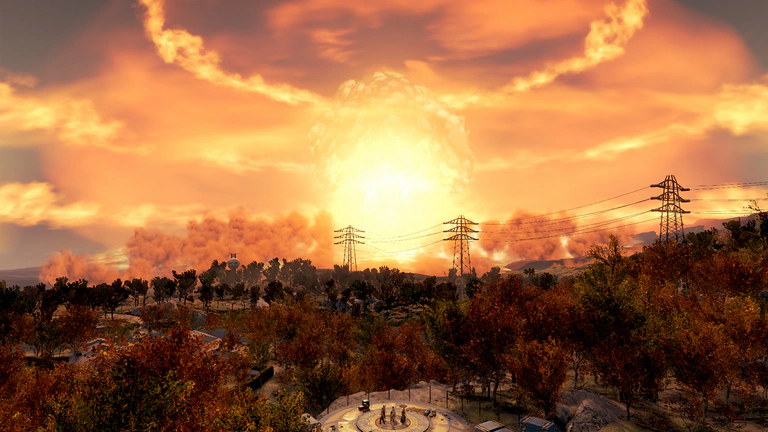
Compared to other parts of the former United States, the Mojave survived the Great War relatively unscathed, largely due to the efforts of Robert House, who had predicted nuclear war would be inevitable twelve years before it struck, and made preparations to save Las Vegas. When the nuclear apocalypse began, 77 atomic warheads were launched at the city and its surroundings, but intricate defense systems set in place by House resulted in 59 of the warheads forcefully disarmed mid-flight, and another nine were blasted out of the sky by a laser defense system situated atop the Lucky 38 Hotel & Casino. The remaining nine hit the surrounding desert, but not the city itself.
The Mojave Wasteland's name had been coined by at least 2083, when one of its residents, Daniel Shin, was recruited into the Brotherhood of Steel by Knight Alan Connors. Nearly twenty years later, the Brotherhood First Expeditionary Force passed through the Mojave on their way to Appalachia. Jack Cabot mentions that his father Lorenzo thought there was an alien city buried under the Mojave Desert, just like Ubar in Rub' al Khali.
In the years immediately following the War, the Mojave was largely ignored by the developing post-apocalyptic civilizations, such as the New California Republic in the west and Caesar's Legion to the east, thus allowing raiders, slavers, and super mutants to prosper there. For years, Vegas sat at its heart, decayed by almost two centuries of neglect and becoming little more than the territory of various squabbling Vault dweller-descended tribes over the years. Various small and/or isolated communities would spring up across the wider Mojave over time, with water remaining as one of the major limits on human resettlement in the desert.
Mr. House, who had preserved himself to survive the war, was initially forced into a coma but revived in 2138. He became aware of the status of Las Vegas, but chose to bide his time before rebuilding society according to his wishes. By 2161, the Desert Rangers, a survivalist and vigilante organization, had been formed by the members of a survivalist community in the Nevada badlands, and they were at least nominally present in the Mojave.
Factional dynamics in the Mojave continued to shift in the 23rd century. These dynamics were intertwined with the larger movements of two major post-War powers, the New California Republic and Caesar's Legion, into the Mojave; see the following section for those details.
Around 2231, a power struggle within Vault 34 led to the self-imposed exile of half of the Vault's population, who went on to settle at Nellis Air Force Base and form the isolationist tribe known as the Boomers.
Some time after 2241, a group of super mutants made their home in the Mojave under the leadership of Marcus at Black Mountain and later Jacobstown after the nightkin leader Tabitha usurped Black Mountain from him. Contemporaneously, the consolidation of the NCR's control over New California also led to various raider tribes, including the Vipers, the Jackals, and the Great Khans, fleeing into the Mojave and other regions bordering the NCR's territory.
In the 2260s, a Brotherhood of Steel expedition was sent into the Mojave to claim Hoover Dam, and this force, led by Elder Elijah, became the fully-fledged Mojave chapter. The Mojave chapter never ended up claiming Hoover Dam; instead, they took the HELIOS One power plant as their headquarters, but were forced into hiding in the Hidden Valley bunker complex after their loss to the NCR during Operation: Sunburst in 2272.
By 2280, much of the southwestern ruins of New Vegas had become occupied by the Fiends, a group of violent, chem addicted raiders. Their position was strengthened by their use of Vault 3 as a headquarters, having massacred its original dwellers, who had naively opened themselves up for trade without preparing any defenses.
NCR/Legion conflict and birth of New Vegas
From the 2250s onwards, the NCR began its Mojave Campaign, seeking to expand its borders by annexing the region. The NCR's initial focus was seemingly not on the Las Vegas area, but instead further to the east around Bullhead City, in retaliation against raiders who had killed multiple NCR citizens in the area. The "Pacification of the Mojave," referring to the extirpation of raiders and tribals around Bullhead City, finally concluded in 2270. It was evidently then that the NCR turned its focus towards Vegas.
Around those same decades, Caesar's Legion was consolidating its power in the east, and advancing steadily towards the Mojave. The Desert Rangers fought in Nevada and Arizona to stop them, but realized this was a losing battle, and they ultimately chose to merge into the New California Republic Rangers in 2271 to stand a better chance against the Legion. In doing so, the NCR also took up the responsibility of protecting southern Nevada from the Legion.
In 2274, President Aaron Kimball sent the NCR Army into the Mojave at large, with the objective of occupying and repairing Hoover Dam. Mr. House detected the arrival of NCR advance scouts to Hoover Dam and, realizing these were signs of an organized civilization, took action to restore Las Vegas. Using his Securitrons, House forced out all but three of the tribes which formerly occupied the Las Vegas Strip. These three collaborator tribes became the Three Families, who helped House rebuild the New Vegas Strip and create the city-state of the Free Economic Zone of New Vegas. The slum community of Freeside eventually formed in the neighborhood outside New Vegas, due to the joint efforts of the Followers of the Apocalypse and the Kings—a newly established local gang—to establish some order in the neighborhood, which had been purposefully cast away by Mr. House.
Subsequently, when the NCR arrived at Hoover Dam in force, House's Securitrons were already there waiting for them. The NCR was forced to negotiate with House, resulting in the Treaty of New Vegas. The clauses of the treaty allow for the NCR to send 95% of Hoover Dam's power output back to their home states, as well as granting them rights to establish military bases at the Hoover Dam and McCarran Airport. In exchange, Mr. House's New Vegas Strip retains its sovereignty and could receive the tourism of NCR citizens without interference from the government as well as the remaining 5% from the dam.
Shortly thereafter, combined forces of the Legion's 86 conquered tribes arrived from the east, led by Caesar and the Malpais Legate, seeking a city to call their capital. The Legion launched an attack on the dam and the NCR troops stationed there but were repelled and forced back east. Most of the credit went to Chief Hanlon for issuing a tactical retreat to Boulder City and luring the Legion into a trap laid by the NCR Rangers that leveled half of the town, then routing the surviving Legionaries back across the dam. This ultimately led to the attempted execution of the Malpais Legate. The outcome of the battle solidified the delicate balance of power in the Mojave; between the NCR, Legion, and House, should one attack the other, the third could take advantage of the conflict and attack in turn.
Though the Legion had been defeated, Caesar's goal of claiming New Vegas as the Legion's new capital remained unchanged, and the Legion spent the next four years replenishing its forces in preparation for a renewed conflict.
Acceleration of regional conflict
Amidst the overall state of affairs between the NCR and Caesar's Legion, another party acted independently to try and accelerate armed conflict across the Mojave, not just between the NCR and the Legion but also among the various small communities and local factions within the Mojave and the Sierra Nevadas. This party was a conspiracy masterminded by Major Jean Boulanger, a former member of the Boomers who saw both the NCR and Legion as deeply flawed, and all of the communities between them as "cowards;" she viewed war as "great and glorious" and believed that it would cleanse the wasteland of the weak and allow a better society to be rebuilt by only the strong.
To those ends, Boulanger sought to ignite this war by distributing weapons she acquired from a pre-War U.S. military storage facility, the Valley of Fire Supply Depot, to various individuals and factions across the Mojave whom she believed would use the weapons to further their own goals—thus escalating regional tensions towards war.Royal Flush pg. 4: The central conflict of Royal Flush is born from its core theme, accelerationism: The deliberate stoking of hostilities and tensions with the goal of sparking a violent conflict. The principal antagonist—a former Boomer known as Major Boulanger—hopes to fire off a set of skirmishes across the region to ignite the war that her people believe is inevitable. In the process, she hopes to wipe the Mojave clear of anyone too weak to survive the conflict, leaving only the strongest to rebuild society. Of course, her goals are deeply flawed: A major explosion of hostilities may simply leave everyone dead or trigger the next war between the NCR and Caesar’s Legion, leaving the partially-rebuilt remains of the world in cooling ruins. To achieve her goal of igniting a new regional conflict, Boulanger seeds communities across the Mojave and Sierras with weapons acquired from a pre-War depot east of New Vegas. Like many governments before her, she hopes that putting guns into the hands of unhappy people will destabilize the area and lead to the collapse of local governments, creating both regime change and conflict. For her, it’s not about becoming rich or even being in control; she desires the return of a great and glorious war and happily gives away tools of death in pursuit of that goal. Of course, in the Wasteland, nobody looks a gift gun in the barrel. Her deliveries of weapons are eagerly accepted by anyone and everyone, leading to constant escalation. War never changes, after all. In every settlement across the Mojave, this escalation leads various people to make (often ill-advised) attempts to achieve their own goals through violence. Freshly armed and ready to fight, they pursue their dreams of wealth, power, and control. Boulanger doesn’t care about their individual motivations so long as they contribute to increasing aggression. This escalation makes the already-dangerous settlements of the region even more hostile and violent.
Second Battle of Hoover Dam
By 2281, the Legion made inroads back across the Colorado River, seemingly having pushed the NCR out of all the lands to the east entirely, and it gained several victories which further destabilized the NCR's positions along the eastern Mojave. These tensions were quickly building up to a Second Battle of Hoover Dam by October 2281—a situation which House sought to exploit to gain control over the Mojave himself, while another man, Benny, sought to exploit House's plans to push out all of these major powers.
Return to anarchy
The exact outcome of the Second Battle of Hoover Dam is unclear. Some conflict continued between the NCR and the Legion, and seemingly even Mr. House's Securitrons, but in the long term, none of its three major players were able to consolidate power in the Mojave, each suffering setbacks to various degrees, to the degree that the Mojave had seemingly returned to a state of anarchy.
Following the destruction of Shady Sands, the NCR's presence in the Mojave all but vanished, with their camps and materiel sitting abandoned and the only known holdouts being a three-man squad left overlooking Primm as of 2296, still believing that reinforcements would come. New Vegas itself had seemingly completely dissolved, as the Strip—the heart of the Free Economic Zone of New Vegas—had been taken over by a pack of deathclaws and left abandoned, and Mr. House was also out of the picture.
The Legion maintained a strong presence in the region, but they were paralyzed by an ongoing succession crisis following the death of Caesar. Two men claimed to be his successor, and their opposing factions were left at a stalemate. They considered themselves still to be at war with the NCR, the Brotherhood, and their former allies, the Great Khans, but were focused primarily on their internal conflict. The Khans, meanwhile, had moved, if not expanded their presence, taking over the town of Novac and even moving back into the Los Angeles area in New California.
Freeside continued to thrive as a seemingly independent community. The status of the Kings, who formerly set the rules in Freeside, is unclear; it is only known that many of its members had been turned into feral ghouls at some point, and were left wandering New Vegas outside of Freeside.
In 2296, former Vault 33 overseer Hank MacLean fled to a Vault-Tec management Vault built beneath Las Vegas, intending to use brain-computer interface chip technology to end all factional conflict in the region by mind-controlling all rival factions to turn them into loyal Vault-Tec subordinates. Hank abducted numerous wastelanders from around the Mojave, including multiple legionaries of Caesar's Legion and one NCR Ranger holdout, turning them into loyal office workers. Hank's daughter Lucy and bounty hunter the Ghoul tracked him to New Vegas, where they discovered the situations of the various factions around the Mojave.
Concurrently, the San Fernando chapter of the Brotherhood occupied Area 51 in order to use cold fusion to restore hegemony over the wider Brotherhood back to the West Coast Brotherhood chapters. This failed, with the chapter and three other western chapters ending up in a civil war over the cold fusion, which was stolen by former San Fernando knight Maximus. Maximus and the Ghoul teamed up to enter the Vault-Tec facility used by Hank, where Lucy, as well as the Ghoul's family, were being held. Maximus inadvertently became a symbol of the NCR's return to the people of Freeside when he donned a suit of NCR Ranger power armor to fight off the deathclaws infesting the Strip. The Ghoul entered the Lucky 38, where he used the cold fusion to activate a digitized version of Robert House's consciousness, restoring a version of the former New Vegas executive to life. What will follow from these events remains to be seen.
Layout
The Mojave Wasteland has significant diversity in terms of inhabitants and landscapes. In the northwest, the super mutant and nightkin-friendly settlement of Jacobstown overlooks the valley from the snow and pine-covered mountains. To the west, the Great Khans have settled in the vibrant cliffs of Red Rock Canyon. The independent settlements of Goodsprings and Primm sit amid the encroaching New California Republic from their Mojave Outpost and the Powder Gangers, a group of escaped convicts, from the NCR Correctional Facility and surrounding camps. The forces of Caesar's Legion are slowly seeping east across the Colorado River at all possible junctures, from their mainstay at the Fort, the newly captured town of Nelson, the destroyed settlement of Nipton and Camp Searchlight, a former NCR stronghold sabotaged by means of radiation. Their forces gather strength each day, readying themselves for a second offensive against the NCR for control of the much-coveted Hoover Dam.
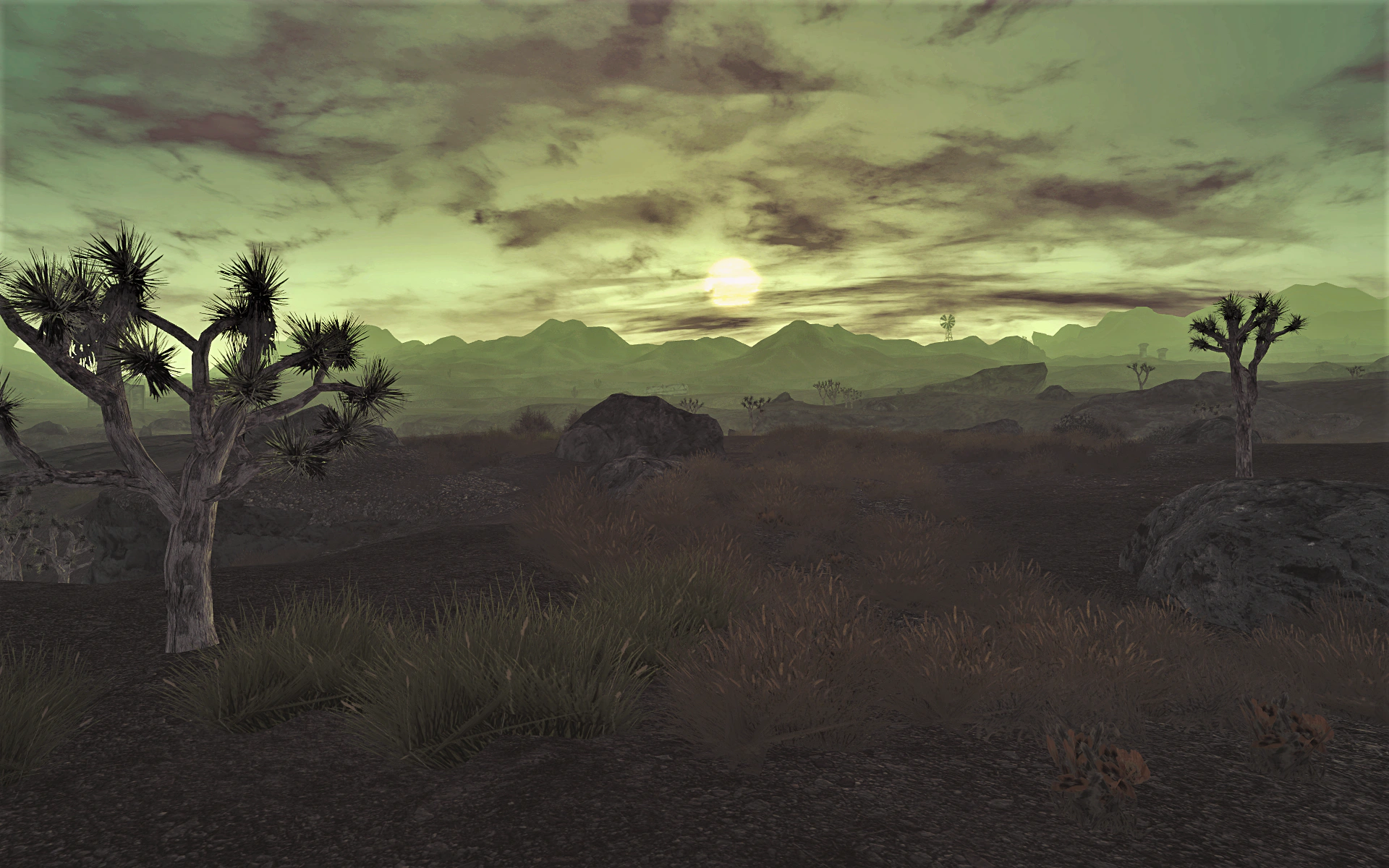
The central region hosts tall and imposing mountain peaks with accompanying valleys, one of which shelters the remainder of the area's Brotherhood of Steel chapter. A group of deranged super mutants and nightkin have taken residence on the foremost peak of Black Mountain. The independent settlement of Novac struggles with neighbors consisting of irradiated abominations, while businesses such as the Gun Runners, Crimson Caravan Company and the 188 Trading Post traders attempt to keep commerce viable amidst the growing chaos.
Fringe groups in settlements circling the middle of the region, such as the Kings and Followers of the Apocalypse in Freeside, citizens of North Vegas Square and Westside, all actively exerting their independence while supporting and sheltering those who call the neighborhoods home.
In the center of it all, the glowing jewel of the desert, the New Vegas Strip's casinos light up the night sky, contently continuing business as usual by attracting those who wish to partake in the allure of riches. Yet similar to the surrounding powers that be, also quietly fortifying itself as a power against all those who may attempt to breach its walls is the secretive benefactor of the beautiful city itself.
Regions
• The following describes the subregions of the Mojave as it appears in Fallout: New Vegas.
West
The northwest-southeast side of the Las Vegas Valley south of the border with California includes the Southwest Commonwealth Conservation Area, encompassing Red Rock Canyon. Examples of locations within this region are Goodsprings, Devil Peak, Mummy Mountain, Mount Charleston, Red Rock Canyon and Vault 22 along Nevada State Route 157 and Nevada State Route 159. Locations such as Floyd Lamb State Park and the Corn Creek Dunes are situated in the foothills of Mount Charleston along Highway 95.
Las Vegas Valley
This New Vegas basin area is surrounded by mountains to the north, south, east and west of the main metropolitan areas of the region. Frenchman Mountain and Lake Mead are located to the east. Locations include the New Vegas Strip, Camp McCarran, Freeside, Westside, Vault 3, Nellis Air Force Base at the northeast corner of the valley, and Camp Golf and Lake Las Vegas in the southeast.
Interstate 15 traverses through Jean before descending into the valley, entering the semi-rural South Vegas area. After passing the Strip, the road elevates and turns northeast, continuing through Freeside until turning sharply north before reaching Nellis Air Force Base towards Garnet.
Highway 95 enters just northwest of the 188 Trading Post and follows the course of the valley. First traveling northwest through Henderson until where it elevates and continues northeast, skirting Frenchman Mountain (which contains Vault 34) until it abruptly turns northwest. From there it continues over the north Vegas suburbs until, just before Freeside, it descends to ground level and merges into urban Vegas.
Central
A mountain range runs parallel to both Interstate 15 and the main railroad system of the region. It is surrounded by three areas, the New Vegas Valley which lies to the north, the Ivanpah Dry Lake to the west and the El Dorado Dry Lake to the east. Traversing the range is Nevada State Route 164, which begins in the Ivanpah Valley and ends in Searchlight. Locations include Nipton, Black Mountain, Jack Rabbit Springs, Primm Pass, scorpion gulch, Wolfhorn Ranch in the foothills and the REPCONN test site.
The Ivanpah Valley features several locations including Primm, Jean Sky Diving, Sloan, Hidden Valley and the Ivanpah Dry Lake. To the northwest of the valley is the Mesquite Mountains and the mining towns of Sandy Valley and Ripley.
Opposite of I-15 is the Mesquite Mountains crater, the canyon wreckage to the Divide, and the Mojave Outpost. The outpost is built along Interstate 15, which traverses the mountain pass heading into California. At the foot of the mountains is NV-164, which passes through Nipton into Nevada.
East
Highway 95 traverses the valley parallel with the Colorado River and meets Highway 93 at the 188 Trading Post, connecting Boulder City to Henderson. Locations include the El Dorado dry lake, Vault 11, HELIOS One and Novac. The region stretches all the way from Camp Searchlight to the Hoover Dam and contain locations such as Boulder City, Nelson, Techatticup Mine, the Lucky Jim Mine and the abandoned BoS bunker. Parallel with Highway 95, Ranger Station Charlie, Legion raid camp and the broc flower cave are situated in a valley. This valley connects HELIOS One with Nevada 164, running parallel with Highway 95 along the powerlines.
Lake Mead and the Colorado River
The Colorado River flows from the Rocky Mountains southwest across the Colorado Plateau and through the lower end of the Grand Canyon before widening into Lake Mead, formed by the construction of the Hoover Dam. U.S. Route 93 passes over the Hoover Dam into Arizona. The river passes Willow Beach and Cottonwood Cove where it continues past the Cottonwood crater and Dry Wells.
Flora and fauna
According to Chief Hanlon, the state that was once Nevada is more fertile and has more water and foliage than California, as the population in California has exploded and caused the need for expansion east in search of new opportunities and land.
A large number of native and familiar species have continued to thrive in the Mojave Wasteland. A variety of birds including ravens are seen in the wastes, pecking through debris and vegetation for food. Fish are present in Lake Mead and the Colorado River. Coyotes have managed to survive in the wasteland with little to no mutation. Despite this, the Mojave wastes are still peppered with mutated species, such as bighorners, brahmin, radscorpions, night stalkers and cazadores, with the last two a result of experimentation at Big MT.
Nevada agave fruit grow in abundance, as do banana yucca fruit. The ever-present radioactive fallout has still altered some of the native life, with glowing mushrooms a common sight. Snow is also present in the area. Water encountered throughout the Mojave is safer to drink and some instances are free of radiation, plant life is found consistently throughout the area and various animals are encountered on a regular basis, thriving in the mostly undisturbed lands.
Inhabitants
Because only nine warheads hit the surrounding areas around the Mojave, rebuilding society has been less challenging than in other parts of the country. Many portions of the wasteland have remained untouched by humans since the Great War (such as Vault 22 and H&H Tools Factory), while others have been resettled (such as Freeside and Novac). The pre-War buildings and factories are more intact, allowing businesses such as the Gun Runners and Michael Angelo's workshop to continue to run and operate. Technology is more well preserved, thanks to the lack of nuclear fallout, and items such as the neon signs that dot the New Vegas Strip, the monorail within Camp McCarran, or the massive generators of the Hoover Dam, have been repaired to proper working order.
Everyday society is stable in some areas and not in others. While small-time traders and traveling merchants along Highway 95 and the Long 15 are able to operate, it is a fraction of what the larger and more organized traders and caravans are capable of. The larger entities have the advantages of manpower and firepower, and those that have managed to acquire pre-War technology, such as the Crimson Caravan Company, prove even more successful. Some wastelanders were even recruited out of the region to serve with military organizations elsewhere in the post-War United States.
Super mutants are less common here than other parts of the country, and most who are residing in the area have chosen to do so in their own community of Jacobstown or the more hostile Black Mountain. Composed of remnants of the former Unity, they are considerably more intelligent than their Vault 87 and Institute cousins, though nightkin ail from severe psychological damage.
Separating New Vegas from the rest of the Mojave exists a vast expanse of desert where many dangerous creatures such as deathclaws, feral ghouls and radscorpions thrive. This generally causes most travelers to traverse along NCR-controlled highways or hire mercenaries to escort them.
Casinos and gambling are popular among the locals in the area, making the New Vegas Strip a popular hub of activity for merchants, caravans, NCR troopers, opportunists and everyday people wanting to hit it big at the slots. The main casinos, The Tops, Gomorrah and the Ultra-Luxe, are run by the three tribes that settled in New Vegas. Each has its own personal rules and customs, other than the universal rule against carrying weapons into their casinos, and are overseen by Mr. House and his Securitrons.
Politics
For much of the post-War period, the Mojave was effectively in anarchy, though power dynamics may have continued to shape individual communities in the region. The situation began to shift towards a more complex state in the mid-to-late 23rd century, with the growth and expansion of both the NCR and Caesar's Legion towards the Mojave, and Mr. House's founding of New Vegas in response.
As of 2281, politics play a large role in the society of the Mojave. Politics in the region boils down to three major powers: the NCR, Caesar's Legion and the Free Economic Zone of New Vegas controlled by Mr. House. The NCR is finding its war with Caesar's Legion both increasingly unpopular back in California and expensive to fund. Caravans and merchants heading to and from the Mojave deal with exorbitant taxes and fees imposed on them by the NCR. Caesar's Legion is coming ever closer to finding out what happens when their absolute ruler, and god, finally passes away and is facing the question of what truly unified the Legion in the first place, Caesar's ideals or Caesar himself. The casinos on the Strip have their own agendas and Mr. House has his own mysterious plans for the Mojave and more specifically, the Strip.
The NCR's goal in the region is to annex the Strip as an NCR territory and completely settle the region as NCR land. Many NCR soldiers and former soldiers, such as Craig Boone, believe this is not possible until the NCR takes the fight to the Legion and takes out Caesar himself; only then will the NCR be an unchallenged power in the region and able to safely settle without danger of constant attack. This sentiment is brought on by the commanding officer in the region, General Lee Oliver, constantly ordering his forces to hold the line, despite objections from his subordinates such as Chief Hanlon, Colonel James Hsu and Major Dhatri. They feel that the position the general is putting them all in, holding the line against the Fiends, ordering Chief Hanlon not to pursue the Legion at the First Battle of Hoover Dam or ordering the NCR Rangers into a support role when they have more skill than the NCR's heavy troopers, are racking a higher body count than would actively pursuing an offensive campaign against these opposing entities, which each one feels the NCR is capable of doing.
The Legion's goal is to make the Strip its new capital, replacing Flagstaff to the southeast. It also desires complete control of Hoover Dam as it is a strategic position to defend and a source of clean water. They are less interested in the power the plant provides as they reject advanced technology, believing it a crutch rather than a tool to be used. The Legion, despite a devastating defeat at the First Battle of Hoover Dam, has once again emerged from the east and actively attacks NCR outposts and camps from its base at Cottonwood Cove. Camp Forlorn Hope is an excellent example of how the Legion has regained strength, as they took the nearby city of Nelson and repeatedly assault the camp, lowering morale among the camp's inhabitants. Once the Legion takes a position, they seem to be able to hold it effectively, without much resistance. This is the opposite of the NCR, which is constantly losing footholds in positions in the eastern Mojave.
Meanwhile, Mr. House fortifies his position on the Strip, letting the conflict between the NCR and the Legion play out. He believes that the fewer soldiers of each organization who try to impede his progress at the next battle of Hoover Dam, the better. He patiently bides his time, waiting to exploit vulnerabilities generated by one faction attacking the other as a constant backdrop of distant explosions, artillery and gunfire can be heard regularly throughout the region.
Developments after 2281 resulted in each of the Mojave's major powers suffering major setbacks, if not losing their grips in the region entirely. By 2296, the Mojave at large seems to have returned to a state of anarchy, and factional conflict continues.
Sources
Adapted from the original article, under CC BY-SA 3.0.