Place
Pennsylvania
State of the pre-War United States of America
Pennsylvania was a state of the pre-War United States of America.
Background
The Province of Pennsylvania was one of the original thirteen colonies of Great Britain on the North American continent. Amidst the tensions leading to the Revolutionary War, it was included in Benjamin Franklin's political illustration calling for unity among the North American colonies in the 1700s. Pennsylvania subsequently became an important site in the cause for American independence: The Second Continental Congress held their meetings in the city of Philadelphia, Pennsylvania, including drafting and later adopting the Declaration of Independence on July 4, 1776, with the last of the delegates signing on August 2 of that year. This led it to later gain the moniker as the "State of Independence." It is also identified in the inscription placed on the Liberty Bell displayed outside the Pennsylvania State House in Philadelphia.
In 1863, Gettysburg, Pennsylvania was the site of the bloodiest conflict in the course of the American Civil War. After the battle, President Abraham Lincoln delivered the Gettysburg Address at the battlefield, which was later commemorated with an inscription on the Lincoln Memorial in Washington, D.C..
In the 21st century, the Museum of History in D.C. included an exhibit with a Protectron "actor" playing the part of James Wilson of Pennsylvania, the state's representative signatory of the Declaration of Independence and one of the first Supreme Court Justices of the U.S.
Industrialization
Since the 19th century, Pennsylvania had steadily become more industrialized, with some of the largest industries being steel and concrete production. A high concentration of companies within these industries were established in the city of Pittsburgh, which was built at a confluence of three rivers: the Allegheny, the Monongahela, and the Ohio. This fostered Pittsburgh's dual epithets as the "Steel City" or "City of Steel," and the "Gateway to the West." Known companies based there included PA. Steel Company USA, the Pittsburgh Union Steel Company, and the Holland Chase Concrete Company. A stone furniture manufacturer, Top Drawer Livin', was established in the city of Waynesboro and did business with Thicket Excavations in Massachusetts. Coal mining towns were also present as well. The state also drew military interests, with a particular mountainous area close to D.C. being chosen to host the Raven Rock command center complex.
In the latter half of the 21st century, as the Resource Wars dragged on and the U.S. become entangled in open war with China, factories across Pennsylvania, including those in Pittsburgh, were redirected to produce war supplies such as weapons, munitions, power armor, combat-ready robots, and vertibirds. The Department of Defense also arranged for the construction of at least one internment camp in the state, intended to hold prisoners suspected of being Chinese infiltrators who were detained by private military contractors under the authority of the US Marine Corps.
However, when the costs of the war effort began mounting, the automation riots broke out in many areas, including both the Keystone State and surrounding regions such as Appalachia. In the face of corporate entities trying to replace their factory workforces with fully robotic production lines, the laborers sought to strike back, often to the point of forceful obstruction and vandalism. As a major industrial hub, Pittsburgh was at the heart of the anti-automation movement in Pennsylvania. When the workers of the Pittsburgh Union Steel Company were given orders to triple production of war supplies in mid-2077, they were nearly prepared to riot, and it took many months to get company leadership to agree to negotiations for better conditions. Conversely, laborers working in one of the city's supply plants were less successful and were faced with their management fully replacing them with Protectron workers. Two workers who vandalized the factory machinery in protest were quickly terminated and replaced in a matter of days. When this came to light, the employees saw no recourse for negotiation and rebelled, taking over the plant and holding their supervisor hostage until he activated the Protectrons, which slaughtered the rioting workers.
Post-War development
On October 23, 2077, the state was bombarded by multiple nuclear missiles. Pittsburgh was largely reduced to ruin, although a great deal of its industrial infrastructure was spared. Philadelphia was also hit as well to an unclear degree, with the ruins later described as "a dump." In the immediate aftermath of the bombs, some military infrastructure was still present in the state, as a National Guard unit from Pennsylvania was able to deploy to support the National Catastrophe Relief Auxiliary at the Germantown Police HQ in Maryland.
Professional baseball players Nathan Broadhurst and Jim Walker, who survived the initial destruction of the Great War by sheltering in Fenway Park in Boston, attempted to reach family in Charleston, West Virginia by traveling through Pennsylvania instead of their original plan to follow the coast, due to rumors that places like New York City were worse off. The journey was initially peaceful as they walked along the highways and joined a nomadic group in the city of Hartford, Connecticut who were trying to reach Pittsburgh. They eventually split off near Altoona, Pennsylvania to continue on their own. However, when Nathan and Jim reached Bedford, they were accosted and captured by hostile survivors who had already established a fortified stronghold. Though they managed to escape their captors, Jim was fatally shot as they tried to escape the city, leaving Nathan to continue alone.
Another group of survivors weathered the apocalypse and built a town in the remains of an abandoned resort in the Pocono Mountains. They were able to last there for around 15 years until 2092, when the town was destroyed by a group of raiders, killing many and scattering the survivors. One of them, Yasmin Chowdhury, took her cooking recipes she had cultivated over time, and eventually made her way to Appalachia, following stories of the region's cooking traditions told to her by travelers over the years.
The Pitt
By the turn of the 2100s, the state had very little law and order to speak of. Street gangs that formerly operated on the fringes of society organized into vicious raider tribes that started moving into the old industrial centers to take control and carve out strongholds for themselves, killing or enslaving weaker groups of survivors to do the work for them. The constant danger and lawlessness eventually forced most survivors to flee into other regions, such as the coalition of Settlers led by former union leader Paige who traveled to Appalachia and formed Foundation in 2103.
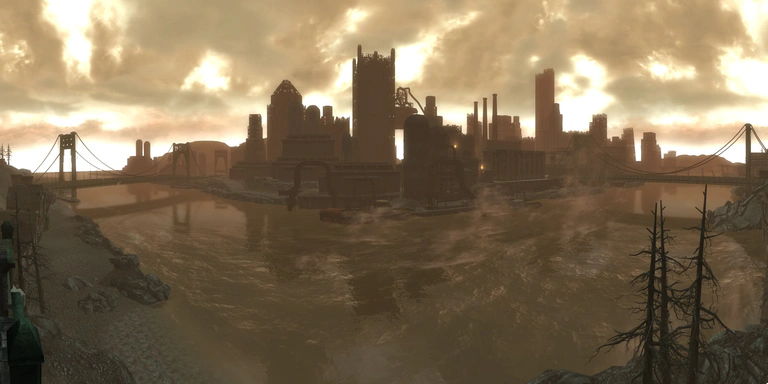
Over time, the raider gangs of Pittsburgh cultivated a harsh form of settlement that subsequently reestablished the city under the name "The Pitt." A complete takeover by the gangs was resisted by the Union, a coalition formed by remnants of the city's old steelworker chapters, who sought to rebuild their home to its former glory. The Union's greatest challenge came in the form of the raider group known as the Fanatics, against whom they fought a war on the streets of the Pitt in the early 2100s. This conflict drew in the involvement of outside help from both mercenaries of the Hellcat Company and the members of the Vault 76 reclamation effort in Appalachia.
Despite the struggles of its inhabitants to salvage a semblance of safety, the surrounding area of the Pitt was ultimately doomed. Years of industrial pollutants and mutagenic compounds seeping into the groundwater, combined with the intense radiation from the Great War, rendered the waters of the three rivers intensely toxic. Over the following decades after the war, children would be born with deformities such as cancerous growths or vestigial limbs, eventually resulting in nearly the entire population becoming afflicted with genetic diseases and mutations caused by the polluted river waters. Some people would suffer neurological damage, becoming violent madmen known as the wildmen; others would fully degenerate into primal creatures known as trogs.Fallout 3 Official Game Guide Game of the Year Edition pp. 43-44: "Pitt Raiders Pitt Slaves Trogs Wildmen Following the Great War, survivors established a settlement on the remains of a city at the confluence of rivers. The rivers seem to provide a clear resource, and enough of the city was cleared by the bombs that a new settlement could be established. However, radioactive material and unidentified mutagens mixed into the groundwater, causing it to become slightly mutagenic and highly carcinogenic. As a result, the people in the new settlement began to change ever so slightly. The changes were subtle, not nearly to the degree of the Super Mutants or the various Wasteland creatures, but over the next 140 years, it became undeniable that something was affecting the people of The Pitt. Starting from the first few years, children were often born with strange growths or extra vestigial limbs. The mutations never went far beyond the occasional hunchback or cleft palate, but it wasn't long before the vast majority of the residents of The Pitt developed some sort of physical deformity in their lifetimes. Although many children were born "clean," the older they got, the more likely that a problem would develop. The most disturbing change that the environment caused was not nearly as noticeable as the physical deformities. The infected water and poisoned sky began to cause neurological damage to those exposed to it. People became more hostile, violent, and short-tempered; they became known as "Wildmen." Their emotions became out of control, and their actions often teetered on primal. In severe cases, mutated humans devolved into hunched, savage beasts nicknamed "Trogs." Over the first 50 years, The Pitt quickly degenerated into a dangerous den of murderers and rapists; even cannibalism was not uncommon. The only loyalty was in strength, and the only organization was between those who were strong enough to control others and those who were controlled. Rumors of the horrors of The Pitt spread throughout the Wasteland, and all travelers knew to avoid it at all costs. However, The Pitt became one of the most self-sufficient communities in the Wastes. Granted, their self-sufficiency relied on the citizens occasionally eating one another, but they functioned without trade or export. (Fallout 3 Official Game Guide faction profiles) These mutations were already common in the early 2100s, amidst the Union's war with the Fanatics.
By the 2250s, the Pitt had largely devolved into a den of misery and violence inhabited by murderers, rapists, and the worst that humanity had to offer. Its fate changed significantly in 2255, however, when a scout force of the Brotherhood of Steel led by Owyn Lyons, a star paladin at the time, discovered the Pitt and decided to scour it for pre-War technology before wiping it off the map. In an event later dubbed "the Scourge," the Brotherhood swept through the city from Mount Wash, eradicating every crook, cretin, raider, and wretch that tried to stand in their way. In addition to recovering technology, Lyons' men also liberated a small number of unmutated children to be trained into would-be initiates of the Brotherhood, including Greg Bear, later named Kodiak.
In the wake of the Scourge, however, a new figure emerged in the Pitt: Ishmael Ashur, one of Lyons' men who was inadvertently presumed dead and left behind after being buried in debris in one of the old steel mills during the Scourge. He was found by surviving inhabitants of the Pitt and came to realize the potential value of restoring its steel mills to function and returning civilization to the city's streets. Reinventing himself as the "Lord of the Pitt," Ashur spent the next three decades trying to bring the Pitt to prosperity, though at the cost of having to rely on vicious raiders for an army as well as capturing inhabitants from other settlements or purchasing them from organized groups like the slavers of Paradise Falls in the Capital Wasteland to amass an enslaved workforce in the steel mills, which has fostered its reputation as a major contributor to the slave trade on the East Coast. The polluted atmosphere of the city and the mutation phenomenon later dubbed the troglodyte degeneration contagion were Ashur's biggest hurdles to getting away from the need for slaves, and progress on combatting it was only possible after meeting Sandra Kundanika, an educated scientist who eventually became his wife and the mother of his daughter, Marie. Through research on their child's genetic immunity to radiation and TDC, the couple hoped to eventually develop a cure for the Pitt's ills.
Other 23rd century events
In the mid-2240s, Raven Rock's intact ZAX supercomputer unit, under its new personality as John Henry Eden, made contact with the surviving members of the Enclave sheltering at Camp Navarro in the wake of the destruction of Control Station Enclave in 2241, declaring itself their new president. On Eden's orders, several high-ranking members led by the scientist Autumn Senior departed from the West Coast and traveled across the nuclear wasteland to reach the military complex, going on to form a new division of the Enclave. Fallout 3 Official Game Guide Game of the Year Edition p. 41: "The Enclave In the recent past, the Enclave—the remains of the United States government—were evacuated to an oil rig off the coast of California. Little is known about what happened to these forces, although the country has a new commander-in-chief: President John Henry Eden. However, recent reports and chatter have pinpointed the resurgence of the Enclave, with their base centered on a secure underground facility known as Raven Rock. Initial contact was made there 35 years ago. During this time, the new President Eden has been slowly rebuilding his resources, thanks in part to the technology already available at the Raven Rock military base. Vertibirds, weapons, and robots were easy to construct, but human followers were more difficult to find. The answer was to rely on Colonel Autumn, who controls the Enclave soldier forces, as well as creating a propaganda-spewing series of Eyebots sent to roam the Wasteland, spreading hope. Eden could spout his pro-government rhetoric, and promise a return of the pre-war America of legend: a land of white picket fences, baseball, apple pie, and good, old-fashioned American global supremacy. President Eden's secretive plan all along has been to rule over an America of the "pure," free from any mutation. He has learned of a ridiculously ambitious experiment known as Project Purity, and knew the time to strike had come: His Enclave forces would "reclaim" the Jefferson Memorial. By controlling the purified water, Eden would control the Capital Wasteland, and the rest of the country eventually. What better way to administer modified F.E.V.- which kills anyone infected with any form of mutation-than through the water supply?" (Fallout 3 Official Game Guide faction profiles) Note: 2277-35=
By the 2270s, the suburb of Monroeville was also known to have been infested with trogs and feral ghouls. Abraham Washington, curator of the Capitol Preservation Society in Rivet City in 2277, once had an encounter with a traveler who claimed to possess a shard of the Liberty Bell from Philadelphia, but he dismissed it as a fake; Washington fervently believes that the Liberty Bell remains fully intact in the ruins of Philly and funded an expedition hoping to retrieve it for the Society's collection of historical artifacts.
Locations
The Pitt (formerly Pittsburgh)
Altoona
Allegheny River
Appalachian Trail
Bedford
Gettysburg
Monroeville
Mount Wash
Oakmont
Philadelphia
Pocono Mountains
Waynesboro
WRA site PA-32
Sources
Adapted from the original article, under CC BY-SA 3.0.