Group
United States Army
The United States Army was a branch of the United States Armed Forces, under…
The United States Army was a branch of the United States Armed Forces, under the management of the United States Department of the Army.
2050-2059
In 2051, the United States began exerting pressure on Mexico to protect their economic interests there, primarily the crude oil supply. The U.S. deliberately destabilized the country through economic pressure, paving the way for a military invasion. American units seized oil refineries and infrastructure to ensure the flow of crude oil did not cease. Not long afterward, rising oil prices worldwide bankrupted smaller nations and led to the European Commonwealth declaring war on the Middle East; the United States was severely affected by the skyrocketing prices of oil. In subsequent years, this would become known as the beginning of the so-called Resource Wars, exacerbated by the dissolution of the United Nations in July that ensured no international body would exist to mediate between nations or enforce international treaties, allowing for unrestricted use of military force.
Against the backdrop of an increasingly worsening international situation, including nuclear exchanges in the Middle East and the Euro-Middle Eastern War, the United States stepped up its efforts to militarize. One of the first major projects emerged in 2059, as the Anchorage Front Line was established in Alaska to protect the state's natural resources. A side effect of this decision was the escalation of tensions with Canada, as the United States Army demanded the ability to station troops on Canadian soil, in an effort to protect the Alaskan pipeline.

2060-2069
A year later, in 2060, available fuel reserves were on the brink of depletion worldwide. The problem was further emphasized by the collapse of the European Commonwealth and the Middle East oil powers, as the oil fields were exhausted. Together with a deteriorating economy and worsening social climate, the United States began to crack. The Third Red Scare was a response to the increased hostility of the People's Republic of China, primarily its intelligence operations on American soil, and pervasive propaganda that blamed the nation's problems on Communist foes.
The Army was particularly affected by the fuel shortages, as its vehicle fleets became crippled by fuel shortages, although it did not stop them from deploying cargobots in Appalachia in late 2060 for providing reconnaissance and delivering supplies. In response to the shortages, the United States Army initiated a research program to develop power armor in 2065. Although no prototype proves itself to be workable in the field, intense research, development, and prototyping paved the way for future advances in military, construction, and most importantly, cold fusion technology. The military continued research in other areas continues as well, including more powerful nuclear weapons.
These advances would prove crucial for the Army in the near future. Spring of 2066 was the turning point in history, as oil resources dried up across the globe causing an energy crisis in China. Bordering on collapse, the Communist state aggressively pursued a trade agreement with the United States to export crude oil to the Asian superpower. The talks eventually broke down,
It is claimed that on June 24, 2074, the U.S. president made a declaration that the last known supply of petroleum would be used exclusively by the U.S. and they would not sell or trade any oil to outside parties. However, this information is from the Sierra Depot GNN transcript, which is an unreliable source.
Adding further insult was the public announcement of the development of the first crude fusion cell, an offshoot of the power armor project, in the summer.
In the winter of 2066, China launched an invasion of Alaska to seize its natural resources and stave off collapse. This daring, trans-Pacific military operation began the Sino-American War, the last war the United States would ever fight. The initial invasion overwhelmed American defenders. Military units of the Army and other branches of the military found themselves reeling from the initial attack, retreating on all fronts well into 2067, despite the Canadian government backing down and acquiescing to American demands for transfer rights through Canadian territory at the end of 2066. It was not until the first suits of T-45 power armor were pressed into production that the Chinese thrust into the nether regions of America was slowed and halted. The first units proved to be incredibly effective in defense, but somewhat lacking in offensive capabilities. As the Chinese military lost the initiative, the situation rapidly deteriorated into trench warfare as neither side was capable of breaking the stalemate and forcing peace terms on the enemy.
The war continued, with the Army and other branches liberally drawing on Canadian natural resources to support its war effort. Protests from Ottawa were routinely ignored as Canada became Little America: A colony of the last superpower on the continent.
2070-2077
The Army outright occupied Canada in 2072, as rioting and protests in Canadian cities culminated in a sabotage attempt of the Alaskan pipeline. Army troops marched north, opening a second front: Fighting against Canadians.
On the domestic front, the Army deepened its ties with the corporate world, as its robotics program developed. The Army commissions RobCo Industries and General Atomics International, long-time suppliers of combat robots to the military, to create the most powerful combat robot in the history of warfare. Its mission? To liberate Anchorage, Alaska from Chinese occupation. The project was meant to serve both military and propaganda needs. The former dictated the capacity, the latter the design: In the words of General Constantine Chase, initiator of the project, Liberty Prime was to embody the American military: A walking, talking, nuke-tossing hero reminding enemies of the U.S. that they picked a fight with a global superpower. Confident that the project would soon yield result, General Chase publicly confirmed in June 2072 that the U.S. Army was working with General Atomics and RobCo to create a superweapon meant to establish dominance of the United States on the Alaskan front.
Not all companies were lucky enough to be commissioned. For example, in 2071, the West Tek research facility was put under Army command, which would oversee the development of a Pan-Immunity Virion from 2073. The research would eventually evolve into the Forced Evolutionary Virus project.
One of the turning points of the War came in 2074, as, despite claims of fighting a defensive war, American infantry and mechanized divisions landed in Asia, in a counter-invasion of Chinese mainland. The American economy strained as American soldiers, Marines, sailors, and airmen fought a war on three fronts: Canada, Alaska, and mainland China. Neither side was willing to yield, despite eight years of constant warfare. The situation rapidly deteriorated into a stalemate, just like in Alaska. Ambitious flanking maneuvers such as the Gobi Campaign, and the Yangtze Campaign, where U.S. Marines rapidly overran Shanghai and Nanjing, did little to tip the scales in favor of American forces. As late as 2077, American troops would struggle to control supply routes, forcing permanent garrisons, such as the 5th Infantry Regiment in remote locales such as Mambajao in the Bohol Sea region.
By 2076, the war had raged for a decade. Both China and the United States were nearing exhaustion. In January, the Army stationed a permanent garrison at West Tek's research facility in California to ensure that the Forced Evolutionary Virus project (a super-soldier program that emerged from PVP development) remained safe from international espionage. Dogs and chimpanzees are the first test subjects, paving the way for future development. Outside the nation's borders, the annexation of Canada completed later in the month. Its provinces remained under martial law - all protesters and rioters were shot on sight. Atrocities committed by the Army quickly made their way stateside, fermenting anti-governmental sentiment.
Later that year, the Army gained a decisive advantage. The T-51 power armor finally completed testing with the Corps of Engineers in June, giving the American soldier the tool they needed to confront the Chinese. Next-generation power armor was rapidly manufactured and provided to mechanized cavalry units. Sent to the Alaskan and Chinese fronts, they carved a swath through Communist forces. The Chinese economy crumbled under the onslaught and supply lines from nations annexed by the Beijing regime started falling apart. However, the Washington regime did not fare any better. In August, food and energy riots started in urban centers across the United States. A state of emergency and eventually martial law was declared, with Army deployed on the domestic front to fight their own countrymen. Demoralized troops behaved like thugs towards their own countrymen.
Collapse of America
The counterpoint to this disastrous turn of events came in early 2077, as the Battle of Anchorage ended with a decisive American victory on January 10, after a final offensive spearheaded by T-51 power armor units adapted to the cold environment penetrated Chinese defenses around Anchorage. Despite the embarrassment of the Liberty Prime project, which failed to produce a working weapon for use in Anchorage, General Constantine Chase was credited with the victory. The Anchorage War Memorial was hastily erected on FDR Island to commemorate the efforts and sacrifices of American soldiers on the Alaskan front, basing on an iconic photograph taken in Anchorage. The victory in Alaska heralded bad news for American and Canadian citizens, as the military junta in control of the United States deployed mechanized cavalry units to Canada and the United States. Veterans of the Chinese and Alaskan fronts found themselves fighting their own countrymen, quelling riots, and enforcing the national quarantine. Mounting civilian casualties tested the loyalty of soldiers and desertions started to occur. Captured deserters were imprisoned or sent to feed the Army's newest Robobrain development program.
The campaign in mainland China was reinvigorated by the victory in Alaska and the deployment of T-51 units. Army troops clad in T-51 regularly witnessed Chinese troops surrendering upon sighting them and their miniguns. Fallout 3 Official Game Guide Game of the Year Edition p. 43: "Chinese Army (Simulated) U.S. Army (Simulated) With conditions deteriorating between the United States and China, a military presence in Alaska was established to prevent a possible invasion across the Bering Strait. With increasingly scarce oil reserves, a last deep-sea deposit below the Pacific Ocean was claimed by China before allegedly being sabotaged by American special operatives. Strained relationships spiraled downward into conflict as China marched on Alaska, and the Sino-American War of 2066—2077 erupted. Under the command of General Jingwei, the Chinese Army usurped control of Alaska's oil pipeline and reserves. In response, the Americans began what came to be called "The Alaskan Reclamation Operation" (2067—2077). Under the leadership of General Constantine Chase, the U.S. Army battled fiercely to the front lines of the conflict before Chase began deploying specialized Power Armor units that began pushing the Chinese back. Future Power Armor suits were further refined as the conflict dragged on, and the Trans-Alaska Pipeline was reclaimed. With resources flowing through Canada, strained diplomatic tensions between Canada and the United States becoming problematic, and Canadian forces attacking the pipeline, the country was annexed. A combination of inclement weather, constant American bombardment and trench warfare, and U.S. Powered Armor unit attacks sweeping through mainline China, the Chinese supply lines weakened and finally broke down completely. By the beginning of 2077, the city of Anchorage was finally liberated, the Chinese eradicated, and the operation deemed a success. A commemorative memorial was erected in Washington, D.C., in honor of the soldiers who fought and perished for the greater American good. Violence between America and pockets of Canadian freedom fighters continued throughout 2077, until the Great War obliterated almost all infrastructure, commerce, and human life." (Fallout 3 Official Game Guide faction profiles) However, the effect did not last. As American troops pushed deeper into the mainland, Chinese resistance increased. By October, the situation transitioned from a rout into a stalemate. After a decade of war, there was no end in sight. Billions of dollars and thousands of casualties were spent in vain. To bolster the offensive, bases across the United States were sealed and troops redeployed to provide more men for the meat grinder.
The situation was made worse by the fact that the oligarchs ruling the United States retreated to remote locations around the globe, expecting a last-ditch nuclear strike from China at any moment. The oil rig was claimed by the president and key members of the junta, becoming the foundation of the future Enclave. The United States was leaderless, continuing on simply due through inertia. When the U.S. Army security detail at Mariposa discovered the FEV experiments conducted on their comrades in arms – the very men arrested for refusing to fight their own countrymen – they rebel. However, even as Captain Roger Maxson declared them in full desertion from the Army and broke all ties with the United States, there was no response – the chain of command ceased to exist.
The Great War
Nuclear weapons were launched on October 23, 2077. Within two hours, the United States ceased to exist as a nation, its cities vaporized in nuclear fireballs, the former leaders of the country having already retreated to their safe havens. Abandoned by their leaders, the survivors began rebuilding on their own.
The military is suggested to have had contingencies in case of nuclear war, including plans to preserve personnel from every level in safe locations, or to regroup at designated safehouses. However, it is unclear to what extent these contigencies were carried out, if they existed (independent of other organizations like the Enclave). The war devastated military chain of command, with many units left isolated and without orders. In some regions, military survivors appeared to have reorganized to some level and attempted to maintain order by taking control of critical infrastructure, such as with Mass Bay Medical Center in Boston and Monongah Power Plant in Appalachia. However, these efforts all failed over time. Some units and personnel would end up joining other military-adjacent organizations, such as the Enclave or the Brotherhood of Steel. Others settled down in the wastes, or even founded their own settlements, such as with Junktown in New California.
Personnel
By 2077 and the Great War, the United States Armed Forces was the most powerful military in the world, thanks to its overwhelming technological superiority. T-60 power armor, T-51 and the older T-45 model, guaranteed a qualitative advantage over any foe, thanks to their superb protection and ability to carry heavy weapons into combat, including rotary cannons usually mounted on gunships or fighters, and crew-served weapons like anti-tank missile launchers. They were essentially mobile firing positions, filling a similar (but not identical) niche as tanks. Power armor units were usually issued to mechanized cavalry formations operating on critical fronts, although significant numbers were issued to special purpose units assigned to domestic security, such as at the Mariposa Military Base.
Energy weapons were another example of the United States enjoying technological superiority over any potential foe. While Germany had developed infantry fielded railguns in the form of the M72 Gauss rifle and the PPK-12 Gauss pistol (which the United States fielded as well ), the United States Armed Forces were entering a stage where laser and plasma weapons were issued to soldiers in the field, slowly replacing conventional firearms. While many continued to be developed and tested, production models like the Wattz 2000 laser rifle or the modular General Atomics AER-9 were issued to frontline troops in China and Alaska. The weapons have not yet managed to eclipse conventional armaments, but provided a significant edge to United States forces, thanks to the versatility of power cells, a micro-fusion cell could power anything from a close-range scattergun to a high-precision long-range laser marksman's rifle.
Outside power armor and energy weapons, the Armed Forces deployed advanced, reliable technologies. The standard combat uniform of the military was combat armor, manufactured from advanced defensive polymers, providing excellent protection. Even the first generation, where the armor was manufactured as individual plates affixed to a uniform, was a great combat uniform and was used by light infantry formation well into 2077, with more advanced suits reserved for frontline use in China or sensitive areas on the domestic front. Weapons tended to be more reliable than advanced, with the rugged, reliable M199, and R91 assault rifles, the humble service rifle and/or the MP9 10mm submachine gun being the perfect examples of the philosophy. Although advanced conventional designs (such as bullpup designs and caseless ammunition) were certainly deployed and in number.
Robotics and vehicles
Robotics played an important role in Army operations. Apart from sentry bots, designed originally for guard duties – used to carry heavy weapons into combat on a semi-autonomous unit, the Army also employed a variety of other robotic materiel. Among the materiel were cargobots, protectrons, the more advanced Mister Gutsy robots (militarized versions of the popular Mister Handy utility robot), which entered service in 2077, and the Assaultron. This RobCo design was built as a frontline wartime combatant. Fast and deadly at close range, and employs a devastating laser at a distance. Some units can even employ stealth technology. With the progression of the War and subsequent straining of personnel, the military began a process to automate facilities wherever possible, effectively replacing the staff with machines.
With the advancement of cyber-robotics came the development of the Robobrain. Developed shortly before the war by GAI, the Robobrain was uniquely designed to accept brains as its central processor. They were intended to be a multipurpose platform, with such duties as to command units of robots, interrogation, and to fill tactically proficient combat roles.
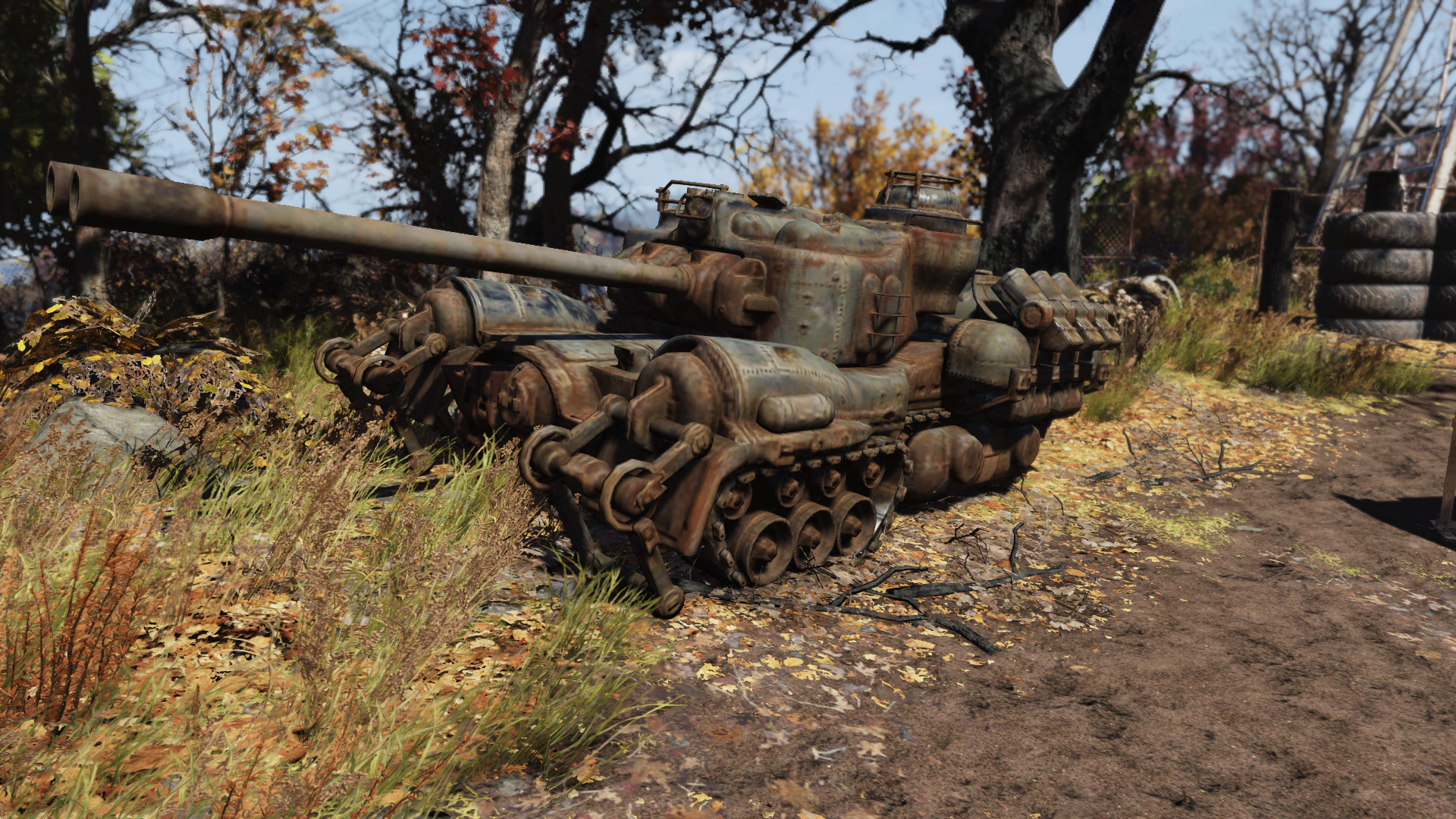
Despite the resource crisis, the Army continued to field its extensive vehicle fleet. Trucks and armored personnel carriers were commonly used on the domestic front, while tanks provided the firepower necessary on the frontlines and occasionally the home front. The biggest asset of the Army was the vertibird transport VTOL, enhancing the mobility of power armor units. A new and improved prototype XVB02 vertibird tiltrotor gunship was in development by 2077, with full-scale adoption planned for 2083. Lastly, though they can hardly be considered aircraft, hundreds of orbital micronuclear platforms were also placed in orbit around Earth, to provide tactical fire support for military forces or defend the home front if need be.
Combat drugs
Combat drug use was sanctioned by commanders. In fact, one of the most popular drugs, Psycho, was developed by an R&D company owned by General Constantine Chase and operated directly as a Army research division. To prevent addiction, many bases stockpiled endorphin blockers, allowing soldiers to use these drugs freely.
Divisions
101st Field Artillery Regiment
104th Infantry Regiment
108th Infantry Battalion
108th Infantry Regiment
121st Infantry Platoon
132nd Engineering Corps
184th Infantry Regiment
5th Infantry
3rd Company
708th Infantry Division
8063rd
Army Research Laboratory
Chase R&D
Industrial Operations Command
Intelligence Corps
Special Forces
Strategic Arms Division
US Army CWD
United States Army Rangers
US Army Reserve
Army Space Troopers
Installations
Command forward depot
Fort Knox
Hawthorne Army Depot
West Point
Sources
Adapted from the original article, under CC BY-SA 3.0.