Event
Synth abolitionism
Abolitionism for synths is a post-War military and ideological conflict…
Abolitionism for synths is a post-War military and ideological conflict occurring on the East Coast of the former United States, concentrated in the Commonwealth with tangential effects in the Capital Wasteland, from the 2220s at the earliest into the late 2280s.
The primary actors in the conflict are the Institute and the Railroad, waging a shadow war to decide the fate of the artificial race of synths and whether they remain as a servant class to the former or ascend to the rights inherent to a free willed being through the help of the latter. Occurring parallel with the War of the Commonwealth, the conflict appears in a minor capacity in Fallout 3 and is a driving story element in Fallout 4.
Creating artificial life
The Institute was founded in 2110 by students of the Commonwealth Institute of Technology who survived the Great War in the basement levels of the college's campus in Cambridge, Massachusetts. Since then, the Institute has put their collective expertise into pursuing multiple fields of scientific study and developing many cutting-edge advanced technologies, according to their guiding mantra: "Mankind - Redefined."
One of their most prominent feats was the creation of the artificial race colloquially known as the synths (short for "synthetic humanoid"). While the exact date that the scientists achieved the final design of the first generation of synths is unknown, the Institute would pursue greater advancement over subsequent decades of research.
Second generation
By the 2170s, the Gen 1 model's capabilities were being outpaced by the Institute's growing resource needs. In order to overcome their limitations of finite and nonrenewable materials, the scientists sought to improve upon the original metallic skeletal design by coating it in a layer of synthetic flesh so that their creations could more safely traverse the surface. Research into the second generation of synth development officially began in 2178 under the auspices of Doctor Frederick, with the initial focus on bio-engineering samples of the Forced Evolutionary Virus, despite the objections of some senior members of the BioScience division.
Over the course of the research process, numerous wastelanders were abducted from the Commonwealth and submerged in vats of the Institute's modified FEV, with the mutated results carefully tracked and extensively investigated. Successful mutations were monitored to ensure survivability, then tagged and discarded, inadvertently contributing to the chaotic state of the Commonwealth as the resulting plague of super mutants became a persistent threat to the region's inhabitants. The research was intended to produce effective synthetic organics, but it ground to a halt in March 2224; despite perfecting two FEV strains for experimentation, radiation-induced hereditary damage proved too much of an obstacle for the research team.
A separate venture started sometime before 2187 involved the creation of two prototypes, intended to test if and how synths could handle independent thinking and personalities. One of them was designed to integrate an implanted artificial personality based on memory recordings of pre-war humans while the other (later naming himself DiMA ) was allowed to develop his own personality based on personal experience. For years the first synth was experimented on, having various personalities and memories loaded into him before they achieved success. Despite this, he and DiMA grew a familial bond to one another due to being the first and only synths of their kind. Gradually, however, DiMA grew to resent the experiments being performed on him and his "brother." Eventually, the two synths managed to escape, but not before the Institute uploaded one final personality package into DiMA's brother.
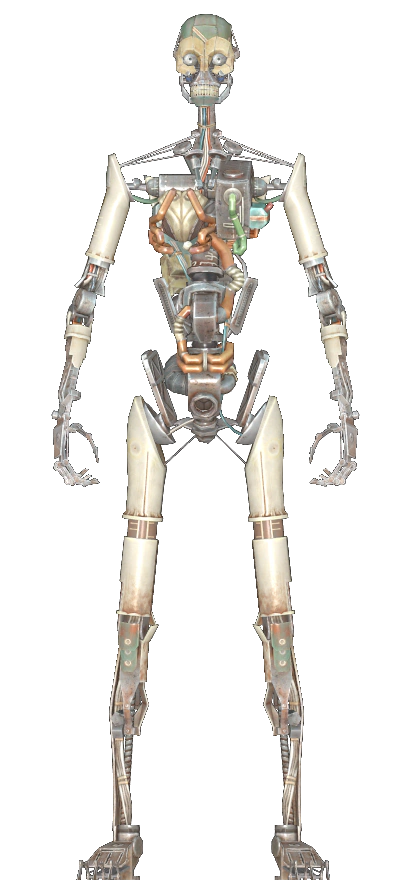
Eventually, development was finalized on the Gen 2 model. These synths were essentially Gen 1s provided with a suite of upgrades to their mechanisms and programming. The most noticeable difference was the inclusion of an internal mesh that shields the mechanisms of the synth from damage and provides support for an artificial skin layer that more closely emulates a human appearance, but not to a passable level. Though more humanoid than Gen 1s, the Gen 2s still possessed limited A.I. and superficially resembled a mannequin more than a human. Still, their artificial skin layer and improved mechanics elevated their performance well above that of Gen 1s, providing precedent for Gen 2 synths to become the primary workhorses of Institute scouting operations and scavenging missions for many years afterward.
Rejecting the surface
Around this time, the Institute had not yet withdrawn from the irradiated wasteland on the surface and remained open to the idea of coexistence and cooperation with the inhabitants of the Commonwealth. However, mutual mistrust between both sides quickly deteriorated any substantial hopes of long-term interaction. The Institute chose to go into seclusion from the surface after the failure of an initial attempt at a unified Commonwealth Provisional Government, which they had tried to support, due to political infighting. Sometime shortly after 2187, the Institute cut off all access and contact with the surface, faciliated by the recent invention of the molecular relay.
Over time, in their isolation, the Institute came to view humanity on the surface as doomed, and little more than test subjects and resources to be exploited for their research. The synths became the Institute's main agents for carrying out experiments, scavenging, and/or combat missions, and they operated without any concern about the consequences of their actions for the people of the Commonwealth. Occasionally, entire towns could be stripped bare by synth scavenging teams, with their residents helpless to stop them.
A turning point
Despite their remarkable accomplishment in creating a nigh-inexhaustible supply of fully obedient workers, the Institute desired to continue pushing the limits of what could be achieved with synthetic life. However, they were dissatisfied with the idea of merely improving a mechanical design and looked to other areas for inspriation. Researchers eventually hit upon the idea of improving the synthetic with the capabilities of the organic. Thus, they sought to fully model the third generation of synths on what they saw as the most capable organism on the planet: the human being.
Initially, exploration into ways to adapt human genetics into the synth body went into multiple avenues, including cybernetics, and even one that ran parallel with the still-ongoing FEV research. However, the scientists continually came up against the same roadblock: every test subject brought to their labs yielded DNA samples that were heavily and irrevocably tainted by the effects of radiation and other hazards from a life spent in the wasteland. Undeterred, proposals emerged that the Institute needed to locate and obtain a source of human DNA that was untouched by nuclear fallout, one that had never set foot in the wasteland.
The chances of being able to find a subject with such specific parameters seemed astronomical after 200 years of post-nuclear interbreeding practically ingraining the degenerative effects of radiation exposure into every human outside the Institute. However, around 2227, they uncovered pre-War Vault-Tec Corporation records that revealed the existence of Vault 111, one of many Vaults that was designed with ulterior motives; in its case, Vault 111 was an experiment to test the effects of long-term cryonic suspension. The Institute's interest significantly increased upon discovering that among the preserved pre-War Americans in the Vault was an infant, Shaun, who had been brought there and put in cryostasis with both parents. They acted quickly and organized a surface team to find and breach the Vault.
The initial intent was to acquire the infant Shaun as the "primary" source while leaving one or both of his parents in the Vault as "the backup," should the unfortunate happen to him. However, an incident occurred during the extraction when surface operative Conrad Kellogg ended up killing one of the parents when they struggled against taking Shaun and returned the sole surviving parent to cryostasis; the Institute's incumbent director at the time (known only as "the old man") additionally ordered the rest of the pre-War Vault dwellers killed by having their life support shut off, supposedly to tie up "loose ends."
Despite the messy circumstances, the operation was a success and the Institute achieved their goal of acquiring the untainted human DNA they needed. While Shaun was raised as a member of the Institute, a project was carried out under Dr. Walter, where his genetics were harvested to provide a template from which all Generation 3 synths were spawned. By 2229, the Institute had prototyped its Gen 3 synths, which were evidently already indistinguishable from actual humans in external appearance and behavior. Over the following decades, they continued to improve their Gen 3 models.
By 2287, Gen 3 synths remain the pinnacle of synth technology, and are fundamentally different from both previous generations. They are virtually indistinguishable from natural-born humans right down to the cellular level. Each Gen 3 synth is built from lab-grown bones, muscles, and other tissues that are assembled and brought to life at the Institute's Robotics division, and are "born" with the bodies and mental faculties of full-grown adult humans. Though entirely biological, each Gen 3 synth contains a neurological implant inside their brain allowing them to be "programmed" and manipulated via voice commands. This implant cannot be detected or removed without killing the synth. They can also have additional components installed, such as neuro-servos and other implants. Their bio-synthetic design combines the advantageous adaptations encoded into FEV with the versatility of the human body shape, thus allowing the Institute to create synths of different races and appearances despite the base DNA coming from only one source.
Sometime after his election to the director's chair prior to 2287, Shaun, now known as "Father," planned with Alan Binet to execute a phase-out of the Gen-1 model, replacing every unit active in the Institute's facility with Gen-3s while exiling the remaining functional Gen-1s to the surface, to be left there until they stopped functioning or were destroyed; they intended to repeat the process with the Gen-2s as well once the time came.
The Commonwealth's boogeyman
Initial rollout of Gen-3 synths was carefully managed due to the significant differences in their design compared to Gen-1s & 2s, and the multitude of risks that came with placing them in uncontrolled environments. Another reason for secrecy was that the Institute had cut off all communication with the surface years prior, and sought to stay out of the spotlight while preparing its Gen 3 synths. Despite this, sometime around May 2229, a Gen-3 only known as Mr. Carter somehow ended up being sent to the surface despite being considered a "prototype" that was never supposed to be greenlit for field operations, a mistake later blamed on one of the then-division heads, Galton, by the incumbent director.
Carter ended up in Diamond City, the largest settlement in the region. Initially, Carter's human-like appearance allowed him to blend in with the city residents for a night of revelry at the market's central bar. However, according to eyewitnesses, seemingly out of nowhere Carter experienced a physical reaction for unknown reasons (his cheery expression suddenly dropping and a noticeable twitch in his face), right before drawing a pistol and massacring the bartender and several bystanders. Carter's rampage only ended once Diamond City security returned fire and killed him. The damage the synth sustained caused his internal components to be exposed, revealing the Institute's new synths to the wasteland. The event, later known as the Broken Mask incident, sparked years of subsequent social upheaval and rampant paranoia over people being replaced by synthetic doppelgangers intent on killing or kidnapping their friends and families.
In the wake of the Broken Mask, as fear of the Institute began to spread and people began to question if the Institute's new synths were really out to destroy mankind, one event cemented their notoriety as an enemy to wastelanders. After the failure of earlier talks to establish a Commonwealth Provisional Government decades ago, a new round of talks evidently began around the mid-23rd century, in the 2230s at the earliest. What followed, however, was an event known as the massacre of the CPG, which ended in every settlement delegate that showed up to the eventful meeting turning up dead, supposedly wiped out by an Institute gen-3 synth infiltrator.
Since the premature downfall of the CPG, there have been no known further attempts to unify the Commonwealth up through 2287, especially as the region grew more and more destabilized and factions like the Commonwealth Minutemen fell from power. Fear of the Institute and its synths was cemented into the people of Diamond City and the rest of the Commonwealth by the combination of the Broken Mask incident, the CPG massacre, further aggression such as the razing of towns like University Point, and countless allegedly Institute-orchestrated kidnappings over the years.
The Railroad arises
Though many in the Commonwealth would learn to hate and fear the idea of synth infiltration and despise the Institute for it, the revelation of the existence of artificial life also brought about greater discussion over one core question: "Does an artificial being deserve the same right to freedom as a natural one?"
Many believed that the Institute's synths were just a more advanced model of robot—uncanny imitations of humanity at best, or Institute double agents and dangerous malfunctions like Mr. Carter waiting to happen at worst. But there still stood a vocal portion that came to the conclusion that, despite being assembled rather than birthed, synths deserved to enjoy the same rights that humans possessed, which they were deprived of while toiling in what they viewed as slavery to the Institute that created them. It was from this growing demographic that the earliest incarnation of the Railroad would emerge.
While there is little to no evidence regarding the Railroad's earliest actions against the Institute, it is known that the group takes success and failure hand in hand while strictly maintaining their clandestine approach to the conflict, evolving new stratagems, tactics and security protocols with each change in infrastructure and leadership. The earliest known leader of the Railroad was named Agamemnon, though all that is known about them is that they led the Railroad up to 2266, when an Institute raid on their then-headquarters scorched the organization to its foundations, killing Agamemnon and causing most survivors to abandon the mission... but not all. With the help of the sole surviving original member, John D., the organization recovered, now led by a man named Wyatt.
Reorganizing around February 2267, the Railroad began to find success, completing its first extraction of a synth from the Commonwealth in that year. Under his leadership, Wyatt introduced multiple reforms to the Railroad's infrastructure. One of the most critical was a clear hierarchy of gradually ascending power; a pyramid structure with independent tourists and civilian sympathizers on the bottom, safehouse operators and runners third, field agents second, and finally the core members of the HQ on top. He also instituted the first version of a dead drop system, intending to create a more robust and secure method of communication between agents, safehouses and HQ.
Wyatt's tenure as Railroad leader lasted until another downturn in the early 2270s, when the Institute again uncovered and raided their headquarters and he lost his life to attacks by coursers. This time, however, the Railroad's losses were kept minimal thanks to the intervention of Deacon, who got most of the HQ's people out of danger. Pinky Thompson assumed the vacant mantle as leader and immediately instituted a tighter security web around their new headquarters, allowing only "heavy" combat enforcers to come and go from there, and pushing for increased operational efficiency in getting as many "packages" out of the region as quickly as possible. Following a disastrous incident where coursers raided a safehouse near Parsons State Insane Asylum, leading to the losses of a synth and her spouse, Pinky amended field protocol so that all "packages" were to remain in the custody of their Railroad handlers until they had safely exited the Commonwealth.
Androids in the Capital
While the epicenter of the shadow war between the two groups took place in the Commonwealth, its effects still reached beyond to other areas. Such was the case in January 2276, when field agents reported to Pinky about sightings of a courser that had left the region, traveling with company to the south. Finding it noteworthy, one of Pinky's trusted agents, Victoria Watts volunteered herself to follow after the pair and find out what their intentions were.
In reality, as Watts discovered later, the minor expedition was of greater importance than originally thought, as the travelers were actually Dr. Zimmer, then-current director/head of the Institute's Synth Retention Bureau, the division responsible for all surface operations conducted by coursers including hunting down runaway synths, accompanied by his assigned synth bodyguard Armitage (whom Zimmer insisted on referring to him as an android). Their mission was tracking down and retrieving a specific android that the Railroad had extracted from the Commonwealth, A3-21, considered (at the time) the cutting edge of the Gen-3 design (Armitage himself being an older and superficially "inferior" model).
Zimmer and Armitage's travels eventually brought them to the Capital Wasteland sometime in 2277, specifically the settlement of Rivet City housed in an old aircraft carrier, where Zimmer intended to request the help of their renowned science lab's lead researcher Madison Li in finding his "lost property." However, not only did Dr. Li specifically refuse to conversate with him, but she had her assistant Anna Holt reiterate her disinterest to the doctor on numerous occasions though he too obstinately refused to back down either, harping on Li's hydroponics research at any chance.
Unbeknownst to Zimmer, by coming to Rivet City he had gotten closer to his goal than he realized, for the missing A3-21 resided there too under the identity of Harkness, the captain of the Rivet City security force. In the past, Harkness previously worked for the SRB himself, carrying out synth retrieval operations as a courser and initially executing his duties with the ruthless efficiency expected of his position. That all changed when his sentience led to the development of a sense of guilt and a moral opposition to the enslavement of his kind, causing him to seek a way to escape the Institute. Wanting to fully shed his previous life in service to the Institute, Harkness insisted on receiving a complete facial reconstruction and memory wipe to throw off pursuit by his former controllers and start wholly anew.
With the help of the Railroad and a network of local sympathizers, he managed to get in contact with reclusive scientist Horace Pinkerton in Rivet City, being one of the few in the region capable of performing the facial reconstructive surgery on top of possessing a familiarity with robotics allowing him to successfully suppress/replace the synthetic humanoid's previous memories. The scientist accomplished this by stealing a mem chip from the Visiontrons of Vault 112 and implanting it into A3-21's brain, causing him to believe he was an old combat veteran awakening from a coma. Watts elected to remain nearby, buying an apartment in Rivet City to keep an eye on Harkness while waiting for potential reprisal from the SRB, meanwhile building local connections to facilitate future synth extractions such as allying with the Abolitionists who shared the Railroad's core belief in freedom and opposition against slavery.
Railroad ideological schism
While Harkness' case was the first known to involve a synth undergoing facial reconstruction and a memory-wipe in order to escape the Institute, it was not the last. At some point between their restructuring under Wyatt and the present, the Railroad themselves hit upon the idea of using technology to augment/suppress runaway synths' memories to better integrate them into their new identities by believing they were born naturally as humans. Whether this development occurred before or after A3-21's individual experience working with Horace Pinkerton is unclear, but it is known that sometime prior to 2287, the organization made a connection with Dr. Amari, a neuroscientist and associate of Irma at the Memory Den in Goodneighbor who started helping them by using the Den's in-house memory loungers to perform the memory-wipe on synths brought to her.
Unfortunately, the complex nature of the Gen-3 design has resulted in a non-zero number of cases where a memory-wiped synth is rendered in a vegetative state, essentially braindead and forced to remain on life support for the remainder of their lives. Despite this, many still chose to undergo the procedure on the chance that it would allow them to have a life unburdened by the constant fear and terror of being discovered and recaptured by the Institute.
Months following Watts' departure south, back in the Commonwealth, the home front of the battle against the Institute took another bad turn around September 2276. After the loss of another safehouse, "Trinity," to courser raids, the fallout brought heavier scrutiny down on Pinky's capability as a leader. He also faced vocal opposition from other members of HQ including Desdemona and Dr. Carrington. Eventually, the burden became too great, and Pinky elected to abdicate his position leading to a highly contested vote on his replacement that was won by Desdemona around December 2277, with Carrington subsequently becoming her right-hand man.
Desdemona's ascension proved to be a springboard from which the Railroad would bounce back in a substantial way. Along with an overhaul of their fundamentals including operational security, lookouts, compartmentalization, and counterintelligence, the arrival of inventor and technical genius Thomas Weatherby, a.k.a. "Tinker Tom," in 2279 following an Institute raid on his homestead spearheaded a full rearmament of the organization, bringing new technology and weapons into their arsenal. During the same year, they also experienced a drought of courser activity, allowing for continued "package" extractions without issue.
With operations taking a step up, a new problem began to arise. Throughout their history, the Railroad has always been dedicated to the liberation of synthkind from their enslavement under the Institute. However, once their cause became largely dedicated to the rescue of Generation-3 synths, who could walk, talk, think, and feel like natural humans, the question would be often be raised about whether rescuing synths also extended to the previous Gen-1 & Gen-2 models.
This caused a quasi-schism within the organization where, while everyone remained loyal to the cause, some would argue for also liberating the mechanical synths while others would argue against it precisely because of their mechanical nature, in that the older models fundamentally lacked the ability to comprehend or utilize free will and only ever obeyed their programming and their Institute creators. The former side gained one of their loudest voices in 2280, after a Gen-3, designated G7-81, opted out of the memory wipe and instead took the name Glory when she directly joined the Railroad, proving herself enough of an asset to be promoted as a "heavy" combat enforcer the same year.
Institute retaliation
Railroad operations continued into 2281, when another safehouse was claimed by courser raids, though Desdemona's security overhauls proved effective in minimizing overall casualties. Later that same year, Tommy Whispers, a fellow "heavy" along with Glory, uncovered the existence of the Switchboard, a pre-War DIA facility housed beneath a Slocum's Joe outlet in Lexington. Seizing the opportunity, after moving the organization's HQ to take up residence there, the Railroad also uncovered the Predictive Analytic Machine (P.A.M.), an advanced AI capable of incredibly precise probability calculations that would become a vital asset to the Railroad for years to come.
Only two years later, in 2283, the Railroad got another leg up in their war against the Institute when they discovered hidden messages left with many runaway synths, made with the Trinity algorithm that came from its creator, Liam Binet, son of Robotics division head Alan Binet. Liam had begun arranging for synths to be ferried from their facility in secret due to an independently developed moral disagreement with their treatment by their creators. Once Tinker Tom intercepted his messages sent blindly into the outside world and figured out his passphrase, "Mass Fusion," from then on, Liam became the Railroad's main contact in the Institute under the codename "Patriot," although the young man himself was deliberately left totally unaware of this connection for security reasons.
For the remaining years up to 2287, the organization's wins and losses against Institute counteroffensives skewed largely in favor of synths liberated despite increased courser activity and even a few incidents of having to rescue synths from lynch mobs of wastelanders. However this would be the calm before the storm.
Sometime around October 2287, catastrophe struck. After a three-month drought of courser activity, they emerged in a full-force attack on multiple Railroad safehouses throughout the Commonwealth. Many went dark with their fates still unknown by the present, others confirmed destroyed later, but the worst was the siege on the Switchboard itself. When the synths launched their attack, they successfully breached the doors within 30 seconds and began shooting at everyone within. With both coursers and hostile synths sweeping through the facility, many Railroad members fled through the protected escape tunnel. Tommy Whispers stayed behind to secure vital supplies left in the vault (including an unspecified prototype made by Carrington) but was wounded in the process, later dying. Though Tom activated a suite of automated turrets to slow down the attackers, they proved to be of little use.
The result was the near-destruction of the Railroad for the second time, but still not enough to complete its end yet. Most of HQ staff survived, Desdemona included, eventually coalescing back together at a new HQ in the catacombs of the Old North Church. While in the process of licking their wounds, the Railroad sought to restore operations, tightening security even further with Desdemona instituting a strict policy of seclusion; if a field operative even suspected that they were being followed by a courser or any agent of the Institute, they were to stay far away from the HQ until the threat was over. They also implemented new security measures including one doubling as a test of character involving augmenting the Freedom Trail landmarks leading to the church to act as a large-scale decoder for the password that opens the entrance to the HQ; this was designed to rely on the general illiteracy and lack of formal education among wastelanders and ensure that only the most capable will find their way to the Railroad and thus serve as ample material for recruitment. Despite their precarious position, the Railroad sought to endure and continue the mission to safeguard synthkind's future out from under the Institute's yoke.
The Sole Survivor's search
Around October 2287, Shaun, now known as "Father" as the incumbent Director of the Institute, grew an interest in seeing if the parent he never knew would still care enough about him to brave the post-nuclear wasteland to find him; a secondary goal was fulfilling a deep-seeded desire to exact revenge on Kellogg by proxy for killing his other parent when the Institute first came to Vault 111 for him as an infant. Thus, on October 23 of that year, 210 years to the day since they entered Vault 111 and 60 years since Shaun was taken from them (though they did not know this at the time), the "backup" parent, the Sole Survivor is finally released from their cryo-pod within the old Vault through a remote command from Shaun in the Institute and emerges into the Commonwealth on a mission to find their missing infant son.
Going through trials and troubles such as fighting a deathclaw in Concord, reaching the settlement of Diamond City in the heart of destroyed Boston, rescuing the distressed detective Nick Valentine from Vault-dwelling triggermen, and getting his and Dogmeat's help to uncover Kellogg's whereabouts, the Sole Survivor is able to corner the mercenary at his base in Fort Hagen where Kellogg reveals he had already given Shaun to the Institute (letting them continue to believe Shaun was younger than he really was) before engaging in a fight that ends in his death. Shortly after this, an expedition by the Brotherhood of Steel arrives in the region onboard their airship, the Prydwen, kickstarting the War of the Commonwealth as the Brotherhood's staunch opposition to uncontrolled technology, up to and including synths put them directly at odds with both the Institute and the Railroad's goals.
After getting Valentine's assistance in convincing Dr. Amari to use her memory lounger technology in order to explore Kellogg's memories via his cybernetic implants the Sole Survivor tracks down the rogue Institute scientist Dr. Brian Virgil at his secluded hideout in the Glowing Sea; they learn there that entering the Institute requires hijacking the Molceular Relay via encrypted codes from a special chip installed in one of their courser units. Once they track down and kill an active courser at Greenetech Genetics, the Sole Survivor is directed by Amari to find the Railroad via completing their secret test in following the Freedom Trail to the Old North Church and figuring out the password. Desdemona breaks protocol in allowing the Sole Survivor to enter the Railroad's HQ, though with a warning not to reveal them to anyone especially the Institute, and has Tinker Tom decrypt the courser chip and give them the data they need, as well as extending an offer for them to join the Railroad itself.
After returning the data to Virgil, the scientist drafts a set of plans for the Sole Survivor to construct a signal interceptor that will get them into the Institute. The complex design and significant resource requirement compel them to seek out the assistance of a powerful faction in the Commonwealth, with the options of working with the Railroad, the Brotherhood of Steel or the Minutemen. Once they make their choice, the chosen faction helps the Sole Survivor build and operate the signal interceptor in exchange for helping them gather valuable data from inside the Institute using a network scanner. Once everything is in order, the interceptor carries out its function and hijacks the Molecular Relay to send the Sole Survivor into the Institute itself.
After entering the Institute for the first time, the Sole Survivor is met by its current Director, Father who then reveals himself to be their son Shaun, 60 years older than they were led to believe. Whether the Sole Survivor accepts this or not, Shaun extends them a welcome to the Institute and hopes to convince his long-lost parent that they can be comfortable and happy there, forgetting all about surface life and the people dwelling in the wasteland. He encourages them to meet with the Institute's division heads and get to know the circumstances the organization resides in before they speak more about ensuring its continued future.
Fate of synthkind
Continued enslavement
While exploring the Institute, the Sole Survivor learns that, barring isolated cases, the majority of the Institute's members views synths as merely tools to use and discard, believing themselves as the artificial race's creators to know better than their creations. Consequently, any and all attempts to try and convince the upper echelons including Shaun of synths' inherent sentience and ability to free will either go ignored or are rebuked.
By helping the Institute and Shaun during the War of the Commonwealth, the Sole Survivor will irrevocably cement synthkind's status as the property of their scientist creators and destroy the dream of synth freedom by wiping out the Railroad and Brotherhood as well as powering up their facility's underground nuclear reactor, placing the Institute as the dominant power in the Commonwealth.
Freedom as a dying race
Regardless of whichever faction helped the Sole Survivor enter the Institute, continuing to side with them over the interests of the organization eventually leads to a breaking point wherein Shaun and his people will sever all ties and declare them an enemy to be exterminated with the rest of the surface.
Whether the Sole Survivor works within the Institute to instigate a synth rebellion with the Railroad, rebuilds Liberty Prime for the Brotherhood to blast their way into the Institute, or resurrects the Minutemen and leads an infiltration of the Institute, they commit to wiping out the scientist cabal and destroying the means of synth production, giving those remaining their freedom while irrevocably ensuring there will be no more synths created after them.
Aftermath
The immediate post-conflict status of the Commonwealth and its inhabitants is unknown. However, it is stated that by 2296, the Brotherhood still maintained a presence in the Commonwealth that was considered a full-fledged chapter. This chapter apparently rose in influence within the wider Brotherhood since its formation to become the leading force, to the extent of being able to direct the elders of other chapters to carry out high-priority missions on their behalf, as was the case of charging the Knights of San Fernando to hunt the defecting Enclave scientist Siggi Wilzig on the West Coast that year.
Whether this means the Brotherhood was the ultimate victor in the war, merely a survivor as a result of the Minutemen's victory, or some other event occurred, all evidence would suggest that the Institute was canonically destroyed in 2287, thus ending the continued production of new synths, and that it was not the Railroad who won the War of the Commonwealth as a result. However, the organization's fate is left uncertain, as a Minutemen victory does not require their destruction, and although the Railroad's destruction is part of the Brotherhood main quest, it can be skipped under certain conditions.
Sources
Adapted from the original article, under CC BY-SA 3.0.