

Place
Shady Sands
Major location in Fallout and Fallout 2
Shady Sands, later colloquially referred to as NCR and the New California Republic, is a major location in Fallout and Fallout 2 and serves as a vital plot element in the Fallout TV series' first season.
Originally existing as a small farming village founded by former inhabitants of Vault 15 in the post-War wastelands of California, in the wake of the mutant-supremacist Unity's destruction and the fall of the Master, Shady Sands surprised its neighbors by developing rapidly towards infrastructure based on the pre-War United States of America, culminating in a joint effort with its sister settlement Junktown to the formation of a provisional state named Shady, the first in the growing nation of the New California Republic. Shady Sands itself was later selected as the nation's first capital in 2198, nine years after the republic's foundation.
Throughout its existence, it was one of the largest cities of the NCR and the derivative territory of New California. It was also the largest known urban center constructed without using pre-War ruins as the foundation, boasting a population of over 3,000 inhabitants by 2241, and 34,852 by 2283. Shady Sands housed the Hall of Congress of the NCR, as well as the president and their office, quartered in the same building.
Around 2277, a series of events started that were later collectively coined as the Fall of Shady Sands, though the exact nature and circumstances of these events have yet to be officially clarified. In 2283, Shady Sands was destroyed by a nuclear bomb on the orders of Hank MacLean, a Vault-Tec executive and overseer of Vault 33, who wanted to erase all factionalism and ensure the world would be remade according to his and Vault-Tec's ideals. This would also hide the truth of the surface world from Vault 32 and 33's inhabitants (after Vault 33's water was discovered to have been partially siphoned). A handful of survivors found refuge in nearby towns, settlements, Vaults, and even the Brotherhood of Steel, of which members of the latter were known to have been immediately on-site after the nuclear blast.
With the executive and legislative branches wiped out by Shady Sands' destruction, remnants of the republic's populace within the region led by the pre-war scientist Lee Moldaver established a new regional headquarters at the Griffith Observatory. This reduced force was ultimately wiped out during the Battle of Griffith Observatory against the Knights of San Fernando, a western chapter of the Brotherhood of Steel, in 2296, effectively ending any substantial NCR presence around the greater Los Angeles area and giving the Brotherhood control of Moldaver's pre-War cold fusion technology and its capacity to generate unlimited power.
History
Shady Sands was founded by an ancestor of Aradesh after they left Vault 15, in 2141. The official establishment of the town was later recorded as 2142. By design, Vault 15 was overcrowded, and populated by people of radically diverse ideologies and backgrounds. The original inhabitants of Shady Sands left the Vault after some collective disagreement, and formed a peaceful community in the desert.
The settlement was jump-started using Vault 15's G.E.C.K., allowing for rudimentary agriculture, and the construction of adobe buildings from sandcrete. A protective wall was erected to protect the city from raider tribes that formed in the winter, raiding outlying communities to replenish their food supplies. They were often attacked by other communities which had emerged from Vault 15 since their exodus, like the Khans, Vipers, and Jackals. The raiders would steal food from the town and sometimes shoot a few residents, with Seth forming the first town guard to fight them off. The resistance would continue for years.
Shady Sands
By 2161, it was a small but thriving settlement, completely self-sufficient, as they managed to irrigate the wasteland soil to support crops (primarily maize and cabbage), drill a well to provide them with water, and even establish brahmin herds. Their grown crops and resources sustained the settlement and provided goods for trade with other towns. The teachings of Dharma were influential: All denizens of Shady Sands looked after one another, according to Dharma's maxim: "Many sticks can be broken. A bundle cannot." While outsiders were welcome to visit, they were kept under close observation to ensure they couldn't do harm to the community. All members worked together and shared the fruit of their labor, with an elder elected by the community to lead with their experience (Aradesh at the time). To remind everyone of the future, a pillar was erected, with stories of hope and peace carved into its surface.
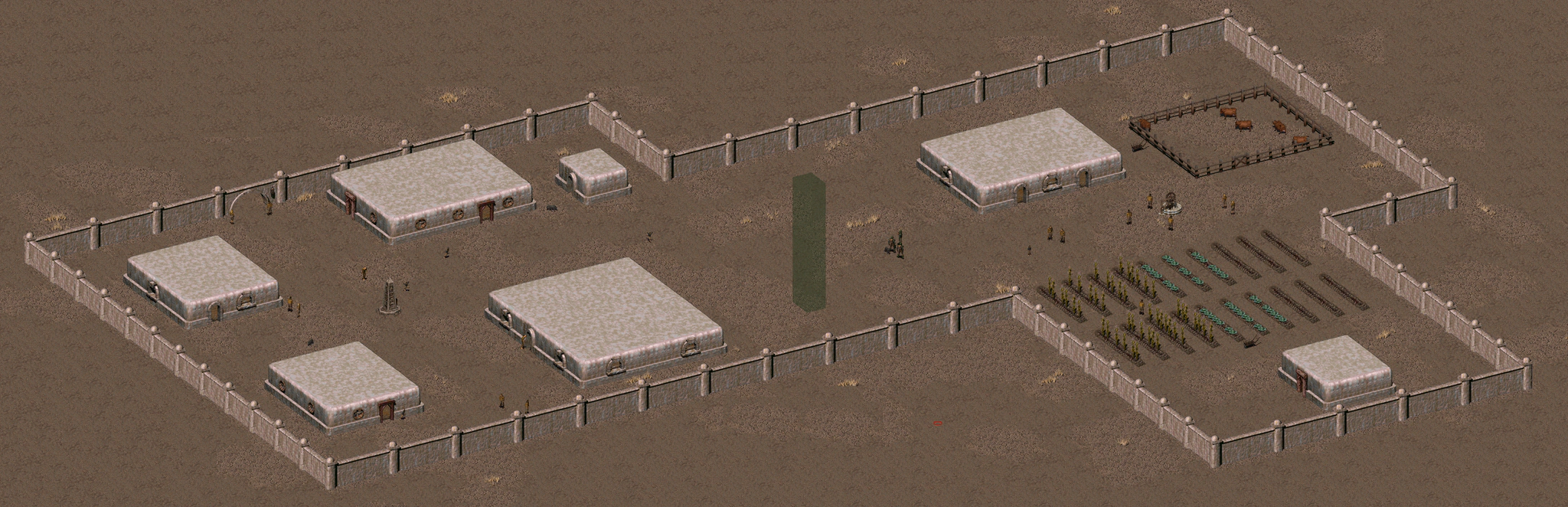
The settlement kept mostly to itself, trading with the occasional merchant from Junktown and even the Hub. Aradesh was deliberately avoiding opening up trade to a greater degree, concerned about Shady Sands' security.
Regardless of Aradesh's attitude, some, like Duc, made it a part of their regular trade route, but usually it was considered small and unimportant (which also affected knowledge transfer, for example, some farmers did not understand the principle of crop rotation, leading to lower yields), but also large enough to deter most of the problems the wastes presented, primarily the local raider clans (Khans, Jackals, and Vipers, both also originating from Vault 15) and repeated attacks by radscorpions. While present for years, both of these threats slowly escalated: Radscorpions became more numerous and aggressive, while raiders constantly developed their strength and numbers, infuriated by Shady Sands' resistance. By December 2161, the attacks increased in severity, endangering entire brahmin herds and even attacking some of the town dwellers. The raiders, angered by Shady Sands' repeated refusal to give in to their demands, have also stepped up their attacks, eventually culminating in the abduction of Aradesh's daughter, Tandi.
While Shady Sands kept to itself, it never refused aid. Ian, a caravan guard wounded during a raid stayed at the town to recuperate and became a part of its community, helping trade with Junktown and the Hub. However, the most important helper was the Vault Dweller, who discovered the settlement en route to Vault 15. Initially distrusting of the stranger, the inhabitants quickly warmed up to the hero as they successfully rid the community of the radscorpion threat, and rescued from captivity at the hands of raiders, paving the way for expansion and development with willing partners, such as Killian Darkwater of Junktown, who was looking to expand trade with the town.
Expansion and foundation of the NCR
Following the destruction of the Unity by the Vault Dweller, Shady Sands thrived. Already considered one of the most promising communities in the wastes, if not the best chance for a new civilization in New California, with the raiders broken by the same Dweller, the community got room to breathe, develop, and expand. The Dweller became a venerated hero, even if nobody believed their claims about coming from Vault 13, which remained lost. Tandi helped Aradesh create a new community and a new life out of the barren wasteland, eventually starting the work towards forming the New California Republic. Junktown became one of its first allies in the formative phase, as a long-standing and most trustworthy trading partner.

In 2186, after years of expansion through trade routes, Aradesh proposed the idea of the NCR to other major cities in the region, forming a trial council in Shady Sands to draft a constitution.Fallout: New Vegas Official Game Guide Collector's Edition p. 41: "The New California Republic The New California Republic was born from the remnants of the survivors of Vault 15 and the small walled community they founded, Shady Sands. Under the leadership of Aradesh, and with the assistance of the Vault Dweller (who saved Tandi, Aradesh's daughter and a future president of the NCR), the community prospered. Trade routes with other settlements allowed cultural exchange, and a movement to form a national entity gradually took root and won popular acceptance. In 2186, the town of Shady Sands changed its name to "New California Republic" and formed a trial council government to draft a constitution. Four more settlements joined the council, and in 2189 the NCR was voted into existence as a sprawling federation of five states: Shady Sands, Los Angeles, Maxson, Hub, and Dayglow. By post-apocalyptic standards, the NCR is a paragon of economic success and good ethical character: political enfranchisement, rule of law, a reasonable degree of physical security, and a standard of living better than mere subsistence are daily realities for it's 700,000+ citizens. Currently, the NCR in a state of transition, with rapid economic growth and a sea change in political leadership endangering its grand humanitarian ideals. Nowhere is this more evident than in the Mojave, where the occupation of Hoover Dam has improved access to electricity and water, but at the cost of straining its budget and embroiling its armed forces in a morally corrosive imperialist project. The NCR government's aim is to annex New Vegas as the republic's sixth state. While it already controls Hoover Dam, its treaty with Mr. House and the three families compels it to allot one-fifth of the dam's electrical and water production to local use free of charge. Adding injury to insult, the NCR is locked into protecting New Vegas from invasion by Caesar's legion even as it receives not one cap in tax revenue from the Strip's highly lucrative resort operations. NCR citizens in the Mojave have largely come here for economic reasons, whether as paid citizen soldiers or as prospectors and fortune-seekers." (Fallout: New Vegas Official Game Guide faction profiles) Three years later, in 2189, NCR was officially formed after a referendum held at the Hub resulted in it signing on. The newly established Hall of Congress at Shady Sands became the site of celebrations, as President Aradesh addressed the crowd. He and his daughter continued the work, with Tandi becoming the mayor of Shady Sands and the President of the Republic in 2196, after Aradesh's death. Under her leadership, the city continued to grow. Just two years into her presidency, Shady Sands was chosen as the first capital of the New California Republic.
Capital of the New California Republic
Over the next forty-three years, Shady Sands expanded and developed, with Shady Sands remaining the northernmost major city of the Republic: A border city, capital of the state of Shady, and the Republic's capital. While the name remained, the town was frequently called the NCR, particularly in the north. Within the Republic, it was simply Shady Sands, California.

Over 80 years it expanded to become one of the most prosperous cities in the region, reaching a population of 3,000 by 2241 and offering a quality of life nearing that of the pre-War world within the city: Ample electricity provided by the city power plant, defensive walls with force field emitters installed in the gates, a complete water and sewage system, including fire hydrants, and even quiet parks to provide the citizens with a moment of respite. A uniformed police force kept the peace and enforced municipal laws prohibiting open carry of weapons, gambling, public drunkenness and drug use, and especially slavery. While the city's mayor is President Tandi, the citizens elect the sheriff to head the police force (Dumont in 2241).
Despite its remote location, the capital city attracted people and wealth. It house the Hall of Congress of the NCR's legislature and the executive, including the President's office, as well as the headquarters of the Stockmen's Association, an outpost of the Brotherhood of Steel, the covert headquarters of the NCR Rangers, and even a chapel for religious services, including Hubology, expanding at the time from San Francisco. Some of the major figures in NCR politics, like Roger Westin, operated ranches on the outskirts of town. The city was constantly expanding, with an insatiable hunger for resources to fuel this expansion. In 2241, this ran into obstacles: As the NCR turned its gaze northward, President Tandi sought to use Vault 15 to support expansion, but ran into an issue with "squatters" who moved in. As Vault 15 was seen as the NCR's ancestral home and most NCR families traced their roots to dwellers who survived within, it was a matter of both resources and pride. With the help of the Chosen One, Vault Dweller's descendant, the NCR regained access to Vault 15, vindicating Tandi's diplomatic policies, demonstrating the value of working with other communities to make them self-sufficient and prosperous.
While NCR took laws seriously, it led to a number of peculiarities in Shady Sands. All territory within city limits was considered NCR territory, while land beyond its walls was not. This led to a thriving bazaar founded just outside city gates, where non-citizens, traders, caravan drivers, and other people who didn't like NCR's strict laws gathered, thriving in the relaxed environment. This included weapons traders, parking attendants (as the NCR was prosperous enough to have a limited number of motor vehicles restored to working condition), and even a slave holding pen established to allow slave owners to temporarily store their victims. While NCR laws didn't fully apply, all bazaar business owners - including the slaver - had to have an NCR-issued business license. Of course, the NCR had other ways to address the issue of laws not reaching far enough.
Fall of Shady Sands
The capital expanded even further over the next 40 years, thanks to the aggressive expansionist policies ushered in after Tandi's passing in 2248, which led to the Mojave Campaign and expansion eastwards. The New Vegas Treaty of 2274 was a major step forward, as water and electricity flowed into the home states, including Shady Sands. The population exploded tenfold, reaching 34,852 citizens by 2281, when the war with Caesar's Legion began to escalate towards the Second Battle of Hoover Dam. At this point, Shady Sands boasted a public transport system operated by the dedicated Department of Transportation, a Greek Revival courthouse, a public school and library.

The development also further increased the prominence of Shady Sands, with the headquarters of the Office of Science and Industry, the NCR's answer to reliance on the Followers of the Apocalypse, established in Shady Sands in 2275. OSI Central played a key role in harnessing the power of Hoover Dam and many other projects, With Shady Sands becoming a core element of the energy grid delivering power from Hoover Dam, while caravan houses that built the economic power of the NCR resulted in Shady Sands becoming a major transportation hub and supplier of advanced components (e.g., to the aforementioned OSI). The expansion of the senate also led to the rise of lobbyists, trying to convince the legislators to pass laws beneficial to them.
The resulting political maneuvering and inevitable corruption led to a deterioration in relations. The beneficiaries of the re-emerging capitalist systems were primarily the brahmin and agricultural barons, who formally had one vote, but could use their wealth to influence decision making, affecting troop allocations and conscription laws that disproportionally affected the poor. The support of the Senate for the Mojave Campaign tied the annexation's fate to the Senate's, and undermined trust in the democratic institutions. On the frontier, Shady Sands became synonymous with detached politicians passing laws without thinking them through, like the Thaler Act, or going all-in on the expansion, without regard for local populations, only concerned about productivity and growth. Still, to servicemen, Shady Sands remained a powerful symbol of the Republic. As of 2281, Shady Sands was still called the capital of the NCR.
Family confrontation
Some time between 2271 and 2277, Rose MacLean fled Vault 33 after realizing the surface survived, based on imbalances in the Vault's water supply. She escaped with her two very young children, Lucy and Norman and reached Shady Sands, trying to start a new life with Lee Moldaver. However, at another unspecified point in time, her husband Hank and former overseer Betty Pearson pursued her to the city and confronted her. Rose refused to return, and Hank took his children away from Rose and left the city, moving them back into Vault 33.

Destruction
In 2283, shortly after the Second Battle of Hoover Dam, Hank sent a wastelander controlled by a black box chip into Shady Sands with an armed nuclear warhead disguised as caravan cargo. After it was discovered, one citizen attempted to disarm it, but this was foiled by a failsafe built in by Hank, preventing the abortion of the three-minute timer. The resulting detonation left a giant crater where the NCR's capital city once stood. This was because Vault-Tec doctrine did not predict that not only would people survive on the surface, but that they could form their own civilization beyond Vault-Tec's control (this is despite Shady Sands itself having been founded by Vault dwellers). Thus, Hank acted to ensure that Vault-Tec could keep its monopoly on the survival of the human race.

Thousands were vaporized in the blast, many more killed by the heat and blast wave. Survivors of the blast were permanently scarred. Some, like one boy (Maximus) who lost his parents in the attack, were taken in by the Brotherhood of Steel. Others fled away from the blast, finding refuge in Vault 4 and other places willing to take in survivors. The trauma of the loss was so severe that children who survived the blast, like Birdie, would deal with it through religion: Remembrance of Shady Sands at its zenith was accomplished by communal reminiscing and recreating landmarks of the city together, as well as complex rituals, where the survivors would cover themselves in ash and blood around an altar covered in produce and symbols of the NCR (e.g., a portrait of President Aaron Kimball), symbolically bringing the city and the Republic back. Lee Moldaver was a key figure in these figures, venerated as the Flame Mother, for her roles in bringing the survivors away from the blast.)

The shock of losing the capital, government, agencies, and a key logistical hub sent the NCR into freefall, and by 2296 the Republic had retreated from much of New California. Moldaver rallied a military unit and civilians around Griffith Observatory, establishing the local NCR headquarters, while waiting for her cold fusion gambit to play out. Meanwhile, Shady Sands remained a barren crater, surrounded by what remained of the city, including the Shady Sands Public Library and Shady Sands Elementary. The site was abandoned, as nuclear fallout rendered the surroundings radioactive. Even into 2296, the crater of Shady Sands remains "radioactive as hell."
Sources
Adapted from the original article, under CC BY-SA 3.0.


