Place
Los Angeles
One of the largest cities in the pre-War United States
Los Angeles, abbreviated as LA, was one of the largest cities in the pre-War United States. Located in Los Angeles County, California, it was home to major corporations across various industry sectors, including entertainment (California Crest Studios) and defense (Vault-Tec Corporation).
Following the war, the ruins of Los Angeles became known as the Angel's Boneyard (or the L.A. Boneyard, or just the Boneyard), which was subsequently incorporated into the New California Republic as part of the state of Los Angeles.
Pre-War
By the 21st century, Los Angeles was a huge, thriving city on the West Coast of the United States of America that exemplified the American Dream. By the mid-21st century, Los Angeles featured multiple districts with skyscrapers, a robust network of monorails connecting the vast city, and was home to numerous prominent companies. Film companies such as California Crest Studios had their main studios here in Hollywood, the film capital of America, producing blockbusters like The Man from Deadhorse, while the Vault-Tec Corporation had its original headquarters in the southern part of the city, beneath which it constructed the first demonstration Vault, winning the government bid for Project Safehouse. Subsequently open to the public, the Vault drove public enthusiasm and a junk bond drive to provide funds for constructing a nationwide network of Vaults.
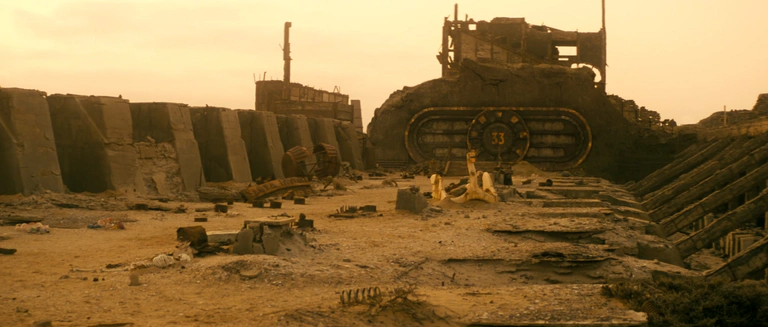
Vault-Tec would eventually set up numerous Vaults across the greater Los Angeles area, including Vault 4, a refuge for scientists established beneath Hawthorne Medical Laboratories (a division of the corporation), and the Three Vaults (31, 32, and 33, forming an experimental network), alongside the still-functioning original demonstration Vault. However, as Vault-Tec's influence grew, tapping stars like Cooper Howard to promote its products, opposition to the company and the increasingly ruthless American system grew. While nowhere near as radical as the opposition in West Virginia, which culminated in the brief, but destructive automation riots, there was nonetheless rising discontent and ostracism towards actors and figures associated with the company, Howard in particular. The entertainment companies retaliated via firings, and the script writer for The Man from Deadhorse was summarily dismissed as an alleged communist. With organized opposition difficult, people like Lee Moldaver preferred to operate smaller dissident groups, fomenting dissent and in her case, looking for a way to oppose Vault-Tec. That being said, some anti-automation protests did occur in Los Angeles in the late 2070s, with one trade union decrying RobCo Industries for its role in replacing human workers.
However, for anyone who toed the line, Los Angeles could be the American Dream come true. While Vault-Tec leadership plotted, with its headquarters hosting a secret conference to subvert Project Safehouse for the ends of the corporate elite, idyllic birthday parties still took place and the lucky rich could enjoy luxurious homes with stunning views of the Los Angeles skyline in high-end neighborhoods such as Hollywood Hills. On October 23, 2077, they received a front seat to the city's destruction, as nuclear weapons struck the city, with at least four falling in the city's urban center, impacting downtown, mid-city, Koreatown, and Hollywood.
The Boneyard
The initial attacks left the city decimated, with much of the remaining population dying in the following weeks and months due to radiation poisoning, disease, famine, and collapsing social order. The city's skeletal skyscrapers, twisted and scorched by nuclear fire, were surrounded by skeletons of the dead, eventually gaining the name Angel's Boneyard. Much of the city desertified over time, including Santa Monica, large swathes of Hollywood, and the area around the Los Angeles airport, leaving no trace of their former urban landscape; on the other hand, some areas became overgrown, forested wilderness.
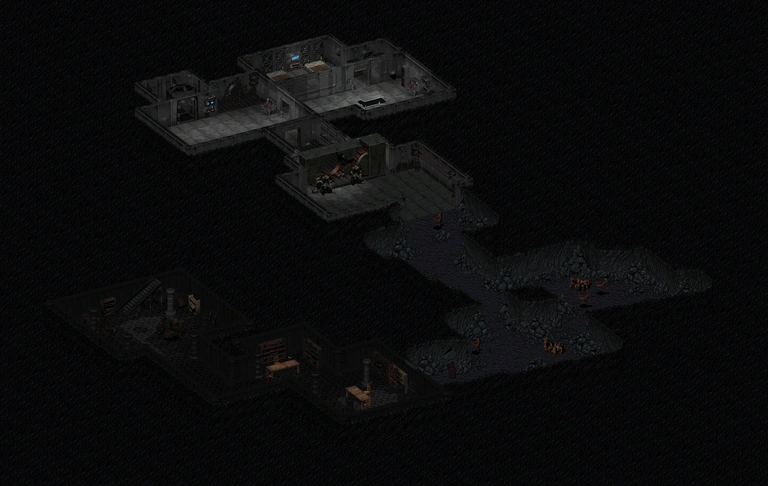
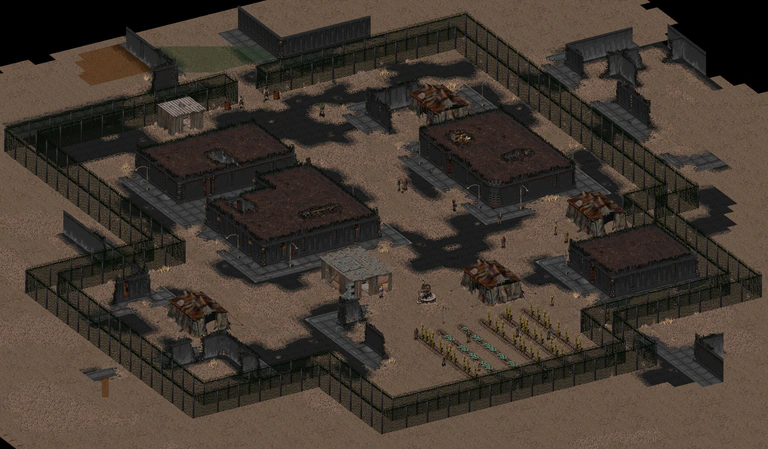
The demonstration Vault and other Vaults in the area were sealed and functioned as intended. The former opened fifteen years later, with the survivors founding Adytum in the Boneyard. Sometime after the sealing, the technocrats of Vault 4 were also deposed, with the survivors of their experiments rising up against the scientists and killing them, establishing a communal society open to receiving survivors from the surface. However, no major population center emerged in the sea of ruins, with human habitation limited to a number of isolated communities, mostly dividing the ruins between themselves as factions warred for territory. Adytum remained a small, fortified semi-industrial town, with the location of its Vault fading from memory.
Over the years, the main power groups became the Blades, the Rippers, and the Adytum, with its Regulators providing the town with a measure of protection. The Rippers and Blades remained at each other's throats for decades, fighting a destructive war of attrition that ended up breaking both. Around 2131, the Gun Runners came to the Hub, originally attempting to establish their own turf, but quickly established a lucrative trade in weapons and ammunition, selling second-hand weapons, purchases from the Hub, and eventually own designs.
Sometime in the 2150s, the Followers of the Apocalypse formed out of survivors that migrated north away from San Diego, which became uninhabitable due to radioactive contamination drifting off from Great Glow. The Followers established their stronghold in the ruins of a great library in the center of the city, fortifying and restoring it to spread the word of peace. They established a reputation for being polite, helpful, but unaccustomed to the ways of the world.
The last group to emerge in the Boneyard were the Children of the Cathedral. They originated from a doomsday cult formed by Morpheus after he left the Rippers after ten years, and their development started when the Master's scouts found them in 2152. Rather than take and dip them, the Master allowed Morpheus to pledge himself and his followers to the Master's service, using them as spies. The capture of a group of Vault Dwellers still living in the demonstration Vault around 2155 led to the discovery of the Vault by the Unity, with the Children formed as a benevolent religion to provide convenient cover for the Unity's activities. The Boneyard became the hub for Unity and Children operations, with missionaries spreading slowly across New California.
The Vault Dweller
By 2161, the gang war between the Rippers and Blades gave the Boneyard a reputation as a violent and inhospitable place, a place of hard life, and general desolation. However, it had a reputation for being "cool" among more daring merchants, like the Crimson Caravan.
As a result, many avoided the ruined expanse, even though the derelict highways (or "black walkways" as some called them) made travel very easy. The only reason The Hub, took an interest in the city was because Adytum and the Gun Runners provided excellent trade opportunities. In 2158, Adytum came under the thumb of Caleb and his mercenaries, who became the Regulators and turned the town into a work camp, while squeezing the Gun Runners hard, extracting a high price for raw materials they needed to produce their weapons and ammunitions. Since the Gun Runners were unable to move due to the deathclaw infestation that emerged next door, after wiping out the bulk of the Rippers, they were stuck in a holding pattern.
The Rippers were reduced to a small, ultra-violent pocket camped out west of the Followers' library, while the weakened Blades fell prey to the Regulators. Caleb's men rounded Blades in monthly raids, taking them away to Adytum and putting them to work, with summary execution for anyone who resisted. Around 2161, Razor migrated into the city from the Hub, assuming leadership of the motley band of survivors, stuck between Adytum and the proliferating Deathclaws.
Meanwhile, in the southern part of the Boneyard, the Children expanded their power base centered at the Cathedral, with the Master protected in the demonstration Vault buried deep beneath the Cathedral. The faithful congregated on the surface (ranging from borderline mindless zombies, through thugs hired by the Children, to the nightkin), preparing for the Crusades to advance the Unity's agenda across New California. While most denizens of the region dismissed them as just creepy cultists, the Followers were the only group to realize that the Children were not what they were on the surface and planned to strike against them.
Rise of the New California Republic
The Vault Dweller entered the Boneyard in 2162, finding a desolate city. They found many enemies and a few friends in the Boneyard, killing when necessary. Eventually, the dweller infiltrated and confronted the Master beneath the Cathedral on March 3, 2162 and slew him. The Cathedral was engulfed by nuclear fire, wiping out the Children and destroying the Vault together with the Unity's leader. The experience left the Dweller permanently scarred, unable or unwilling to describe his discovery even decades after the fact. The Boneyard thrived in subsequent years, after Caleb's Regulators were deposed (likely with the Dweller's aid), with ghouls who settled down in Dayglow eventually forming profitable partnerships with its companies after starting salvage operations in The Glow. In 2189, the Boneyard became one of the five founding states of the New California Republic, as the capital of the state of Los Angeles. What was once a vast sea of ruins saw major recovery, with the Republic placing the Republic Reserve in what became formally known as the Angel's Boneyard, while the Followers expanded their operations alongside the Republic, establishing, among others, the Angel's Boneyard Medical University. They also offered work and education to everyone in need, especially survivors of raider attacks that were not uncommon during the rise of the Republic. Edward Sallow was a survivor of one such attack in 2228, finding a haven and education at the Followers' library.
By 2281, the Boneyard was a vital element of the Republic, though it was not evenly restored. Those parts under firm NCR control and reclaimed offered a good quality of life and the ability for educated people to make a living plying their trade (e.g. as a family doctor). The bad parts of the Boneyard still experienced violence and gang warfare, with choices in life boiling down to joining a gang or the NCR Army. Furthermore, while the Mojave Campaign provided much needed power and water to the NCR heartland, the Boneyard also tied up much of the budget, as the lack of a definite resolution and annexation of New Vegas turned the Campaign into what denizens of the Boneyard saw as a money sink: Consuming money and lives of their relatives for no further gain. As a result, the NCR Senate was unwilling to divert funds away from LA and increase funding for military operations, especially with the 2281 elections coming up and many local representatives seeking re-election.
Fall of Shady Sands
The Boneyard's fortunes took a dramatic turn after the destruction of Shady Sands following the Second Battle of Hoover Dam. By 2296, the NCR's presence in the region was reduced to an outpost at Griffith Observatory consisting of forces who were not at Shady Sands when it was destroyed, led by Lee Moldaver, seen as just a local warlord. Without the NCR, the region experienced a power vacuum, with most of the territory left up for grabs. Settlements such as Filly and Vault 4 (which also received a substantial number of Shady Sands refugees) became independent, with varying levels of exposure to the outside world. Most people continued on with their lives, though one gang has declared itself as "the governmint" with the intent to spread its influence across the city. The Great Khans, or some other gang calling itself the Khans, had apparently also claimed territory in the region.

In 2296, Moldaver led a group of raiders to infiltrate Vault 32 (whose inhabitants had seemingly wiped each other out circa two years back) and then Vault 33, with the intent of abducting Hank MacLean, the Vault-Tec employee responsible for the destruction of Shady Sands. As a Vault-Tec employee, he could provide the codes for Moldaver to activate the cold fusion reactor she built in Griffith Observatory, which would provide virtually unlimited energy and allow for the reestablishment of order under the NCR. A vital component was to be brought by Enclave defector Siggi Wilzig, though complications (such as his partial dismemberment and eventual beheading) led to the delivery being made by Hank's daughter, Lucy MacLean. With the delivered component and Hank's codes, Moldaver finally activated her cold fusion generator.
However, the Knights of San Fernando, also on the hunt for Wilzig and tracking his remains to Griffith Observatory, seized Filly and subsequently assaulted the observatory. Despite anti-aircraft defenses, the Brotherhood managed to land troops and fought a pitched battle with casualties piling on both sides. The NCR was wiped out at Griffith, Moldaver killed in action, and the cold fusion generator came under the control of the Brotherhood. Though Moldaver was briefly able to activate the reactor, bringing power back to much of the ruins of Los Angeles, the Knights of San Fernando subsequently took the cold fusion technology with them to Area 51 for their own purposes. Before they left, they also burned down Filly, destroying the town and forcing its residents to scatter throughout the region.
Locations
The following is a list of locations within Los Angeles and its greater metropolitan area.

Pre-War
Los Angeles City Hall: It was the site of an anti-RobCo protest in pre-War times.
Griffith Observatory: An observatory meant for observing space, it was sponsored by Vault-Tec and designated as a "Science & Friendship Center." By 2296, it had been turned into a headquarters and refugee camp by NCR remnants under Lee Moldaver. It was the site of a major battle between the NCR remnants and the Brotherhood in 2296, with the Brotherhood wiping out the NCR remnants.
Hawthorne Medical Laboratories: A campus for a medical research division of the Vault-Tec Corporation.
Hollywood: The center of pre-War America's film industry, the area suffered a red scare leading to the blacklisting of various industry figures. After the War, the area seems to be largely deserted; some sections have fully desertified, while others are green but heavily irradiated and flooded.
California Crest Studios: The filming lot of the eponymous film studio.
Hollywood Boulevard: A street in Hollywood.
Hollywood Forever: A cemetery and funeral home in Hollywood.
Hollywood Hills: A residential neighborhood located in the Hollywood area.
KPSS radio station: A radio station.
Spencer residence: The home of Bob and Ronda Spencer along with their son Roy.
Hollywood Walk of Fame: A tourist attraction.
Howard residence: The home of Cooper and Barb Howard along with their daughter Janey.
Irvine: a pre-War city in the Los Angeles metropolitan area.
Los Angeles International Airport: a pre-War airport in the Los Angeles metropolitan area. While the main structures of the airport still stand by 2296, the area around it has largely desertified.
Santa Monica: A coastal city northwest of Los Angeles proper, which was chosen as the location of Vault 33, connected to Vaults 31 and 32. Its iconic pier has survived the ravages of the Great War and remained standing as late as 2296, but its surroundings have desertified.
BBQ Shack: A restaurant. By 2296, it is the headquarters of a gang proclaiming itself as the new local "Govermint."
Santa Monica Pier: A beachside attraction and tourist site.
Santa Monica Boulevard
Super Duper Mart: A franchise supermarket. By 2296, it became a semi-automated drug trading and organ harvesting operation. It was protected by the "govermint."
Tarzana: an area in greater Los Angeles.
Vault-Tec headquarters (Los Angeles): A Vault-Tec headquarters located within the city.
Vault-Tec headquarters (TV series): a Vault-Tec headquarters located within the city.
Vaults
Los Angeles Vault: A demonstration vault meant to showcase what vaults were and sell them to the population.
Vault 4: A vault meant to perform various DNA experiments on humans and animals, led by scientists with unlimited authority.
Vault 31: One of three interconnected vaults in Santa Monica, meant to cryonically preserve Bud Askins' Vault-Tec junior trainees for a breeding program to create a class of "super managers."
Vault 32: One of three interconnected vaults in Santa Monica, meant to act as a breeding population for Vault 31.
Vault 33: One of three interconnected vaults in Santa Monica, meant to act as a breeding population for Vault 31.
Pre-NCR
Adytum: A fortified settlement founded by denizens of the Los Angeles Vault, and a major trading center in the Boneyard.
Boneyard downtown: An expanse of ruined buildings centered around a nightclub.
The Cathedral: A large church built by the Children of the Cathedral and secretly ran by the Master. Destroyed in 2162 by the Vault Dweller.
Deathclaw playground: The headquarters of the Rippers that were turned by the deathclaws into a nest.
Fortress: The Gun Runners' headquarters.
NCR
The Shithole
Post-NCR
Filly: A post-War settlement built out of an old junkyard containing old cars and plane parts. Despite the collapse of the NCR in Los Angeles, it was a thriving merchant community including Ma June's sundries. The area is split into a wooded outer area and a downtown built in a crater-like depression. It was forcefully occupied by the Knights of San Fernando in 2296, and was later abandoned and burned down by them when they left.
Sources
Adapted from the original article, under CC BY-SA 3.0.