Event
NCR-Brotherhood War
The NCR-Brotherhood War, referred to in the New California Republic as the…
The NCR-Brotherhood War, referred to in the New California Republic as the Brotherhood War, is a major conflict between the Brotherhood of Steel and the NCR that has thoroughly affected New California as well as areas around it, shifting its fragile balance of power.
Background
The roots of the war lie in the stagnation of the Brotherhood of Steel between the eldership of Rhombus and the emergence of the New California Republic as the dominant power in New California. Confronted with an expanding nation state, the Brotherhood adopted a reactionary policy, attempting to seize any advanced pre-War technology, limiting and controlling access to such technologies throughout the region, particularly energy weapons.
The NCR refused to accept the policy the Brotherhood attempted to impose on it, which resulted in a military confrontation. By stark contrast - in the early 2240s and prior, the Brotherhood had good relations with the quickly developing New California Republic, to the point that one of the states of the federation was named after the founder of the Brotherhood: Maxson. However, Lost Hills was never incorporated into the NCR. They even had an outpost in the NCR's capital of Shady Sands. However, aforementioned policies later instituted by the Brotherhood made it certain that by the late 2250s or early 2260s, military clashes between the republic and the Brotherhood were already commonplace and consuming lives.
First stage on Western front
This gave way to a long and bloody war that took a considerable toll on the NCR Army and the republic itself, as well as the Brotherhood. During the early years of the war, the Brotherhood was able to inflict heavy losses on the NCR, achieving numerous victories and successes in the opening stages of the conflict. However, despite enjoying a huge advantage in individual training and equipment, as the conflict dragged on, the Brotherhood was unable to match the New California Republic's manpower and ability to replace losses, along with the tactical and strategic flexibility it provided. Despite the NCR military consisting of mostly under trained and under equipped soldiers, they had a population of more than 700,000 to draw from.
As a part of their war effort, the Brotherhood would launch raids against NCR treasuries, stealing large amounts of their gold deposits. This affected the NCR's economy and hindered its ability to fight the war. Eventually, after decades of fighting, the Brotherhood was temporarily forced into retreat and hiding. At least four chapter bunkers were self-destructed by the Brotherhood in a last-ditch attempt to deny them to the NCR. But the NCR military would suffer greatly for these victories. In 2277, Elder Owyn Lyons mentions the war indirectly, stating that "the Brotherhood of Steel has been struggling for years, both here and back home."
Eastern front
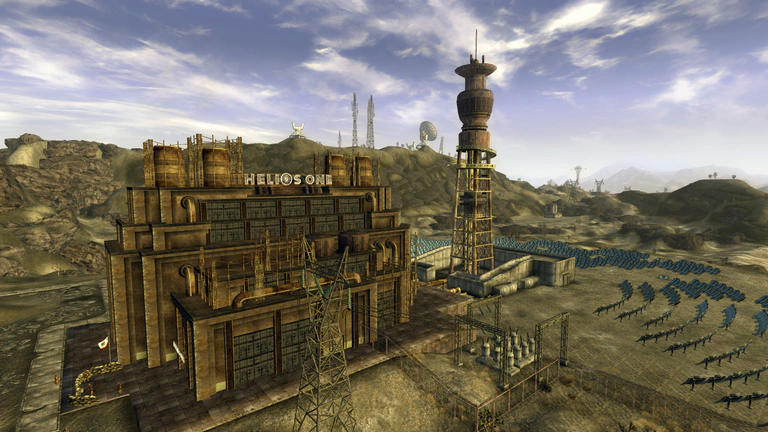
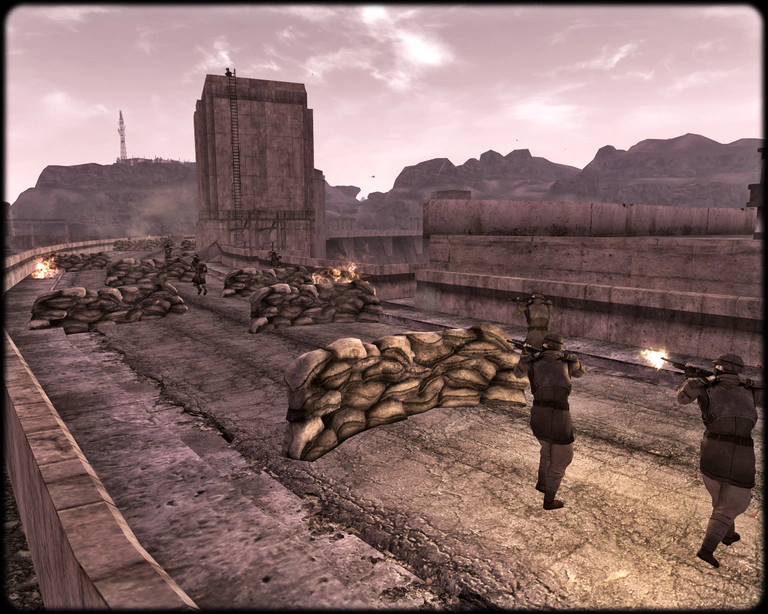
Although hostilities continued in New California, the NCR had begun to recover and focused its efforts on expanding eastwards into the Mojave Wasteland and Hoover Dam. The subsequent occupation of the dam in 2274 brought it into conflict with the Mojave chapter of the Brotherhood, which operated unrestricted in the region for years. After two years of guerrilla skirmishes the NCR launched Operation: Sunburst to neutralize the chapter in a single, pitched battle at HELIOS One. The indefensible nature of the solar power plant, limited manpower and poor tactical decisions made by Elder Elijah were ruthlessly exploited by the republic and its commanders. Concentrating a force that outnumbered the Brotherhood defense by a factor of between 15 and 20 to 1.
It was ultimately a huge tactical victory for the NCR, though Lieutenant Haggerty comments that it was a tough battle for the republic regardless. The Brotherhood was able to initially repulse several NCR assaults, but once their forces started to run low on ammunition they were forced to launch a counter offensive to break out from HELIOS and head west. Paladin Ramos comments on how NCR manpower won them the day, stating "they had more men than we had ammo." But the Brotherhood had also suffered; the battle resulted in the loss of half the Mojave chapter's manpower, including over half of its veteran knights and paladins. In the end, the Brotherhood's activation of the facility's security system prevented the NCR from gaining access to the control center. By 2281, this area was still inaccessible to the NCR, denying them the fruits of their victory. The remaining Brotherhood forces retreated west to Hidden Valley through mountains and enacted a strict lockdown.Fallout: New Vegas Official Game Guide Collector's Edition p.43: "Brotherhood of Steel" "The Brotherhood of Steel is a militant organization devoted to the preservation of pre-war technology and human knowledge. Their professed mission is to preserve pre-war technology and human knowledge for the benefit of future generations. In practice, its definition of technology is strangely selective, ignoring basic but potentially useful technologies (genetic modification of crops and civil engineering, for example) in favor of combat technology such as energy weapons and power armor: and even now, nearly two centuries after the Great War, the Brotherhood zealously restricts the use and knowledge of such technologies to its own membership. The Mojave Brotherhood operated freely amid the Vegas wastes for several years, carrying out many reclamation missions without serious opposition. The balance of power shifted in 2251, when a large contingent of NCR troops entered the region and occupied Hoover Dam. Conflict was inevitable. Nearly two years of guerrilla skirmishes culminated in a pitched battle at HELIOS One, a solar energy plant the Brotherhood had been refurbishing for several months with the goals of bringing it back online and activating its hidden offensive capabilities (the ARCHIMEDES II death ray). The battle for HELIOS One (Operation: Sunburst) proved a disaster for the Mojave Brotherhood. More than half its Paladins and Knights were killed. The chapter's leader, Elder Elijah, disappeared without a trace. The Brotherhood was driven from the facility, which suffered extensive damage. Survivors retreated to Hidden Valley. Since that defeat, the chapter's leader, Elder McNamara, has restricted activity outside the bunker to occasional reconnaissance missions and high-value raids. All operations take place at night, and engagement of NCR forces is strictly forbidden. Though the Brotherhood's ascetic lifestyle has prepared its members for a sequestered existence better than most, the passivity of their current situation has proved highly stressful." (Fallout: New Vegas Official Game Guide faction profiles) As they remained in lockdown and recovered, the republic increased its military presence in the Mojave five-fold. The period following the battle was tenuous for the Mojave chapter, with some of its most talented members, like Elijah, going rogue instead of aiding the Brotherhood's efforts. The depletion of manpower had severely impacted its ability to wage war, with fallen veterans being replaced by relatively inexperienced soldiers who were promoted out of necessity.
By 2281, the lockdown continued in response to the NCR increasing its presence in the Mojave Wasteland five-fold since 2276. The Mojave chapter, according to Elder McNamara, had time to fully recuperate from their losses suffered during the Battle of HELIOS One, although the isolation meant a portion of their new knights and paladins were not combat experienced outside of a virtual training simulators. Some of their first scouting missions revealed that the NCR's presence in the region had only increased in their absence, so the lockdown was extended. The Brotherhood used the time in lockdown to re-strategize when it came to facing the NCR. However, in 2281, reports from reconnaissance scouts revealed that the NCR's control over the region had faltered significantly due to the NCR-Legion War. The Brotherhood also hoped to install a remote signal transmitter to gain access to Black Mountain's radar systems; they had not done so in the past out of respect for the peaceful mutant population there under Marcus, but no longer consider the State of Utobitha under Tabitha worthy of this respect. This is all to gather intelligence in preparation for the Brotherhood's return to activity on the surface in the Mojave.
Despite many within the NCR writing them off as a spent force, Colonel Cassandra Moore still considered the Brotherhood to be a dangerous threat. In 2281, she noticed that multiple NCR scouts had gone missing west of HELIOS One to presumed Brotherhood activity. The Brotherhood had also taken offensive actions against Mr. House in the years since the retreat from Helios One: a large amount of Securitrons, bearing the damage of energy weapons, had been destroyed as they entered the area in and around Hidden Valley. Similarly, other factions within the Mojave Wasteland still see the Brotherhood as their biggest future threat. Despite their seclusion from the outside world and previous losses, the Brotherhood is still regarded as a powerful faction in the region, with some competing factions considering them to be a bigger threat than the NCR or Caesar's Legion. This is shown in Mr. House's calculations, as he analyzed a future Brotherhood insurgency to be the greatest threat to his long-term reign over the Mojave Wasteland, based on their views on technology. Yes Man's calculations also came to a similar conclusion: that the Mojave Brotherhood would be the biggest enemy of anyone seeking a sovereign New Vegas.
Developments over time
By 2281, hostilities between the two groups continued in New California, although it was no longer considered the main priority for the NCR, as by that point they maintained the upper hand in the conflict and the bloody NCR-Legion War was in full-swing. After years of warfare and attrition, the Brotherhood had been forced into hiding and retreated into their bunkers. Veteran commanders of the Brotherhood War had been reassigned to other fronts, with the most prominent of those being Colonel Cassandra Moore, with four tours to her name, a legendary status among the troops, and tasked with effecting the annexation of the Mojave through any means necessary. Victories for the NCR came at a significant cost in men and materiel, especially during bunker assaults, when entire platoons of troops were lost to eliminate a stronghold.
The NCR had stopped actively searching for Brotherhood bunkers by 2281 to focus on the NCR-Legion War. Despite ongoing hostilities, the NCR was willing to continue its pursuit and elimination of the Brotherhood. However, in the interest of strategy, NCR was also willing to form alliances with surviving chapters, provided they are not at crossed purposes.
Although stationary, Lost Hills, the heart of the Brotherhood's foundational chapter, remained under Brotherhood control as of 2287, and its elder council remained in power. The elders continued monitoring far flung chapters, reestablishing contact with Lyons' chapter in D.C. and reintegrating it after the rise of Arthur Maxson. Cults dedicated to the new Maxson started to emerge on the West Coast, routinely suppressed by the council.
NCR economic hardship
Although victorious on many battlefields, the NCR's economy suffered greatly. When the Brotherhood could not counter the NCR's advantage in manpower, it raided the gold reserves that backed the New Californian dollar, robbing its stockpiles.
As the raids intensified and gold became unavailable, destroyed or taken by Brotherhood operations, NCR citizens panicked and rushed to reclaim the listed face value of currency from the NCR's remaining gold reserves. Since the NCR was unable to realize these withdrawals, particularly towards the frontier, value in their currency considerably dropped. To protect against actual economic collapse, the NCR government abandoned the gold standard and established fiat currency, not payable in specie. Since then, many wastelanders have lost faith in the NCR dollar as a medium of worth, both as a result of it not being backed by anything but the government's word and the inevitable inflation. In response to the loss of faith, the merchant consortiums of the Hub re-established their own currency, the venerable bottle cap, backing it with water by exchanging a standardized measure of water for caps. (The traders of the Hub had introduced the bottle cap a long time ago, but had switched to NCR dollars as the "default" currency instead of bottle caps.) The decision to reintroduce the bottle cap as the leading post-nuclear currency was born out of frustration stemming from NCR's ineptitude in handling the currency crisis.
This crisis was most likely further exacerbated by the destruction of Shady Sands sometime shortly after the Second Battle of Hoover Dam in 2281, which severely limited the New California Republic's influence in the region. The nuclear detonation in the area around the Boneyard would have undoubtedly affected the NCR's ability to print even their fiat currency, as all of the state's currency was minted in the Boneyard.Joshua Sawyer: "It happened during the BoS-NCR war. I believe Alice McLafferty mentions it, but I'm not positive. She doesn't detail the events in this much detail, but here they are: The attacks caused NCR citizens (and others who held NCR currency) to panic, resulting in a rush to reclaim the listed face value of currency from NCR's gold reserves. Inability to do this at several locations (especially near the periphery of NCR territory where reserves were normally low) caused a loss of faith in NCR's ability to back their currency. Though NCR eventually stopped the BoS attacks, they decided to protect against future problems by switching to fiat currency. While this meant that BoS could no longer attack a) reserves or b) the source of production (all NCR bills are made in the Boneyard), some people felt more uneasy about their money not having any "real" (backed) value. This loss of confidence increased with NCR inflation, an ever-looming spectre of fiat currency. Because the Hub links NCR with the Mojave Wasteland and beyond, the merchants there grew frustrated with NCR's handling of the currency crisis. They conspired to re-introduce the bottle cap as a water-backed currency that could "bridge the gap" between NCR and Legion territory. In the time leading up to the re-introduction, they did the footwork to position themselves properly. If some old-timer had a chest full of caps, they didn't care (in fact, they thought that was great, since the old-timers would enthusiastically embrace the return of the cap), but they did seek to control or destroy production facilities and truly large volumes of caps (e.g. Typhon's treasure) whenever possible." (Josh Sawyer talks about boneyard making currency on forums.somethingawful.com) By 2296, with most of the Boneyard reduced to lawlessness, caps had once again become the dominant regional currency, as the only one guaranteed to be accepted by anyone in the wastes.
Brotherhood returns to the surface
The destruction of Shady Sands severely reduced the influence of the New California Republic in the region. As a result, the Brotherhood became more active on the surface once again and started recruiting outsiders into its ranks. By the 2290s, the Brotherhood was overtly operating training facilities and airbases on the surface. They had also began some construction projects, such as air strips. In 2296, the West Coast Brotherhood of Steel received reinforcements from the East Coast Brotherhood, with the West Coast Brotherhood taking orders from the highest ranking clerics in the Commonwealth.
Conflict returns to the West
In 2283, the NCR city of Shady Sands was destroyed by a nuclear detonation. At least one Brotherhood knight from a West Coast chapter known as the Knights of San Fernando was present immediately after the explosion, rescuing a child survivor and bringing him back to be raised by the chapter.
By 2296, the NCR's presence around Los Angeles had waned greatly, and the Knights of San Fernando were operating actively on the surface of New California. That year, they were reinforced and seemingly given directives by the East Coast Brotherhood, as The Prydwen arrived at the Knights of San Fernando's base. This resulted in the integration of the two forces, with the Knights of San Fernando providing squires for the East Coast knights. Their initial objective, as stated by Elder Cleric Quintus of the Knights of San Fernando, came from East Coast leadership: the Brotherhood was to locate a crucial item in the possession of an Enclave deserter named Siggi Wilzig. To accomplish this mission, the Brotherhood sent several search teams into the Wilds.
The search for this artifact would once again reignite open hostilities between the Brotherhood of Steel and remnants of the New California Republic in Los Angeles led by the "Flame Mother," Lee Moldaver, as the NCR forces under her command were also looking to acquire the artifact. She had established contact with Wilzig, who had managed to create a working cold fusion reactor technology and would offer him safe harbor with the NCR in exchange for it, in the hopes of using the technology to restore power to all of Los Angeles.
When the cold fusion technology made its way into the NCR's possession by the way of Lucy MacLean, the Brotherhood took action. Their forces forcefully occupied the town of Filly to use as a forward operating and supply base, suppressing resistance from its residents. Brotherhood flags and banners were raised across the town, marking one of the first known territorial expansions of any Brotherhood chapter on the West Coast in decades. At this time, Quintus privately remarked that the wider Brotherhood had "lost its way" before reminiscing about the time when they ruled the wasteland on the West Coast, adding that power is "taken, not given." Quintus initiated plans for the creation of "a new Brotherhood" on the West Coast with him as its leader.
Battle for Griffith Observatory
From the settlement of Filly, the Brotherhood traveled to Griffith Observatory, which acted as the NCR remnants' headquarters in the area. The first wave of vertibirds landed its troops amidst heavy anti-aircraft fire from the NCR remnants. A vicious battle ensued in the facility's courtyard as Brotherhood and NCR soldiers clashed at extremely close quarters, with NCR civilians caught in between them. Both sides took severe casualties during this period.

The Brotherhood's forces, spearheaded by its armored units, were eventually able to pierce through the NCR defenders and breach the front doors of the facility. From there they seemingly split into two groups: three Knights along with Maximus and others headed for the artifact, while others including Dane continued to engage NCR defenders within the observatory. Despite interference from the Ghoul, which increased casualties for the Brotherhood, they were able to eventually secure the facility and the cold fusion reactor after seemingly wiping out the NCR remnants in Los Angeles, but not before Moldaver was able to activate the cold fusion generator, providing unlimited power to the Los Angeles and Shady Sands ruins, which now seem to be under the influence of the Brotherhood.
Notable battles
Operation: Sunburst, a pitched battle in 2276 where the Mojave chapter lost control of HELIOS One and suffered crippling casualties amounting to half the chapter.
Battle of Griffith Observatory, a crucial battle in 2296 between united Brotherhood forces and NCR remnants in the Boneyard in New California where the Brotherhood secured the cold fusion generator with the NCR remnants being wiped out after a bloody battle.
Sources
Adapted from the original article, under CC BY-SA 3.0.